Antigua and Barbuda
Antigua and Barbuda
Sugar colony worked by enslaved Africans; claims 365 beaches.
See Antigua and Barbuda on the 3D globeTake a quiz
Population90 thousand
Area442 km²
CapitalSaint John's
RegionCaribbean
Did you know?
- Said to have 365 beaches, one for each day
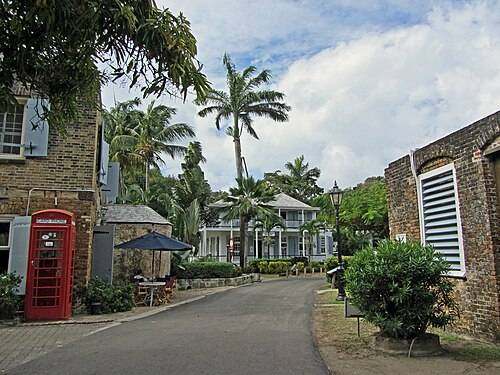
- Nelson's Dockyard is the only working Georgian dockyard
- Produced cricket legend Viv Richards
Key facts about Antigua and Barbuda
- Government
- Parliamentary constitutional monarchy (Commonwealth realm)
- Religion
- Christian ~93%
- Founded / independence
- 1981 (from UK)
- Rich in
- Tourism, offshore finance
- Languages
- English
English; Antiguan Creole - Currency
- Eastern Caribbean dollar ($)
- People are called
- Antiguan, Barbudan
- Main cities
- St. John's, All Saints
Timeline of Antigua and Barbuda
- 1493Columbus names it
- 1632English colony
- 1834Slavery abolished
- 1981Independence
Places to see in Antigua and Barbuda
- Nelson's Dockyard
- Shirley Heights
- Half Moon Bay
- Stingray City
Food and drink
Fungee and pepperpot · ducana
Culture and famous for
Antigua Sailing Week; carnival
Popular sports
Cricket, sailing
Geography and climate
- Highest point
- Boggy Peak (Mount Obama), 402 m
- Rivers, lakes and seas
- No rivers
- Climate
- Tropical marine
- Coastline
- Has a sea coast
- Population density
- 204 people per km²
Wars and conflicts
- None
Alliances and memberships
Political unions and regional organisations
CARICOMCELACOrganization of American StatesCommonwealth of Nations
Culture, religion and history
Antigua and Barbuda in depth
Detailed facts from the CIA World Factbook (public domain, latest edition).
Overview
- History in brief
- The Siboney were the first people to inhabit the islands of Antigua and Barbuda in 2400 B.C., but the Arawaks populated the islands when Christopher COLUMBUS landed on his second voyage in 1493. Early Spanish and French settlements were succeeded by an English colony in 1667. Slavery, which provided labor on the sugar plantations on Antigua, was abolished in 1834. The islands became an independent state within the British Commonwealth of Nations in 1981. In 2017, Hurricane Irma passed over the island of Barbuda, devastating the island and forcing the evacuation of the population to Antigua. Almost all of the structures on Barbuda were destroyed and the vegetation stripped, but Antigua was spared the worst.
Geography
- Location
- Caribbean, islands between the Caribbean Sea and the North Atlantic Ocean, east-southeast of Puerto Rico
- Size compared
- 2.5 times the size of Washington, D.C.
- Land borders
- Total: 0 km
- Coastline
- 153 km
- Climate
- tropical maritime; little seasonal temperature variation
- Terrain
- mostly low-lying limestone and coral islands, with some higher volcanic areas
- Elevation
- Highest point: Mount Obama 402 mLowest point: Caribbean Sea 0 m
- Natural resources
- NEGL; pleasant climate fosters tourism
- Natural hazards
- hurricanes and tropical storms (July to October); periodic droughts
- Notes
- Antigua has a deeply indented shoreline with many natural harbors and beaches; Barbuda has a large western harbor
- Environmental issues
- limited natural freshwater resources; water management hampered by tree-clearing to increase crop production, causing rapid rainfall runoff
People and society
- Population
- Total: 102,634 (2024 est.)Male: 48,311Female: 54,323
- Nationality
- Noun: Antiguan(s), Barbudan(s)Adjective: Antiguan, Barbudan
- Ethnic groups
- African descent 87.3%, mixed 4.7%, Hispanic 2.7%, White 1.6%, other 2.7%, unspecified 0.9% (2011 est.)
- Languages
- English (official), Antiguan Creole (an English-based creole)
- Religions
- Protestant 68.3% (Anglican 17.6%, Seventh Day Adventist 12.4%, Pentecostal 12.2%, Moravian 8.3%, Methodist 5.6%, Wesleyan Holiness 4.5%, Church of God 4.1%, Baptist 3.6%), Roman Catholic 8.2%, other 12.2%, unspecified 5.5%, none 5.9% (2011 est.)
- Median age
- Total: 34.1 years (2025 est.)Male: 31.9 yearsFemale: 35.7 years
- Population growth
- 1.09% (2025 est.)
- Life expectancy
- Total population: 78.3 years (2024 est.)Male: 76.1 yearsFemale: 80.5 years
- Children per woman
- 1.92 children born/woman (2025 est.)
- Urbanization
- Urban population: 24.3% of total population (2023)Rate of urbanization: 0.87% annual rate of change (2020-25 est.)
- Largest cities
- 21,000 SAINT JOHN'S (capital) (2018)
Government
- Official names
- Conventional long form: Antigua and BarbudaConventional short form: Antigua and BarbudaEtymology: antiguo is Spanish for "ancient" or "old;" Christopher COLUMBUS named the island in 1493, after the church of Santa Maria la Antigua (Old Saint Mary's) in Seville, Spain; barbuda is Spanish for "bearded" and may refer to the island's lichen-covered fig trees
- Government type
- parliamentary democracy under a constitutional monarchy; a Commonwealth realm
- Capital
- Name: Saint John'sGeographic coordinates: 17 07 N, 61 51 WTime difference: UTC-4 (1 hour ahead of Washington, DC, during Standard Time)Etymology: named after Saint John the Apostle
- Regions
- 6 parishes and 2 dependencies*; Barbuda*, Redonda*, Saint George, Saint John, Saint Mary, Saint Paul, Saint Peter, Saint Philip
- Independence
- 1 November 1981 (from the UK)
- National holiday
- Independence Day, 1 November (1981)
- Constitution
- History: several previous; latest presented 31 July 1981, effective 31 October 1981 (The Antigua and Barbuda Constitution Order 1981)Amendment process: proposed by either house of Parliament; passage of amendments to constitutional sections such as citizenship, fundamental rights and freedoms, the establishment, power, and authority of the executive and legislative branches, the Supreme Court Order, and the procedure for amending the constitution requires approval by at least two-thirds majority vote of the membership of both houses, approval by at least two-thirds majority in a referendum, and assent to by the governor general; passage of other amendments requires only two-thirds majority vote by both houses
- Legal system
- common law based on the English model
- Voting age
- 18 years of age; universal
- Flag meaning
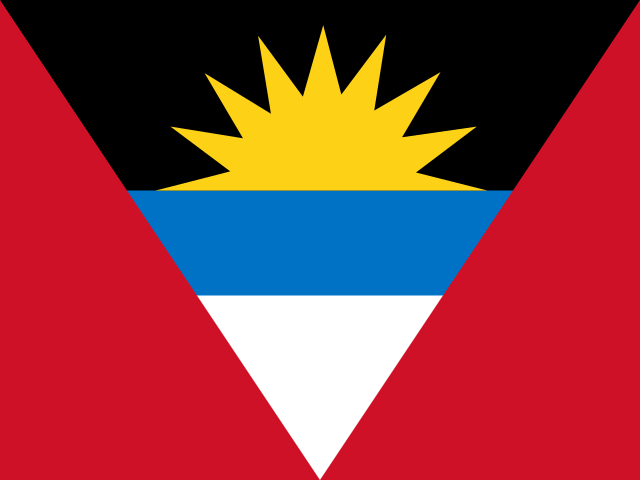
- Description: red, with an inverted isosceles triangle in the center that spans the flag from top to bottom; the triangle contains three horizontal bands of black (top), light blue, and white, with a yellow rising sun in the black bandMeaning: the sun stands for the dawn of a new era, black for the African heritage of most of the population, blue for hope, and red for the dynamism of the people; the "V" shape of the triangle stands for victory; the yellow, blue, and white colors are also meant to evoke the country's tourist attractions of sun, sea, and sand
- National symbols
- fallow deer
- National colours
- red, white, blue, black, yellow
- National anthem
- Title: "God Save the King"Lyrics/music: unknownHistory: royal anthem, as a Commonwealth country
- UNESCO World Heritage Sites
- Total World Heritage Sites: 1 (cultural)Selected World Heritage Site locales: Antigua Naval Dockyard (Nelson's Dockyard)
Economy
- Overview
- dual island-tourism and construction-driven economy; emerging “blue economy”; limited water supply and susceptibility to hurricanes limit activity; improving road infrastructure; friendly to foreign direct investment; looking at financial innovation in cryptocurrency and blockchain technologies
- GDP (PPP)
- $2.772 billion (2024 est.)
- GDP per person (PPP)
- $29,600 (2024 est.)
- GDP growth
- 4.3% (2024 est.)
- Inflation
- 6.2% (2024 est.)
- Farm products
- tropical fruits, milk, mangoes/guavas, eggs, lemons/limes, pumpkins/squash, sweet potatoes, vegetables, cucumbers/gherkins, yams (2023)
- Industries
- tourism, construction, light manufacturing (clothing, alcohol, household appliances)
- Exports
- $1.314 billion (2024 est.)
- Main exports
- refined petroleum, ships, soybean meal, shellfish, paintings (2023)
- Export partners
- Suriname 29%, Poland 21%, USA 8%, Dominican Republic 7%, Australia 5% (2023)
- Main imports
- ships, refined petroleum, cars, plastic products, furniture (2023)
- Import partners
- USA 43%, Poland 6%, China 5%, UK 4%, Germany 4% (2023)
- Money sent home from abroad
- 1.2% of GDP (2024 est.)
Energy, internet and transport
- Electricity access
- Electrification - total population: 100% (2022 est.)
- Electricity sources
- Fossil fuels: 93.6% of total installed capacity (2023 est.)Solar: 6.4% of total installed capacity (2023 est.)
- Internet users
- Percent of population: 78% (2023 est.)
- Mobile phones
- Total subscriptions: 186,182 (2022 est.)Subscriptions per 100 inhabitants: 201 (2022 est.)
- TV and radio
- state-controlled Antigua and Barbuda Broadcasting Service (ABS) operates 1 TV station; multi-channel cable TV subscription services are available; ABS operates 1 radio station; roughly 20 radio stations (2024)
- Airports
- 4 (2025)
- Merchant ships
- Total: 614 (2023)By type: bulk carrier 24, container ship 109, general cargo 425, oil tanker 6, other 50
Military and space
- Armed forces
- Antigua and Barbuda Defense Force (ABDF): Antigua and Barbuda Regiment, Air Wing, Coast GuardRoyal Police Force of Antigua and Barbuda (RPFAB) (2025)
- Military service
- 18-23 years of age for voluntary military service for both men and women; no conscription (2025)
Global issues
- Refugees and displaced people
- Refugees: 5 (2024 est.)
- Phone code
- +1268
- Internet domain
- .ag