Australia
Commonwealth of Australia
Aboriginal people have lived here for at least 65,000 years — the oldest continuous culture. Britain founded a penal colony in 1788; six colonies federated in 1901.
See Australia on the 3D globeTake a quiz
Population27.4 million
Area7,692,024 km²
CapitalCanberra
RegionAustralia and New Zealand
Did you know?
- The Great Barrier Reef is the largest living structure on Earth
- Has more kangaroos than people
- The only country that is also a continent
Key facts about Australia
- Government
- Federal parliamentary constitutional monarchy (Commonwealth realm)
- Religion
- Christian ~44%, unaffiliated ~39%, Islam ~3%, Hindu ~3%
- Founded / independence
- 1901 (federation)
- Rich in
- Iron ore, coal, lithium, gold, LNG, wheat, education, tourism
- Languages
- English
English (Australian); about 120 surviving Aboriginal languages; Torres Strait Creole - Currency
- Australian dollar ($)
- People are called
- Australian
- Main cities
- Sydney, Melbourne, Brisbane, Perth, Adelaide, Canberra
Timeline of Australia
- 65,000 BCAboriginal people arrive
- 1770Cook claims east coast
- 1788First Fleet
- 1901Federation
- 1967Referendum on Aboriginal rights
- 2000Sydney Olympics
Places to see in Australia
- Sydney Opera House
- Great Barrier Reef
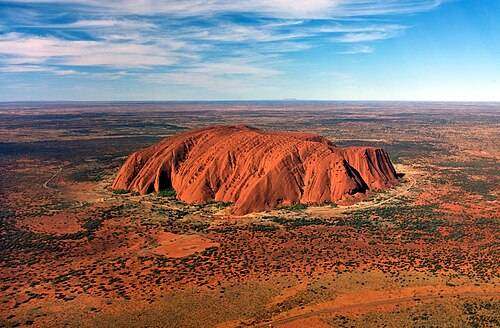
- Uluru
- Twelve Apostles
- Bondi Beach
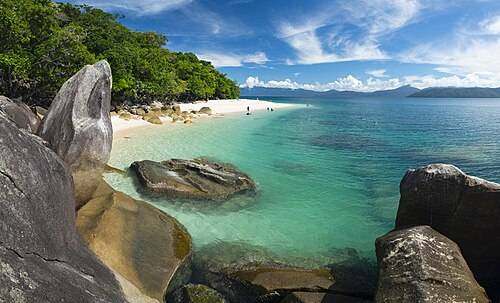
- Daintree Rainforest
- Kakadu
Food and drink
Meat pie · Vegemite on toast · pavlova · lamingtons · barbecue
Culture and famous for
Aboriginal art (oldest continuous culture); kangaroos and koalas; Sydney Harbour fireworks
Popular sports
Cricket, Australian rules football, rugby, swimming
Geography and climate
- Highest point
- Mount Kosciuszko, 2,228 m
- Rivers, lakes and seas
- Murray–Darling
- Climate
- Mostly arid; tropical north, temperate south
- Coastline
- Has a sea coast
- Population density
- 4 people per km²
Wars and conflicts
- Frontier wars with Aboriginal peoples
- Boer War
- WWI (Gallipoli)
- WWII
- Korea
- Vietnam
- Afghanistan
Alliances and memberships
Military and security
ANZUS TreatyAUKUSFive EyesQuad
Political unions and regional organisations
Pacific Islands ForumCommonwealth of Nations
Economy and trade
Culture, religion and history
Australia in depth
Detailed facts from the CIA World Factbook (public domain, latest edition).
Overview
- History in brief
- Aboriginal Australians arrived on the continent at least 60,000 years ago and developed complex hunter-gatherer societies and oral histories. Dutch navigators led by Abel TASMAN were the first Europeans to land in Australia in 1606, and they mapped the western and northern coasts. They named the continent New Holland but made no attempts to permanently settle it. In 1770, Englishman James COOK sailed to the east coast of Australia, named it New South Wales, and claimed it for Great Britain. In 1788 and 1825 respectively, Great Britain established New South Wales and then Tasmania as penal colonies. Great Britain and Ireland sent more than 150,000 convicts to Australia before ending the practice in 1868. As Europeans began settling areas away from the coasts, they came into more direct contact with Aboriginal Australians. Europeans also cleared land for agriculture, impacting Aboriginal Australians’ ways of life. These issues, along with disease and a policy in the 1900s that forcefully removed Aboriginal children from their parents, reduced the Aboriginal Australian population from more than 700,000 pre-European contact to a low of 74,000 in 1933.Four additional colonies were established in Australia in the mid-1800s: Western Australia (1829), South Australia (1836), Victoria (1851), and Queensland (1859). Gold rushes beginning in the 1850s brought thousands of new immigrants to New South Wales and Victoria, helping to reorient Australia away from its penal colony roots. In the second half of the 1800s, the colonies were all gradually granted self-government, and in 1901, they federated and became the Commonwealth of Australia. Australia contributed more than 400,000 troops to Allied efforts during World War I, and Australian troops played a large role in the defeat of Japanese troops in the Pacific in World War II. Australia severed most constitutional links with the UK in 1942 but remained part of the British Commonwealth. Australia’s post-war economy boomed and by the 1970s, racial policies that prevented most non-Whites from immigrating to Australia were removed, greatly increasing Asian immigration to the country. In recent decades, Australia has become an internationally competitive, advanced market economy due in large part to economic reforms adopted in the 1980s and its proximity to East and Southeast Asia. In the early 2000s, Australian politics became unstable with frequent attempts to oust party leaders, including five changes of prime minist
Geography
- Location
- Oceania, continent between the Indian Ocean and the South Pacific Ocean
- Size compared
- slightly smaller than the 48 contiguous US states
- Land borders
- Total: 0 km
- Coastline
- 25,760 km
- Climate
- generally arid to semiarid; temperate in south and east; tropical in north
- Terrain
- mostly low plateau with deserts; fertile plain in southeast
- Elevation
- Highest point: Mount Kosciuszko 2,228 mLowest point: Lake Eyre -15 mMean elevation: 330 m
- Natural resources
- alumina, coal, iron ore, copper, lithium, tin, gold, silver, uranium, nickel, tungsten, rare earth elements, mineral sands, lead, zinc, diamonds, opals, natural gas, petroleum
- Major rivers
- River Murray - 2,508 km; Darling River - 1,545 km; Murrumbidgee River - 1,485 km; Lachlan River - 1,339 km; Cooper Creek - 1,113 km; Flinders River - 1,004 km
- Major lakes
- Fresh water lake(s): Lake Alexandrina - 570 sq kmSalt water lake(s): Lake Eyre - 9,690 sq km; Lake Torrens (ephemeral) - 5,780 sq km; Lake Gairdner - 4,470 sq km; Lake Mackay (ephemeral) - 3,494 sq km; Lake Frome - 2,410 sq km; Lake Amadeus (ephemeral) - 1,032 sq km
- Natural hazards
- cyclones along the coast; severe droughts; forest firesVolcanism: volcanic activity on Heard and McDonald Islands
- Notes
- Note 1: world's smallest continent but sixth-largest country; the largest country in Oceania, the largest country entirely in the Southern Hemisphere, and the largest country without land bordersNote 2: the Great Dividing Range that runs along eastern Australia is that continent’s longest mountain range and the third-longest land-based range in the world; the term "Great Dividing Range" refers to the fact that the mountains form a watershed crest from which all of the rivers of eastern Australia flow – east, west, north, and southNote 3: Australia is the only continent without glaciers; it is the driest inhabited continent on earth; Perth on the west coast is home to the invigorating sea breeze known as the "Fremantle Doctor," one of the most consistent winds in the world; Australia hosts 10% of the world's biodiversity, and a great number of its flora and fauna exist nowhere else in the world
- Environmental issues
- soil erosion from overgrazing, deforestation, industrial development, urbanization, and poor farming practices; limited natural freshwater resources; soil salinity from use of poor-quality water, drought, desertification; habitat loss from agricultural clearing; floral extinctions; Great Barrier Reef preservation; overfishing; pollution; invasive species
People and society
- Population
- Total: 27,490,921 (2025 est.)Male: 13,685,935Female: 13,804,986
- Nationality
- Noun: Australian(s)Adjective: Australian
- Ethnic groups
- English 33%, Australian 29.9%, Irish 9.5%, Scottish 8.6%, Chinese 5.5%, Italian 4.4%, German 4%, Indian 3.1%, Australian Aboriginal 2.9%, Greek 1.7%, unspecified 4.7% (2021 est.)
- Languages
- English 72%, Mandarin 2.7%, Arabic 1.4%, Vietnamese 1.3%, Cantonese 1.2%, other 15.7%, unspecified 5.7% (2021 est.)
- Religions
- Roman Catholic 20%, Protestant 18.1% (Anglican 9.8%, Uniting Church 2.6%, Presbyterian and Reformed 1.6%, Baptist 1.4%, Pentecostal 1%, other Protestant 1.7%), other Christian 3.5%, Muslim 3.2%, Hindu 2.7%, Buddhist 2.4%, Orthodox 2.3% (Eastern Orthodox 2.1%, Oriental Orthodox 0.2%), other 2.1%, none 38.4%, unspecified 7.3% (2021 est.)
- Median age
- Total: 38.5 years (2025 est.)Male: 36.9 yearsFemale: 39.2 years
- Population growth
- 1.59% (2025 est.)
- Life expectancy
- Total population: 83.5 years (2024 est.)Male: 81.3 yearsFemale: 85.7 years
- Children per woman
- 1.5 children born/woman (2025 est.)
- Urbanization
- Urban population: 86.6% of total population (2023)Rate of urbanization: 1.27% annual rate of change (2020-25 est.)
- Largest cities
- 5.235 million Melbourne, 5.121 million Sydney, 2.505 million Brisbane, 2.118 million Perth, 1.367 million Adelaide, 472,000 CANBERRA (capital) (2023)
- Years in school
- Total: 21 years (2023 est.)Male: 20 years (2023 est.)Female: 21 years (2023 est.)
Government
- Official names
- Conventional long form: Commonwealth of AustraliaConventional short form: AustraliaEtymology: the name Australia derives from the Latin australis meaning "southern;" the Australian landmass was long referred to as "Terra Australis," or the Southern Land
- Government type
- federal parliamentary democracy under a constitutional monarchy; a Commonwealth realm
- Capital
- Name: CanberraGeographic coordinates: 35 16 S, 149 08 ETime difference: UTC+11 (16 hours ahead of Washington, DC, during Standard Time)Daylight saving time: +1hr, begins first Sunday in October; ends first Sunday in AprilTime zone note: Australia has six time zones, including Lord Howe Island (UTC+11)Etymology: the name may derive from the Aboriginal word nganbirra, meaning "meeting place"
- Regions
- 6 states and 2 territories*; Australian Capital Territory*, New South Wales, Northern Territory*, Queensland, South Australia, Tasmania, Victoria, Western Australia
- Independence
- 1 January 1901 (from the federation of UK colonies)
- National holiday
- Australia Day (commemorates the arrival of the First Fleet of Australian settlers), 26 January (1788); ANZAC Day (commemorates the anniversary of the landing of troops of the Australian and New Zealand Army Corps during World War I at Gallipoli, Turkey), 25 April (1915)
- Constitution
- History: approved in a series of referenda from 1898 through 1900 and became law 9 July 1900, effective 1 January 1901Amendment process: proposed by Parliament; passage requires approval of a referendum bill by absolute majority vote in both houses of Parliament, approval in a referendum by a majority of voters in at least four states and in the territories, and Royal Assent; proposals that would reduce a state’s representation in either house or change a state’s boundaries require that state’s approval prior to Royal Assent
- Legal system
- common law system based on the English model
- Voting age
- 18 years of age; universal and compulsory
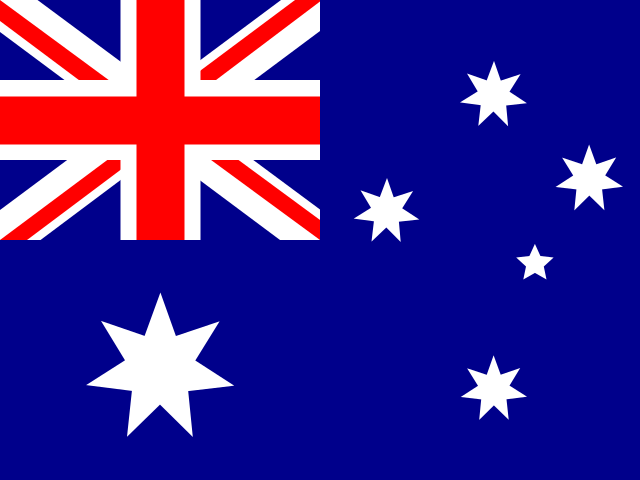
- Flag meaning
- Description: blue, with the UK flag in the upper-left quadrant and a large seven-pointed star in the lower-left quadrant; on the right half is a representation of the Southern Cross constellation in white, with one small five-pointed star and four larger seven-pointed starsMeaning: the largest star is known as the Commonwealth or Federation Star and represents the federation of the Australian colonies in 1901; the star has one point for each of the six original states, plus one representing all of Australia's internal and external territories
- National symbols
- Commonwealth Star (seven-pointed Star of Federation), golden wattle tree (Acacia pycnantha), kangaroo, emu
- National colours
- green, gold
- National anthem
- Title: "God Save the King"Lyrics/music: unknownHistory: royal anthem, as a Commonwealth country
- UNESCO World Heritage Sites
- Total World Heritage Sites: 21 (5 cultural, 12 natural, 4 mixed)Selected World Heritage Site locales: Great Barrier Reef (n); Greater Blue Mountains Area (n); Fraser Island (n); Gondwana Rainforests (n); Lord Howe Island Group (n); Royal Exhibition Building and Carlton Gardens (c); Shark Bay (n); Sydney Opera House (c); Uluṟu-Kata Tjuṯa National Park (m); Kakadu National Park (m); Murujuga Cultural Landscape (c)
Economy
- Overview
- high-income and globally integrated economy; strong mining, manufacturing, and service sectors driving slow but steady growth; net exporter, driven by commodities to East Asian trade partners; weak productivity and aging population straining labor force participation
- GDP (PPP)
- $1.635 trillion (2024 est.)
- GDP per person (PPP)
- $60,100 (2024 est.)
- GDP growth
- 1.4% (2024 est.)
- Inflation
- 3.2% (2024 est.)
- Unemployment
- 4.1% (2024 est.)
- Farm products
- wheat, sugarcane, barley, rapeseed, milk, cotton, sorghum, beef, lentils, grapes (2023)
- Industries
- mining, industrial and transportation equipment, food processing, chemicals, steel
- Exports
- $425.16 billion (2024 est.)
- Main exports
- iron ore, coal, natural gas, gold, minerals (2023)
- Export partners
- China 37%, Japan 16%, S. Korea 6%, India 5%, Taiwan 5% (2023)
- Main imports
- refined petroleum, cars, trucks, broadcasting equipment, garments (2023)
- Import partners
- China 26%, USA 11%, S. Korea 6%, Japan 6%, Thailand 5% (2023)
- Money sent home from abroad
- 0.1% of GDP (2024 est.)
Energy, internet and transport
- Electricity access
- Electrification - total population: 100% (2022 est.)
- Electricity sources
- Fossil fuels: 64.9% of total installed capacity (2023 est.)Solar: 17.1% of total installed capacity (2023 est.)Wind: 11.5% of total installed capacity (2023 est.)Hydroelectricity: 5.4% of total installed capacity (2023 est.)Biomass and waste: 1.1% of total installed capacity (2023 est.)
- Internet users
- Percent of population: 97% (2023 est.)
- Mobile phones
- Total subscriptions: 30.1 million (2024 est.)Subscriptions per 100 inhabitants: 113 (2024 est.)
- TV and radio
- tradition of public broadcasting, but privately owned TV and radio have the biggest audiences; ownership of print and broadcast media is concentrated; Australian Broadcasting Corporation (ABC) runs national and local public radio and TV; other main public broadcaster is the multilingual Special Broadcasting Service (SBS); national commercial TV is dominated by three big free-to-air networks; broadcasters must carry a minimum percentage of Australian-made programs; pay TV via cable, satellite, and IPTV has a strong foothold (2023)
- Airports
- 2,257 (2025)
- Railways
- Total: 32,606 km (2022) 3,448 km electrifiedStandard gauge: 18,007 km (2022) 1.435 mmNarrow gauge: 11,914 km (2022) 1.067 mmBroad gauge: 2,685 km (2022) 1.600 mm
- Merchant ships
- Total: 604 (2023)By type: bulk carrier 2, general cargo 76, oil tanker 6, other 520
Military and space
- Armed forces
- Australian Defense Force (ADF): Australian Army, Royal Australian Navy, Royal Australian Air Force (2025)
- Military spending
- 2% of GDP (2024 est.)
- Military service
- 17 years of age (with parental consent; 18 years of age to deploy) for voluntary military service for men and women; no conscription (abolished 1972) (2025)
- Space programme
- has a history of involvement in space-related activities, including astronomy, rockets, satellites, and space tracking; develops, builds, operates, and tracks satellites, including communications, remote sensing (RS), and navigational, often in partnership with other countries; develops other space technologies, including communications, RS capabilities, and telescopes; encouraging growth in domestic commercial space-industry sector, including satellite launch vehicles; cooperates with a variety of foreign space agencies and industries, including those of China, the ESA, individual ESA member states, India, Japan, New Zealand, South Korea, the UK, and the US; co-leads the Global Earth Observation System of Systems and hosts one of the telescopes for the international Square Kilometer Array radio telescope (2025)
- Space milestones
- 1960 - built first space-tracking station outside the US1967 - first domestically built satellite (WRSEA) launched on a US rocket from Australian test range1981 - commissioned first national satellite system1996 - first Australian in space on US Space Shuttle2021 - announced intent to provide a robotic lunar lander for US Artemis project2022 - launched a US NASA rocket from a commercial launch site; joint Australia-US space surveillance telescope based in Western Australia became operational2025 - first attempted launch of Australian-designed and -manufactured orbital launch vehicle failed to reach orbit
Global issues
- Refugees and displaced people
- Refugees: 120,789 (2024 est.)IDPs: 185 (2024 est.)Stateless persons: 6,922 (2024 est.)
- Phone code
- +61
- Internet domain
- .au