Bahamas
Commonwealth of the Bahamas
Columbus first landed here in 1492. The Lucayan people were wiped out within decades.
See Bahamas on the 3D globeTake a quiz
Population400 thousand
Area13,943 km²
CapitalNassau
RegionCaribbean
Did you know?
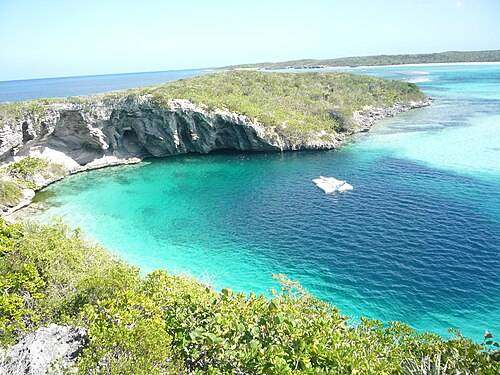
- Dean's Blue Hole is one of the deepest underwater sinkholes
- The famous swimming pigs live on Big Major Cay
- Has about 700 islands and cays
Key facts about Bahamas
- Government
- Parliamentary constitutional monarchy (Commonwealth realm)
- Religion
- Christian ~93%
- Founded / independence
- 1973 (from UK)
- Rich in
- Tourism, offshore finance
- Languages
- English
English; Bahamian Creole - Currency
- Bahamian dollar ($), United States dollar ($)
- People are called
- Bahamian
- Main cities
- Nassau, Freeport
Timeline of Bahamas
- 1492Columbus lands
- 1718British colony
- 1973Independence
Places to see in Bahamas
- Swimming pigs of Exuma
- Dean's Blue Hole
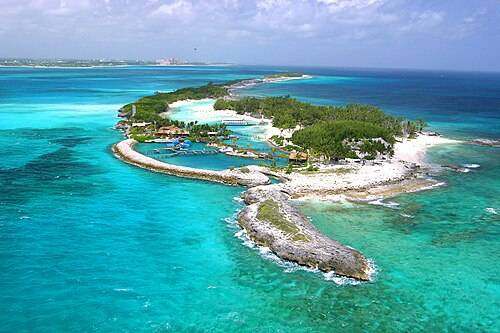
- Nassau's Paradise Island
- Andros barrier reef
Food and drink
Conch fritters · peas and rice · guava duff
Culture and famous for
Junkanoo festival
Popular sports
Athletics, sailing
Geography and climate
- Highest point
- Mount Alvernia, 63 m
- Rivers, lakes and seas
- About 700 islands
- Climate
- Tropical
- Coastline
- Has a sea coast
- Population density
- 29 people per km²
Wars and conflicts
- None
Alliances and memberships
Military and security
Political unions and regional organisations
CARICOMCELACOrganization of American StatesCommonwealth of Nations
Culture, religion and history
Bahamas in depth
Detailed facts from the CIA World Factbook (public domain, latest edition).
Overview
- History in brief
- Lucayan Indians inhabited the Bahama islands when Christopher COLUMBUS first set foot in the New World in 1492. British settlement of the islands began in 1647; the islands became a colony in 1783. Piracy thrived in the 17th and 18th centuries because of The Bahamas' close proximity to shipping lanes. Since gaining independence from the UK in 1973, The Bahamas has prospered through tourism, international banking, and investment management, which comprise up to 85% of GDP. Because of its proximity to the US -- the nearest Bahamian landmass is only 80 km (50 mi) from Florida -- the country is a major transshipment point for illicit trafficking to the US mainland, as well as to Europe. US law enforcement agencies cooperate closely with The Bahamas; the Drug Enforcement Administration, US Coast Guard, and US Customs and Border Protection assist Bahamian authorities with maritime security and law enforcement through Operation Bahamas, Turks and Caicos, or OPBAT.
Geography
- Location
- chain of islands in the North Atlantic Ocean, southeast of Florida, northeast of Cuba; note - although The Bahamas does not border the Caribbean Sea, geopolitically it is often designated as a Caribbean nation
- Size compared
- slightly smaller than Connecticut
- Land borders
- Total: 0 km
- Coastline
- 3,542 km
- Climate
- tropical marine; moderated by warm waters of Gulf Stream
- Terrain
- long, flat coral formations with some low rounded hills
- Elevation
- Highest point: 1.3 km NE of Old Bight on Cat Island 64 mLowest point: Atlantic Ocean 0 m
- Natural resources
- salt, aragonite, timber, arable land
- Natural hazards
- hurricanes and other tropical storms cause extensive flood and wind damage
- Notes
- strategic location adjacent to US and Cuba; extensive island chain of which 30 are inhabited
- Environmental issues
- coral reef decay; solid waste disposal
People and society
- Population
- Total: 415,306 (2025 est.)Male: 192,055Female: 223,251
- Nationality
- Noun: Bahamian(s)Adjective: Bahamian
- Ethnic groups
- African descent 90.6%, White 4.7%, mixed 2.1%, other 1.9%, unspecified 0.7% (2010 est.)
- Languages
- English (official), Creole (among Haitian immigrants)
- Religions
- Protestant 69.9% (includes Baptist 34.9%, Anglican 13.7%, Pentecostal 8.9% Seventh Day Adventist 4.4%, Methodist 3.6%, Church of God 1.9%, Plymouth Brethren 1.6%, other Protestant 0.9%), Roman Catholic 12%, other Christian 13% (includes Jehovah's Witness 1.1%), other 0.6%, none 1.9%, unspecified 2.6% (2010 est.)
- Median age
- Total: 31.1 years (2025 est.)Male: 30.6 yearsFemale: 30.7 years
- Population growth
- 1.08% (2025 est.)
- Life expectancy
- Total population: 76.7 years (2024 est.)Male: 75.1 yearsFemale: 78.4 years
- Children per woman
- 1.45 children born/woman (2025 est.)
- Urbanization
- Urban population: 83.6% of total population (2023)Rate of urbanization: 1.02% annual rate of change (2020-25 est.)
- Largest cities
- 280,000 NASSAU (capital) (2018)
Government
- Official names
- Conventional long form: Commonwealth of The BahamasConventional short form: The BahamasEtymology: name may be derived from the Spanish baha mar, meaning "low sea," which describes the shallow waters of the Bahama Banks; alternatively, it may be a form of the local name Guanahani, which is of unknown origin and meaning
- Government type
- parliamentary democracy under a constitutional monarchy; a Commonwealth realm
- Capital
- Name: NassauGeographic coordinates: 25 05 N, 77 21 WTime difference: UTC-5 (same time as Washington, DC, during Standard Time)Daylight saving time: +1hr, begins second Sunday in March; ends first Sunday in NovemberEtymology: named after King WILLIAM III of England (1650-1702), who was a member of the House of Orange-Nassau
- Regions
- 31 districts; Acklins Islands, Berry Islands, Bimini, Black Point, Cat Island, Central Abaco, Central Andros, Central Eleuthera, City of Freeport, Crooked Island and Long Cay, East Grand Bahama, Exuma, Grand Cay, Harbour Island, Hope Town, Inagua, Long Island, Mangrove Cay, Mayaguana, Moore's Island, North Abaco, North Andros, North Eleuthera, Ragged Island, Rum Cay, San Salvador, South Abaco, South Andros, South Eleuthera, Spanish Wells, West Grand Bahama
- Independence
- 10 July 1973 (from the UK)
- National holiday
- Independence Day, 10 July (1973)
- Constitution
- History: previous 1964 (pre-independence); latest adopted 20 June 1973, effective 10 July 1973Amendment process: proposed as an "Act" by Parliament; passage of amendments to articles such as the organization and composition of the branches of government requires approval by at least two-thirds majority of the membership of both houses of Parliament and majority approval in a referendum; passage of amendments to constitutional articles such as fundamental rights and individual freedoms, the powers, authorities, and procedures of the branches of government, or changes to the Bahamas Independence Act 1973 requires approval by at least three-fourths majority of the membership of both houses and majority approval in a referendum
- Legal system
- common-law system based on the English model
- Voting age
- 18 years of age; universal
- Flag meaning
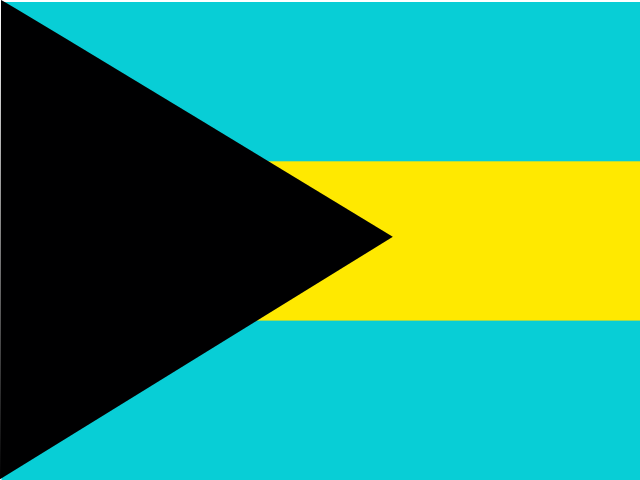
- Description: three equal horizontal bands of aquamarine (top), gold, and aquamarine, with a black equilateral triangle based on the left sideMeaning: the band colors represent the islands' golden beaches surrounded by the aquamarine sea; black stands for the vigor and force of a united people, and the triangle for the people's enterprise and determination
- National symbols
- blue marlin, flamingo, yellow elderflower
- National colours
- aquamarine, yellow, black
- National anthem
- Title: "God Save the King"Lyrics/music: unknownHistory: royal anthem, as a Commonwealth country
Economy
- Overview
- high-income tourism and financial services economy; major income inequality; strong US bilateral relations; several tax relief programs; targeted investment in agriculture, energy, light manufacturing, and technology industries
- GDP (PPP)
- $14.544 billion (2024 est.)
- GDP per person (PPP)
- $36,200 (2024 est.)
- GDP growth
- 3.4% (2024 est.)
- Inflation
- 0.4% (2024 est.)
- Unemployment
- 8.5% (2024 est.)
- Farm products
- sugarcane, grapefruits, vegetables, bananas, tomatoes, chicken, tropical fruits, oranges, coconuts, mangoes/guavas (2023)
- Industries
- tourism, banking, oil bunkering, maritime industries, transshipment and logistics, salt, aragonite, pharmaceuticals
- Exports
- $6.771 billion (2024 est.)
- Main exports
- refined petroleum, ships, aluminum, shellfish, plastics (2023)
- Export partners
- USA 36%, Zimbabwe 16%, Cote d'Ivoire 14%, Germany 8%, Guyana 8% (2023)
- Main imports
- refined petroleum, ships, aircraft, cars, crude petroleum (2023)
- Import partners
- USA 60%, Germany 13%, China 5%, Japan 3%, Brazil 2% (2023)
- Money sent home from abroad
- 0.4% of GDP (2024 est.)
Energy, internet and transport
- Electricity access
- Electrification - total population: 100% (2022 est.)
- Electricity sources
- Fossil fuels: 99.1% of total installed capacity (2023 est.)Solar: 0.9% of total installed capacity (2023 est.)
- Internet users
- Percent of population: 95% (2023 est.)
- Mobile phones
- Total subscriptions: 388,000 (2024 est.)Subscriptions per 100 inhabitants: 97 (2024 est.)
- TV and radio
- 4 major TV providers; 1 TV station is operated by government-owned, commercially run Broadcasting Corporation of the Bahamas (BCB) and competes with 4 privately owned TV stations; multi-channel cable TV subscription service is widely available; 32 licensed broadcast (radio) service providers, with 31 privately owned FM radio stations; the BCB operates a multi-channel radio network with national coverage; the sector is regulated by the Utilities Regulation and Competition Authority (2019)
- Airports
- 54 (2025)
- Merchant ships
- Total: 1,274 (2023)By type: bulk carrier 345, container ship 39, general cargo 58, oil tanker 193, other 639
Military and space
- Armed forces
- Royal Bahamas Defense Force (RBDF): includes land, air, maritime elements; Royal Bahamas Police Force (RBPF) (2025)
- Military spending
- 0.7% of GDP (2024 est.)
- Military service
- 18-30 years of age for voluntary service for men and women (18-60 for Reserves); no conscription (2025)
Global issues
- Refugees and displaced people
- Refugees: 30 (2024 est.)IDPs: 30 (2024 est.)
- Drug trade
- USG identification: major illicit drug-producing and/or drug-transit country (2025)
- Phone code
- +1242
- Internet domain
- .bs