Cape Verde
Republic of Cabo Verde · Cabo Verde
Uninhabited until Portuguese settlement in 1462; a slave-trade hub. Now one of Africa's most stable democracies.
See Cape Verde on the 3D globeTake a quiz
Population520 thousand
Area4,033 km²
CapitalPraia
RegionWestern Africa
Did you know?
- More Cape Verdeans live abroad than at home
- Cidade Velha was the first European colonial town in the tropics
- Morna music is UNESCO heritage
Key facts about Cape Verde
- Government
- Parliamentary republic
- Religion
- Catholic ~77%
- Founded / independence
- 1975 (from Portugal)
- Rich in
- Tourism, fishing, remittances, music (morna)
- Languages
- Portuguese
Portuguese; Cape Verdean Creole (Kriolu) - Currency
- Cape Verdean escudo (Esc)
- People are called
- Cape Verdian
- Main cities
- Praia, Mindelo
Timeline of Cape Verde
- 1462Portuguese settlement
- 1975Independence
- 1991Multi-party democracy
Places to see in Cape Verde
- Cidade Velha
- Fogo volcano
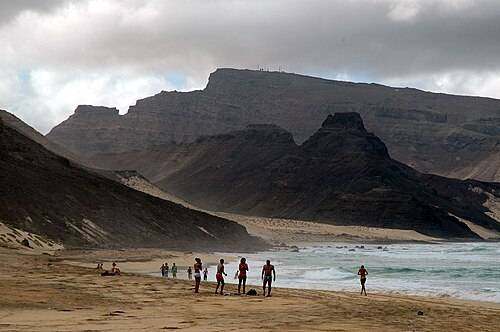
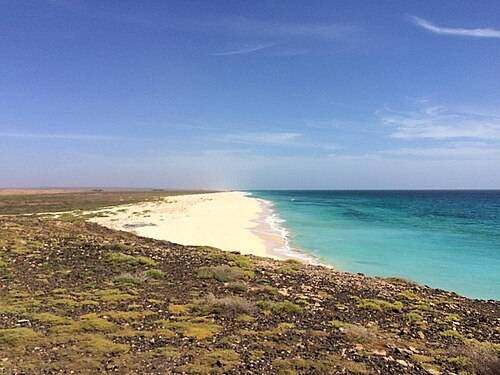
- Sal beaches
- Santo Antão hikes
- Mindelo
Food and drink
Cachupa (corn and bean stew) · grogue rum
Culture and famous for
Morna music (Cesária Évora); Creole culture
Popular sports
Football, kitesurfing
Geography and climate
- Highest point
- Pico do Fogo, 2,829 m
- Rivers, lakes and seas
- No rivers; ten islands
- Climate
- Dry tropical
- Coastline
- Has a sea coast
- Population density
- 129 people per km²
Wars and conflicts
- Independence struggle with Guinea-Bissau
Alliances and memberships
Political unions and regional organisations
Cape Verde in depth
Detailed facts from the CIA World Factbook (public domain, latest edition).
Overview
- History in brief
- The Portuguese discovered and colonized the uninhabited islands of Cabo Verde in the 15th century; Cabo Verde subsequently became a trading center for African slaves and later an important coaling and resupply stop for whaling and transatlantic shipping. The fusing of European and various African cultural traditions is reflected in Cabo Verde’s Crioulo language, music, and pano textiles. After gaining independence in 1975, a one-party system was established and maintained until multi-party elections were held in 1990. Cabo Verde continues to sustain one of Africa's most stable democratic governments and relatively stable economies, maintaining a currency pegged first to the Portuguese escudo and then to the euro since 1998. Repeated droughts during the second half of the 20th century caused significant hardship and prompted heavy emigration. As a result, Cabo Verde's expatriate population -- concentrated in Boston, Massachusetts and Western Europe -- is greater than its domestic one.Most Cabo Verdeans have both African and Portuguese antecedents. Cabo Verde’s population descends from its first permanent inhabitants in the late 15th-century -- a preponderance of West African slaves, a small share of Portuguese colonists, and even fewer Italians and Spaniards. Among the nine inhabited islands, population distribution is varied. The islands in the east are very dry and are home to the country's growing tourism industry. The more western islands receive more precipitation and support larger populations, but agriculture and livestock grazing have damaged their soil fertility and vegetation. For centuries, the country’s overall population size has fluctuated significantly, as recurring periods of famine and epidemics have caused high death tolls and emigration.
Geography
- Location
- Western Africa, group of islands in the North Atlantic Ocean, west of Senegal
- Size compared
- slightly larger than Rhode Island
- Land borders
- Total: 0 km
- Coastline
- 965 km
- Climate
- temperate; warm, dry summer; precipitation meager and erratic
- Terrain
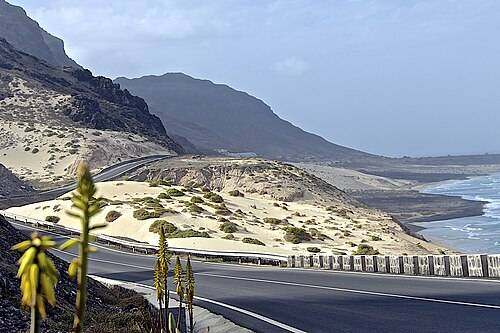
- steep, rugged, rocky, volcanic
- Elevation
- Highest point: Mt. Fogo (a volcano on Fogo Island) 2,829 mLowest point: Atlantic Ocean 0 m
- Natural resources
- salt, basalt rock, limestone, kaolin, fish, clay, gypsum
- Natural hazards
- prolonged droughts; seasonal harmattan wind produces obscuring dust; volcanically and seismically activeVolcanism: Fogo (2,829 m), which last erupted in 1995, is Cabo Verde's only active volcano
- Notes
- strategic location 500 km from west coast of Africa near major north-south sea routes; one of four North Atlantic archipelagos that make up Macaronesia; the others are Azores (Portugal), Canary Islands (Spain), and Madeira (Portugal)
- Environmental issues
- deforestation due to demand for firewood; water shortages; droughts; desertification; soil erosion; illegal beach sand extraction; overfishing
People and society
- Population
- Total: 611,014 (2024 est.)Male: 297,106Female: 313,908
- Nationality
- Noun: Cabo Verdean(s)Adjective: Cabo Verdean
- Ethnic groups
- Creole (Mulatto) 71%, African 28%, European 1%
- Languages
- Portuguese (official), Crioulo (a Portuguese-based creole language with two main dialects)
- Religions
- Roman Catholic 72.5%, Protestant 4% (includes Adventist 1.9%, Nazarene 1.8%, Assembly of God 0.2%, God is Love 0.1%), Christian Rationalism 1.7%, Muslim 1.3%, Jehovah's Witness 1.2%, Church of Jesus Christ 1%, other Christian 1.3%, other 1.2%, none 15.6%, no response 0.4% (2021 est.)
- Median age
- Total: 29.3 years (2025 est.)Male: 27.9 yearsFemale: 29.6 years
- Population growth
- 1.12% (2025 est.)
- Life expectancy
- Total population: 74.3 years (2024 est.)Male: 72 yearsFemale: 76.7 years
- Children per woman
- 2.08 children born/woman (2025 est.)
- Urbanization
- Urban population: 68% of total population (2023)Rate of urbanization: 1.83% annual rate of change (2020-25 est.)
- Largest cities
- 168,000 PRAIA (capital) (2018)
- Literacy
- Total population: 88.5% (2024 est.)Male: 92.9% (2024 est.)Female: 84.1% (2024 est.)
- Years in school
- Total: 13 years (2018 est.)Male: 13 years (2018 est.)Female: 14 years (2018 est.)
Government
- Official names
- Conventional long form: Republic of Cabo VerdeConventional short form: Cabo VerdeLocal long form: Republica de Cabo VerdeLocal short form: Cabo VerdeEtymology: the name derives from the Cape Verde (Green Cape) peninsula on the Senegalese coast, the westernmost point of Africa and the nearest mainland to the islands
- Government type
- parliamentary republic
- Capital
- Name: PraiaGeographic coordinates: 14 55 N, 23 31 WTime difference: UTC-1 (4 hours ahead of Washington, DC, during Standard Time)Etymology: the earlier Portuguese name was Villa de Praia ("Village of the Beach"); it was shortened to Praia in 1974
- Regions
- 22 municipalities (concelhos, singular - concelho); Boa Vista, Brava, Maio, Mosteiros, Paul, Porto Novo, Praia, Ribeira Brava, Ribeira Grande, Ribeira Grande de Santiago, Sal, Santa Catarina, Santa Catarina do Fogo, Santa Cruz, São Domingos, São Filipe, São Lourenco dos Orgaos, São Miguel, São Salvador do Mundo, São Vicente, Tarrafal, Tarrafal de São Nicolau
- Independence
- 5 July 1975 (from Portugal)
- National holiday
- Independence Day, 5 July (1975)
- Constitution
- History: previous 1981; latest effective 25 September 1992Amendment process: proposals require support of at least four fifths of the active National Assembly membership; amendment drafts require sponsorship of at least one third of the active Assembly membership; passage requires at least two-thirds majority vote by the Assembly membership; constitutional sections, including those on national independence, form of government, political pluralism, suffrage, and human rights and liberties, cannot be amended
- Legal system
- civil law system of Portugal
- Voting age
- 18 years of age; universal
- Flag meaning
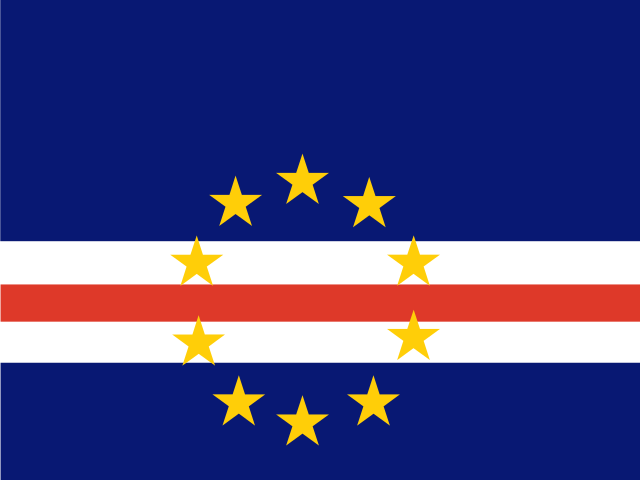
- Description: five unequal horizontal bands; the top band of blue is half the height of the flag; under it are three narrow bands of white, red, and white, and a bottom stripe of blue; a circle of 10 five-pointed yellow stars is centered on the red stripe and sits toward the left side of the flagMeaning: blue stands for the sea and sky; the stripes symbolize the country's formation through peace (white) and effort (red); the stars represent the 10 major islands
- National symbols
- ten five-pointed yellow stars
- National colours
- blue, white, red, yellow
- National anthem
- Title: "Cantico da Liberdade" (Song of Freedom)Lyrics/music: Amilcar Spencer LOPES/Adalberto Higino Tavares SILVAHistory: adopted 1996
- UNESCO World Heritage Sites
- Total World Heritage Sites: 1 (cultural)Selected World Heritage Site locales: Cidade Velha; Historic Center of Ribeira Grande
Economy
- Overview
- stable, middle-income, developing island economy; strong GDP growth led by tourism sector recovery; sustained poverty reduction through PEDS II development plan; high reliance on foreign remittances and aid to finance external debt
- GDP (PPP)
- $5.2 billion (2024 est.)
- GDP per person (PPP)
- $9,900 (2024 est.)
- GDP growth
- 7.3% (2024 est.)
- Inflation
- 1% (2024 est.)
- Unemployment
- 11.9% (2024 est.)
- Below poverty line
- 35.2% (2015 est.)
- Farm products
- sugarcane, tomatoes, coconuts, pulses, goat milk, milk, vegetables, bananas, cabbages, onions (2023)
- Industries
- food and beverages, fish processing, shoes and garments, salt mining, ship repair
- Exports
- $1.158 billion (2024 est.)
- Main exports
- fish, refined petroleum, railway cargo containers, shellfish, garments (2023)
- Export partners
- Spain 46%, Portugal 9%, Togo 7%, Italy 7%, India 6% (2023)
- Main imports
- refined petroleum, aircraft, cars, fish, railway cargo containers (2023)
- Import partners
- Portugal 29%, Saudi Arabia 11%, Netherlands 9%, Spain 8%, China 7% (2023)
- Money sent home from abroad
- 12.1% of GDP (2024 est.)
Energy, internet and transport
- Electricity access
- Electrification - total population: 97.1% (2022 est.)Electrification - urban areas: 95.3%Electrification - rural areas: 96.9%
- Electricity sources
- Fossil fuels: 71.1% of total installed capacity (2023 est.)Solar: 14.2% of total installed capacity (2023 est.)Wind: 14.6% of total installed capacity (2023 est.)
- Internet users
- Percent of population: 74% (2023 est.)
- Mobile phones
- Total subscriptions: 590,354 (2023 est.)Subscriptions per 100 inhabitants: 112 (2024 est.)
- TV and radio
- state-run TV and radio network, plus a growing number of private broadcasters; Portuguese public TV and radio services for Africa are available; transmissions of a few international broadcasters are available (2019)
- Airports
- 10 (2025)
- Merchant ships
- Total: 44 (2023)By type: general cargo 14, oil tanker 2, other 28
Military and space
- Armed forces
- Cabo Verdean Armed Forces (FACV): National Guard (GN), Cabo Verde Coast Guard (Guardia Costeira de Cabo Verde, GCCV) (2025)
- Military spending
- 0.6% of GDP (2024 est.)
- Military service
- 17 years of age for voluntary service (with parental consent); 18-35 years of age for selective compulsory service (14-month service obligation) (2025)
Global issues
- Refugees and displaced people
- Stateless persons: 115 (2024 est.)
- Phone code
- +238
- Internet domain
- .cv