Cyprus
Republic of Cyprus · Κύπρος · Kıbrıs
Settled by Mycenaean Greeks, later ruled by Persians, Romans, Byzantines, Crusaders, Venice, Ottomans and Britain. After a Greek-backed coup in 1974 Turkey invaded; the north is a self-declared state recognised only by Turkey.
See Cyprus on the 3D globeTake a quiz
Population1.3 million
Area9,251 km²
CapitalNicosia
RegionSouthern Europe
Did you know?
- Nicosia is the last divided capital in Europe
- Halloumi cheese has protected origin status
- British military bases still cover about 3% of the island
Key facts about Cyprus
- Government
- Presidential republic (island divided since 1974)
- Religion
- Greek Orthodox ~73% (south), Sunni Islam (north)
- Founded / independence
- 1960 (from UK)
- Rich in
- Tourism, shipping, financial services, offshore gas
- Languages
- Greek, Turkish
Greek (Cypriot Greek dialect) and Turkish (Cypriot Turkish) - Currency
- Euro (€)
- People are called
- Cypriot
- Main cities
- Nicosia, Limassol, Larnaca, Paphos
Timeline of Cyprus
- 1571Ottoman conquest
- 1878British administration
- 1960Independence
- 1974Coup and Turkish invasion
- 1983North declares independence
- 2004Joins EU
- 2008Adopts euro
Places to see in Cyprus
- Tombs of the Kings, Paphos
- Kourion
- Troodos painted churches
- Ayia Napa beaches
- Kyrenia harbour
Food and drink
Halloumi · meze · souvlaki · kleftiko
Culture and famous for
Lefkara lace; myth of Aphrodite's birthplace at Petra tou Romiou
Popular sports
Football
Geography and climate
- Highest point
- Mount Olympus, 1,952 m
- Rivers, lakes and seas
- Seasonal rivers; salt lakes at Larnaca
- Climate
- Hot dry summers, mild winters
- Coastline
- Has a sea coast
- Population density
- 141 people per km²
Wars and conflicts
- 1955–59 anti-British uprising
- 1974 Turkish invasion and partition
Alliances and memberships
Political unions and regional organisations
European UnionEurozoneCouncil of EuropeCommonwealth of Nations
Cyprus in depth
Detailed facts from the CIA World Factbook (public domain, latest edition).
Overview
- History in brief
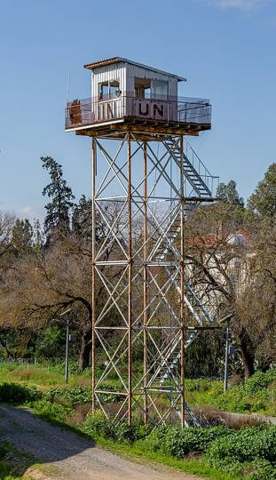
- A former British colony, Cyprus became independent in 1960 after years of resistance to British rule. Tensions between the Greek Cypriot majority and Turkish Cypriot minority came to a head in December 1963, when violence broke out in the capital of Nicosia. Despite the deployment of UN peacekeepers in 1964, sporadic intercommunal violence continued and forced most Turkish Cypriots into enclaves throughout the island. In 1974, a Greek Government-sponsored attempt to overthrow the elected president of Cyprus was met by military intervention from Turkey, which soon controlled more than a third of the island. In 1983, the Turkish Cypriot administered area declared itself the "Turkish Republic of Northern Cyprus" (TRNC), but it is recognized only by Turkey. A UN-mediated agreement to reunite Cyprus, the Annan Plan, failed to win approval from both communities in 2004. The most recent round of reunification negotiations was suspended in 2017 after failure to achieve a breakthrough.The entire island joined the EU in 2004, although the EU acquis -- the body of common rights and obligations -- applies only to the areas under the internationally recognized government and is suspended in the TRNC. However, individual Turkish Cypriots able to document their eligibility for Republic of Cyprus citizenship have the same legal rights accorded to citizens of other EU states.
Geography
- Location
- Middle East, island in the Mediterranean Sea, south of Turkey; note - Cyprus views itself as part of Europe; geopolitically, it can be classified as falling within Europe, the Middle East, or both
- Size compared
- about 0.6 times the size of Connecticut
- Land borders
- Total: 156 kmBorder sovereign base areas: Akrotiri 48 km; Dhekelia 108 km
- Coastline
- 648 km
- Climate
- temperate; Mediterranean with hot, dry summers and cool winters
- Terrain
- central plain with mountains to north and south; scattered but significant plains along southern coast
- Elevation
- Highest point: Mount Olympus 1,951 mLowest point: Mediterranean Sea 0 mMean elevation: 91 m
- Natural resources
- copper, pyrites, asbestos, gypsum, timber, salt, marble, clay earth pigment
- Natural hazards
- moderate earthquake activity; droughts
- Notes
- the third largest island in the Mediterranean Sea (after Sicily and Sardinia)
- Environmental issues
- scarce water resources; salination; water pollution from sewage, industrial wastes, and pesticides; coastal degradation; erosion; loss of wildlife habitats from urbanization
People and society
- Population
- Total: 1,332,293 (2025 est.)Male: 681,128Female: 651,165
- Nationality
- Noun: Cypriot(s)Adjective: Cypriot
- Ethnic groups
- Greek 98.8%, other 1% (includes Maronite, Armenian, Turkish-Cypriot), unspecified 0.2% (2011 est.)
- Languages
- Greek (official) 80.9%, Turkish (official) 0.2%, English 4.1%, Romanian 2.9%, Russian 2.5%, Bulgarian 2.2%, Arabic 1.2%, Filipino 1.1%, other 4.3%, unspecified 0.6% (2011 est.)Major-language sample(s): Το Παγκόσμιο Βιβλίο Δεδομένων, η απαραίτητη πηγή βασικών πληροφοριών. (Greek)The World Factbook, the indispensable source for basic information.
- Religions
- Eastern Orthodox Christian 89.1%, Roman Catholic 2.9%, Protestant/Anglican 2%, Muslim 1.8%, Buddhist 1%, other (includes Maronite Catholic, Armenian Apostolic, Hindu) 1.4%, unknown 1.1%, none/atheist 0.6% (2011 est.)
- Median age
- Total: 39.9 years (2025 est.)Male: 38.2 yearsFemale: 41 years
- Population growth
- 0.89% (2025 est.)
- Life expectancy
- Total population: 80.2 years (2024 est.)Male: 77.4 yearsFemale: 83.1 years
- Children per woman
- 1.49 children born/woman (2025 est.)
- Urbanization
- Urban population: 67% of total population (2023)Rate of urbanization: 0.76% annual rate of change (2020-25 est.)
- Largest cities
- 269,000 NICOSIA (capital) (2018)
- Years in school
- Total: 16 years (2022 est.)Male: 16 years (2022 est.)Female: 17 years (2022 est.)
Government
- Official names
- Conventional long form: Republic of CyprusConventional short form: CyprusLocal long form: Kypriaki Dimokratia (Greek)/ Kibris Cumhuriyeti (Turkish)Local short form: Kypros (Greek)/ Kibris (Turkish)Etymology: the Greek name for the island is Kupros, which is probably derived from the Sumerian kabar, meaning "copper" or "bronze;" copper mines were located on the island in antiquity
- Government type
- Republic of Cyprus - presidential republic; self-declared "Turkish Republic of Northern Cyprus" (TRNC) - parliamentary republic with enhanced presidency
- Capital
- Name: Nicosia (Lefkosia/Lefkosa)Geographic coordinates: 35 10 N, 33 22 ETime difference: UTC+2 (7 hours ahead of Washington, DC, during Standard Time)Daylight saving time: +1hr, begins last Sunday in March; ends last Sunday in OctoberEtymology: may have been named after Nike, the Greek goddess of victory; the Greek name for the city, Lefkosia, and the Turkish name, Lefkosa, both mean "White City"
- Regions
- 6 districts; Ammochostos (Famagusta; all but a small part located in the Turkish Cypriot community), Keryneia (Kyrenia; the only district located entirely in the Turkish Cypriot community), Larnaka (Larnaca; with a small part located in the Turkish Cypriot community), Lefkosia (Nicosia; a small part administered by Turkish Cypriots), Lemesos (Limassol), Pafos (Paphos)
- Independence
- 16 August 1960 (from the UK)
- National holiday
- Independence Day, 1 October (1960)
- Constitution
- History: ratified 16 August 1960Amendment process: constitution of the Republic of Cyprus -- proposed by the House of Representatives; passage requires at least two-thirds majority vote of the total membership of the "Greek Community" and the "Turkish Community"; however, all seats of Turkish Cypriot members have remained vacant since 1964constitution of the “Turkish Republic of Northern Cyprus” -- proposed by at least 10 members of the "Assembly of the Republic"; passage requires at least two-thirds majority vote of the total Assembly membership and approval by referendum
- Legal system
- mixed system of English common law and civil law, with European law supremacy
- Voting age
- 18 years of age; universal
- Flag meaning
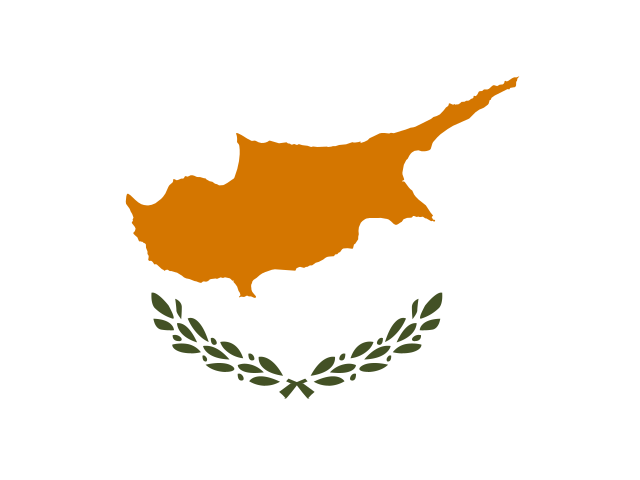
- Description: a copper-colored silhouette of the island is centered on a white field above two crossed green olive branchesMeaning: the olive branches symbolize hope for peace and reconciliation between the Greek and Turkish communities
- National symbols
- Cypriot mouflon (wild sheep), white dove
- National colours
- blue, white
- National anthem
- Title: "Ymnos eis tin Eleftherian" (Hymn to Freedom)Lyrics/music: Dionysios SOLOMOS/Nikolaos MANTZAROSHistory: adopted 1966; Cyprus uses the Greek national anthem; the Turkish Cypriot community in Cyprus uses Turkey's national anthem
- UNESCO World Heritage Sites
- Total World Heritage Sites: 3 (all cultural)Selected World Heritage Site locales: Paphos; Painted Churches in the Troodos Region; Choirokoitia
Economy
- Overview
- services-based, high-income EU island economy; heavy tourism; sustained growth between recovery of national banking system and COVID-19 trade restrictions; high living standards; a known financial hub, its stock exchange functions as an investment bridge between EU-and EEU-member countries
- GDP (PPP)
- $50.055 billion (2024 est.)
- GDP per person (PPP)
- $53,300 (2024 est.)
- GDP growth
- 3.4% (2024 est.)
- Inflation
- 1.8% (2024 est.)
- Unemployment
- 5.7% (2024 est.)
- Below poverty line
- 13.9% (2021 est.)
- Farm products
- milk, potatoes, sheep milk, pork, goat milk, wheat, chicken, olives, grapes, barley (2023)
- Industries
- tourism, food and beverage processing, cement and gypsum, ship repair and refurbishment, textiles, light chemicals, metal products, wood, paper, stone and clay products
- Exports
- $35.12 billion (2024 est.)
- Main exports
- ships, refined petroleum, packaged medicine, cheese, scented mixtures (2023)
- Export partners
- Libya 14%, Greece 11%, Lebanon 8%, Bermuda 7%, Marshall Islands 5% (2023)
- Main imports
- refined petroleum, ships, cars, packaged medicine, coal tar oil (2023)
- Import partners
- Greece 20%, UK 10%, Italy 7%, Turkey 6%, Spain 6% (2023)
- Money sent home from abroad
- 1.8% of GDP (2023 est.)
Energy, internet and transport
- Electricity access
- Electrification - total population: 100% (2022 est.)
- Electricity sources
- Fossil fuels: 79.1% of total installed capacity (2023 est.)Solar: 16% of total installed capacity (2023 est.)Wind: 3.9% of total installed capacity (2023 est.)Biomass and waste: 1% of total installed capacity (2023 est.)
- Internet users
- Percent of population: 91% (2023 est.)
- Mobile phones
- Total subscriptions: 1.51 million (2024 est.)Subscriptions per 100 inhabitants: 156 (2024 est.)
- TV and radio
- mix of state and privately run TV and radio; the public broadcaster operates 2 TV channels and 4 radio stations; 6 private TV broadcasters, satellite and cable TV services (including from Greece and Turkey), and a number of private radio stations; in areas administered by Turkish Cypriots, there are 2 public TV stations, 4 public radio stations, 7 privately owned TV stations and 21 privately owned radio stations, 6 radio and 4 TV channels at local universities, 1 military radio station, and 1 radio station for civil defense cooperation, as well as relay stations from Turkey (2019)
- Airports
- 14 (2025)
- Merchant ships
- Total: 1,005 (2023)By type: bulk carrier 243, container ship 154, general cargo 211, oil tanker 47, other 350
Military and space
- Armed forces
- Cypriot National Guard (Ethniki Froura, EF): Army, Navy, Air Force (2025)
- Military spending
- 1.7% of GDP (2024 est.)
- Military service
- all Cypriot men must complete 14 months of compulsory service upon reaching the age of 18; women may volunteer for 6 months of service at age 18; men and women may also enlist as contract soldiers up to age 42 (2025)
Global issues
- Refugees and displaced people
- Refugees: 73,303 (2024 est.)IDPs: 244,944 (2024 est.)Stateless persons: 130 (2024 est.)
- Phone code
- +357
- Internet domain
- .cy