Dominica
Commonwealth of Dominica
"Nature Island" with the last Kalinago (Carib) territory.
See Dominica on the 3D globeTake a quiz
Population70 thousand
Area751 km²
CapitalRoseau
RegionCaribbean
Did you know?
- Its Boiling Lake is the second-largest hot lake in the world
- Has a river for every day of the year
- Nicknamed the "Nature Island"
Key facts about Dominica
- Government
- Parliamentary republic
- Religion
- Catholic ~60%
- Founded / independence
- 1978 (from UK)
- Rich in
- Bananas, ecotourism, citizenship sales
- Languages
- English
English; Dominican Creole French (Kwéyòl) - Currency
- Eastern Caribbean dollar ($)
- People are called
- Dominican
- Main cities
- Roseau, Portsmouth
Timeline of Dominica
- 1493Columbus names it
- 1763British rule
- 1978Independence
- 2017Hurricane Maria
Places to see in Dominica
- Boiling Lake
- Trafalgar Falls
- Morne Trois Pitons NP
- Champagne Reef
Food and drink
Callaloo soup · mountain chicken (frog)
Culture and famous for
Kalinago Territory; World Creole Music Festival
Popular sports
Cricket
Geography and climate
- Highest point
- Morne Diablotins, 1,447 m
- Rivers, lakes and seas
- Over 300 rivers
- Climate
- Tropical rainforest
- Coastline
- Has a sea coast
- Population density
- 93 people per km²
Wars and conflicts
- Hurricane Maria 2017
Alliances and memberships
Political unions and regional organisations
CARICOMCELACOrganization of American StatesCommonwealth of Nations
Dominica in depth
Detailed facts from the CIA World Factbook (public domain, latest edition).
Overview
- History in brief
- Dominica was the last of the Caribbean islands to be colonized by Europeans, due chiefly to the fierce resistance of the native Caribs. France ceded possession to Britain in 1763, and Dominica became a British colony in 1805. Slavery ended in 1833, and in 1835, the first three men of African descent were elected to the legislative assembly of Dominica. In 1871, Dominica became first part of the British Leeward Islands and then the British Windward Islands until 1958. In 1967, Dominica became an associated state of the UK, formally taking responsibility for its internal affairs, and the country gained its independence in 1978. In 1980, Dominica's fortunes improved when Mary Eugenia CHARLES -- the first female prime minister in the Caribbean -- replaced a corrupt and tyrannical administration, and she served for the next 15 years. In 2017, Hurricane Maria passed over the island, causing extensive damage to structures, roads, communications, and the power supply, and largely destroying critical agricultural areas.
Geography
- Location
- Caribbean, island between the Caribbean Sea and the North Atlantic Ocean, about halfway between Puerto Rico and Trinidad and Tobago
- Size compared
- slightly more than four times the size of Washington, D.C.
- Land borders
- Total: 0 km
- Coastline
- 148 km
- Climate
- tropical; moderated by northeast trade winds; heavy rainfall
- Terrain
- rugged mountains of volcanic origin
- Elevation
- Highest point: Morne Diablotins 1,447 mLowest point: Caribbean Sea 0 m
- Natural resources
- timber, hydropower, arable land
- Natural hazards
- flash floods are a constant threat; destructive hurricanes can be expected during the late summer monthsVolcanism: Dominica lies in the middle of the volcanic-island arc of the Lesser Antilles that extends from the island of Saba in the north to Grenada in the south; of the 16 volcanoes that make up this arc, five are located on Dominica, more than any other island in the Caribbean: Morne aux Diables (861 m), Morne Diablotins (1,430 m), Morne Trois Pitons (1,387 m), Watt Mountain (1,224 m), which last erupted in 1997, and Morne Plat Pays (940 m); the two best-known volcanic features on Dominica, the Valley of Desolation and the Boiling Lake thermal areas, lie on the flanks of Watt Mountain, and both are popular tourist destinations
- Notes
- known as "The Nature Island of the Caribbean" due to its lush and varied flora and fauna, which are protected by an extensive natural park system; the most mountainous of the Lesser Antilles, its volcanic peaks are cones of lava craters and include Boiling Lake, the second-largest thermally active lake in the world
- Environmental issues
- pollution from agrochemicals and from untreated sewage; forests endangered by the expansion of farming; soil erosion; pollution of the coastal zone from agricultural/industrial chemicals and untreated sewage
People and society
- Population
- Total: 74,661 (2024 est.)Male: 37,753Female: 36,908
- Nationality
- Noun: Dominican(s)Adjective: Dominican
- Ethnic groups
- African descent 84.5%, mixed 9%, Indigenous 3.8%, other 2.1%, unspecified 0.6% (2011 est.)
- Languages
- English (official), French patois
- Religions
- Roman Catholic 52.7%, Protestant 29.7% (includes Seventh Day Adventist 6.7%, Pentecostal 6.1%, Baptist 5.2%, Christian Union Church 3.9%, Methodist 2.6%, Gospel Mission 2.1%, other Protestant 3.1%), Jehovah's Witness 1.3%, Rastafarian 1.1%, other 4.3%, none 9.4%, unspecified 1.4% (2011 est.)
- Median age
- Total: 37.5 years (2025 est.)Male: 36.5 yearsFemale: 37.6 years
- Population growth
- -0.04% (2025 est.)
- Life expectancy
- Total population: 78.7 years (2024 est.)Male: 75.8 yearsFemale: 81.8 years
- Children per woman
- 2.01 children born/woman (2025 est.)
- Urbanization
- Urban population: 72% of total population (2023)Rate of urbanization: 0.84% annual rate of change (2020-25 est.)
- Largest cities
- 15,000 ROSEAU (capital) (2018)
Government
- Official names
- Conventional long form: Commonwealth of DominicaConventional short form: DominicaEtymology: the island was named by explorer Christopher COLUMBUS for the day of the week on which he spotted it, Sunday (Domingo in Spanish, dominica dies in Latin), 3 November 1493
- Government type
- parliamentary republic
- Capital
- Name: RoseauGeographic coordinates: 15 18 N, 61 24 WTime difference: UTC-4 (1 hour ahead of Washington, DC, during Standard Time)Etymology: the name is French for "reed;" the first settlement was named after the river reeds that grew in the area
- Regions
- 10 parishes; Saint Andrew, Saint David, Saint George, Saint John, Saint Joseph, Saint Luke, Saint Mark, Saint Patrick, Saint Paul, Saint Peter
- Independence
- 3 November 1978 (from the UK)
- National holiday
- Independence Day, 3 November (1978)
- Constitution
- History: previous 1967 (pre-independence); latest presented 25 July 1978, entered into force 3 November 1978Amendment process: proposed by the House of Assembly; passage of amendments to constitutional sections such as fundamental rights and freedoms, the government structure, and constitutional amendment procedures requires approval by three fourths of the Assembly membership in the final reading of the amendment bill, approval by simple majority in a referendum, and assent of the president
- Legal system
- common law based on the English model
- Voting age
- 18 years of age; universal
- Flag meaning
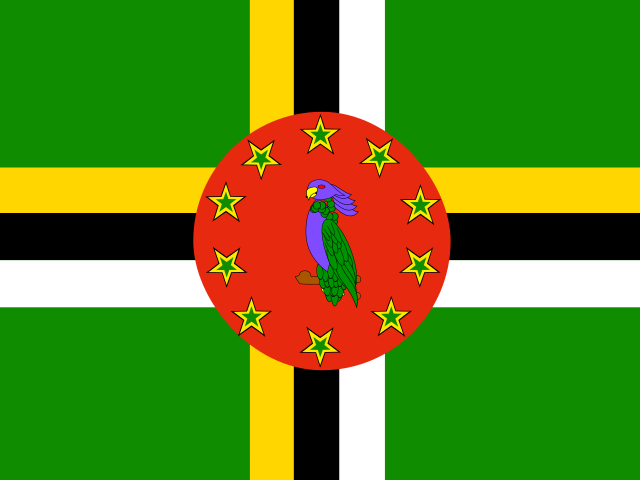
- Description: green with a centered cross of three equal bands in yellow, black, and white; in the center of the cross is a red disk with a Sisserou parrot surrounded by 10 five-pointed green stars edged in yellowMeaning: the stars represent the 10 administrative divisions (parishes); green symbolizes the island's lush vegetation; the tricolor cross represents the Christian Trinity; yellow stands for sunshine, the primary agricultural products (citrus and bananas), and the Carib people; black for the rich soil and the African heritage of most citizens; white for rivers, waterfalls, and the purity of aspirations; the red disc for social justice
- National symbols
- sisserou parrot, Carib wood flower
- National colours
- green, yellow, black, white, red
- National anthem
- Title: "Isle of Beauty"Lyrics/music: Wilfred Oscar Morgan POND/Lemuel McPherson CHRISTIANHistory: adopted 1967
Economy
- Overview
- highly agrarian OECS island economy; ECCU-member state; large banana exporter; improved oversight of its citizenship-by-investment program; emerging ecotourism, information and communications, and education industries
- GDP (PPP)
- $1.241 billion (2024 est.)
- GDP per person (PPP)
- $18,700 (2024 est.)
- GDP growth
- 2.1% (2024 est.)
- Inflation
- 2.6% (2024 est.)
- Farm products
- taro, grapefruits, yams, bananas, coconuts, plantains, milk, yautia, sugarcane, oranges (2023)
- Industries
- soap, coconut oil, tourism, copra, furniture, cement blocks, shoes
- Exports
- $212.753 million (2024 est.)
- Main exports
- iron blocks, medical instruments, excavation machinery, power equipment, soap (2023)
- Export partners
- Bahamas, The 13%, Saudi Arabia 11%, Iceland 10%, Guyana 7%, Antigua & Barbuda 7% (2023)
- Main imports
- refined petroleum, ships, plastic products, semi-finished iron, cars (2023)
- Import partners
- USA 24%, China 11%, Indonesia 8%, Trinidad & Tobago 7%, Italy 7% (2023)
- Money sent home from abroad
- 5.6% of GDP (2024 est.)
Energy, internet and transport
- Electricity access
- Electrification - total population: 100% (2022 est.)
- Electricity sources
- Fossil fuels: 84.3% of total installed capacity (2023 est.)Solar: 0.1% of total installed capacity (2023 est.)Wind: 0.7% of total installed capacity (2023 est.)Hydroelectricity: 15% of total installed capacity (2023 est.)
- Internet users
- Percent of population: 84% (2023 est.)
- Mobile phones
- Total subscriptions: 56,929 (2022 est.)Subscriptions per 100 inhabitants: 85 (2022 est.)
- TV and radio
- no terrestrial TV service; subscription cable TV provider offers some locally produced programming, plus channels from the US, Latin America, and the Caribbean; state-operated radio broadcasts on 6 stations; privately owned radio broadcasts on about 15 stations (2019)
- Airports
- 2 (2025)
- Merchant ships
- Total: 77 (2023)By type: general cargo 26, oil tanker 10, other 41
Military and space
- Armed forces
- no regular military forces; Commonwealth of Dominica Police Force (CDPF) under the Ministry of National Security and Legal Affairs
Global issues
- Refugees and displaced people
- Refugees: 5 (2024 est.)
- Phone code
- +1767
- Internet domain
- .dm