Fiji
Republic of Fiji · Viti · फिजी
Ceded to Britain in 1874; indentured Indian workers created a large Indo-Fijian community.
See Fiji on the 3D globeTake a quiz
Population930 thousand
Area18,272 km²
CapitalSuva
RegionMelanesia
Did you know?
- Won its first Olympic gold in rugby sevens in 2016
- The 180° meridian passes through it
- Has about 330 islands
Key facts about Fiji
- Government
- Parliamentary republic
- Religion
- Christian ~64%, Hindu ~28%, Islam ~6%
- Founded / independence
- 1970 (from UK)
- Rich in
- Tourism, sugar, bottled water
- Languages
- English, Fijian, Fiji Hindi
English, Fijian, Fiji Hindi - Currency
- Fijian dollar ($)
- People are called
- Fijian
- Main cities
- Suva, Nadi, Lautoka
Timeline of Fiji
- 1643Tasman sights islands
- 1874British colony
- 1970Independence
- 1987Coups
- 2006Coup
Places to see in Fiji
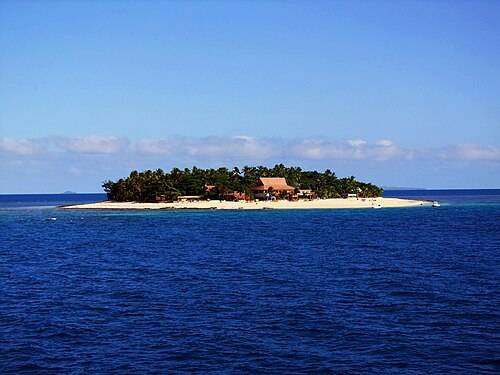
- Mamanuca and Yasawa islands
- Sabeto mud pools
- Garden of the Sleeping Giant
- Beqa Lagoon shark diving
Food and drink
Kokoda (raw fish in coconut) · lovo (earth-oven feast)
Culture and famous for
Kava ceremonies; "Bula!" greeting; firewalking on Beqa
Popular sports
Rugby sevens (Olympic gold 2016, 2020)
Geography and climate
- Highest point
- Mount Tomanivi, 1,324 m
- Rivers, lakes and seas
- Rewa River; 330 islands
- Climate
- Tropical marine
- Coastline
- Has a sea coast
- Population density
- 51 people per km²
Wars and conflicts
- Coups 1987, 2000, 2006
Alliances and memberships
Political unions and regional organisations
Pacific Islands ForumCommonwealth of Nations
Fiji in depth
Detailed facts from the CIA World Factbook (public domain, latest edition).
Overview
- History in brief
- Austronesians settled Fiji around 1000 B.C., followed by successive waves of Melanesians starting around the first century A.D. Fijians traded with Polynesian groups in Samoa and Tonga, and by about 900, much of Fiji was in the Tu’i Tongan Empire’s sphere of influence. The Tongan influence declined significantly by 1200, while Melanesian seafarers continued to periodically arrive in Fiji, further mixing Melanesian and Polynesian cultural traditions. The first European spotted Fiji in 1643 and by the 1800s, European merchants, missionaries, traders, and whalers frequented the islands. Rival kings and chiefs competed for power, at times aided by Europeans, and in 1865, Seru Epenisa CAKOBAU united many groups into the Confederacy of Independent Kingdoms of Viti. The arrangement proved weak, however, and in 1871 CAKOBAU formed the Kingdom of Fiji in an attempt to centralize power. Fearing a hostile takeover by a foreign power as the kingdom’s economy began to falter, CAKOBAU ceded Fiji to the UK in 1874.The first British governor set up a plantation-style economy and brought in more than 60,000 Indians as indentured laborers, most of whom chose to stay in Fiji rather than return to India when their contracts expired. In the early 1900s, society was divided along ethnic lines, with iTaukei (indigenous Fijians), Europeans, and Indo-Fijians living in separate areas and maintaining their own languages and traditions. ITaukei fears of an Indo-Fijian takeover of government delayed independence through the 1960s; Fiji achieved independence in 1970 with agreements to allocate parliamentary seats by ethnic groups. After two coups in 1987, a new constitution in 1990 cemented iTaukei control of politics, leading thousands of Indo-Fijians to leave. A reformed constitution in 1997 was more equitable and led to the election of an Indo-Fijian prime minister in 1999, who was ousted in a coup the following year. In 2005, the new prime minister put forward a bill that would grant pardons to the coup perpetrators, leading Josaia Voreqe "Frank" BAINIMARAMA to launch a coup in 2006. BAINIMARAMA appointed himself prime minister in 2007 and retained the position after elections in 2014 and 2018 that international observers deemed credible. BAINIMARAMA's party lost control of the prime minister position after elections in 2022 with former opposition leader Sitiveni Ligamamada RABUKA winning the office by a narrow margin.
Geography
- Location
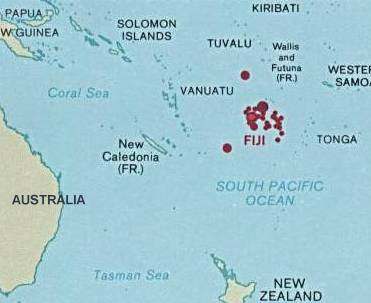
- Oceania, island group in the South Pacific Ocean, about two-thirds of the way from Hawaii to New Zealand
- Size compared
- slightly smaller than New Jersey
- Land borders
- Total: 0 km
- Coastline
- 1,129 km
- Climate
- tropical marine; only slight seasonal temperature variation
- Terrain
- mostly mountains of volcanic origin
- Elevation
- Highest point: Tomanivi 1,324 mLowest point: Pacific Ocean 0 m
- Natural resources
- timber, fish, gold, copper, offshore oil potential, hydropower
- Natural hazards
- cyclonic storms can occur from November to January
- Notes
- consists of 332 islands, approximately 110 of which are inhabited, and more than 500 islets
- Environmental issues
- air pollution from waste incineration and vehicle emissions; deforestation and soil erosion; soil erosion from clearing land by bush burning
People and society
- Population
- Total: 951,611 (2024 est.)Male: 482,304Female: 469,307
- Nationality
- Noun: Fijian(s)Adjective: Fijian
- Ethnic groups
- iTaukei 56.8% (predominantly Melanesian with a Polynesian admixture), Indo-Fijian 37.5%, Rotuman 1.2%, other 4.5% (European, part European, other Pacific Islanders, Chinese) (2007 est.)
- Languages
- English (official), iTaukei (official), Fiji Hindi (official)
- Religions
- Protestant 45% (Methodist 34.6%, Assembly of God 5.7%, Seventh Day Adventist 3.9%, and Anglican 0.8%), Hindu 27.9%, other Christian 10.4%, Roman Catholic 9.1%, Muslim 6.3%, Sikh 0.3%, other 0.3%, none 0.8% (2007 est.)
- Median age
- Total: 32 years (2025 est.)Male: 31.4 yearsFemale: 31.8 years
- Population growth
- 0.38% (2025 est.)
- Life expectancy
- Total population: 74.8 years (2024 est.)Male: 72.2 yearsFemale: 77.6 years
- Children per woman
- 2.18 children born/woman (2025 est.)
- Urbanization
- Urban population: 58.7% of total population (2023)Rate of urbanization: 1.37% annual rate of change (2020-25 est.)
- Largest cities
- 178,000 SUVA (capital) (2018)
- Literacy
- Female: 92.4% (2021 est.)
Government
- Official names
- Conventional long form: Republic of FijiConventional short form: FijiLocal long form: Republic of Fiji (English)/ Matanitu ko Viti (Fijian)Local short form: Fiji (English)/ Viti (Fijian)Etymology: the Fijians called their home Viti, but the neighboring Tongans called it Fisi; in the Anglicized spelling of the Tongan pronunciation -- promulgated by explorer Captain James COOK -- the designation became Fiji
- Government type
- parliamentary republic
- Capital
- Name: Suva (on Viti Levu)Geographic coordinates: 18 08 S, 178 25 ETime difference: UTC+12 (17 hours ahead of Washington, DC, during Standard Time)Etymology: the name means "little hill" in the native Fijian language and may refer to a mound where a temple once stood
- Regions
- 14 provinces and 1 dependency*; Ba, Bua, Cakaudrove, Kadavu, Lau, Lomaiviti, Macuata, Nadroga and Navosa, Naitasiri, Namosi, Ra, Rewa, Rotuma*, Serua, Tailevu
- Independence
- 10 October 1970 (from the UK)
- National holiday
- Fiji (Independence) Day, 10 October (1970)
- Constitution
- History: several previous; latest signed into law 6 September 2013Amendment process: proposed as a bill by Parliament and supported by at least three quarters of its members, followed by referral to the president and then to the Electoral Commission, which conducts a referendum; passage requires approval by at least three-quarters of registered voters and assent by the president
- Legal system
- common law system based on the English model
- Voting age
- 18 years of age; universal
- Flag meaning
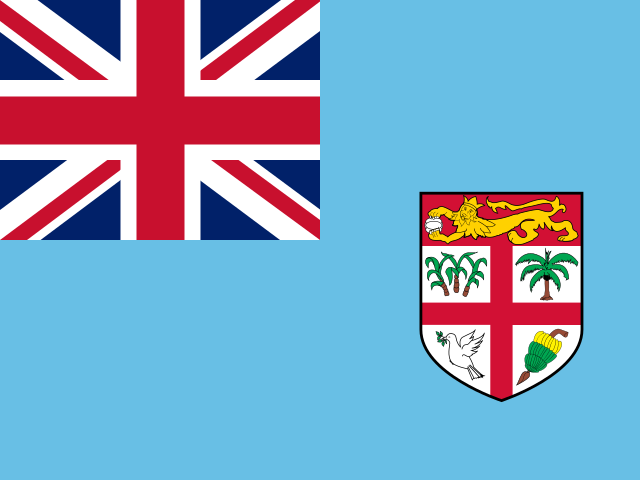
- Description: light blue with the UK flag in the upper-left quadrant and the Fijian shield centered on the right half of the flag; the shield shows a yellow lion holding a coconut above a white field quartered by the cross of Saint George; the four quarters depict sugarcane, a palm tree, a banana bunch, and a white doveMeaning: blue symbolizes the Pacific Ocean
- National symbols
- Fijian canoe
- National colours
- light blue
- National anthem
- Title: "God Bless Fiji" (Let Us Show Pride)Lyrics/music: Michael Francis Alexander PRESCOTT/C. Austin MILES (adapted by Michael Francis Alexander PRESCOTT)History: adopted 1970; known in Fijian as "Meda Dau Doka" (Let Us Show Pride); adapted from the hymn, "Dwelling in Beulah Land," the anthem's English lyrics are usually used, although they differ in meaning from the official Fijian lyrics
- UNESCO World Heritage Sites
- Total World Heritage Sites: 1 (cultural)Selected World Heritage Site locales: Levuka Historical Port Town
Economy
- Overview
- upper-middle income, tourism-based Pacific island economy; susceptible to ocean rises; key energy and infrastructure investments; post-pandemic tourism resurgence; improved debt standing; limited workforce
- GDP (PPP)
- $13.1 billion (2024 est.)
- GDP per person (PPP)
- $14,100 (2024 est.)
- GDP growth
- 3.8% (2024 est.)
- Inflation
- 4.5% (2024 est.)
- Unemployment
- 4.4% (2024 est.)
- Below poverty line
- 24.1% (2019 est.)
- Farm products
- sugarcane, cassava, taro, vegetables, chicken, coconuts, eggs, ginger, milk, sweet potatoes (2023)
- Industries
- tourism, sugar processing, clothing, copra, gold, silver, lumber
- Exports
- $2.376 billion (2022 est.)
- Main exports
- water, fish, raw sugar, refined petroleum, garments (2023)
- Export partners
- USA 32%, Australia 12%, Tonga 6%, NZ 6%, Samoa 4% (2023)
- Main imports
- refined petroleum, medical instruments, cars, broadcasting equipment, plastics (2023)
- Import partners
- Singapore 25%, China 16%, Australia 15%, NZ 14%, USA 5% (2023)
- Money sent home from abroad
- 9.2% of GDP (2023 est.)
Energy, internet and transport
- Electricity access
- Electrification - total population: 92% (2022 est.)Electrification - urban areas: 97.6%Electrification - rural areas: 86.8%
- Electricity sources
- Fossil fuels: 36.3% of total installed capacity (2023 est.)Solar: 1.1% of total installed capacity (2023 est.)Wind: 0.2% of total installed capacity (2023 est.)Hydroelectricity: 52.3% of total installed capacity (2023 est.)Biomass and waste: 10% of total installed capacity (2023 est.)
- Internet users
- Percent of population: 79% (2023 est.)
- Mobile phones
- Total subscriptions: 5.33 million (2024 est.)Subscriptions per 100 inhabitants: 574 (2024 est.)
- TV and radio
- Fiji TV, a publicly traded company, operates a free-to-air channel; Digicel Fiji operates the Sky Fiji and Sky Pacific multi-channel pay-TV services; state-owned commercial company, Fiji Broadcasting Corporation, Ltd, operates 6 radio stations, including 2 public broadcasters and 4 commercial broadcasters with multiple repeaters; 5 radio stations with repeaters operated by Communications Fiji, Ltd; transmissions of multiple international broadcasters are available
- Airports
- 26 (2025)
- Railways
- Total: 597 km (2008)Narrow gauge: 597 km (2008) 0.600-m gauge
- Merchant ships
- Total: 74 (2023)By type: general cargo 21, oil tanker 4, other 49
Military and space
- Armed forces
- Republic of Fiji Military Forces (RFMF): Land Force, Republic of Fiji Navy (2025)
- Military spending
- 1.4% of GDP (2024 est.)
- Military service
- 18-25 years of age for voluntary military service for men and women (2026)
Global issues
- Refugees and displaced people
- Refugees: 25 (2024 est.)IDPs: 259 (2024 est.)
- Phone code
- +679
- Internet domain
- .fj