Grenada
Grenada
A 1979 revolution led to a 1983 coup and US invasion.
See Grenada on the 3D globeTake a quiz
Population120 thousand
Area344 km²
CapitalSt. George's
RegionCaribbean
Did you know?
- Nutmeg appears on its flag
- Has the world's first underwater sculpture park
- Kirani James won Olympic 400 m gold in 2012
Key facts about Grenada
- Government
- Parliamentary constitutional monarchy (Commonwealth realm)
- Religion
- Christian ~95%
- Founded / independence
- 1974 (from UK)
- Rich in
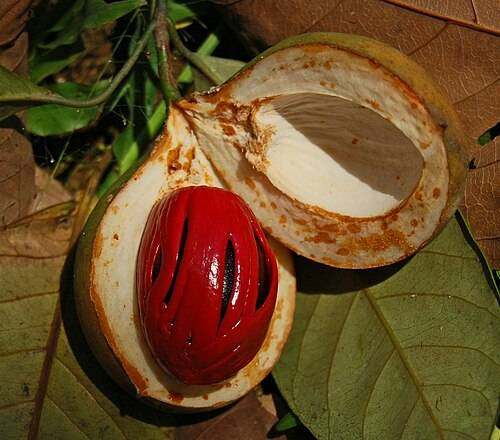
- Nutmeg ("Spice Isle"), tourism
- Languages
- English
English; Grenadian Creole - Currency
- Eastern Caribbean dollar ($)
- People are called
- Grenadian
- Main cities
- St. George's
Timeline of Grenada
- 1498Columbus sights
- 1763British rule
- 1974Independence
- 1979Revolution
- 1983US invasion
Places to see in Grenada
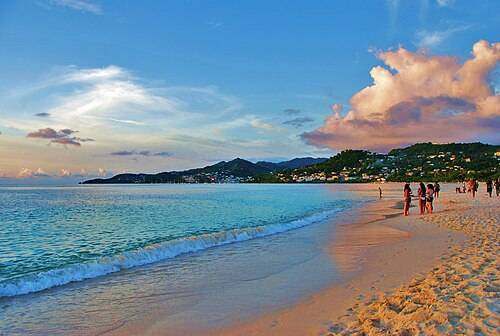
- Grand Anse Beach
- Underwater Sculpture Park
- Grand Etang Lake
- Fort George
Food and drink
Oil down (national dish) · nutmeg ice cream
Culture and famous for
"Spice Isle"; nutmeg on its flag
Popular sports
Cricket, athletics
Geography and climate
- Highest point
- Mount St Catherine, 840 m
- Rivers, lakes and seas
- Crater lakes
- Climate
- Tropical
- Coastline
- Has a sea coast
- Population density
- 349 people per km²
Wars and conflicts
- US invasion 1983
Alliances and memberships
Political unions and regional organisations
CARICOMCELACOrganization of American StatesCommonwealth of Nations
Culture, religion and history
Grenada in depth
Detailed facts from the CIA World Factbook (public domain, latest edition).
Overview
- History in brief
- The indigenous Carib people inhabited Grenada when Christopher COLUMBUS landed on the island in 1498, but it remained uncolonized for more than a century. The French settled Grenada in the 17th century, established sugar estates, and imported large numbers of African slaves. Britain took the island in 1762 and vigorously expanded sugar production. In the 19th century, cacao eventually surpassed sugar as the main export crop; in the 20th century, nutmeg became the leading export. In 1967, Britain gave Grenada autonomy over its internal affairs. Full independence was attained in 1974, making Grenada one of the smallest independent countries in the Western Hemisphere. In 1979, a leftist New Jewel Movement seized power under Maurice BISHOP, ushering in the Grenada Revolution. On 19 October 1983, factions within the revolutionary government overthrew and killed BISHOP and members of his party. Six days later, US forces and those of six other Caribbean nations intervened, quickly capturing the ringleaders and their hundreds of Cuban advisers. Rule of law was restored, and democratic elections were reinstituted the following year and have continued since.
Geography
- Location
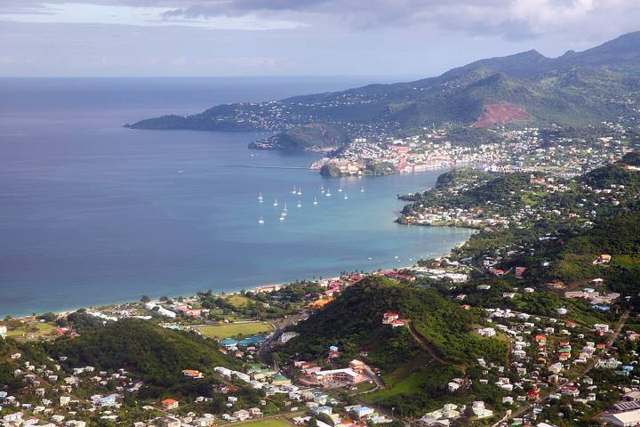
- Caribbean, island between the Caribbean Sea and Atlantic Ocean, north of Trinidad and Tobago
- Size compared
- twice the size of Washington, D.C.
- Land borders
- Total: 0 km
- Coastline
- 121 km
- Climate
- tropical; tempered by northeast trade winds
- Terrain
- volcanic in origin with central mountains
- Elevation
- Highest point: Mount Saint Catherine 840 mLowest point: Caribbean Sea 0 m
- Natural resources
- timber, tropical fruit
- Natural hazards
- lies on edge of hurricane belt; hurricane season lasts from June to NovemberVolcanism: Mount Saint Catherine (840 m) is on the island of Grenada; Kick 'em Jenny, an active submarine volcano (seamount) on the Caribbean Sea floor, lies about 8 km (5 mi) north of Grenada; these two volcanoes are at the southern end of the volcanic island arc of the Lesser Antilles that extends to the Dutch dependency of Saba in the north
- Environmental issues
- deforestation causing habitat and species loss; coastal erosion and contamination; pollution and sedimentation; inadequate solid waste management
People and society
- Population
- Total: 114,621 (2024 est.)Male: 58,168Female: 56,453
- Nationality
- Noun: Grenadian(s)Adjective: Grenadian
- Ethnic groups
- African descent 82.4%, mixed 13.3%, East Indian 2.2%, other 1.3%, unspecified 0.9% (2011 est.)
- Languages
- English (official), French patois
- Religions
- Protestant 49.2% (includes Pentecostal 17.2%, Seventh Day Adventist 13.2%, Anglican 8.5%, Baptist 3.2%, Church of God 2.4%, Evangelical 1.9%, Methodist 1.6%, other 1.2%), Roman Catholic 36%, Jehovah's Witness 1.2%, Rastafarian 1.2%, other 5.5%, none 5.7%, unspecified 1.3% (2011 est.)
- Median age
- Total: 35.9 years (2025 est.)Male: 35.2 yearsFemale: 35.7 years
- Population growth
- 0.24% (2025 est.)
- Life expectancy
- Total population: 76.3 years (2024 est.)Male: 73.7 yearsFemale: 79.1 years
- Children per woman
- 1.89 children born/woman (2025 est.)
- Urbanization
- Urban population: 37.1% of total population (2023)Rate of urbanization: 0.86% annual rate of change (2020-25 est.)
- Largest cities
- 39,000 SAINT GEORGE'S (capital) (2018)
- Years in school
- Total: 18 years (2018 est.)Male: 17 years (2018 est.)Female: 18 years (2018 est.)
Government
- Official names
- Conventional long form: noneConventional short form: GrenadaEtymology: origin of the name remains obscure; some sources attribute the designation to Spanish influence (most likely named for the Spanish city of Granada); in Spanish granada means "pomegranate"
- Government type
- parliamentary democracy under a constitutional monarchy; a Commonwealth realm
- Capital
- Name: Saint George'sGeographic coordinates: 12 03 N, 61 45 WTime difference: UTC-4 (1 hour ahead of Washington, DC, during Standard Time)Etymology: originally named Ville de Fort Royal (Fort Royal Town), the name was changed to Saint George's Town in 1764, in honor of the patron saint of England, when the English took over Grenada from the French; the name was eventually shortened to Saint George's
- Regions
- 6 parishes and 1 dependency*; Carriacou and Petite Martinique*, Saint Andrew, Saint David, Saint George, Saint John, Saint Mark, Saint Patrick
- Independence
- 7 February 1974 (from the UK)
- National holiday
- Independence Day, 7 February (1974)
- Constitution
- History: previous 1967; latest presented 19 December 1973, effective 7 February 1974, suspended 1979 following a revolution but restored in 1983Amendment process: proposed by either house of Parliament; passage requires two-thirds majority vote by the membership in both houses and assent of the governor general; passage of amendments to constitutional sections, such as personal rights and freedoms, the structure, authorities, and procedures of the branches of government, the delimitation of electoral constituencies, or the procedure for amending the constitution, also requires two-thirds majority approval in a referendum
- Legal system
- common law based on English model
- Voting age
- 18 years of age; universal
- Flag meaning
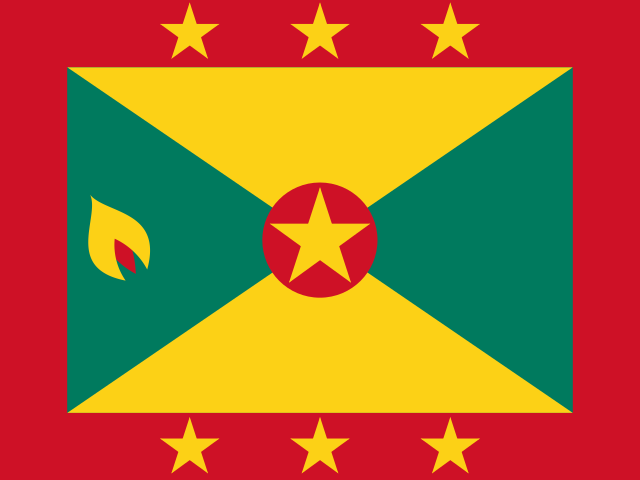
- Description: a rectangle divided diagonally into yellow triangles (top and bottom) and green triangles (left and right), with a wide red border around the flag; three five-pointed yellow stars are centered on the top and bottom of the red border, with one larger yellow star on a red disk at the center of the flag; a small yellow-and-red nutmeg pod is on the left triangleMeaning: the seven stars stand for the country's administrative divisions, with the central star symbolizing the capital, St. George's; yellow stands for the sun and the warmth of the people, green for vegetation and agriculture, and red for harmony, unity, and courage
- National symbols
- Grenada dove, bougainvillea flower
- National colours
- red, yellow, green
- National anthem
- Title: "God Save the King"Lyrics/music: unknownHistory: royal anthem, as a Commonwealth country
Economy
- Overview
- small OECS service-based economy; large tourism, construction, transportation, and education sectors; major spice exporter; shrinking but still high public debt; vulnerable to hurricanes; emerging blue economy incentives
- GDP (PPP)
- $2.08 billion (2024 est.)
- GDP per person (PPP)
- $17,700 (2024 est.)
- GDP growth
- 3.7% (2024 est.)
- Inflation
- 1.1% (2024 est.)
- Below poverty line
- 25% (2018 est.)
- Farm products
- sugarcane, coconuts, eggs, vegetables, fruits, bananas, plantains, grapefruits, avocados, mangoes/guavas (2023)
- Industries
- food and beverages, textiles, light assembly operations, tourism, construction, education, call-center operations
- Exports
- $858.949 million (2024 est.)
- Main exports
- nutmeg/cardamons, fish, wheat flours, frozen fruits and nuts, aqueous paints (2023)
- Export partners
- USA 24%, Antigua & Barbuda 13%, St. Vincent & the Grenadines 8%, Dominica 6%, Trinidad & Tobago 5% (2023)
- Main imports
- refined petroleum, cars, poultry, ships, plastic products (2023)
- Import partners
- USA 37%, Trinidad & Tobago 13%, Cayman Islands 10%, China 4%, UK 3% (2023)
- Money sent home from abroad
- 5% of GDP (2024 est.)
Energy, internet and transport
- Electricity access
- Electrification - total population: 94.2% (2022 est.)
- Electricity sources
- Fossil fuels: 98.2% of total installed capacity (2023 est.)Solar: 1.7% of total installed capacity (2023 est.)Wind: 0.1% of total installed capacity (2023 est.)
- Internet users
- Percent of population: 74% (2023 est.)
- Mobile phones
- Total subscriptions: 112,000 (2022 est.)Subscriptions per 100 inhabitants: 81 (2021 est.)
- TV and radio
- multiple publicly and privately owned TV and radio stations; state-owned Grenada Information Service (GIS) provides TV and radio; the Grenada Broadcasting Network, jointly owned by the government and the Caribbean Communications Network of Trinidad and Tobago, operates a TV station and 2 radio stations; multi-channel cable TV subscription service is provided by Columbus Communications Grenada (FLOW GRENADA); approximately 25 private radio stations (2019)
- Airports
- 2 (2025)
- Merchant ships
- Total: 6 (2023)By type: general cargo 3, other 3
Military and space
- Armed forces
- no regular military forces; the Royal Grenada Police Force (under the Ministry of National Security) includes a Coast Guard and a paramilitary Special Services Unit (2025)
Global issues
- Refugees and displaced people
- IDPs: 383 (2024 est.)
- Phone code
- +1473
- Internet domain
- .gd