Kosovo
Heartland of medieval Serbia, then Ottoman for five centuries. Repression of the Albanian majority led to war in 1998–99 and UN administration. Declared independence in 2008; recognised by about 100 countries but not Serbia.
See Kosovo on the 3D globeTake a quiz
Population1.6 million
Area10,887 km²
CapitalPristina
RegionSoutheast Europe
Did you know?
- Europe's youngest population on average
- Uses the euro without being in the eurozone
- Judoka Majlinda Kelmendi won its first Olympic gold in 2016
Key facts about Kosovo
- Government
- Parliamentary republic (partially recognised)
- Religion
- Islam ~95%
- Founded / independence
- 2008 (declared from Serbia)
- Rich in
- Lignite coal, mining, remittances
- Languages
- Albanian, Serbian
Albanian (Gheg dialect) and Serbian - Currency
- Euro (€)
- Main cities
- Pristina, Prizren, Peja, Ferizaj
Timeline of Kosovo
- 1389Battle of Kosovo
- 1455Ottoman rule
- 1912Taken by Serbia
- 1999NATO intervention and UN rule
- 2008Declares independence
Places to see in Kosovo
- Gračanica Monastery
- Prizren old town
- Rugova Canyon
- Newborn monument, Pristina
Food and drink
Flija (layered pancake) · pite · tavë
Culture and famous for
Mixed Albanian and Serbian Orthodox heritage
Popular sports
Judo, football
Geography and climate
- Highest point
- Velika Rudoka, 2,658 m
- Rivers, lakes and seas
- White Drin; Ibar
- Climate
- Continental
- Coastline
- Has a sea coast
- Population density
- 147 people per km²
Wars and conflicts
- Kosovo War 1998–99 (NATO bombing of Yugoslavia)
Empires and states that once stood here
Kingdom/SFR of Yugoslavia 1918–1992Serbia and Montenegro 1992–2006
Alliances and memberships
Political unions and regional organisations
Eurozone (uses the euro without being in the eurozone)
Kosovo in depth
Detailed facts from the CIA World Factbook (public domain, latest edition).
Overview
- History in brief
- The Ottoman Empire took control of Kosovo in 1389 after defeating Serbian forces. Large numbers of Turks and Albanians moved to the region, and by the end of the 19th century, Albanians had replaced Serbs as the majority ethnic group in Kosovo. Serbia reacquired control of Kosovo during the First Balkan War of 1912, and after World War II, Kosovo became an autonomous province of Serbia in the Socialist Federal Republic of Yugoslavia (SFRY). Increasing Albanian nationalism in the 1980s led to riots and calls for Kosovo's independence, but in 1989, Belgrade -- which has in turn served as the capital of Serbia and Yugoslavia -- revoked Kosovo's autonomous status. When the SFRY broke up in 1991, Kosovo Albanian leaders organized an independence referendum, and Belgrade's repressive response led to an insurgency. Kosovo remained part of Serbia, which joined with Montenegro to declare a new Federal Republic of Yugoslavia (FRY) in 1992.In 1998, Belgrade launched a brutal counterinsurgency campaign, with some 800,000 ethnic Albanians expelled from their homes in Kosovo. After international mediation failed, a NATO military operation began in March 1999 and forced Belgrade to withdraw its forces from Kosovo. UN Security Council Resolution 1244 (1999) placed Kosovo under the temporary control of the UN Interim Administration Mission in Kosovo (UNMIK). Negotiations in 2006-07 ended without agreement between Serbia and Kosovo, though the UN issued a comprehensive report that endorsed independence. On 17 February 2008, the Kosovo Assembly declared Kosovo independent.Serbia continues to reject Kosovo's independence, but the two countries began EU-facilitated discussions in 2013 to normalize relations, which resulted in several agreements. Additional agreements were reached in 2015 and 2023, but implementation remains incomplete. In 2022, Kosovo formally applied for membership in the EU, which is contingent on fulfillment of accession criteria, and the Council of Europe. Kosovo is also seeking UN and NATO memberships.
Geography
- Location
- Southeastern Europe, between Serbia and Macedonia
- Size compared
- slightly larger than Delaware
- Land borders
- Total: 714 kmBorder countries: Albania 112 km; North Macedonia 160 km; Montenegro 76 km; Serbia 366 km
- Coastline
- 0 km (landlocked)
- Climate
- influenced by continental air masses resulting in relatively cold winters with heavy snowfall and hot, dry summers and autumns; Mediterranean and alpine influences create regional variation; maximum rainfall between October and December
- Terrain
- flat fluvial basin at an elevation of 400-700 m above sea level surrounded by several high mountain ranges with elevations of 2,000 to 2,500 m
- Elevation
- Highest point: Gjeravica/Deravica 2,656 mLowest point: Drini i Bardhe/Beli Drim (located on the border with Albania) 297 mMean elevation: 450 m
- Natural resources
- nickel, lead, zinc, magnesium, lignite, kaolin, chrome, bauxite
- Notes
- the 41-km (25-mi) Nerodimka River divides into two branches, each of which flows into a different sea: the northern branch flows into the Sitnica River, which via the Ibar, Morava, and Danube Rivers ultimately flows into the Black Sea; the southern branch flows via the Lepenac and Vardar Rivers into the Aegean Sea
- Environmental issues
- air pollution from power plants and lignite mines; water scarcity and pollution; land degradation
People and society
- Population
- Total: 1,977,093 (2024 est.)Male: 1,017,992Female: 959,101
- Nationality
- Noun: KosovanAdjective: Kosovan
- Ethnic groups
- Albanians 92.9%, Bosniaks 1.6%, Serbs 1.5%, Turk 1.1%, Ashkali 0.9%, Egyptian 0.7%, Gorani 0.6%, Romani 0.5%, other/unspecified 0.2% (2011 est.)
- Languages
- Albanian (official) 94.5%, Bosnian 1.7%, Serbian (official) 1.6%, Turkish 1.1%, other 0.9% (includes Romani), unspecified 0.1% (2011 est.)Major-language sample(s): Libri i fakteve boterore, burimi i pazevendesueshem per informacione elementare (Albanian)Knjiga svetskih činjenica, neophodan izvor osnovnih informacija. (Serbian)The World Factbook, the indispensable source for basic information.
- Religions
- Muslim 95.6%, Roman Catholic 2.2%, Orthodox 1.5%, other 0.1%, none 0.1%, unspecified 0.6% (2011 est.)
- Median age
- Total: 32.3 years (2025 est.)Male: 31.7 yearsFemale: 32.4 years
- Population growth
- 0.73% (2025 est.)
- Life expectancy
- Total population: 73.1 years (2024 est.)Male: 71 yearsFemale: 75.5 years
- Children per woman
- 1.85 children born/woman (2025 est.)
- Largest cities
- 218,782 PRISTINA (capital) (2020)
Government
- Official names
- Conventional long form: Republic of KosovoConventional short form: KosovoLocal long form: Republika e Kosoves (Albanian)/ Republika Kosovo (Serbian)Local short form: Kosove (Albanian)/ Kosovo (Serbian)Etymology: name may derive from the Serbian word kos, meaning "blackbird," or from a personal name
- Government type
- parliamentary republic
- Capital
- Name: Pristina (Prishtine, Prishtina)Geographic coordinates: 42 40 N, 21 10 ETime difference: UTC+1 (6 hours ahead of Washington, DC, during Standard Time)Daylight saving time: +1hr, begins last Sunday in March; ends last Sunday in OctoberEtymology: the town takes its name from the river; the origin of the river's name is unclear but could come from a pre-Slavic language
- Regions
- 38 municipalities (komunat, singular - komuna (Albanian); opstine, singular - opstina (Serbian)); Decan (Decani), Dragash (Dragas), Ferizaj (Urosevac), Fushe Kosove (Kosovo Polje), Gjakove (Dakovica), Gjilan (Gnjilane), Gllogovc (Glogovac), Gracanice (Gracanica), Hani i Elezit (Deneral Jankovic), Istog (Istok), Junik, Kacanik, Kamenice (Kamenica), Kline (Klina), Kllokot (Klokot), Leposaviq (Leposavic), Lipjan (Lipljan), Malisheve (Malisevo), Mamushe (Mamusa), Mitrovice e Jugut (Juzna Mitrovica) [South Mitrovica], Mitrovice e Veriut (Severna Mitrovica) [North Mitrovica], Novoberde (Novo Brdo), Obiliq (Obilic), Partesh (Partes), Peje (Pec), Podujeve (Podujevo), Prishtine (Pristina), Prizren, Rahovec (Orahovac), Ranillug (Ranilug), Shterpce (Strpce), Shtime (Stimlje), Skenderaj (Srbica), Suhareke (Suva Reka), Viti (Vitina), Vushtrri (Vucitrn), Zubin Potok, Zvecan
- Independence
- 17 February 2008 (from Serbia)
- National holiday
- Independence Day, 17 February (2008)
- Constitution
- History: previous 1974, 1990; latest (post-independence) draft finalized 2 April 2008, signed 7 April 2008, ratified 9 April 2008, entered into force 15 June 2008Amendment process: proposed by the government, by the president of the republic, or by one fourth of Assembly deputies; passage requires two-thirds majority vote of the Assembly, including two-thirds majority vote of deputies representing non-majority communities, followed by a favorable Constitutional Court assessment
- Legal system
- civil law system
- Voting age
- 18 years of age; universal
- Flag meaning
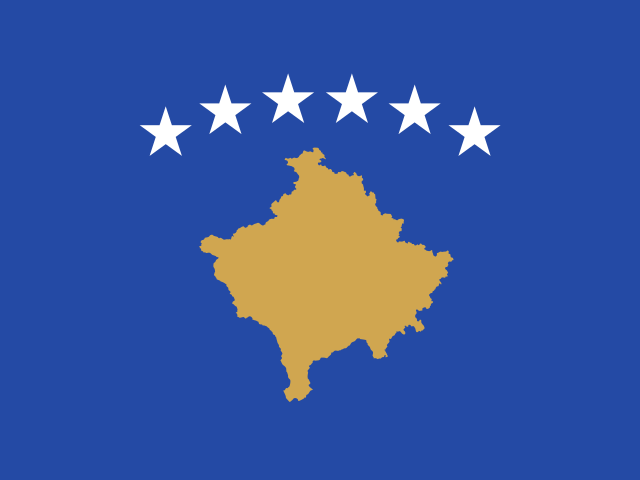
- Description: a dark blue field with a gold-colored silhouette of Kosovo in the center, with six five-pointed white stars in a slight arc over itMeaning: each star represents one of the major ethnic groups of Kosovo: Albanians, Serbs, Turks, Gorani, Roma, and Bosniaks
- National symbols
- six five-pointed white stars
- National colours
- blue, gold, white
- National anthem
- Title: "Europe"Lyrics/music: no lyrics/Mendi MENGJIQIHistory: adopted 2008; Kosovo chose not to include lyrics in its anthem to avoid offending the country's minority ethnic groups
- UNESCO World Heritage Sites
- Total World Heritage Sites: 1 (cultural)Selected World Heritage Site locales: Medieval Monuments in Kosovo
Economy
- Overview
- small-but-growing European economy; non-EU member but unilateral euro user; very high unemployment, especially youth; vulnerable reliance on diaspora tourism services, curtailed by COVID-19 disruptions; unclear public loan portfolio health
- GDP (PPP)
- $25.019 billion (2024 est.)
- GDP per person (PPP)
- $16,400 (2024 est.)
- GDP growth
- 4.4% (2024 est.)
- Inflation
- 1.6% (2024 est.)
- Below poverty line
- 17.6% (2015 est.)
- Farm products
- wheat, corn, berries, potatoes, peppers, fruit; dairy, livestock; fish
- Industries
- mineral mining, construction materials, base metals, leather, machinery, appliances, foodstuffs and beverages, textiles
- Exports
- $4.156 billion (2023 est.)
- Main exports
- mattress materials, iron alloys, metal piping, scrap iron, building plastics (2021)
- Export partners
- United States 16%, Albania 15%, North Macedonia 12%, Germany 8%, Italy 8% (2021)
- Main imports
- refined petroleum, cars, iron rods, electricity, cigars, packaged medicines (2021)
- Import partners
- Germany 13%, Turkey 13%, China 10%, Serbia 7%, Italy 6% (2021)
- Money sent home from abroad
- 17.5% of GDP (2023 est.)
Energy, internet and transport
- Electricity sources
- Fossil fuels: 87.3% of total installed capacity (2023 est.)Solar: 0.1% of total installed capacity (2023 est.)Wind: 6.3% of total installed capacity (2023 est.)Hydroelectricity: 6.2% of total installed capacity (2023 est.)
- Internet users
- Percent of population: 89% (2018 est.)
- Mobile phones
- Total subscriptions: 593,000 (2022 est.)Subscriptions per 100 inhabitants: 35 (2022 est.)
- Airports
- 2 (2025)
- Railways
- Total: 437 km (2020)
Military and space
- Armed forces
- Kosovo Security Force (KSF; Forca e Sigurisë së Kosovës or FSK): Land Force, National Guard (2025)
- Military spending
- 1.5% of GDP (2024 est.)
- Military service
- any citizen of Kosovo over the age of 18 is eligible to serve in the Kosovo Security Force; upper age for enlisting is 30 for officers, 25 for other ranks, although these may be waived for recruits with key skills considered essential for the KSF(2025)
Global issues
- Refugees and displaced people
- IDPs: 15,582 (2024 est.)