Mauritius
Republic of Mauritius · Maurice · Moris
Uninhabited until the Dutch; home of the extinct dodo. The UK agreed in 2025 to return the Chagos Islands.
See Mauritius on the 3D globeTake a quiz
Population1.3 million
Area2,040 km²
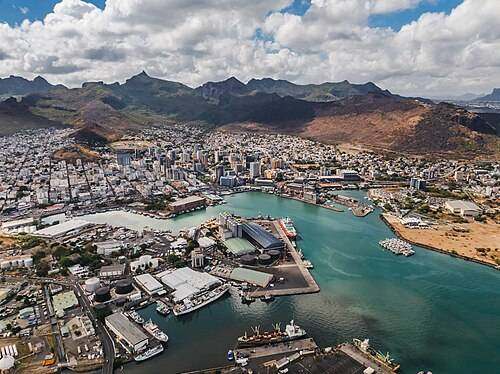
CapitalPort Louis
RegionEastern Africa
Did you know?
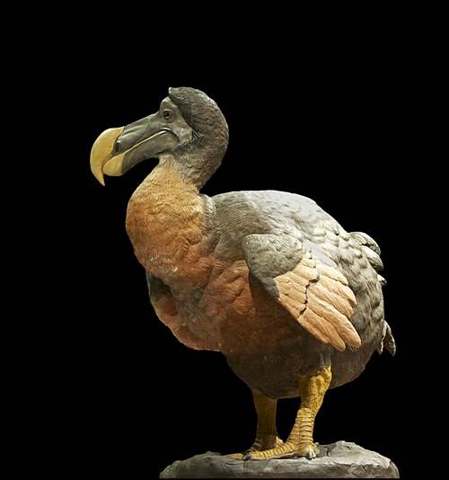
- The dodo lived only here
- Has no permanent army
- Africa's highest-ranked democracy in many indices
Key facts about Mauritius
- Government
- Parliamentary republic
- Religion
- Hindu ~48%, Christian ~32%, Islam ~17%
- Founded / independence
- 1968 (from UK)
- Rich in
- Tourism, textiles, sugar, offshore finance
- Languages
- English, French, Mauritian Creole
English; Mauritian Creole, French, Bhojpuri - Currency
- Mauritian rupee (₨)
- People are called
- Mauritian
- Main cities
- Port Louis, Beau Bassin-Rose Hill, Vacoas
Timeline of Mauritius
- 1598Dutch arrive
- 1715French colony
- 1810British rule
- 1968Independence
- 1992Republic
Places to see in Mauritius
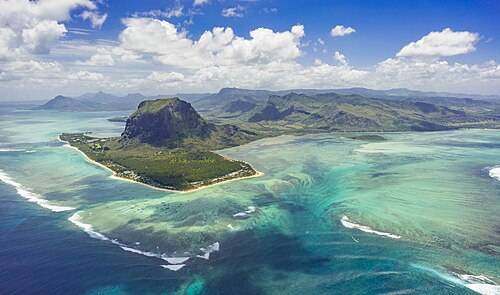
- Le Morne Brabant
- Chamarel Seven Coloured Earth
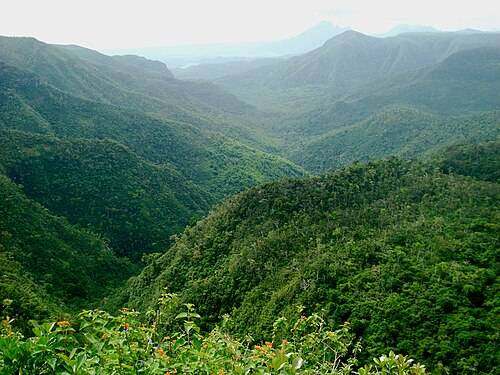
- Black River Gorges
- Pamplemousses garden
Food and drink
Dholl puri · rougaille · biryani
Culture and famous for
Sega music; the dodo (extinct)
Popular sports
Football
Geography and climate
- Highest point
- Piton de la Petite Rivière Noire, 828 m
- Rivers, lakes and seas
- Grand River South East
- Climate
- Tropical
- Coastline
- Has a sea coast
- Population density
- 637 people per km²
Wars and conflicts
- None
Alliances and memberships
Political unions and regional organisations
African UnionSADCCommonwealth of Nations
Mauritius in depth
Detailed facts from the CIA World Factbook (public domain, latest edition).
Overview
- History in brief
- Although known to Arab and European sailors since at least the early 1500s, the island of Mauritius was uninhabited until 1638 when the Dutch established a settlement named in honor of Prince Maurits van NASSAU. Their presence led to the rapid disappearance of the flightless dodo bird that has since become one of the most well-known examples of extinction in modern times. The Dutch abandoned their financially distressed settlement in 1710, although a number of formerly enslaved people remained. In 1722, the French established what would become a highly profitable settlement focused on sugar cane plantations that were reliant on the labor of enslaved people brought to Mauritius from other parts of Africa. In the 1790s, the island had a brief period of autonomous rule when plantation owners rejected French control because of laws ending slavery that were temporarily in effect during the French Revolution. Britain captured the island in 1810 as part of the Napoleonic Wars but kept most of the French administrative structure, which remains to this day in the form of the country’s legal codes and widespread use of the French Creole language. The abolition of slavery in 1835 -- later than most other British colonies -- led to increased reliance on contracted laborers from the Indian subcontinent to work on plantations. Today their descendants form the majority of the population. Mauritius remained a strategically important British naval base and later an air station, and it played a role during World War II in anti-submarine and convoy operations, as well as in the collection of signals intelligence. Mauritius gained independence from the UK in 1968 as a Parliamentary Republic and has remained a stable democracy with regular free elections and a positive human rights record. The country also attracted considerable foreign investment and now has one of Africa's highest per capita incomes. Mauritius’ often-fractious coalition politics has been dominated by two prominent families, each of which has had father-son pairs who have been prime minister over multiple, often nonconsecutive, terms. Seewoosagur RAMGOOLAM (1968-76) was Mauritius’ first prime minister, and he was succeeded by Anerood JUGNAUTH (1982-95, 2000-03, 2014-17); his son Navin RAMGOOLAM (1995-2000, 2005-14); and Paul Raymond BERENGER (2003-05), the only non-Hindu prime minister of post-independence Mauritius. In 2017, Pravind JUGNAUTH became prime minister after his father stepped down short of comple
Geography
- Location
- Southern Africa, island in the Indian Ocean, about 800 km (500 mi) east of Madagascar
- Size compared
- almost 11 times the size of Washington, D.C.
- Land borders
- Total: 0 km
- Coastline
- 177 km
- Climate
- tropical, modified by southeast trade winds; warm, dry winter (May to November); hot, wet, humid summer (November to May)
- Terrain
- small coastal plain rising to discontinuous mountains encircling central plateau
- Elevation
- Highest point: Mont Piton 828 mLowest point: Indian Ocean 0 m
- Natural resources
- arable land, fish
- Natural hazards
- cyclones (November to April); almost completely surrounded by reefs that may pose maritime hazards
- Notes
- the main island, from which the country derives its name, is of volcanic origin and is almost entirely surrounded by coral reefs; former home of the extinct dodo, a large flightless bird related to pigeons
- Environmental issues
- water pollution, degradation of coral reefs; soil erosion; wildlife preservation; solid-waste disposal
People and society
- Population
- Total: 1,311,375 (2025 est.)Male: 639,707Female: 671,668
- Nationality
- Noun: Mauritian(s)Adjective: Mauritian
- Ethnic groups
- Indo-Mauritian (compose approximately two thirds of the total population), Creole, Sino-Mauritian, Franco-Mauritian
- Languages
- Creole 86.5%, Bhojpuri 5.3%, French 4.1%, two languages 1.4%, other 2.6% (includes English, one of the two official languages of the National Assembly, which is spoken by less than 1% of the population), unspecified 0.1% (2011 est.)
- Religions
- Hindu 48.5%, Roman Catholic 26.3%, Muslim 17.3%, other Christian 6.4%, other 0.6%, none 0.7%, unspecified 0.1% (2011 est.)
- Median age
- Total: 40 years (2025 est.)Male: 38.1 yearsFemale: 41 years
- Population growth
- 0.06% (2025 est.)
- Life expectancy
- Total population: 75.4 years (2024 est.)Male: 72.6 yearsFemale: 78.4 years
- Children per woman
- 1.36 children born/woman (2025 est.)
- Urbanization
- Urban population: 40.9% of total population (2023)Rate of urbanization: 0.28% annual rate of change (2020-25 est.)
- Largest cities
- 149,000 PORT LOUIS (capital) (2018)
- Literacy
- Total population: 94.3% (2023 est.)Male: 96.3% (2023 est.)Female: 92.8% (2023 est.)
- Years in school
- Total: 14 years (2020 est.)Male: 14 years (2020 est.)Female: 15 years (2020 est.)
Government
- Official names
- Conventional long form: Republic of MauritiusConventional short form: MauritiusLocal long form: Republic of MauritiusLocal short form: MauritiusEtymology: named after Prince Maurice VAN NASSAU, stadtholder (governor) of the Dutch Republic, in 1598
- Government type
- parliamentary republic
- Capital
- Name: Port LouisGeographic coordinates: 20 09 S, 57 29 ETime difference: UTC+4 (9 hours ahead of Washington, DC, during Standard Time)Etymology: named after LOUIS XV, who was king of France in 1736 when the port became the administrative center of Mauritius
- Regions
- 9 districts and 3 dependencies*; Agalega Islands*, Black River, Cargados Carajos Shoals*, Flacq, Grand Port, Moka, Pamplemousses, Plaines Wilhems, Port Louis, Riviere du Rempart, Rodrigues*, Savanne
- Independence
- 12 March 1968 (from the UK)
- National holiday
- Independence and Republic Day, 12 March (1968, 1992)
- Constitution
- History: several previous; latest adopted 12 March 1968Amendment process: proposed by the National Assembly; passage of amendments affecting constitutional articles, including the sovereignty of the state, fundamental rights and freedoms, citizenship, or the branches of government, requires approval in a referendum by at least three-fourths majority of voters followed by a unanimous vote by the Assembly; passage of other amendments requires only two-thirds majority vote by the Assembly
- Legal system
- civil system based on French civil law with some elements of English common law
- Voting age
- 18 years of age; universal
- Flag meaning
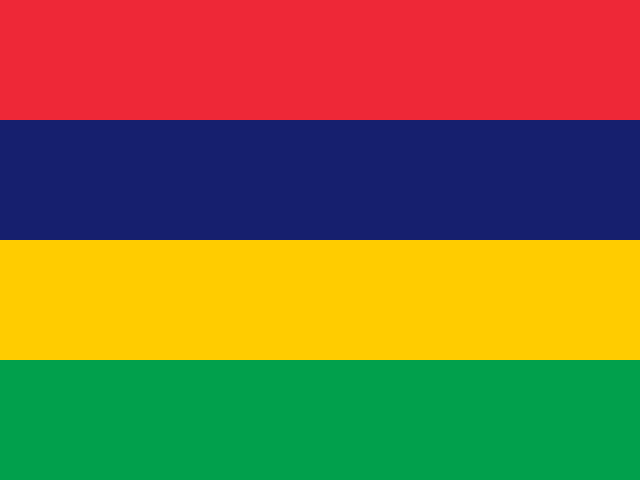
- Description: four equal horizontal bands of red (top), blue, yellow, and greenMeaning: red stands for self-determination and independence; blue for the Indian Ocean; yellow for the new light of independence, golden sunshine, or the bright future; and green for agriculture or the island's lush vegetation
- National symbols
- dodo bird, earring tree flower (Trochetia boutoniana)
- National colours
- red, blue, yellow, green
- National anthem
- Title: "Motherland"Lyrics/music: Jean Georges PROSPER/Philippe GENTILHistory: adopted 1968
- UNESCO World Heritage Sites
- Total World Heritage Sites: 2 (both cultural)Selected World Heritage Site locales: Aapravasi Ghat; Le Morne Cultural Landscape
Economy
- Overview
- upper middle-income Indian Ocean island economy; diversified portfolio; investing in maritime security; strong tourism sector decimated by COVID-19; expanding in information and financial services; environmentally fragile
- GDP (PPP)
- $34.406 billion (2024 est.)
- GDP per person (PPP)
- $27,300 (2024 est.)
- GDP growth
- 4.7% (2024 est.)
- Inflation
- 3.6% (2024 est.)
- Unemployment
- 5.5% (2024 est.)
- Below poverty line
- 10.3% (2017 est.)
- Farm products
- sugarcane, chicken, pumpkins/squash, tomatoes, eggs, potatoes, cabbages, bananas, onions, cucumbers/gherkins (2023)
- Industries
- food processing (largely sugar milling), textiles, clothing, mining, chemicals, metal products, transport equipment, nonelectrical machinery, tourism
- Exports
- $6.381 billion (2023 est.)
- Main exports
- fish, garments, raw sugar, fertilizers, diamonds (2023)
- Export partners
- USA 11%, France 11%, Zimbabwe 10%, South Africa 7%, Zambia 7% (2023)
- Main imports
- refined petroleum, cars, fish, coal, packaged medicine (2023)
- Import partners
- China 15%, UAE 11%, India 10%, South Africa 9%, France 6% (2023)
- Money sent home from abroad
- 2.2% of GDP (2023 est.)
Energy, internet and transport
- Electricity access
- Electrification - total population: 100% (2022 est.)Electrification - urban areas: 99%Electrification - rural areas: 100%
- Electricity sources
- Fossil fuels: 82.4% of total installed capacity (2023 est.)Solar: 4.6% of total installed capacity (2023 est.)Wind: 0.3% of total installed capacity (2023 est.)Hydroelectricity: 2.9% of total installed capacity (2023 est.)Biomass and waste: 9.9% of total installed capacity (2023 est.)
- Internet users
- Percent of population: 80% (2023 est.)
- Mobile phones
- Total subscriptions: 2.2 million (2024 est.)Subscriptions per 100 inhabitants: 173 (2024 est.)
- TV and radio
- the Mauritius Broadcasting Corporation (MBC) is the national public TV and radio broadcaster, with programming in French, English, Hindi, Creole, and Chinese; MBC provides 17 television channels in Mauritius; 9 FM radio stations and 2 AM radio stations (2022)
- Airports
- 5 (2025)
- Merchant ships
- Total: 32 (2023)By type: general cargo 1, oil tanker 4, other 27
Military and space
- Armed forces
- no regular military forces; the Mauritius Police Force (MPF) under the Ministry of Defense is responsible for the country's security; it includes a paramilitary unit known as the Special Mobile Force, which includes some motorized infantry and light armored units; the MPF also has a Police Helicopter Squadron, a Special Support Unit (riot police), and the National Coast Guard (2025)
Global issues
- Refugees and displaced people
- Refugees: 82 (2024 est.)IDPs: 39 (2024 est.)
- Phone code
- +230
- Internet domain
- .mu