Nauru
Republic of Nauru
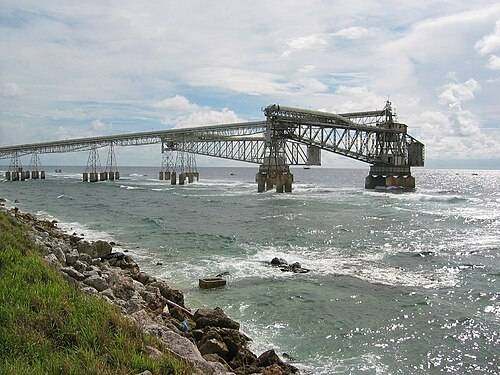
Once among the richest nations per person from phosphate mining, which stripped most of the island.
See Nauru on the 3D globeTake a quiz
Population12 thousand
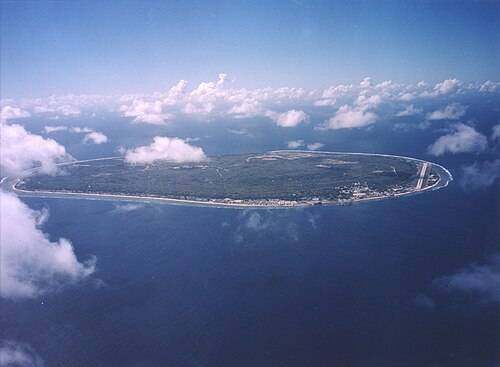
Area21 km²
CapitalYaren
RegionMicronesia
Did you know?
- The world's smallest island country (21 km²)
- Has no official capital
- Has very high obesity rates
Key facts about Nauru
- Government
- Parliamentary republic
- Religion
- Christian ~95%
- Founded / independence
- 1968 (from Australia)
- Rich in
- Phosphate (mostly exhausted), Australian detention centre
- Languages
- English, Nauru
Nauruan, English - Currency
- Australian dollar ($)
- People are called
- Nauruan
- Main cities
- Yaren (district)
Timeline of Nauru
- 1888German annexation
- 1920Australian administration
- 1968Independence
- 2001Australian detention centre opens
Places to see in Nauru
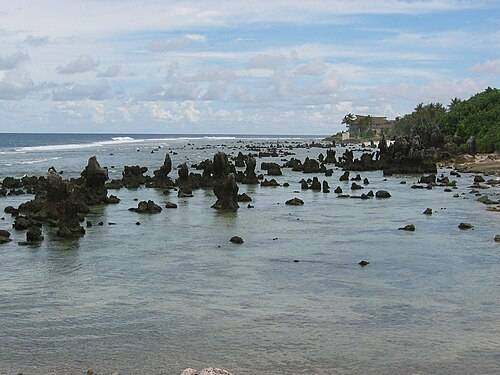
- Anibare Bay
- Command Ridge
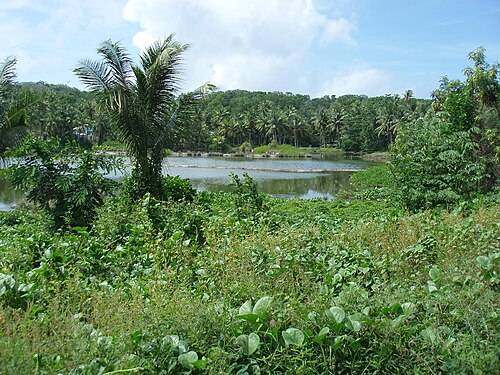
- Buada Lagoon
Food and drink
Coconut fish · Chinese-influenced dishes
Culture and famous for
Phosphate mining
Popular sports
Australian rules football, weightlifting
Geography and climate
- Highest point
- Command Ridge, 71 m
- Rivers, lakes and seas
- Buada Lagoon
- Climate
- Tropical
- Coastline
- Has a sea coast
- Population density
- 571 people per km²
Wars and conflicts
- WWII Japanese occupation
Alliances and memberships
Political unions and regional organisations
Pacific Islands ForumCommonwealth of Nations
Nauru in depth
Detailed facts from the CIA World Factbook (public domain, latest edition).
Overview
- History in brief
- By 1000 B.C., Micronesian and Polynesian settlers inhabited Nauru, and the island was divided among 12 clans. Nauru developed in relative isolation because ocean currents made landfall on the island difficult. As a result, the Nauruan language does not clearly resemble any other in the Pacific region. In 1798, a British mariner was the first European to spot the island and by 1830, European whalers used Nauru as a supply stop, trading firearms for food. A civil war in 1878 reduced the population by more than a third. Germany forcibly annexed Nauru in 1888 by holding the 12 chiefs under house arrest until they consented to the annexation. Phosphate was discovered in 1900 and was heavily mined, although Nauru and Nauruans earned about one tenth of one percent of the profits from the phosphate deposits.Australian forces captured Nauru from Germany during World War I, and in 1919, it was placed under a joint Australian-British-New Zealand mandate with Australian administration. Japan occupied Nauru during World War II and used its residents as forced labor elsewhere in the Pacific while destroying much of the infrastructure on the island. After the war, Nauru became a UN trust territory under Australian administration. In 1962, recognizing the phosphate stocks would eventually be depleted, Australian Prime Minister Robert MENZIES offered to resettle all Nauruans on Curtis Island in Queensland, but Nauruans rejected that plan and opted for independence, which was achieved in 1968. In 1970, Nauru purchased the phosphate mining assets, and income from the mines made Nauruans among the richest people in the world. However, a series of unwise investments led to near bankruptcy by 2000. Widespread phosphate mining officially ceased in 2006.As its economy faltered, Nauru briefly tried to rebrand itself as an offshore banking haven, an initiative that ended in 2005, and the country made a successful bid for Russian humanitarian aid in 2008. In 2001, Australia set up the Nauru Regional Processing Center (NRPC), an offshore refugee detention facility, paying Nauru per person at the center. The NRPC closed in 2008 but reopened in 2012. The number of refugees steadily declined after 2014, and in 2020, the remaining people were moved to Brisbane, Australia, effectively shuttering the NRPC. However, in 2023, Australia agreed to continue funding NRPC for two years and restarted settling asylees in the center in mid-2023. The center remains the Government of Nauru’s largest
Geography
- Location
- Oceania, island in the South Pacific Ocean, south of the Marshall Islands
- Size compared
- about 0.1 times the size of Washington, D.C.
- Land borders
- Total: 0 km
- Coastline
- 30 km
- Climate
- tropical with a monsoonal pattern; rainy season (November to February)
- Terrain
- sandy beach rises to fertile ring around raised coral reefs with phosphate plateau in center
- Elevation
- Highest point: Command Ridge 70 mLowest point: Pacific Ocean 0 m
- Natural resources
- phosphates, fish
- Natural hazards
- periodic droughts
- Notes
- Nauru is the third-smallest country in the world behind the Holy See (Vatican City) and Monaco; it is the smallest country in the Pacific Ocean, the smallest country outside Europe, the world's smallest island country, and the world's smallest independent republic; situated just 53 km south of the equator, Nauru is one of the three great phosphate rock islands in the Pacific Ocean -- the others are Banaba (Ocean Island) in Kiribati and Makatea in French Polynesia
- Environmental issues
- limited natural freshwater resources; effects of intensive phosphate mining that left the central 90% of Nauru a wasteland; air and water pollution from cadmium residue, phosphate dust, and other contaminants; rising sea levels
People and society
- Population
- Total: 9,930 (2025 est.)Male: 4,874Female: 5,056
- Nationality
- Noun: Nauruan(s)Adjective: Nauruan
- Ethnic groups
- Nauruan 94.6%, I-Kiribati 2.2%, Fijian 1.3%, other 1.9% (2021 est.)
- Languages
- Nauruan 93% (official, a distinct Pacific Island language), English 2% (widely understood, spoken, and used for most government and commercial purposes), other 5% (includes Gilbertese 2% and Chinese 2%) (2011 est.)
- Religions
- Protestant 60.4% (Nauruan Congregational 34.7%, Assemblies of God 11.6%, Pacific Light House 6.3%, Nauru Independent 3.6%, Baptist 1.5, Seventh Day Adventist 1.3%, other Protestant 1.4%), Roman Catholic 33.9%, other 4.2%, none 1.3%, no answer 0.3% (2021 est.)
- Median age
- Total: 28.2 years (2025 est.)Male: 27.3 yearsFemale: 28.4 years
- Population growth
- 0.37% (2025 est.)
- Life expectancy
- Total population: 68.6 years (2024 est.)Male: 65 yearsFemale: 72.3 years
- Children per woman
- 2.52 children born/woman (2025 est.)
- Urbanization
- Urban population: 100% of total population (2023)Rate of urbanization: 0.18% annual rate of change (2020-25 est.)
- Literacy
- Total population: 96.6% (2023 est.)Male: 93.4% (2023 est.)Female: 99.7% (2023 est.)
Government
- Official names
- Conventional long form: Republic of NauruConventional short form: NauruLocal long form: Republic of NauruLocal short form: NauruFormer: Pleasant IslandEtymology: the island name may derive from the Nauruan word "anaoero" meaning "I go to the beach"; the former name, Pleasant Island, came from British navigator John Frean, who visited in 1798
- Government type
- parliamentary republic
- Capital
- Name: no official capital; government offices in the Yaren DistrictTime difference: UTC+12 (17 hours ahead of Washington, DC, during Standard Time)
- Regions
- 14 districts; Aiwo, Anabar, Anetan, Anibare, Baitsi, Boe, Buada, Denigomodu, Ewa, Ijuw, Meneng, Nibok, Uaboe, Yaren
- Independence
- 31 January 1968 (from the Australia-, NZ-, and UK-administered UN trusteeship)
- National holiday
- Independence Day, 31 January (1968)
- Constitution
- History: effective 29 January 1968Amendment process: proposed by Parliament; passage requires two-thirds majority vote of Parliament; amendments to constitutional articles, such as the republican form of government, protection of fundamental rights and freedoms, the structure and authorities of the executive and legislative branches, also require two-thirds majority of votes in a referendum
- Legal system
- mixed system of common law based on the English model and customary law
- Voting age
- 20 years of age; universal and compulsory
- Flag meaning
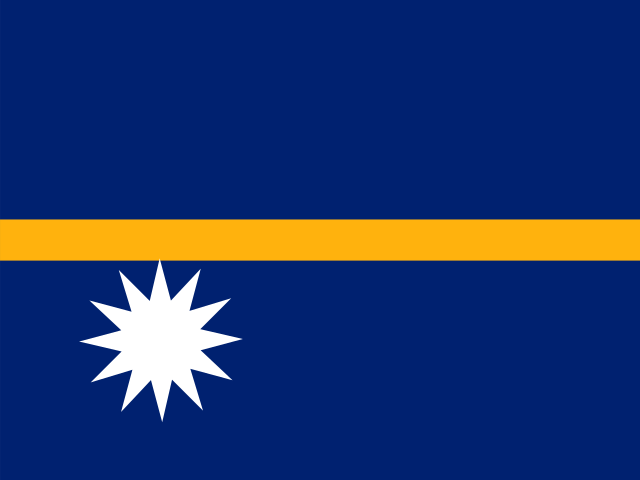
- Description: blue with a narrow horizontal gold stripe across the center and a large white 12-pointed star below the stripe on the left sideMeaning: blue stands for the Pacific Ocean; the star indicates the country's location in relation to the equator (the gold stripe), and the 12 points stand for the original tribes of Nauru; the star's white color represents phosphate, the basis of the island's wealth
- National symbols
- frigatebird, calophyllum flower
- National colours
- blue, yellow, white
- National anthem
- Title: "Nauru Bwiema" (Nauru, Our Homeland)Lyrics/music: Margaret HENDRIE/Laurence Henry HICKSHistory: adopted 1968
Economy
- Overview
- upper-middle-income Pacific island country; phosphate resource exhaustion made island interior uninhabitable; licenses fishing rights; houses Australia’s Regional Processing Centre; former tax haven; largely dependent on foreign subsidies
- GDP (PPP)
- $150.581 million (2024 est.)
- GDP per person (PPP)
- $12,600 (2024 est.)
- GDP growth
- 1.8% (2024 est.)
- Inflation
- 2.6% (2022 est.)
- Farm products
- coconuts, tropical fruits, pork, eggs, pork offal, pork fat, chicken, papayas, vegetables, cabbages (2023)
- Industries
- phosphate mining, offshore banking, coconut products
- Exports
- $64.931 million (2023 est.)
- Main exports
- fish, phosphates (2023)
- Export partners
- Thailand 78%, Philippines 11%, NZ 5%, Japan 1%, Canada 1% (2023)
- Main imports
- ships, titanium ore, refined petroleum, plastic products, other foods (2023)
- Import partners
- Australia 50%, Japan 11%, Fiji 9%, Senegal 9%, China 9% (2023)
- Money sent home from abroad
- 0.6% of GDP (2023 est.)
Energy, internet and transport
- Electricity access
- Electrification - total population: 100% (2022 est.)
- Electricity sources
- Fossil fuels: 88% of total installed capacity (2023 est.)Solar: 12% of total installed capacity (2023 est.)
- Internet users
- Percent of population: 82% (2020 est.)
- Mobile phones
- Total subscriptions: 10,300 (2022 est.)Subscriptions per 100 inhabitants: 87 (2022 est.)
- TV and radio
- 1 state-owned TV station broadcasting programs from New Zealand; 1 state-owned radio station, broadcasting on AM and FM, uses Australian and British programs (2019)
- Airports
- 1 (2025)
- Merchant ships
- Total: 6 (2023)By type: other 6
Military and space
- Armed forces
- no regular military forces; Nauru Police Force
Global issues
- Refugees and displaced people
- Refugees: 95 (2024 est.)
- Phone code
- +674
- Internet domain
- .nr