Palau
Republic of Palau · Belau
Created the world's first shark sanctuary.
See Palau on the 3D globeTake a quiz
Population20 thousand
Area459 km²
CapitalNgerulmud
RegionMicronesia
Did you know?
- Jellyfish Lake has millions of stingless jellyfish
- Created the world's first shark sanctuary (2009)
- Visitors sign an eco-pledge in their passports
Key facts about Palau
- Government
- Presidential republic (free association with US)
- Religion
- Christian ~75%, Modekngei
- Founded / independence
- 1994 (from US trust)
- Rich in
- Tourism, diving, US aid
- Languages
- English, Palauan
Palauan, English - Currency
- United States dollar ($)
- People are called
- Palauan
- Main cities
- Koror, Ngerulmud
Timeline of Palau
- 1885Spanish rule
- 1899Sold to Germany
- 1944Battle of Peleliu
- 1994Independence
Places to see in Palau
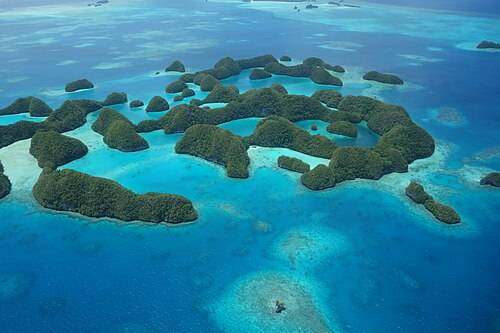
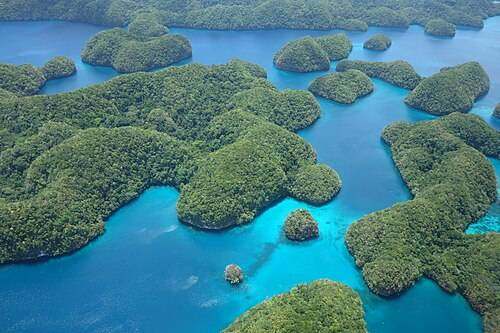
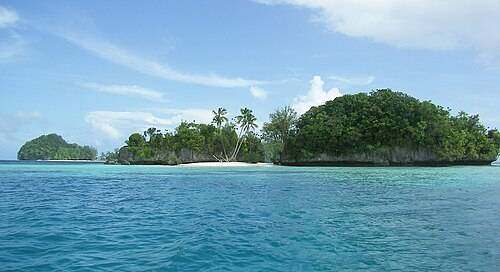
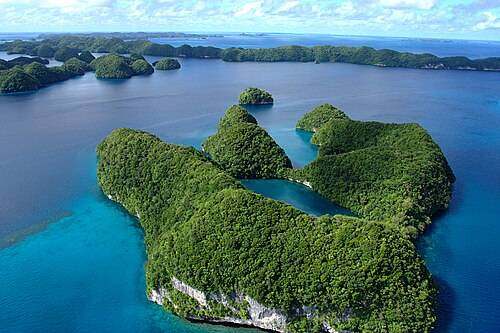
- Rock Islands
- Jellyfish Lake
- Blue Corner dive site
- Ngardmau Falls
Food and drink
Taro · fish · fruit bat soup (traditional)
Culture and famous for
Bai meeting houses; storyboards
Popular sports
Baseball
Geography and climate
- Highest point
- Mount Ngerchelchuus, 242 m
- Rivers, lakes and seas
- Over 340 islands
- Climate
- Tropical
- Coastline
- Has a sea coast
- Population density
- 44 people per km²
Wars and conflicts
- Battle of Peleliu 1944
Alliances and memberships
Political unions and regional organisations
Defence treaties
- Compact of Free Association (1986–94): The US is responsible for the defence of these three Pacific nations.
Palau in depth
Detailed facts from the CIA World Factbook (public domain, latest edition).
Overview
- History in brief
- Humans arrived in the Palauan archipelago from Southeast Asia around 1000 B.C. and developed a complex, highly organized matrilineal society where high-ranking women picked the chiefs. The islands were the westernmost part of the widely scattered Pacific islands north of New Guinea that Spanish explorers named the Caroline Islands in the 17th century. The 18th and 19th centuries saw occasional visits of whalers and traders as Spain gained some influence in the islands and administered it from the Philippines. Spain sold Palau to Germany in 1899 after losing the Philippines in the Spanish-American War.Japan seized Palau in 1914, was granted a League of Nations mandate to administer the islands in 1920, and made Koror the capital of its South Seas Mandate in 1922. By the outbreak of World War II, there were four times as many Japanese living in Koror as Palauans. In 1944, the US invasion of the island of Peleliu was one of the bloodiest island fights of the Pacific War. After the war, Palau became part of the US-administered Trust Territory of the Pacific Islands.Palau voted against joining the Federated States of Micronesia in 1978 and adopted its own constitution in 1981, which stated that Palau was a nuclear-free country. In 1982, Palau signed a Compact of Free Association (COFA) with the US, which granted Palau financial assistance and access to many US domestic programs in exchange for exclusive US military access and defense responsibilities. However, many Palauans saw the COFA as incompatible with the Palauan Constitution because of the US military’s nuclear arsenal, and seven referenda failed to achieve ratification. Following a constitutional amendment and eighth referendum in 1993, the COFA was ratified and entered into force in 1994 when the islands gained their independence. Its funding was renewed in 2010.Palau has been on the frontlines of combatting climate change and protecting marine resources. In 2011, Palau banned commercial shark fishing and created the world’s first shark sanctuary. In 2017, Palau began stamping the Palau Pledge into passports, reminding visitors to act in ecologically and culturally responsible ways. In 2020, Palau banned coral reef-toxic sunscreens and expanded its fishing prohibition to include 80% of its exclusive economic zone.
Geography
- Location
- Oceania, group of islands in the North Pacific Ocean, southeast of the Philippines
- Size compared
- slightly more than 2.5 times the size of Washington, D.C.
- Land borders
- Total: 0 km
- Coastline
- 1,519 km
- Climate
- tropical; hot and humid; wet season May to November
- Terrain
- varying topography from the high, mountainous main island of Babelthuap to low, coral islands usually fringed by large barrier reefs
- Elevation
- Highest point: Mount Ngerchelchuus 242 mLowest point: Pacific Ocean 0 m
- Natural resources
- forests, minerals (especially gold), marine products, deep-seabed minerals
- Natural hazards
- typhoons (June to December)
- Notes
- westernmost archipelago in the Caroline chain, consists of six island groups totaling more than 300 islands; includes world-famous Rock Islands
- Environmental issues
- inadequate facilities for disposal of solid waste; threats to the marine ecosystem from sand and coral dredging, illegal fishing practices, and overfishing; rising sea level; coral bleaching; drought
People and society
- Population
- Total: 21,947 (2025 est.)Male: 11,257Female: 10,690
- Nationality
- Noun: Palauan(s)Adjective: Palauan
- Ethnic groups
- Palauan (Micronesian with Malayan and Melanesian admixtures) 70.6%, Carolinian 1.2%, Asian 26.5%, other 1.7% (2020 est.)
- Languages
- Palauan (official on most islands) 65.2%, other Micronesian 1.9%, English (official) 19.1%, Filipino 9.9%, Chinese 1.2%, other 2.8% (2015 est.)
- Religions
- Roman Catholic 46.9%, Protestant 30.9% (Evangelical 24.6%, Seventh Day Adventist 5%, other Protestant 1.4%), Modekngei 5.1% (indigenous to Palau), Muslim 4.9%, other 12.3% (2020 est.)
- Median age
- Total: 35.5 years (2025 est.)Male: 34.1 yearsFemale: 37.4 years
- Population growth
- 0.38% (2025 est.)
- Life expectancy
- Total population: 75.2 years (2024 est.)Male: 72 yearsFemale: 78.5 years
- Children per woman
- 1.7 children born/woman (2025 est.)
- Urbanization
- Urban population: 82.4% of total population (2023)Rate of urbanization: 1.59% annual rate of change (2020-25 est.)
- Largest cities
- 277 NGERULMUD (capital) (2018)
- Literacy
- Total population: 100% (2020 est.)Male: 100% (2020 est.)Female: 100% (2020 est.)
- Years in school
- Total: 15 years (2023 est.)Male: 14 years (2023 est.)Female: 16 years (2023 est.)
Government
- Official names
- Conventional long form: Republic of PalauConventional short form: PalauLocal long form: Beluu er a BelauLocal short form: BelauFormer: Trust Territory of the Pacific Islands, Palau DistrictEtymology: from the Palauan name for the islands, Belau, which likely derives from the Palauan word beluu, meaning "village"
- Government type
- presidential republic in free association with the US
- Capital
- Name: NgerulmudGeographic coordinates: 7 30 N, 134 37 ETime difference: UTC+9 (14 hours ahead of Washington, DC, during Standard Time)Etymology: the name comes from a Palauan term meaning "place of fermented angelfish;" the site of the capital was the traditional location for women to gather and offer fermented angelfish to the gods
- Regions
- 16 states; Aimeliik, Airai, Angaur, Hatohobei, Kayangel, Koror, Melekeok, Ngaraard, Ngarchelong, Ngardmau, Ngatpang, Ngchesar, Ngeremlengui, Ngiwal, Peleliu, Sonsorol
- Independence
- 1 October 1994 (from the US-administered UN trusteeship)
- National holiday
- Constitution Day, 9 July (1981); Independence Day, 1 October (1994)
- Constitution
- History: ratified 9 July 1980, effective 1 January 1981Amendment process: proposed by a constitutional convention (held at least once every 15 years with voter approval), by public petition of at least 25% of eligible voters, or by a resolution adopted by at least three fourths of National Congress members; passage requires approval by a majority of votes in at least three fourths of the states in the next regular general election
- Legal system
- mixed system of civil, common, and customary law
- Voting age
- 18 years of age; universal
- Flag meaning
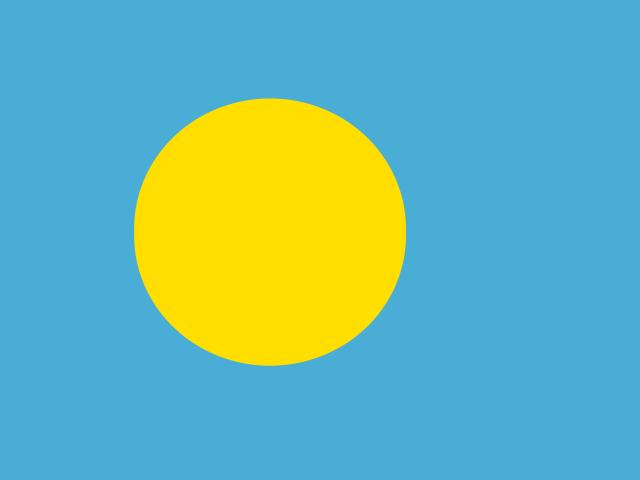
- Description: light blue with a large yellow disk to the left sideMeaning: blue stands for the ocean, and the disk for the moon, which is considered a symbol of peace, love, and tranquility
- National symbols
- bai (native meeting house)
- National colours
- blue, yellow
- National anthem
- Title: "Belau rekid" (Our Palau)Lyrics/music: multiple/Ymesei O. EZEKIELHistory: adopted 1980
- UNESCO World Heritage Sites
- Total World Heritage Sites: 1 (mixed)Selected World Heritage Site locales: Rock Islands Southern Lagoon
Economy
- Overview
- high-income Pacific island economy; environmentally fragile; subsistence agriculture and fishing industries; US aid reliance; rebounding post-pandemic tourism industry and services sector; very high living standard and low unemployment
- GDP (PPP)
- $280.025 million (2023 est.)
- GDP per person (PPP)
- $15,800 (2023 est.)
- GDP growth
- 1.9% (2023 est.)
- Inflation
- 2.2% (2024 est.)
- Farm products
- coconuts, cassava (manioc, tapioca), sweet potatoes; fish, pigs, chickens, eggs, bananas, papaya, breadfruit, calamansi, soursop, Polynesian chestnuts, Polynesian almonds, mangoes, taro, guava, beans, cucumbers, squash/pumpkins (various), eggplant, green onions, kangkong (watercress), cabbages (various), radishes, betel nuts, melons, peppers, noni, okra
- Industries
- tourism, fishing, subsistence agriculture
- Exports
- $24.48 million (2022 est.)
- Main exports
- ships, refined petroleum (2023)
- Export partners
- India 41%, Turkey 26%, Taiwan 10%, USA 9%, Japan 5% (2023)
- Main imports
- ships, refined petroleum, additive manufacturing machines, cars, plastic products (2023)
- Import partners
- Italy 32%, China 25%, USA 11%, Turkey 10%, Japan 6% (2023)
- Money sent home from abroad
- 0.7% of GDP (2023 est.)
Energy, internet and transport
- Electricity access
- Electrification - total population: 100% (2022 est.)Electrification - urban areas: 99.9%Electrification - rural areas: 100%
- Internet users
- Percent of population: 27% (2004 est.)
- Mobile phones
- Total subscriptions: 24,000 (2023 est.)Subscriptions per 100 inhabitants: 135 (2023 est.)
- TV and radio
- no broadcast TV stations; a cable TV network covers the major islands and provides access to 4 local cable stations, rebroadcasts (on a delayed basis) of a number of US stations, as well as access to a number of real-time satellite TV channels; about a half dozen radio stations (1 government-owned) (2019)
- Airports
- 3 (2025)
- Merchant ships
- Total: 427 (2023)By type: bulk carrier 49, container ship 8, general cargo 200, oil tanker 52, other 118
Military and space
- Armed forces
- no regular military forces; the Bureau of Public Safety (Ministry of Justice) has divisions for police functions and maritime security (2025)
Global issues
- Refugees and displaced people
- Refugees: 5 (2024 est.)
- Phone code
- +680
- Internet domain
- .pw