Philippines
Republic of the Philippines · Pilipinas
Spanish colony for 333 years, then American until 1946. Marcos dictatorship ended in the 1986 People Power revolution. Asia's most Catholic country.
See Philippines on the 3D globeTake a quiz
Population116 million
Area342,353 km²
CapitalManila
RegionSouth-Eastern Asia
Did you know?
- Has about 7,600 islands
- Sends texts at one of the highest rates in the world
- Its Puerto Princesa underground river is a New Wonder of Nature
Key facts about Philippines
- Government
- Presidential republic
- Religion
- Catholic ~79%, Islam ~6%, other Christian ~10%
- Founded / independence
- 1898/1946 (from Spain/USA)
- Rich in
- Electronics, business process outsourcing, remittances, nickel, coconut
- Languages
- English, Filipino
Filipino (Tagalog) and English; Cebuano, Ilocano, Hiligaynon, Bikol and over 170 languages - Currency
- Philippine peso (₱)
- People are called
- Filipino
- Main cities
- Quezon City, Manila, Davao, Cebu, Zamboanga
Timeline of Philippines
- 1521Magellan arrives
- 1565Spanish rule
- 1898Independence declared; US takes over
- 1946Independence
- 1986People Power revolution
Places to see in Philippines
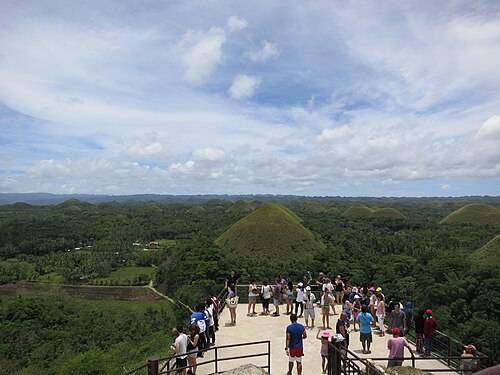
- Chocolate Hills, Bohol
- Banaue rice terraces
- Palawan's El Nido
- Intramuros, Manila
- Mayon Volcano
- Boracay
Food and drink
Adobo · lechon · sinigang · halo-halo
Culture and famous for
Jeepneys; karaoke culture; fiesta traditions
Popular sports
Basketball, boxing (Manny Pacquiao)
Geography and climate
- Highest point
- Mount Apo, 2,954 m
- Rivers, lakes and seas
- Cagayan River; Laguna de Bay
- Climate
- Tropical; typhoons
- Coastline
- Has a sea coast
- Population density
- 339 people per km²
Wars and conflicts
- Philippine Revolution
- Philippine-American War
- WWII
- Moro and communist insurgencies
- South China Sea tensions
Alliances and memberships
Political unions and regional organisations
Economy and trade
Defence treaties
- US–Philippines Mutual Defense Treaty (1951): The oldest US bilateral defence treaty in Asia.
Philippines in depth
Detailed facts from the CIA World Factbook (public domain, latest edition).
Overview
- History in brief
- The Philippine Islands became a Spanish colony during the 16th century; they were ceded to the US in 1898 following the Spanish-American War. Led by Emilio AGUINALDO, the Filipinos conducted an insurgency against US rule from 1899-1902, although some fighting continued in outlying islands as late as 1913. In 1935, the Philippines became a self-governing commonwealth. Manuel QUEZON was elected president and was tasked with preparing the country for independence after a 10-year transition. The islands fell under Japanese occupation during World War II, and US forces and Filipinos fought together during 1944-45 to regain control. On 4 July 1946 the Republic of the Philippines attained its independence.Twenty-one years of authoritarian rule under Ferdinand MARCOS ended in 1986, when a "people power" movement in Manila ("EDSA 1") forced him into exile and installed Corazon AQUINO as president. Several coup attempts hampered her presidency, and progress on political stability and economic development faltered until Fidel RAMOS was elected president in 1992. The US closed its last military bases on the islands the same year. Joseph ESTRADA was elected president in 1998. His vice-president, Gloria MACAPAGAL-ARROYO, succeded him in 2001 after ESTRADA's stormy impeachment trial on corruption charges broke down and another "people power" movement ("EDSA 2") demanded his resignation. MACAPAGAL-ARROYO was elected president in 2004. Corruption allegations marred her presidency, but the Philippine economy was one of the few to avoid contraction after the 2008 global financial crisis. Benigno AQUINO III was elected as president in 2010, followed by Rodrigo DUTERTE in 2016. During his term, DUTERTE pursued a controversial drug war that garnered international criticism for alleged human rights abuses. Ferdinand MARCOS, Jr. was elected president in 2022 with the largest popular vote in a presidential election since his father's ouster.For decades, the country has been challenged by armed ethnic separatists, communist rebels, and Islamic terrorist groups, particularly in the southern islands and remote areas of Luzon.
Geography
- Location
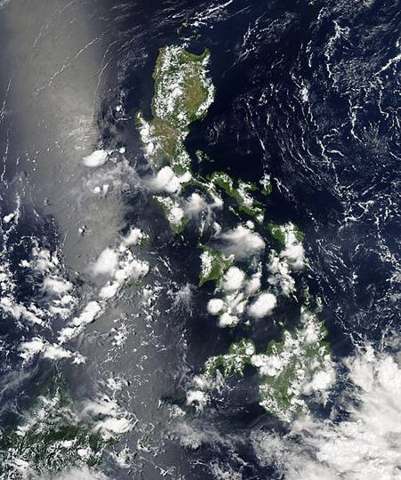
- Southeastern Asia, archipelago between the Philippine Sea and the South China Sea, east of Vietnam
- Size compared
- slightly less than twice the size of Georgia; slightly larger than Arizona
- Land borders
- Total: 0 km
- Coastline
- 36,289 km
- Climate
- tropical marine; northeast monsoon (November to April); southwest monsoon (May to October)
- Terrain
- mostly mountains with narrow to extensive coastal lowlands
- Elevation
- Highest point: Mount Apo 2,954 mLowest point: Philippine Sea 0 mMean elevation: 442 m
- Natural resources
- timber, petroleum, nickel, cobalt, silver, gold, salt, copper
- Major lakes
- Salt water lake(s): Laguna de Bay - 890 sq km
- Natural hazards
- astride typhoon belt, usually affected by several cyclonic storms each year; landslides; active volcanoes; destructive earthquakes; tsunamisVolcanism: significant volcanic activity; Taal (311 m) has been deemed a Decade Volcano by the International Association of Volcanology and Chemistry of the Earth's Interior, worthy of study due to its explosive history and close proximity to human populations; Mayon (2,462 m), the country's most active volcano, erupted in 2009 and forced over 33,000 to be evacuated; other historically active volcanoes include Biliran, Babuyan Claro, Bulusan, Camiguin, Camiguin de Babuyanes, Didicas, Iraya, Jolo, Kanlaon, Makaturing, Musuan, Parker, Pinatubo, and Ragang; see note 2 under "Geography - note"
- Notes
- Note 1: for decades, the Philippine archipelago was reported as having 7,107 islands; in 2016, the national mapping authority reported that hundreds of new islands had been discovered and increased the number of islands to 7,641, though not all of the new islands have been verifiedNote 2: the Philippines is one of the countries along the Ring of Fire, which is a belt bordering the Pacific Ocean that contains about 75% of the world's volcanoes and up to 90% of the world's earthquakesNote 3: the Philippines sits on the Pacific typhoon belt, and an average of 9 typhoons make landfall on the islands each year, with about 5 being destructive; the country is the most exposed in the world to tropical storms
- Environmental issues
- deforestation, especially in watershed areas; illegal mining and logging; soil erosion; air and water pollution in major urban centers; coral reef degradation; increasing pollution of coastal mangrove swamps; coastal erosion; dynamite fishing; wildlife extinction
People and society
- Population
- Total: 118,277,063 (2024 est.)Male: 59,227,092Female: 59,049,971
- Nationality
- Noun: Filipino(s)Adjective: Philippine
- Ethnic groups
- Tagalog 26%, Bisaya/Binisaya 14.3%, Ilocano 8%, Cebuano 8%, Illonggo 7.9%, Bikol/Bicol 6.5%, Waray 3.8%, Kapampangan 3%, Maguindanao 1.9%, Pangasinan 1.9%, other local ethnicities 18.5%, foreign ethnicities 0.2% (2020 est.)
- Languages
- Tagalog 39.9%, Bisaya/Binisaya 16%, Hiligaynon/Ilonggo 7.3%, Ilocano 7.1%, Cebuano 6.5%, Bikol/Bicol 3.9%, Waray 2.6%, Kapampangan 2.4%, Maguindanao 1.4%, Pangasinan/Panggalato 1.3%, other languages/dialects 11.2%, unspecified 0.4% (2020 est.)Major-language sample(s): Ang World Factbook, ang mapagkukunan ng kailangang impormasyon. (Tagalog)The World Factbook, the indispensable source for basic information.
- Religions
- Roman Catholic 78.8%, Muslim 6.4%, Iglesia ni Cristo 2.6%, other Christian 3.9%, other 8.2%, none/unspecified <0.1 (2020 est.)
- Median age
- Total: 27.1 years (2025 est.)Male: 25.1 yearsFemale: 26.3 years
- Population growth
- 0.74% (2025 est.)
- Life expectancy
- Total population: 70.8 years (2024 est.)Male: 67.3 yearsFemale: 74.5 years
- Children per woman
- 1.94 children born/woman (2025 est.)
- Urbanization
- Urban population: 48.3% of total population (2023)Rate of urbanization: 2.04% annual rate of change (2020-25 est.)
- Largest cities
- 14.667 million MANILA (capital), 1.949 million Davao, 1.025 million Cebu City, 931,000 Zamboanga, 960,000 Antipolo, 803,000 Cagayan de Oro City, 803,000 Dasmarinas (2023)
- Literacy
- Total population: 98.5% (2020 est.)Male: 98.4% (2020 est.)Female: 97% (2022 est.)
- Years in school
- Total: 12 years (2021 est.)Male: 12 years (2021 est.)Female: 13 years (2021 est.)
Government
- Official names
- Conventional long form: Republic of the PhilippinesConventional short form: PhilippinesLocal long form: Republika ng PilipinasLocal short form: PilipinasEtymology: named in honor of King PHILLIP II of Spain by Spanish explorer Ruy LOPEZ de VILLALOBOS, who visited the islands in 1543
- Government type
- presidential republic
- Capital
- Name: ManilaGeographic coordinates: 14 36 N, 120 58 ETime difference: UTC+8 (13 hours ahead of Washington, DC, during Standard Time)Etymology: derives from the Tagalog word may, meaning "there is," and nila, the local name for a shrub in the indigo family
- Regions
- 81 provinces and 38 chartered citiesProvinces: Abra, Agusan del Norte, Agusan del Sur, Aklan, Albay, Antique, Apayao, Aurora, Basilan, Bataan, Batanes, Batangas, Biliran, Benguet, Bohol, Bukidnon, Bulacan, Cagayan, Camarines Norte, Camarines Sur, Camiguin, Capiz, Catanduanes, Cavite, Cebu, Cotabato, Davao del Norte, Davao del Sur, Davao de Oro, Davao Occidental, Davao Oriental, Dinagat Islands, Eastern Samar, Guimaras, Ifugao, Ilocos Norte, Ilocos Sur, Iloilo, Isabela, Kalinga, Laguna, Lanao del Norte, Lanao del Sur, La Union, Leyte, Maguindanao, Marinduque, Masbate, Mindoro Occidental, Mindoro Oriental, Misamis Occidental, Misamis Oriental, Mountain, Negros Occidental, Negros Oriental, Northern Samar, Nueva Ecija, Nueva Vizcaya, Palawan, Pampanga, Pangasinan, Quezon, Quirino, Rizal, Romblon, Samar, Sarangani, Siquijor, Sorsogon, South Cotabato, Southern Leyte, Sultan Kudarat, Sulu, Surigao del Norte, Surigao del Sur, Tarlac, Tawi-Tawi, Zambales, Zamboanga del Norte, Zamboanga del Sur, Zamboanga SibugayChartered cities: Angeles, Bacolod, Baguio, Butuan, Cagayan de Oro, Caloocan, Cebu, Cotabato, Dagupan, Davao, General Santos, Iligan, Iloilo, Lapu-Lapu, Las Pinas, Lucena, Makati, Malabon, Mandaluyong, Mandaue, Manila, Marikina, Muntinlupa, Naga, Navotas, Olongapo, Ormoc, Paranaque, Pasay, Pasig, Puerto Princesa, Quezon, San Juan, Santiago, Tacloban, Taguig, Valenzuela, Zamboanga
- Independence
- 4 July 1946 (from the US)
- National holiday
- Independence Day, 12 June (1898)
- Constitution
- History: several previous; latest ratified 2 February 1987, effective 11 February 1987Amendment process: proposed by Congress if supported by three fourths of the membership, by a constitutional convention called by Congress, or by public petition; passage by either of the three proposal methods requires a majority vote in a national referendum
- Legal system
- mixed system of civil, common, Islamic (sharia), and customary law
- Voting age
- 18 years of age; universal
- Flag meaning
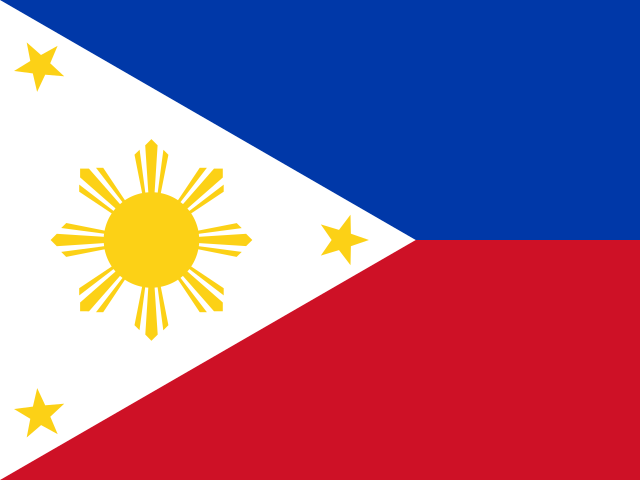
- Description: two equal horizontal bands of blue (top) and red; a white equilateral triangle is based on the left side; the center of the triangle has a yellow sun with eight rays, each split into smaller rays; the triangle's corners each have a small five-pointed yellow starMeaning: blue stands for peace and justice, red for courage, and the triangle for equality; the rays represent the first eight provinces that sought independence from Spain, and the stars represent the country's three parts: Luzon, Visayas, and MindanaoHistory: the design dates to 1897
- National symbols
- three stars and sun, Philippine eagle
- National colours
- red, white, blue, yellow
- National anthem
- Title: "Lupang Hinirang" (Chosen Land)Lyrics/music: collectively/Julian FELIPEHistory: music adopted 1898 and lyrics adopted 1956; only sung in Tagalog
- UNESCO World Heritage Sites
- Total World Heritage Sites: 6 (3 cultural, 3 natural)Selected World Heritage Site locales: Baroque Churches of the Philippines (c); Tubbataha Reefs Natural Park (n); Rice Terraces of the Philippine Cordilleras (c); Historic Vigan (c); Puerto-Princesa Subterranean River National Park (n); Mount Hamiguitan Range Wildlife Sanctuary (n)
Economy
- Overview
- growing Southeast Asian economy; commercial rebound led by transportation, construction and financial services; electronics exports recovering from sector slowdown; significant remittances; interest rate rises following heightened inflation; uncertainties due to increased regional tensions with China
- GDP (PPP)
- $1.202 trillion (2024 est.)
- GDP per person (PPP)
- $10,400 (2024 est.)
- GDP growth
- 5.7% (2024 est.)
- Inflation
- 3.2% (2024 est.)
- Unemployment
- 2.2% (2024 est.)
- Below poverty line
- 15.5% (2023 est.)
- Farm products
- sugarcane, rice, coconuts, maize, bananas, vegetables, tropical fruits, plantains, pineapples, cassava (2023)
- Industries
- semiconductors and electronics assembly, business process outsourcing, food and beverage manufacturing, construction, electric/gas/water supply, chemical products, radio/television/communications equipment and apparatus, petroleum and fuel, textile and garments, non-metallic minerals, basic metal industries, transport equipment
- Exports
- $106.99 billion (2024 est.)
- Main exports
- integrated circuits, machine parts, gold, insulated wire, semiconductors (2023)
- Export partners
- China 19%, USA 13%, Hong Kong 12%, Japan 11%, Germany 5% (2023)
- Main imports
- integrated circuits, refined petroleum, cars, crude petroleum, coal (2023)
- Import partners
- China 25%, Indonesia 8%, Japan 8%, S. Korea 6%, USA 6% (2023)
- Money sent home from abroad
- 8.7% of GDP (2024 est.)
Energy, internet and transport
- Electricity access
- Electrification - total population: 94.8% (2022 est.)Electrification - urban areas: 98%Electrification - rural areas: 91.1%
- Electricity sources
- Fossil fuels: 77.9% of total installed capacity (2023 est.)Solar: 1.6% of total installed capacity (2023 est.)Wind: 0.9% of total installed capacity (2023 est.)Hydroelectricity: 9% of total installed capacity (2023 est.)Geothermal: 9.3% of total installed capacity (2023 est.)Biomass and waste: 1.2% of total installed capacity (2023 est.)
- Internet users
- Percent of population: 84% (2023 est.)
- Mobile phones
- Total subscriptions: 135 million (2023 est.)Subscriptions per 100 inhabitants: 144 (2022 est.)
- TV and radio
- multiple national private TV and radio networks; multi-channel satellite and cable TV systems available; more than 400 TV stations; about 1,500 cable TV providers with more than 2 million subscribers; over 1,400 radio stations; was scheduled to move to digital by the end of 2023 (2019)
- Airports
- 256 (2025)
- Railways
- Total: 77 km (2017)Standard gauge: 49 km (2017) 1.435-m gaugeNarrow gauge: 28 km (2017) 1.067-m gauge
- Merchant ships
- Total: 2,203 (2023)By type: bulk carrier 52, container ship 43, general cargo 955, oil tanker 207, other 946
Military and space
- Armed forces
- Armed Forces of the Philippines (AFP): Army, Navy (includes Marine Corps), Air ForceDepartment of Transportation: Philippine Coast Guard (PCG); Department of the Interior: Philippine National Police Force (PNP) (2025)
- Military spending
- 1.7% of GDP (2024 est.)
- Military service
- some variations in age based on the branch of service, but generally 18-27 years of age for voluntary military service for men and women; no conscription (2025)
- Space programme
- has a small space program focused on acquiring satellites and related technologies, largely for climate studies, national security, and risk management; also prioritizing development of space expertise and industry; manufactures and operates satellites (mostly micro- and nano-sized), including remote sensing and scientific/experimental; has relations with a variety of foreign space agencies and industries, including those of China, the ESA (and some of its member states), India, Japan, Russia, and the US (2025)
- Space milestones
- 1994 - formed a consortium of companies to acquire and operate satellites1996 - acquired first communications satellite (Agila-1) from Indonesia after it was already in orbit2014 - initiated a scientific remote sensing (RS) microsatellite development program in collaboration with Japan, resulting in first RS microsatellite (Diwata-1) being deployed from the International Space Station (ISS) in 20162018 - first domestically designed and built scientific/technology-demonstrator cube satellite (Maya-1) deployed from ISS; second RS microsatellite (Diwata-2) developed with assistance from and launched by Japan2023 - signed agreement with the ESA and EU to expand cooperation on Earth observation/RS data sharing2025 - signed US-led Artemis Accords for space exploration
Global issues
- Refugees and displaced people
- Refugees: 2,342 (2024 est.)IDPs: 1,158,643 (2024 est.)Stateless persons: 30 (2024 est.)
- Phone code
- +63
- Internet domain
- .ph