Qatar
State of Qatar · قطر
Pearl-diving peninsula ruled by the Al Thani family since the 19th century. Gas made it one of the world's richest countries per person; a key mediator in Gaza and Iran talks.
See Qatar on the 3D globeTake a quiz
Population3 million
Area11,586 km²
CapitalDoha
RegionWestern Asia
Did you know?
- First Middle East country to host a football World Cup
- Has one of the world's highest incomes per person
- Only about 10% of residents are citizens
Key facts about Qatar
- Government
- Absolute monarchy (emirate)
- Religion
- Islam ~65%, many migrant Christians and Hindus
- Founded / independence
- 1971 (from UK)
- Rich in
- Liquefied natural gas, Al Jazeera, sovereign fund; hosted 2022 World Cup
- Languages
- Arabic
Arabic (Gulf dialect), English - Currency
- Qatari riyal (ر.ق)
- People are called
- Qatari
- Main cities
- Doha, Al Rayyan, Al Wakrah
Timeline of Qatar
- 1868Al Thani rule recognised
- 1916British protectorate
- 1940Oil found
- 1971Independence
- 2022Hosts World Cup
Places to see in Qatar
- Museum of Islamic Art
- National Museum (desert rose shape)
- Souq Waqif
- the Pearl
- Khor Al Adaid inland sea
Food and drink
Machboos · harees · luqaimat
Culture and famous for
Al Jazeera; 2022 FIFA World Cup
Popular sports
Football, athletics, falconry
Geography and climate
- Highest point
- Qurayn Abu al Bawl, 103 m
- Rivers, lakes and seas
- No rivers
- Climate
- Hot desert
- Coastline
- Has a sea coast
- Population density
- 259 people per km²
Wars and conflicts
- 2017–21 Gulf blockade
- Iranian missile strike 2025
Alliances and memberships
Political unions and regional organisations
Arab LeagueGulf Cooperation CouncilOrganisation of Islamic Cooperation
Qatar in depth
Detailed facts from the CIA World Factbook (public domain, latest edition).
Overview
- History in brief
- Ruled by the Al Thani family since the mid-1800s, Qatar within the last 60 years transformed itself from a poor British protectorate noted mainly for pearling into an independent state with significant hydrocarbon revenues. Former Amir HAMAD bin Khalifa Al Thani, who overthrew his father in a bloodless coup in 1995, ushered in wide-sweeping political and media reforms, unprecedented economic investment, and a growing Qatari regional leadership role, in part through the creation of the pan-Arab satellite news network Al-Jazeera and Qatar's mediation of some regional conflicts. In the 2000s, Qatar resolved its longstanding border disputes with both Bahrain and Saudi Arabia, and by 2007, Doha had attained the highest per capita income in the world. Qatar did not experience domestic unrest or violence like that seen in other Near Eastern and North African countries in 2011, due in part to its immense wealth and patronage network. In mid-2013, HAMAD peacefully abdicated, transferring power to his son, the current Amir TAMIM bin Hamad. TAMIM is popular with the Qatari public for his role in shepherding the country through an economic embargo from some other regional countries, for his efforts to improve the country's healthcare and education systems, and for his expansion of the country's infrastructure in anticipation of hosting international sporting events. Qatar became the first country in the Arab world to host the FIFA Men’s World Cup in 2022. Following the outbreak of regional unrest in 2011, Doha prided itself on its support for many popular revolutions, particularly in Libya and Syria. This stance was to the detriment of Qatar’s relations with Bahrain, Egypt, Saudi Arabia, and the United Arab Emirates (UAE), which temporarily recalled their respective ambassadors from Doha in 2014. TAMIM later oversaw a warming of Qatar’s relations with Bahrain, Egypt, Saudi Arabia, and the UAE in November 2014 following Kuwaiti mediation and signing of the Riyadh Agreement. This reconciliation, however, was short-lived. In 2017, Bahrain, Egypt, Saudi Arabia, and the UAE (the "Quartet") cut diplomatic and economic ties with Qatar in response to alleged violations of the agreement, among other complaints. They restored ties in 2021 after signing a declaration at the Gulf Cooperation Council Summit in Al Ula, Saudi Arabia. In 2022, the United States designated Qatar as a major non-NATO ally.
Geography
- Location
- Middle East, peninsula bordering the Persian Gulf and Saudi Arabia
- Size compared
- almost twice the size of Delaware; slightly smaller than Connecticut
- Land borders
- Total: 87 kmBorder countries: Saudi Arabia 87 km
- Coastline
- 563 km
- Climate
- arid; mild, pleasant winters; very hot, humid summers
- Terrain
- mostly flat and barren desert
- Elevation
- Highest point: Tuwayyir al Hamir 103 mLowest point: Persian Gulf 0 mMean elevation: 28 m
- Natural resources
- petroleum, fish, natural gas
- Natural hazards
- haze, dust storms, sandstorms common
- Notes
- the peninsula occupies a strategic location in the central Persian Gulf near major petroleum deposits
- Environmental issues
- air, land, and water pollution; limited natural freshwater resources; limited conservation of oil and wildlife
People and society
- Population
- Total: 2,568,426 (2025 est.)Male: 1,970,605Female: 597,821
- Nationality
- Noun: Qatari(s)Adjective: Qatari
- Ethnic groups
- non-Qatari 88.4%, Qatari 11.6% (2015 est.)
- Languages
- Arabic (official), English commonly used as a second languageMajor-language sample(s): كتاب حقائق العالم، المصدر الذي لا يمكن الاستغناء عنه للمعلومات الأساسية (Arabic)The World Factbook, the indispensable source for basic information.
- Religions
- Muslim 65.2%, Christian 13.7%, Hindu 15.9%, Buddhist 3.8%, folk religion <0.1%, Jewish <0.1%, other <1%, unaffiliated <1% (2020 est.)
- Median age
- Total: 34.4 years (2025 est.)Male: 35.7 yearsFemale: 28.1 years
- Population growth
- 0.57% (2025 est.)
- Life expectancy
- Total population: 80.3 years (2024 est.)Male: 78.2 yearsFemale: 82.4 years
- Children per woman
- 1.9 children born/woman (2025 est.)
- Urbanization
- Urban population: 99.4% of total population (2023)Rate of urbanization: 1.66% annual rate of change (2020-25 est.)
- Largest cities
- 798,000 Ar-Rayyan, 658,000 DOHA (capital) (2023)
- Years in school
- Total: 13 years (2022 est.)Male: 12 years (2022 est.)Female: 15 years (2022 est.)
Government
- Official names
- Conventional long form: State of QatarConventional short form: QatarLocal long form: Dawlat QatarLocal short form: QatarEtymology: the name may derive from the Arabic word katran, meaning "tar" or "resin" in reference to the area's oil and natural gas reserves
- Government type
- absolute monarchy
- Capital
- Name: DohaGeographic coordinates: 25 17 N, 51 32 ETime difference: UTC+3 (8 hours ahead of Washington, DC, during Standard Time)Etymology: the name is derived from the Arabic ad-dawha, meaning "the big tree," and probably referred to a large tree at the site of the original fishing village
- Regions
- 8 municipalities (baladiyat, singular - baladiyah); Ad Dawhah, Al Khawr wa adh Dhakhirah, Al Wakrah, Ar Rayyan, Ash Shamal, Ash Shihaniyah, Az Za'ayin, Umm Salal
- Independence
- 3 September 1971 (from the UK)
- National holiday
- National Day, 18 December (1878), anniversary of Al Thani family accession to the throne; Independence Day, 3 September (1971)
- Constitution
- History: previous 1972 (provisional); latest drafted 2 July 2002, approved by referendum 29 April 2003, endorsed 8 June 2004, effective 9 June 2005Amendment process: proposed by the Amir or by one third of Advisory Council members; passage requires two-thirds majority vote of Advisory Council members and approval and promulgation by the emir; articles pertaining to the rule of state and its inheritance, functions of the emir, and citizen rights and liberties cannot be amended
- Legal system
- mixed system of civil law and Islamic (sharia) law (in family and personal matters)
- Voting age
- 18 years of age; universal
- Flag meaning
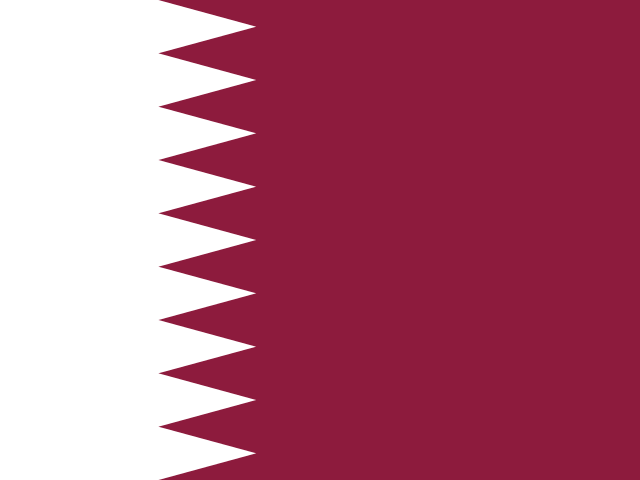
- Description: maroon with a broad, serrated white band on the left sideMeaning: maroon stands for the blood shed in Qatari wars, and white for peace; the nine-pointed serrated edge is a reference to Qatar's status as the ninth member of the "reconciled emirates" after the Qatari-British treaty of 1916 -- the other eight members are Bahrain and the seven that make up the UAE
- National symbols
- a white serrated band with nine white points on top of a maroon field
- National colours
- maroon, white
- National anthem
- Title: "Al-Salam Al-Amiri" (Peace be to the Emir)Lyrics/music: Sheikh MUBARAK bin Saif al-Thani/Abdul Aziz Nasser OBAIDANHistory: adopted 1996
- UNESCO World Heritage Sites
- Total World Heritage Sites: 1 (cultural)Selected World Heritage Site locales: Al Zubarah Archaeological Site
Economy
- Overview
- high-income, oil-and-gas-based Middle Eastern economy; implementing “National Vision 2030” government strategy for economic development, diversification, and favorable business conditions to boost investment and employment; expansion of LNG sector expected to boost growth; Islamic finance leader
- GDP (PPP)
- $317.064 billion (2024 est.)
- GDP per person (PPP)
- $110,900 (2024 est.)
- GDP growth
- 2.8% (2024 est.)
- Inflation
- 1.3% (2024 est.)
- Unemployment
- 0.2% (2024 est.)
- Farm products
- dates, chicken, tomatoes, camel milk, vegetables, cucumbers/gherkins, pumpkins/squash, eggs, sheep milk, eggplants (2023)
- Industries
- liquefied natural gas, crude oil production and refining, ammonia, fertilizer, petrochemicals, steel reinforcing bars, cement, commercial ship repair
- Exports
- $125.216 billion (2024 est.)
- Main exports
- natural gas, crude petroleum, refined petroleum, plastics, fertilizers (2023)
- Export partners
- China 18%, India 11%, S. Korea 10%, Japan 7%, Pakistan 6% (2023)
- Main imports
- gas turbines, cars, aircraft, iron pipes, ships (2023)
- Import partners
- USA 12%, China 12%, UAE 9%, UK 7%, India 5% (2023)
- Money sent home from abroad
- 0.7% of GDP (2024 est.)
Energy, internet and transport
- Electricity access
- Electrification - total population: 100% (2022 est.)
- Electricity sources
- Fossil fuels: 99.7% of total installed capacity (2023 est.)Biomass and waste: 0.2% of total installed capacity (2023 est.)
- Internet users
- Percent of population: 100% (2023 est.)
- Mobile phones
- Total subscriptions: 4.68 million (2024 est.)Subscriptions per 100 inhabitants: 154 (2024 est.)
- TV and radio
- state-controlled TV and radio licensing and access to local media markets; home of satellite TV channel Al-Jazeera, which was originally state-owned but is now independent; local radio includes state, private, and international broadcasters on FM frequencies; satellite TV available (2019)
- Airports
- 8 (2025)
- Merchant ships
- Total: 123 (2023)By type: bulk carrier 5, container ship 4, general cargo 4, oil tanker 2, other 108
Military and space
- Armed forces
- Qatar Armed Forces (QAF): Qatari Amiri Land Force (QALF, includes Emiri Guard), Qatari Amiri Navy (QAN, includes Coast Guard), Qatari Amiri Air Force (QAAF)Ministry of Interior: General Directorate of Public Security, General Directorate of Coasts and Border Security, Internal Security Force (ISF or Lekhwiya) (2025)
- Military spending
- 5% of GDP (2023 est.)
- Military service
- typically 18-30 for voluntary service for men and women; compulsory military service for men 18-35; compulsory service is from 4-12 months, depending on educational and professional circumstances (2025)
Global issues
- Refugees and displaced people
- Refugees: 349 (2024 est.)Stateless persons: 1,200 (2024 est.)
Neighbouring countries
- Phone code
- +974
- Internet domain
- .qa