Saint Kitts and Nevis
Federation of Saint Christopher and Nevis
The first English Caribbean colony (1623). The Western Hemisphere's smallest country.
See Saint Kitts and Nevis on the 3D globeTake a quiz
Population50 thousand
Area261 km²
CapitalBasseterre
RegionCaribbean
Did you know?
- The smallest country in the Americas
- Alexander Hamilton was born on Nevis
- Brimstone Hill Fortress is a UNESCO World Heritage Site
Key facts about Saint Kitts and Nevis
- Government
- Parliamentary constitutional monarchy (Commonwealth realm)
- Religion
- Christian ~95%
- Founded / independence
- 1983 (from UK)
- Rich in
- Tourism, citizenship sales
- Languages
- English
English; Kittitian Creole - Currency
- Eastern Caribbean dollar ($)
- People are called
- Kittitian or Nevisian
- Main cities
- Basseterre, Charlestown
Timeline of Saint Kitts and Nevis
- 1623First English Caribbean colony
- 1834Emancipation
- 1983Independence
Places to see in Saint Kitts and Nevis
- Brimstone Hill Fortress
- Nevis Peak
- Pinney's Beach
- St Kitts Scenic Railway
Food and drink
Stewed saltfish with spicy plantains
Culture and famous for
Birthplace of Alexander Hamilton (Nevis)
Popular sports
Cricket, football
Geography and climate
- Highest point
- Mount Liamuiga, 1,156 m
- Rivers, lakes and seas
- No rivers
- Climate
- Tropical
- Coastline
- Has a sea coast
- Population density
- 192 people per km²
Wars and conflicts
- None
Alliances and memberships
Political unions and regional organisations
CARICOMCELACOrganization of American StatesCommonwealth of Nations
Culture, religion and history
Saint Kitts and Nevis in depth
Detailed facts from the CIA World Factbook (public domain, latest edition).
Overview
- History in brief
- Carib Indians occupied the islands of the West Indies for hundreds of years before the British and French began settlement in 1623. During the 17th century, Saint Kitts became the premier base for British and French expansion into the Caribbean. The French ceded the territory to the UK in 1713. At the turn of the 18th century, Saint Kitts was the richest British Crown Colony per capita in the Caribbean, a result of the sugar trade. Although small in size and separated by only 3 km (2 mi) of water, Saint Kitts and Nevis were viewed and governed as different states until the late-19th century, when the British forcibly unified them along with the island of Anguilla. In 1967, the island territory of Saint Christopher-Nevis-Anguilla became an associated state of the UK with full internal autonomy. The island of Anguilla rebelled and was allowed to secede in 1971. The remaining islands achieved independence in 1983 as Saint Kitts and Nevis. In 1998, a referendum on Nevis to separate from Saint Kitts fell short of the necessary two-thirds majority.
Geography
- Location
- Caribbean, islands in the Caribbean Sea, about one-third of the way from Puerto Rico to Trinidad and Tobago
- Size compared
- 1.5 times the size of Washington, D.C.
- Land borders
- Total: 0 km
- Coastline
- 135 km
- Climate
- tropical, tempered by constant sea breezes; little seasonal temperature variation; rainy season (May to November)
- Terrain
- volcanic with mountainous interiors
- Elevation
- Highest point: Mount Liamuiga 1,156 mLowest point: Caribbean Sea 0 m
- Natural resources
- arable land
- Natural hazards
- hurricanes (July to October)Volcanism: Mount Liamuiga (1,156 m) on Saint Kitts and Nevis Peak (985 m) on Nevis are part of the volcanic-island arc of the Lesser Antilles, which extends from Saba in the north to Grenada in the south
- Notes
- smallest country in the Western Hemisphere in terms of both area and population; the two volcanic islands are separated by a 3-km-wide (9-mi-wide) channel called The Narrows; on the southern tip of baseball-bat-shaped Saint Kitts lies the Great Salt Pond; Nevis Peak sits in the center of its ball-shaped namesake island
- Environmental issues
- deforestation; soil erosion and silting affects marine life on coral reefs; water pollution from uncontrolled dumping of sewage
People and society
- Population
- Total: 55,434 (2025 est.)Male: 27,748Female: 27,686
- Nationality
- Noun: Kittitian(s), Nevisian(s)Adjective: Kittitian, Nevisian
- Ethnic groups
- African descent 92.5%, mixed 3%, White 2.1%, East Indian 1.5%, other 0.6%, unspecified 0.3% (2001 est.)
- Languages
- English (official)
- Median age
- Total: 39.1 years (2025 est.)Male: 38.8 yearsFemale: 38.3 years
- Population growth
- 0.53% (2025 est.)
- Life expectancy
- Total population: 77.6 years (2024 est.)Male: 75.2 yearsFemale: 80.1 years
- Children per woman
- 1.76 children born/woman (2025 est.)
- Urbanization
- Urban population: 31.1% of total population (2023)Rate of urbanization: 1.06% annual rate of change (2020-25 est.)
- Largest cities
- 14,000 BASSETERRE (capital) (2018)
- Years in school
- Total: 19 years (2015 est.)Male: 18 years (2015 est.)Female: 20 years (2015 est.)
Government
- Official names
- Conventional long form: Federation of Saint Kitts and NevisConventional short form: Saint Kitts and NevisFormer: Federation of Saint Christopher and NevisEtymology: explorer Christopher COLUMBUS visited the islands in 1493 and named one for his own patron saint; a common nickname for Christopher during the following centuries was Kit or Kitt, and Saint Kitts is still referred to as Saint Christopher; the name of Nevis is said to derive from the original Spanish name "Las Nieves" (The Snows) and refers to its cloud-topped mountain
- Government type
- federal parliamentary democracy under a constitutional monarchy; a Commonwealth realm
- Capital
- Name: BasseterreGeographic coordinates: 17 18 N, 62 43 WTime difference: UTC-4 (1 hour ahead of Washington, DC, during Standard Time)Etymology: the French name translates as "low land" in English; the reference is probably to the city's location in a valley
- Regions
- 14 parishes; Christ Church Nichola Town, Saint Anne Sandy Point, Saint George Basseterre, Saint George Gingerland, Saint James Windward, Saint John Capesterre, Saint John Figtree, Saint Mary Cayon, Saint Paul Capesterre, Saint Paul Charlestown, Saint Peter Basseterre, Saint Thomas Lowland, Saint Thomas Middle Island, Trinity Palmetto Point
- Independence
- 19 September 1983 (from the UK)
- National holiday
- Independence Day, 19 September (1983)
- Constitution
- History: several previous (pre-independence); latest presented 22 June 1983, effective 23 June 1983Amendment process: proposed by the National Assembly; passage requires approval by at least two-thirds majority vote of the total Assembly membership and assent of the governor general; amendments to constitutional provisions such as the sovereignty of the federation, fundamental rights and freedoms, the judiciary, and the Nevis Island Assembly also require approval in a referendum by at least two thirds of the votes cast in Saint Kitts and in Nevis
- Legal system
- English common law
- Voting age
- 18 years of age; universal
- Flag meaning
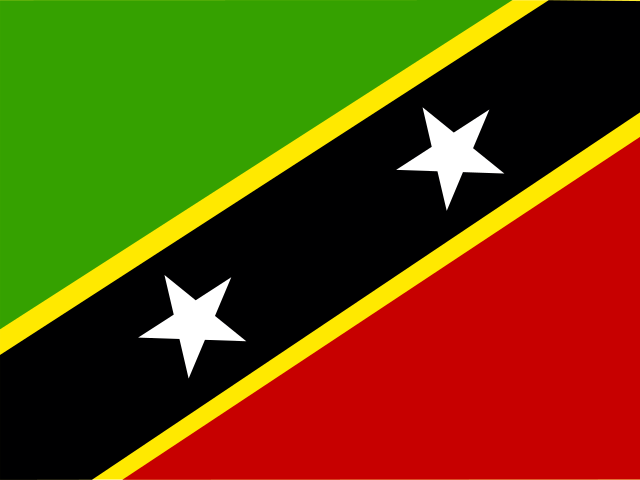
- Description: divided diagonally from the lower left side by a broad black band with two five-pointed white stars; the black band is edged in yellow; the upper triangle is green, and the lower is redMeaning: green stands for the island's fertility, red for the struggles of the people from slavery, yellow for year-round sunshine, and black for the people's African heritage; the white stars stand for the islands of Saint Kitts and Nevis but can also express hope and liberty, or independence and optimism
- National symbols
- brown pelican, royal poinciana (flamboyant) tree
- National colours
- green, yellow, red, black, white
- National anthem
- Title: "God Save the King"Lyrics/music: unknownHistory: in use since 1745
- UNESCO World Heritage Sites
- Total World Heritage Sites: 1 (cultural)Selected World Heritage Site locales: Brimstone Hill Fortress National Park
Economy
- Overview
- high-income, tourism-based Caribbean OECS economy; better debt balancing; CARICOM and ECCU member; growing offshore financial and telecommunications hub; environmentally fragile; unique citizenship-driven growth model
- GDP (PPP)
- $1.465 billion (2024 est.)
- GDP per person (PPP)
- $31,300 (2024 est.)
- GDP growth
- 1.2% (2024 est.)
- Inflation
- 3.6% (2023 est.)
- Farm products
- coconuts, tropical fruits, root vegetables, vegetables, eggs, pulses, sweet potatoes, watermelons, cucumbers/gherkins, tomatoes (2023)
- Industries
- tourism, cotton, salt, copra, clothing, footwear, beverages
- Exports
- $504.391 million (2024 est.)
- Main exports
- ships, measuring instruments, beer, electrical transformers, electrical control boards (2023)
- Export partners
- Malta 49%, USA 21%, Turkey 7%, St. Vincent & the Grenadines 5%, Guyana 3% (2023)
- Main imports
- refined petroleum, ships, cars, jewelry, poultry (2023)
- Import partners
- USA 50%, Italy 11%, China 8%, Japan 2%, UK 2% (2023)
- Money sent home from abroad
- 3.4% of GDP (2024 est.)
Energy, internet and transport
- Electricity access
- Electrification - total population: 100% (2022 est.)
- Electricity sources
- Fossil fuels: 95% of total installed capacity (2023 est.)Solar: 2.3% of total installed capacity (2023 est.)Wind: 2.7% of total installed capacity (2023 est.)
- Internet users
- Percent of population: 76% (2022 est.)
- Mobile phones
- Total subscriptions: 56,600 (2023 est.)Subscriptions per 100 inhabitants: 119 (2023 est.)
- TV and radio
- national state-operated TV network that broadcasts on 2 channels; cable subscription available for local and international channels; national state-operated radio network; mix of state-owned and privately owned broadcasters with about 15 radio stations (2019)
- Airports
- 2 (2025)
- Railways
- Total: 50 km (2008)Narrow gauge: 50 km (2008) 0.762-m gauge on Saint Kitts for tourists
- Merchant ships
- Total: 341 (2023)By type: bulk carrier 22, container ship 16, general cargo 85, oil tanker 59, other 159
Military and space
- Armed forces
- St. Kitts and Nevis Defense Force (SKNDF); Regular Force, Coast Guard Force (SKNDF Coast Guard), Reserve Force, Cadet ForceMinistry of National Security: the Royal St. Christopher and Nevis Police Force (2025)
- Military service
- 18 years of age for voluntary military service for men and women (under 18 with written parental permission); no conscription (2025)
Global issues
- Refugees and displaced people
- Refugees: 5 (2024 est.)
- Phone code
- +1869
- Internet domain
- .kn