Saint Lucia
Saint Lucia
Its volcanic Pitons are a World Heritage site.
See Saint Lucia on the 3D globeTake a quiz
Population180 thousand
Area616 km²
CapitalCastries
RegionCaribbean
Did you know?
- Has the world's only "drive-in" volcano
- Produced two Nobel Prize winners
- Changed hands between Britain and France 14 times
Key facts about Saint Lucia
- Government
- Parliamentary constitutional monarchy (Commonwealth realm)
- Religion
- Catholic ~60%
- Founded / independence
- 1979 (from UK)
- Rich in
- Tourism, bananas
- Languages
- English
English; Saint Lucian Creole French - Currency
- Eastern Caribbean dollar ($)
- People are called
- Saint Lucian
- Main cities
- Castries, Vieux Fort
Timeline of Saint Lucia
- 1660French settlement
- 1814British rule
- 1979Independence
Places to see in Saint Lucia
- The Pitons
- Sulphur Springs drive-in volcano
- Marigot Bay
- Pigeon Island
Food and drink
Green fig and saltfish · bouyon
Culture and famous for
Two Nobel laureates (Derek Walcott, Arthur Lewis)
Popular sports
Cricket
Geography and climate
- Highest point
- Mount Gimie, 950 m
- Rivers, lakes and seas
- Roseau River
- Climate
- Tropical
- Coastline
- Has a sea coast
- Population density
- 292 people per km²
Wars and conflicts
- Changed hands between Britain and France 14 times
Alliances and memberships
Political unions and regional organisations
CARICOMCELACOrganization of American StatesCommonwealth of Nations
Culture, religion and history
Saint Lucia in depth
Detailed facts from the CIA World Factbook (public domain, latest edition).
Overview
- History in brief
- England and France contested Saint Lucia -- with its fine natural harbor at Castries and burgeoning sugar industry -- throughout the 17th and early 18th centuries, with possession changing 14 times; it was finally ceded to the UK in 1814 and became part of the British Windward Islands colony. Even after the abolition of slavery on its plantations in 1834, Saint Lucia remained an agricultural island, dedicated to producing tropical commodity crops. In the mid-20th century, Saint Lucia joined the West Indies Federation (1958–1962) and in 1967 became one of the six members of the West Indies Associated States, with internal self-government. In 1979, Saint Lucia gained full independence.
Geography
- Location
- Caribbean, island between the Caribbean Sea and North Atlantic Ocean, north of Trinidad and Tobago
- Size compared
- 3.5 times the size of Washington, D.C.
- Land borders
- Total: 0 km
- Coastline
- 158 km
- Climate
- tropical, moderated by northeast trade winds; dry season January to April, rainy season May to August
- Terrain
- volcanic and mountainous with broad, fertile valleys
- Elevation
- Highest point: Mount Gimie 948 mLowest point: Caribbean Sea 0 m
- Natural resources
- forests, sandy beaches, minerals (pumice), mineral springs, geothermal potential
- Natural hazards
- hurricanesVolcanism: Mount Gimie (948 m), also known as Qualibou, is a caldera on the west of the island; the iconic twin pyramidal peaks of Gros Piton (771 m) and Petit Piton (743 m) are lava-dome remnants associated with the Soufrière volcano; there have been no historical magmatic eruptions, but a minor steam eruption in 1766 spread a thin layer of ash over a wide area; Saint Lucia is part of the volcanic-island arc of the Lesser Antilles that extends from Saba in the north to Grenada in the south
- Notes
- the twin Pitons (Gros Piton and Petit Piton), striking cone-shaped peaks south of Soufrière, are one of the scenic natural highlights of the Caribbean
- Environmental issues
- deforestation; soil erosion, particularly in the northern region
People and society
- Population
- Total: 168,462 (2025 est.)Male: 81,678Female: 86,784
- Nationality
- Noun: Saint Lucian(s)Adjective: Saint Lucian
- Ethnic groups
- Black/African descent 85.3%, mixed 10.9%, East Indian 2.2%, other 1.6%, unspecified 0.1% (2010 est.)
- Languages
- English (official), Saint Lucian Creole
- Religions
- Roman Catholic 61.5%, Protestant 25.5% (includes Seventh Day Adventist 10.4%, Pentecostal 8.9%, Baptist 2.2%, Anglican 1.6%, Church of God 1.5%, other Protestant 0.9%), other Christian 3.4% (includes Evangelical 2.3% and Jehovah's Witness 1.1%), Rastafarian 1.9%, other 0.4%, none 5.9%, unspecified 1.4% (2010 est.)
- Median age
- Total: 40.4 years (2025 est.)Male: 38.4 yearsFemale: 40.9 years
- Population growth
- 0.25% (2025 est.)
- Life expectancy
- Total population: 79.4 years (2024 est.)Male: 76.7 yearsFemale: 82.3 years
- Children per woman
- 1.71 children born/woman (2025 est.)
- Urbanization
- Urban population: 19.2% of total population (2023)Rate of urbanization: 0.98% annual rate of change (2020-25 est.)
- Largest cities
- 22,000 CASTRIES (capital) (2018)
- Years in school
- Total: 13 years (2023 est.)Male: 12 years (2023 est.)Female: 13 years (2023 est.)
Government
- Official names
- Conventional long form: noneConventional short form: Saint LuciaEtymology: believed to be named after Saint LUCY (Sainte ALOUSIE) of Syracuse by French sailors who were shipwrecked on the island on 13 December 1502, the saint's feast day
- Government type
- parliamentary democracy under a constitutional monarchy; a Commonwealth realm
- Capital
- Name: CastriesGeographic coordinates: 14 00 N, 61 00 WTime difference: UTC-4 (1 hour ahead of Washington, DC, during Standard Time)Etymology: in 1785, the village of Carenage was renamed Castries, after Charles Eugene Gabriel de La Croix de CASTRIES, who was then the French Minister of the Navy and Colonies
- Regions
- 10 districts; Anse-la-Raye, Canaries, Castries, Choiseul, Dennery, Gros-Islet, Laborie, Micoud, Soufrière, Vieux-Fort
- Independence
- 22 February 1979 (from the UK)
- National holiday
- Independence Day, 22 February (1979)
- Constitution
- History: previous 1958, 1960 (pre-independence); latest presented 20 December 1978, effective 22 February 1979Amendment process: proposed by Parliament; passage requires at least two-thirds majority vote by the House of Assembly membership in the final reading and assent of the governor general; passage of amendments to various constitutional sections, such as those on fundamental rights and freedoms, government finances, the judiciary, and procedures for amending the constitution, require at least three-quarters majority vote by the House and assent of the governor general; passage of amendments approved by the House but rejected by the Senate require a majority of votes cast in a referendum
- Legal system
- English common law
- Voting age
- 18 years of age; universal
- Flag meaning
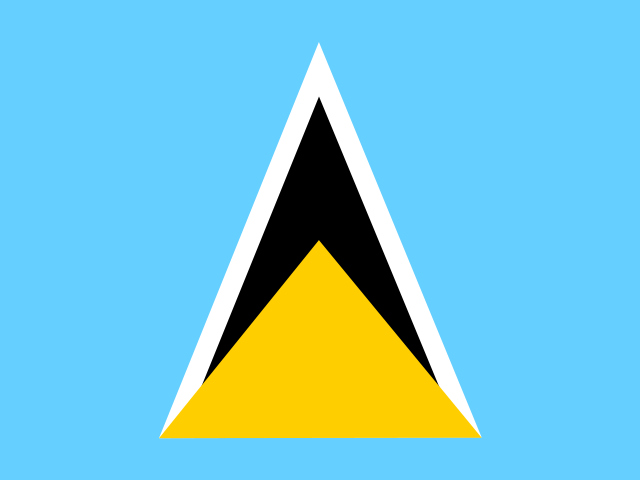
- Description: cerulean blue with a gold isosceles triangle below a black arrowhead; the upper edges of the arrowhead have a white borderMeaning: blue stands for the sky and sea, gold for sunshine and prosperity, and white and black for the ethnic composition of the island; the triangles represent Gros Piton and Petit Piton, the cone-shaped volcanic plugs that are a symbol of the island
- National symbols
- twin pitons (volcanic peaks), Saint Lucia parrot
- National colours
- cerulean blue, gold, black, white
- National anthem
- Title: "God Save the King"Lyrics/music: unknownHistory: in use since 1745
- UNESCO World Heritage Sites
- Total World Heritage Sites: 1 (natural)Selected World Heritage Site locales: Pitons Management Area
Economy
- Overview
- upper middle-income, tourism-based Caribbean island economy; environmentally fragile; energy import-dependent; major banana producer; well-educated labor force; key infrastructure, IT, and communications investments
- GDP (PPP)
- $4.359 billion (2024 est.)
- GDP per person (PPP)
- $24,300 (2024 est.)
- GDP growth
- 3.9% (2024 est.)
- Inflation
- -0.1% (2024 est.)
- Unemployment
- 11% (2024 est.)
- Below poverty line
- 25% (2015 est.)
- Farm products
- coconuts, bananas, tropical fruits, fruits, root vegetables, plantains, vegetables, cassava, chicken, milk (2023)
- Industries
- tourism; clothing, assembly of electronic components, beverages, corrugated cardboard boxes, lime processing, coconut processing
- Exports
- $1.6 billion (2024 est.)
- Main exports
- refined petroleum, gravel and crushed stone, beer, liquor, paper containers (2023)
- Export partners
- Guyana 20%, Suriname 15%, USA 11%, Barbados 8%, Dominica 7% (2023)
- Main imports
- refined petroleum, crude petroleum, cars, poultry, plastic products (2023)
- Import partners
- USA 59%, Guyana 8%, Brazil 7%, China 5%, UK 3% (2023)
- Money sent home from abroad
- 2.5% of GDP (2024 est.)
Energy, internet and transport
- Electricity access
- Electrification - total population: 100% (2022 est.)
- Electricity sources
- Fossil fuels: 98% of total installed capacity (2023 est.)Solar: 2% of total installed capacity (2023 est.)
- Internet users
- Percent of population: 74% (2022 est.)
- Mobile phones
- Total subscriptions: 176,000 (2022 est.)Subscriptions per 100 inhabitants: 99 (2022 est.)
- TV and radio
- 3 privately owned TV stations; 1 public TV station on a cable network; multi-channel cable TV service available; mix of state-owned and privately owned radio broadcasters with about 25 stations, including repeater transmission stations (2019)
- Airports
- 2 (2025)
Military and space
- Armed forces
- no regular military forces; Ministry of Home Affairs, Justice, and National Security: Royal Saint Lucia Police Force (RSLPF) (2025)
Global issues
- Refugees and displaced people
- Refugees: 5 (2024 est.)
- Phone code
- +1758
- Internet domain
- .lc