Samoa
Independent State of Samoa · Sāmoa
The first Pacific island nation to regain independence, in 1962.
See Samoa on the 3D globeTake a quiz
Population220 thousand
Area2,842 km²
CapitalApia
RegionPolynesia
Did you know?
- Skipped 30 December 2011 to move across the date line
- The word "tattoo" comes from Samoan "tatau"
- Author Robert Louis Stevenson is buried here
Key facts about Samoa
- Government
- Parliamentary republic (chiefly system)
- Religion
- Christian ~97%
- Founded / independence
- 1962 (from New Zealand)
- Rich in
- Remittances, tourism, coconut
- Languages
- English, Samoan
Samoan, English - Currency
- Samoan tālā (T)
- People are called
- Samoan
- Main cities
- Apia
Timeline of Samoa
- 1830Missionaries arrive
- 1900German Samoa
- 1914New Zealand rule
- 1962Independence
- 2011Changes time zone
Places to see in Samoa
- To Sua Ocean Trench
- Lalomanu beach
- Robert Louis Stevenson museum
- Alofaaga blowholes
Food and drink
Palusami (taro leaves in coconut cream) · oka · umu feast
Culture and famous for
Fa'a Samoa way of life; traditional tattoo (tatau)
Popular sports
Rugby
Geography and climate
- Highest point
- Mount Silisili, 1,858 m
- Rivers, lakes and seas
- No large rivers
- Climate
- Tropical
- Coastline
- Has a sea coast
- Population density
- 77 people per km²
Wars and conflicts
- Samoan Civil Wars
- Mau movement
Alliances and memberships
Political unions and regional organisations
Pacific Islands ForumCommonwealth of Nations
Samoa in depth
Detailed facts from the CIA World Factbook (public domain, latest edition).
Overview
- History in brief
- The first Austronesian settlers arrived in Samoa around 1000 B.C., and early Samoans traded and intermarried with Fijian and Tongan nobility. The fa’amatai system of titles and nobility developed, which dominates Samoan politics to this day; all but two seats in the legislature are reserved for matai, or heads of families. A Dutch explorer was the first European to spot the islands in 1722. Christian missionaries arrived in the 1830s and were followed by an influx of American and European settlers and influence. By the 1880s, Germany, the UK, and the US had trading posts and claimed parts of the kingdom. In 1886, an eight-year civil war broke out, with rival matai factions fighting over royal succession and the three foreign powers providing support to the factions. Germany, the UK, and the US all sent warships to Apia in 1889 and came close to conflict, but a cyclone damaged or destroyed the ships of all three navies.At the end of the civil war in 1894, Malietoa LAUPEPA was installed as king, but upon his death in 1898, a second civil war over succession broke out. When the war ended in 1899, the Western powers abolished the monarchy, giving the western Samoan islands to Germany and the eastern Samoan islands to the US. The UK abandoned claims in Samoa and received former German territory in the Solomon Islands.New Zealand occupied Samoa during World War I but was accused of negligence and opposed by many Samoans, particularly an organized political movement called the Mau (“Strongly Held View”) that advocated for independence. During the 1918-1919 influenza pandemic, about 20% of the population died. In 1929, New Zealand police shot into a crowd of peaceful Mau protestors, killing 11, in an event known as Black Sunday. In 1962, Samoa became the first Polynesian nation to reestablish its independence as Western Samoa but dropped the “Western” from its name in 1997. The Human Rights Protection Party dominated politics from 1982 until Prime Minister FIAME Naomi Mata'afa's Fa'atuatua i le Atua Samoa ua Tasi (FAST) party gained a majority in elections in 2021.
Geography
- Location
- Oceania, group of islands in the South Pacific Ocean, about halfway between Hawaii and New Zealand
- Size compared
- slightly smaller than Rhode Island
- Land borders
- Total: 0 km
- Coastline
- 403 km
- Climate
- tropical; rainy season (November to April), dry season (May to October)
- Terrain
- two main islands (Savaii, Upolu) and several smaller islands and uninhabited islets; narrow coastal plain with volcanic, rugged mountains in interior
- Elevation
- Highest point: Mount Silisili 1,857 mLowest point: Pacific Ocean 0 m
- Natural resources
- hardwood forests, fish, hydropower
- Natural hazards
- occasional cyclones; active volcanismVolcanism: Savai'I Island (1,858 m) is historically active
- Notes
- occupies an almost central position within Polynesia
- Environmental issues
- soil erosion; deforestation; invasive species; overfishing
People and society
- Population
- Total: 210,223 (2025 est.)Male: 106,542Female: 103,681
- Nationality
- Noun: Samoan(s)Adjective: Samoan
- Ethnic groups
- Samoan 96%, Samoan/New Zealander 2%, other 1.9% (2011 est.)
- Languages
- Samoan (Polynesian) (official) 91.1%, Samoan/English 6.7%, English (official) 0.5%, other 0.2%, unspecified 1.6% (2006 est.)
- Religions
- Protestant 54.9% (Congregationalist 29%, Methodist 12.4%, Assembly of God 6.8%, Seventh Day Adventist 4.4%, other Protestant 2.3%), Roman Catholic 18.8%, Church of Jesus Christ 16.9%, Worship Centre 2.8%, other Christian 3.6%, other 2.9% (includes Baha'i, Muslim), none 0.2% (2016 est.)
- Median age
- Total: 27.8 years (2025 est.)Male: 27 yearsFemale: 27.8 years
- Population growth
- 0.66% (2025 est.)
- Life expectancy
- Total population: 75.7 years (2024 est.)Male: 72.8 yearsFemale: 78.7 years
- Children per woman
- 2.29 children born/woman (2025 est.)
- Urbanization
- Urban population: 17.5% of total population (2023)Rate of urbanization: -0.03% annual rate of change (2020-25 est.)
- Largest cities
- 36,000 APIA (capital) (2018)
- Literacy
- Total population: 98% (2019 est.)Male: 98.3% (2019 est.)Female: 97.7% (2019 est.)
Government
- Official names
- Conventional long form: Independent State of SamoaConventional short form: SamoaLocal long form: Malo Sa'oloto Tuto'atasi o SamoaLocal short form: SamoaFormer: Western SamoaEtymology: the name's meaning and origin are unclear; some assert that it can mean "place of the moa bird" of Polynesian mythology, or it could be a local chieftain's name
- Government type
- parliamentary republic
- Capital
- Name: ApiaGeographic coordinates: 13 49 S, 171 46 WTime difference: UTC+13 (18 hours ahead of Washington, DC, during Standard Time)
- Regions
- 11 districts; A'ana, Aiga-i-le-Tai, Atua, Fa'asaleleaga, Gaga'emauga, Gagaifomauga, Palauli, Satupa'itea, Tuamasaga, Va'a-o-Fonoti, Vaisigano
- Independence
- 1 January 1962 (from New Zealand-administered UN trusteeship)
- National holiday
- Independence Day Celebration, 1 June (1962)
- Constitution
- History: several previous (pre-independence); latest 1 January 1962Amendment process: proposed as an act by the Legislative Assembly; passage requires at least two-thirds majority vote by the Assembly membership in the third reading, provided at least 90 days have elapsed since the second reading, and assent of the chief of state; passage of amendments affecting constitutional articles on customary land or constitutional amendment procedures also requires at least two-thirds majority approval in a referendum
- Legal system
- mixed system of English common law and customary law; judicial review of legislative acts involving fundamental citizen rights
- Voting age
- 21 years of age; universal
- Flag meaning
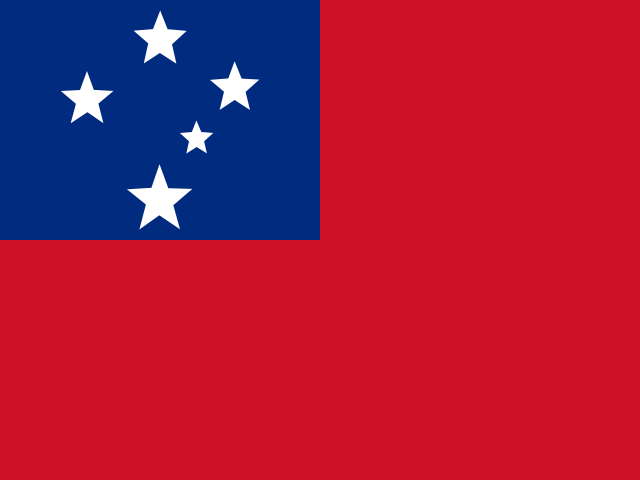
- Description: red with a blue rectangle in the upper-left quadrant; on the rectangle are five five-pointed white stars that represent the Southern Cross constellationMeaning: red stands for courage, blue for freedom, and white for purity
- National symbols
- Southern Cross constellation (five five-pointed stars)
- National colours
- red, white, blue
- National anthem
- Title: "O le Fu'a o le Sa'olotoga o Samoa" (The Banner of Freedom)Lyrics/music: Sauni Liga KURESAHistory: adopted 1962; also known as "Samoa Tula'i" (Samoa Arise)
Economy
- Overview
- ower middle-income Pacific island economy; enormous fishing and agriculture industries; significant remittances; growing offshore financial hub; recently hosted Pacific Games to drive tourism and infrastructure growth
- GDP (PPP)
- $1.503 billion (2024 est.)
- GDP per person (PPP)
- $6,900 (2024 est.)
- GDP growth
- 9.4% (2024 est.)
- Inflation
- 2.2% (2024 est.)
- Unemployment
- 4.6% (2024 est.)
- Below poverty line
- 21.9% (2018 est.)
- Farm products
- coconuts, bananas, taro, tropical fruits, pineapples, mangoes/guavas, papayas, root vegetables, milk, avocados (2023)
- Industries
- food processing, building materials, auto parts
- Exports
- $369.73 million (2024 est.)
- Main exports
- refined petroleum, integrated circuits, coconut oil, fish, insulated wire (2023)
- Export partners
- India 26%, NZ 14%, USA 12%, American Samoa 10%, Australia 9% (2023)
- Main imports
- refined petroleum, poultry, cars, plastic products, milk (2023)
- Import partners
- NZ 20%, Singapore 19%, China 17%, Australia 10%, Fiji 9% (2023)
- Money sent home from abroad
- 26.4% of GDP (2024 est.)
Energy, internet and transport
- Electricity access
- Electrification - total population: 98.3% (2022 est.)Electrification - urban areas: 100%Electrification - rural areas: 97.9%
- Electricity sources
- Fossil fuels: 59.7% of total installed capacity (2023 est.)Solar: 15.1% of total installed capacity (2023 est.)Wind: 0.1% of total installed capacity (2023 est.)Hydroelectricity: 18.9% of total installed capacity (2023 est.)Biomass and waste: 6.3% of total installed capacity (2023 est.)
- Internet users
- Percent of population: 58% (2023 est.)
- Mobile phones
- Total subscriptions: 134,000 (2022 est.)Subscriptions per 100 inhabitants: 62 (2022 est.)
- TV and radio
- state-owned TV station privatized in 2008; 4 privately owned TV stations; about a half-dozen privately owned radio stations and one state-owned; TV and radio broadcasts of several stations from American Samoa are available (2019)
- Airports
- 4 (2025)
- Merchant ships
- Total: 13 (2023)By type: general cargo 3, oil tanker 1, other 9
Military and space
- Armed forces
- no regular military forces; Samoa Police Service (includes a maritime unit) (2025)
- Phone code
- +685
- Internet domain
- .ws