São Tomé and Príncipe
Democratic Republic of São Tomé and Príncipe · São Tomé e Príncipe
Uninhabited until Portuguese settlement; plantation colony using enslaved labour. Africa's second-smallest country.
See São Tomé and Príncipe on the 3D globeTake a quiz
Population230 thousand
Area964 km²
CapitalSão Tomé
RegionMiddle Africa
Did you know?
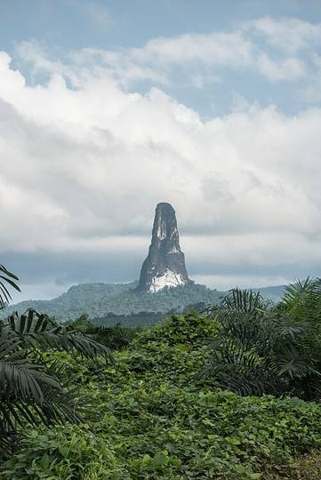
- Pico Cão Grande is a striking 300 m volcanic needle
- Once the world's top cocoa producer
- Sits almost on the equator
Key facts about São Tomé and Príncipe
- Government
- Semi-presidential republic
- Religion
- Catholic ~55%
- Founded / independence
- 1975 (from Portugal)
- Rich in
- Cocoa, tourism, potential oil
- Languages
- Portuguese
Portuguese; Forro Creole - Currency
- São Tomé and Príncipe dobra (Db)
- People are called
- Sao Tomean
- Main cities
- São Tomé, Santo António
Timeline of São Tomé and Príncipe
- 1470Portuguese discover islands
- 1975Independence
- 1991Multi-party elections
Places to see in São Tomé and Príncipe
- Pico Cão Grande
- Obô National Park
- cocoa plantations (roças)
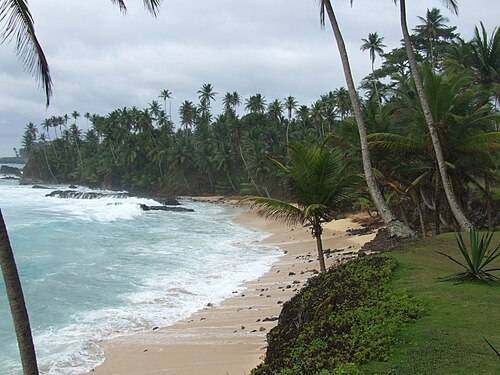
- beaches of Príncipe
Food and drink
Calulu (fish stew) · banana dishes
Culture and famous for
Cocoa plantations; tchiloli theatre
Popular sports
Football
Geography and climate
- Highest point
- Pico de São Tomé, 2,024 m
- Rivers, lakes and seas
- Short mountain rivers
- Climate
- Equatorial
- Coastline
- Has a sea coast
- Population density
- 239 people per km²
Wars and conflicts
- 1953 Batepá massacre
Alliances and memberships
Political unions and regional organisations
São Tomé and Príncipe in depth
Detailed facts from the CIA World Factbook (public domain, latest edition).
Overview
- History in brief
- Portugal discovered and colonized the uninhabited Sao Tome and Principe islands in the late 15th century, setting up a sugar-based economy that gave way to coffee and cocoa in the 19th century -- all grown with African slave labor, a form of which lingered into the 20th century. While independence was achieved in 1975, democratic reforms were not instituted until the late 1980s.The country held its first free elections in 1991, but frequent internal wrangling among the various political parties precipitated repeated changes in leadership and failed, non-violent coup attempts in 1995, 1998, 2003, and 2009. In 2012, three opposition parties combined in a no-confidence vote to bring down the majority government of former Prime Minister Patrice TROVOADA, but legislative elections returned him to the office two years later. President Evaristo CARVALHO, of the same political party as TROVOADA, was elected in 2016, marking a rare instance in which the same party held the positions of president and prime minister. TROVOADA resigned in 2018 and was replaced by Jorge BOM JESUS. Carlos Vila NOVA was elected president in 2021. TROVOADA began his fourth stint as prime minister in 2022, after his party's victory in legislative elections.
Geography
- Location
- Central Africa, islands in the Gulf of Guinea, just north of the Equator, west of Gabon
- Size compared
- more than five times the size of Washington, D.C.
- Land borders
- Total: 0 km
- Coastline
- 209 km
- Climate
- tropical; hot, humid; one rainy season (October to May)
- Terrain
- volcanic, mountainous
- Elevation
- Highest point: Pico de Sao Tome 2,024 mLowest point: Atlantic Ocean 0 m
- Natural resources
- fish, hydropower
- Natural hazards
- flooding
- Notes
- the second-smallest African country (after the Seychelles); the two main islands form part of a chain of extinct volcanoes, and both are mountainous
- Environmental issues
- deforestation and illegal logging; soil erosion and exhaustion; inadequate sewage treatment in cities; biodiversity
People and society
- Population
- Total: 223,561 (2024 est.)Male: 111,553Female: 112,008
- Nationality
- Noun: Sao Tomean(s)Adjective: Sao Tomean
- Ethnic groups
- Mestico, Angolares (descendants of Angolan slaves), Forros (descendants of freed slaves), Servicais (contract laborers from Angola, Mozambique, and Cabo Verde), Tongas (children of servicais born on the islands), Europeans (primarily Portuguese), Asians (mostly Chinese)
- Languages
- Portuguese 98.4% (official), Forro 36.2%, Cabo Verdian 8.5%, French 6.8%, Angolar 6.6%, English 4.9%, Lunguie 1%, other (including sign language) 2.4%; other Portuguese-based Creoles are also spoken (2012 est.)
- Religions
- Catholic 55.7%, Adventist 4.1%, Assembly of God 3.4%, New Apostolic 2.9%, Mana 2.3%, Universal Kingdom of God 2%, Jehovah's Witness 1.2%, other 6.2%, none 21.2%, unspecified 1% (2012 est.)
- Median age
- Total: 21.2 years (2025 est.)Male: 20.4 yearsFemale: 21.2 years
- Population growth
- 1.39% (2025 est.)
- Life expectancy
- Total population: 67.7 years (2024 est.)Male: 66 yearsFemale: 69.4 years
- Children per woman
- 3.18 children born/woman (2025 est.)
- Urbanization
- Urban population: 76.4% of total population (2023)Rate of urbanization: 2.96% annual rate of change (2020-25 est.)
- Largest cities
- 80,000 SAO TOME (capital) (2018)
- Literacy
- Total population: 87.4% (2019 est.)Male: 92.5% (2019 est.)Female: 82.8% (2019 est.)
- Years in school
- Total: 13 years (2021 est.)Male: 13 years (2021 est.)Female: 13 years (2021 est.)
Government
- Official names
- Conventional long form: Democratic Republic of Sao Tome and PrincipeConventional short form: Sao Tome and PrincipeLocal long form: Republica Democratica de Sao Tome e PrincipeLocal short form: Sao Tome e PrincipeEtymology: Sao Tome was named after Saint THOMAS the Apostle by the Portuguese who discovered the island on 21 December 1470 (or 1471), the saint's feast day; Principe is a shortening of the original Portuguese name of "Ilha do Principe" (Isle of the Prince), referring to Prince ALPHONSO of Portugal
- Government type
- semi-presidential republic
- Capital
- Name: Sao TomeGeographic coordinates: 0 20 N, 6 44 ETime difference: UTC 0 (5 hours ahead of Washington, DC, during Standard Time)Etymology: named after Saint THOMAS the Apostle by the Portuguese, who discovered the island on 21 December 1470 (or 1471), the saint's feast day
- Regions
- 6 districts (distritos, singular - distrito), 1 autonomous region* (regiao autonoma); Agua Grande, Cantagalo, Caue, Lemba, Lobata, Me-Zochi, Principe*
- Independence
- 12 July 1975 (from Portugal)
- National holiday
- Independence Day, 12 July (1975)
- Constitution
- History: approved 5 November 1975Amendment process: proposed by the National Assembly; passage requires two-thirds majority vote by the Assembly; the Assembly can propose to the president of the republic that an amendment be submitted to a referendum
- Legal system
- mixed system of civil law based on the Portuguese model and customary law
- Voting age
- 18 years of age; universal
- Flag meaning
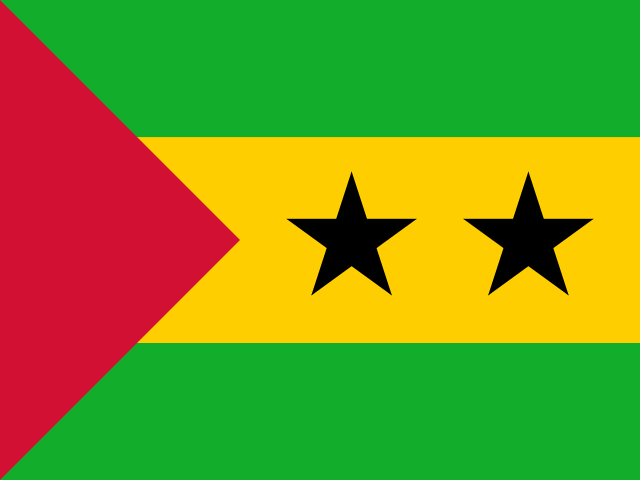
- Description: three horizontal bands of green (top), yellow (double-width), and green with two five-pointed black stars in the center of the yellow band and a red isosceles triangle based on the left sideMeaning: green stands for the country's rich vegetation, red for the struggle for independence, and yellow for cocoa, one of the country's main agricultural products; the two stars symbolize the main islandsHistory: uses the colors of the Pan-African movement
- National symbols
- palm tree
- National colours
- green, yellow, red, black
- National anthem
- Title: "Independencia total" (Total Independence)Lyrics/music: Alda Neves DA GRACA do Espirito Santo/Manuel dos Santos Barreto de Sousa e ALMEIDAHistory: adopted 1975
Economy
- Overview
- lower middle-income Central African island economy; falling cocoa production due to drought and mismanagement; joint oil venture with Nigeria; government owns 90% of land; high debt, partly from fuel subsidies; tourism gutted by COVID-19
- GDP (PPP)
- $1.291 billion (2024 est.)
- GDP per person (PPP)
- $5,500 (2024 est.)
- GDP growth
- 0.9% (2024 est.)
- Inflation
- 14.4% (2024 est.)
- Unemployment
- 9.2% (2024 est.)
- Below poverty line
- 55.5% (2017 est.)
- Farm products
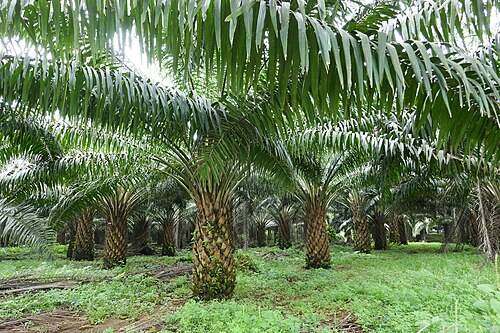
- plantains, oil palm fruit, taro, bananas, fruits, cocoa beans, yams, coconuts, cassava, vegetables (2023)
- Industries
- light construction, textiles, soap, beer, fish processing, timber
- Exports
- $96.977 million (2022 est.)
- Main exports
- crude petroleum, cocoa beans, vehicle parts/accessories, palm oil, aircraft parts (2023)
- Export partners
- Pakistan 54%, Germany 11%, Netherlands 7%, France 5%, UAE 3% (2023)
- Main imports
- ships, refined petroleum, rice, electric generating sets, cars (2023)
- Import partners
- Portugal 35%, Angola 13%, Gabon 11%, Japan 8%, China 6% (2023)
- Money sent home from abroad
- 1.5% of GDP (2023 est.)
Energy, internet and transport
- Electricity access
- Electrification - total population: 78% (2022 est.)Electrification - urban areas: 80%Electrification - rural areas: 73.7%
- Electricity sources
- Fossil fuels: 93.2% of total installed capacity (2023 est.)Hydroelectricity: 6.8% of total installed capacity (2023 est.)
- Internet users
- Percent of population: 62% (2023 est.)
- Mobile phones
- Total subscriptions: 152,000 (2023 est.)Subscriptions per 100 inhabitants: 87 (2022 est.)
- TV and radio
- 1 state-owned TV station; 2 state-owned radio stations; 7 independent local radio stations; transmissions of multiple international broadcasters are available
- Airports
- 2 (2025)
- Merchant ships
- Total: 25 (2023)By type: general cargo 15, oil tanker 4, other 6
Military and space
- Armed forces
- Armed Forces of Sao Tome and Principe (Forcas Armadas de Sao Tome e Principe, FASTP): Army, Coast Guard of Sao Tome e Principe (Guarda Costeira de Sao Tome e Principe, GCSTP), Presidential Guard, National Guard (2025)
- Military service
- limited information; 18 is the minimum age for compulsory military service (reportedly not enforced) and 17 years of age (with parental permission) for voluntary service (2024)
- Phone code
- +239
- Internet domain
- .st