Seychelles
Republic of Seychelles · Sesel
Uninhabited until French settlement in 1770. Africa's smallest country by population.
See Seychelles on the 3D globeTake a quiz
Population130 thousand
Area452 km²
CapitalVictoria
RegionEastern Africa
Did you know?
- The coco de mer has the world's largest seed
- Aldabra has about 150,000 giant tortoises
- Africa's least populated country
Key facts about Seychelles
- Government
- Presidential republic
- Religion
- Christian ~89%
- Founded / independence
- 1976 (from UK)
- Rich in
- Tourism, tuna fishing — Africa's richest per person
- Languages
- Seychellois Creole, English, French
Seychellois Creole, English, French - Currency
- Seychellois rupee (₨)
- People are called
- Seychellois
- Main cities
- Victoria
Timeline of Seychelles
- 1756French claim
- 1814British rule
- 1976Independence
- 1977Coup
- 1993Multi-party democracy
Places to see in Seychelles
- Vallée de Mai (coco de mer palms)
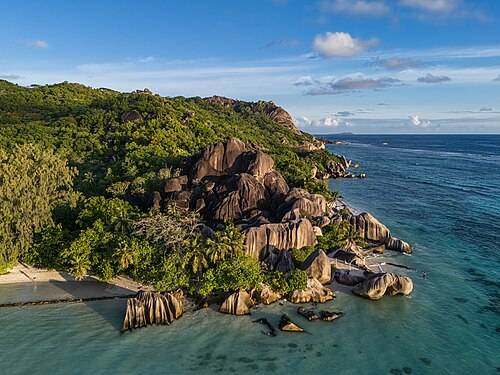
- Anse Source d'Argent
- Aldabra Atoll
- Victoria clock tower
Food and drink
Fish curry · octopus curry · ladob
Culture and famous for
Creole culture; giant tortoises
Popular sports
Football, athletics
Geography and climate
- Highest point
- Morne Seychellois, 905 m
- Rivers, lakes and seas
- 115 islands
- Climate
- Tropical
- Coastline
- Has a sea coast
- Population density
- 288 people per km²
Wars and conflicts
- 1977 coup
Alliances and memberships
Political unions and regional organisations
African UnionSADCCommonwealth of Nations
Seychelles in depth
Detailed facts from the CIA World Factbook (public domain, latest edition).
Overview
- History in brief
- Seychelles was uninhabited before Europeans discovered the islands early in the 16th century. After a lengthy struggle, France eventually ceded control of the islands to Great Britain in 1814. During colonial rule, a plantation-based economy developed that relied on imported labor, primarily from European colonies in Africa. Seychelles gained independence in 1976 through negotiations with Great Britain. In 1977, Prime Minister France-Albert RENE launched a coup against the country’s first president, and Seychelles became a socialist one-party state until adopting a new constitution and holding elections in 1993. RENE continued to lead Seychelles through two election cycles until he stepped down in 2004. Vice President James Alix MICHEL took over the presidency and in 2006 was elected to a new five-year term; he was reelected in 2011 and again in 2015. In 2016, James MICHEL resigned and handed over the presidency to his vice-president, Danny FAURE. In 2020, Wavel RAMKALAWAN was elected president, the first time an opposition candidate has won the presidency.
Geography
- Location
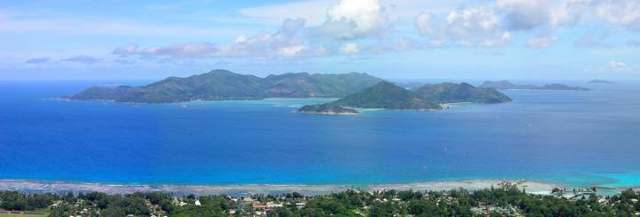
- archipelago in the Indian Ocean, northeast of Madagascar
- Size compared
- 2.5 times the size of Washington, D.C.
- Land borders
- Total: 0 km
- Coastline
- 491 km
- Climate
- tropical marine; humid; cooler season during southeast monsoon (late May to September); warmer season during northwest monsoon (March to May)
- Terrain
- Mahe Group is volcanic with a narrow coastal strip and rocky, hilly interior; others are relatively flat coral atolls, or elevated reefs; sits atop the submarine Mascarene Plateau
- Elevation
- Highest point: Morne Seychellois 905 mLowest point: Indian Ocean 0 m
- Natural resources
- fish, coconuts (copra), cinnamon trees
- Natural hazards
- lies outside the cyclone belt, so severe storms are rare; occasional short droughts
- Notes
- the smallest African country in terms of both area and population; the constitution of the Republic of Seychelles lists 155 islands, including 42 granitic and 113 coralline; the largest island by far is Mahe, which is home to about 90% of the population and is the site of the capital city of Victoria
- Environmental issues
- limited freshwater resources; water pollution; biodiversity
People and society
- Population
- Total: 98,187 (2024 est.)Male: 50,973Female: 47,214
- Nationality
- Noun: Seychellois (singular and plural)Adjective: Seychellois
- Ethnic groups
- predominantly Creole (mainly of East African and Malagasy heritage); also French, Indian, Chinese, and Arab populations
- Languages
- Seychellois Creole (official) 89.1%, English (official) 5.1%, French (official) 0.7%, other 3.8%, unspecified 1.4% (2010 est.)
- Religions
- Roman Catholic 76.2%, Protestant 10.5% (Anglican 6.1%, Pentecostal Assembly 1.5%, Seventh Day Adventist 1.2%, other Protestant 1.7%), other Christian 2.4%, Hindu 2.4%, Muslim 1.6%, other non-Christian 1.1%, unspecified 4.8%, none 0.9% (2010 est.)
- Median age
- Total: 39.2 years (2025 est.)Male: 38.2 yearsFemale: 39.4 years
- Population growth
- 0.53% (2025 est.)
- Life expectancy
- Total population: 76.6 years (2024 est.)Male: 72.2 yearsFemale: 81.1 years
- Children per woman
- 1.8 children born/woman (2025 est.)
- Urbanization
- Urban population: 58.8% of total population (2023)Rate of urbanization: 0.99% annual rate of change (2020-25 est.)
- Largest cities
- 28,000 VICTORIA (capital) (2018)
- Years in school
- Total: 13 years (2023 est.)Male: 13 years (2023 est.)Female: 15 years (2023 est.)
Government
- Official names
- Conventional long form: Republic of SeychellesConventional short form: SeychellesLocal long form: Republic of SeychellesLocal short form: SeychellesEtymology: named by French Captain Corneille Nicholas MORPHEY after Jean Moreau de SÉCHELLES, the finance minister of France, in 1756; the British changed the spelling of the name in 1815 when they acquired the islands
- Government type
- presidential republic
- Capital
- Name: VictoriaGeographic coordinates: 4 37 S, 55 27 ETime difference: UTC+4 (9 hours ahead of Washington, DC, during Standard Time)Etymology: the British named the town Port Victoria in 1841 after Queen VICTORIA; the name was later shortened
- Regions
- 27 administrative districts; Anse aux Pins, Anse Boileau, Anse Etoile, Anse Royale, Au Cap, Baie Lazare, Baie Sainte Anne, Beau Vallon, Bel Air, Bel Ombre, Cascade, Glacis, Grand Anse Mahe, Grand Anse Praslin, Ile Persévérance I, Ile Persévérance II, La Digue, La Rivière Anglaise, Les Mamelles, Mont Buxton, Mont Fleuri, Plaisance, Pointe Larue, Port Glaud, Roche Caiman, Saint Louis, Takamaka
- Independence
- 29 June 1976 (from the UK)
- National holiday
- Constitution Day, 18 June (1993); Independence Day (National Day), 29 June (1976)
- Constitution
- History: previous 1970, 1979; latest drafted May 1993, approved by referendum 18 June 1993, effective 23 June 1993Amendment process: proposed by the National Assembly; passage requires at least two-thirds majority vote by the National Assembly; passage of amendments affecting the country’s sovereignty, symbols and languages, the supremacy of the constitution, fundamental rights and freedoms, amendment procedures, and dissolution of the Assembly also requires approval by at least 60% of voters in a referendum
- Legal system
- mixed system of English common law, French civil law, and customary law
- Voting age
- 18 years of age; universal
- Flag meaning
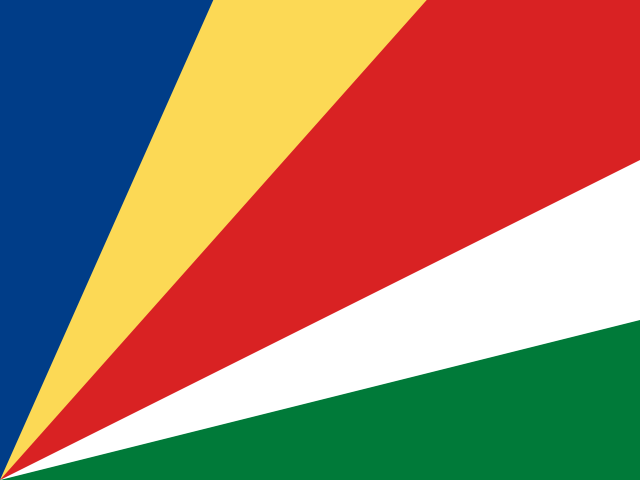
- Description: five expanding bands of blue, yellow, red, white, and green, radiating from the bottom left cornerMeaning: the bands symbolize a dynamic new country moving into the future; blue stands for the sky and sea, yellow for the sun giving light and life, red for the people's determination to work for the future in unity and love, white for social justice and harmony, and green for the land and natural environment
- National symbols
- coco de mer (sea coconut)
- National colours
- blue, yellow, red, white, green
- National anthem
- Title: "Koste Seselwa" (Seychellois Unite)Lyrics/music: David Francois Marc ANDRE and George Charles Robert PAYETHistory: adopted 1996
- UNESCO World Heritage Sites
- Total World Heritage Sites: 2 (both natural)Selected World Heritage Site locales: Aldabra Atoll; Vallée de Mai Nature Reserve
Economy
- Overview
- high-income Indian Ocean island economy; rapidly growing tourism sector; major tuna exporter; offshore financial hub; environmentally fragile and investing in ocean rise mitigation; recently discovered offshore oil potential; successful anticorruption efforts
- GDP (PPP)
- $3.549 billion (2024 est.)
- GDP per person (PPP)
- $29,200 (2024 est.)
- GDP growth
- 3.5% (2024 est.)
- Inflation
- 0.3% (2024 est.)
- Below poverty line
- 25.3% (2018 est.)
- Farm products
- coconuts, vegetables, bananas, eggs, chicken, pork, fruits, tomatoes, tropical fruits, cassava (2023)
- Industries
- fishing, tourism, beverages
- Exports
- $2.375 billion (2023 est.)
- Main exports
- fish, scrap iron, animal meal, broadcasting equipment, ships (2023)
- Export partners
- France 20%, Mauritius 12%, UK 9%, Japan 8%, Italy 8% (2023)
- Main imports
- refined petroleum, fish, ships, cars, plastic products (2023)
- Import partners
- UAE 32%, Spain 10%, France 6%, South Africa 6%, India 6% (2023)
- Money sent home from abroad
- 0.5% of GDP (2023 est.)
Energy, internet and transport
- Electricity access
- Electrification - total population: 100% (2022 est.)
- Electricity sources
- Fossil fuels: 86.4% of total installed capacity (2023 est.)Solar: 12.7% of total installed capacity (2023 est.)Wind: 1% of total installed capacity (2023 est.)
- Internet users
- Percent of population: 87% (2023 est.)
- Mobile phones
- Total subscriptions: 165,000 (2023 est.)Subscriptions per 100 inhabitants: 192 (2022 est.)
- TV and radio
- state-run national broadcaster Seychelles Broadcasting Corporation (SBC) has the only terrestrial TV station, which also airs broadcasts from international services; privately owned Internet Protocol Television (IPTV) channel; multi-channel cable and satellite TV available through 2 providers; SBC operates 1 AM and 1 FM radio station; 2 privately operated radio stations; transmissions of 2 international broadcasters available in Victoria (2019)
- Airports
- 16 (2025)
- Merchant ships
- Total: 30 (2023)By type: general cargo 6, oil tanker 6, other 18
Military and space
- Armed forces
- Seychelles People's Defense Forces (SPDF; aka Seychelles Defense Forces, SDF): Army (includes infantry, special forces, and a presidential security unit), Coast Guard, and Air ForceMinistry of Internal Affairs: Seychelles Police Force (2025)
- Military spending
- 1.5% of GDP (2024 est.)
- Military service
- 18-35 years of age for voluntary military service for men and women; no conscription (2026)
- Phone code
- +248
- Internet domain
- .sc