Solomon Islands
Solomon Islands
Site of one of WWII's turning-point battles. Switched recognition from Taiwan to China in 2019.
See Solomon Islands on the 3D globeTake a quiz
Population820 thousand
Area28,896 km²
CapitalHoniara
RegionMelanesia
Did you know?
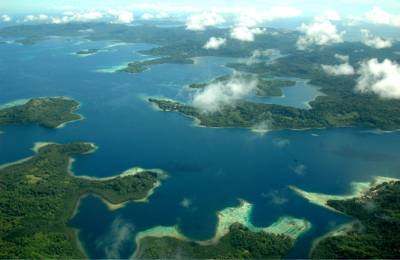
- Marovo is one of the world's largest saltwater lagoons
- The Guadalcanal campaign was a turning point in WWII
- Has about 70 languages
Key facts about Solomon Islands
- Government
- Parliamentary constitutional monarchy (Commonwealth realm)
- Religion
- Christian ~95%
- Founded / independence
- 1978 (from UK)
- Rich in
- Timber, fishing, gold
- Languages
- English
English, Solomon Pijin; about 70 languages - Currency
- Solomon Islands dollar ($)
- People are called
- Solomon Islander
- Main cities
- Honiara, Auki
Timeline of Solomon Islands
- 1568Spanish explorer arrives
- 1893British protectorate
- 1942Guadalcanal campaign
- 1978Independence
- 2003Regional peacekeeping mission
Places to see in Solomon Islands
- Skull Island
- Marovo Lagoon
- Guadalcanal battlefields
- Honiara market
Food and drink
Poi · fish · root crops
Culture and famous for
Shell money; custom dances
Popular sports
Football, futsal
Geography and climate
- Highest point
- Mount Popomanaseu, 2,335 m
- Rivers, lakes and seas
- Over 900 islands
- Climate
- Tropical
- Coastline
- Has a sea coast
- Population density
- 28 people per km²
Wars and conflicts
- Guadalcanal campaign 1942–43
- ethnic tension 1998–2003
Alliances and memberships
Political unions and regional organisations
Pacific Islands ForumCommonwealth of Nations
Culture, religion and history
Solomon Islands in depth
Detailed facts from the CIA World Factbook (public domain, latest edition).
Overview
- History in brief
- Settlers from Papua arrived on the Solomon Islands around 30,000 years ago. About 6,000 years ago, Austronesian settlers came to the islands, and the two groups mixed extensively. Despite significant inter-island trade, no attempts were made to unite the islands into a single political entity. In 1568, a Spanish explorer became the first European to spot the islands. After a failed Spanish attempt at creating a permanent European settlement in the late 1500s, the Solomon Islands remained free of European contact until a British explorer arrived in 1767. European explorers and US and British whaling ships regularly visited the islands into the 1800s.Germany declared a protectorate over the northern Solomon Islands in 1885, and the UK established a protectorate over the southern islands in 1893. In 1899, Germany transferred its islands to the UK in exchange for the UK relinquishing all claims in Samoa. In 1942, Japan invaded the islands, and the Guadalcanal Campaign (August 1942-February 1943) proved a turning point in the Pacific theater of WWII. The fighting destroyed large parts of the Solomon Islands, and a nationalist movement emerged near the end of the war. By 1960, the British allowed some local autonomy. The islands were granted self-government in 1976 and independence two years later under Prime Minister Sir Peter KENILOREA.In 1999, longstanding tensions between ethnic Guale in Honiara and ethnic Malaitans in Honiara’s suburbs erupted in civil war, leading thousands of Malaitans to take refuge in Honiara and prompting Guale to flee the city. In 2000, newly elected Prime Minister Manasseh SOGAVARE focused on peace agreements and distributing resources equally among groups, but his actions bankrupted the government in 2001 and led to his ouster. In 2003, the Solomon Islands requested international assistance to reestablish law and order; the Australian-led Regional Assistance Mission to the Solomon Islands, which ended in 2017, improved the security situation. In 2006, however, riots broke out in Honiara, and the city’s Chinatown was burned amid allegations that the prime minister took money from China. SOGAVARE was reelected prime minister for a fourth time in 2019. When a small group of protestors, mostly from the island of Malaita, approached parliament to lodge a petition calling for SOGAVARE’s removal and more development in Malaita in 2021, police fired tear gas into the crowd which sparked rioting and looting in Honiara.
Geography
- Location
- Oceania, group of islands in the South Pacific Ocean, east of Papua New Guinea
- Size compared
- slightly smaller than Maryland
- Land borders
- Total: 0 km
- Coastline
- 5,313 km
- Climate
- tropical monsoon; few temperature and weather extremes
- Terrain
- mostly rugged mountains with some low coral atolls
- Elevation
- Highest point: Mount Popomanaseu 2,335 mLowest point: Pacific Ocean 0 m
- Natural resources
- fish, forests, gold, bauxite, phosphates, lead, zinc, nickel
- Natural hazards
- tropical cyclones, but rarely destructive; geologically active region with frequent earthquakes, tremors, and volcanic activity; tsunamisVolcanism: Tinakula (851 m) has frequent eruption activity, and an eruption of Savo (485 m) could affect the capital Honiara on nearby Guadalcanal
- Notes
- strategic location on sea routes between the South Pacific Ocean, the Solomon Sea, and the Coral Sea; Rennell Island, the southernmost in the Solomon Islands chain, is one of the world’s largest raised coral atolls; the island’s Lake Tegano, formerly a lagoon on the atoll, is the largest lake in the insular Pacific (15,500 hectares; 38,300 acres)
- Environmental issues
- deforestation; soil erosion; damage to coral reefs
People and society
- Population
- Total: 738,774 (2025 est.)Male: 377,067Female: 361,707
- Nationality
- Noun: Solomon Islander(s)Adjective: Solomon Islander
- Ethnic groups
- Melanesian 95.3%, Polynesian 3.1%, Micronesian 1.2%, other 0.3% (2009 est.)
- Languages
- Melanesian pidgin (lingua franca in much of the country), English (official but spoken by only 1%-2% of the population), 120 indigenous languages
- Religions
- Protestant 73.4% (Church of Melanesia 31.9%, South Sea Evangelical 17.1%, Seventh Day Adventist 11.7%, United Church 10.1%, Christian Fellowship Church 2.5%), Roman Catholic 19.6%, other Christian 2.9%, other 4%, unspecified 0.1% (2009 est.)
- Median age
- Total: 25.5 years (2025 est.)Male: 25 yearsFemale: 25.4 years
- Population growth
- 1.62% (2025 est.)
- Life expectancy
- Total population: 77.2 years (2024 est.)Male: 74.6 yearsFemale: 80 years
- Children per woman
- 2.72 children born/woman (2025 est.)
- Urbanization
- Urban population: 26% of total population (2023)Rate of urbanization: 3.57% annual rate of change (2020-25 est.)
- Largest cities
- 82,000 HONIARA (capital) (2018)
Government
- Official names
- Conventional long form: noneConventional short form: Solomon IslandsLocal long form: noneLocal short form: Solomon IslandsFormer: British Solomon IslandsEtymology: Spanish explorer Alvaro de MENDANA named the isles in 1568 after the wealthy biblical King SOLOMON in the mistaken belief that the islands contained great riches
- Government type
- parliamentary democracy under a constitutional monarchy; a Commonwealth realm
- Capital
- Name: HoniaraGeographic coordinates: 9 26 S, 159 57 ETime difference: UTC+11 (16 hours ahead of Washington, DC, during Standard Time)Etymology: the name derives from the local term nagho ni ara, meaning "place of the east wind" or "facing the trade winds"
- Regions
- 9 provinces and 1 city*; Central, Choiseul, Guadalcanal, Honiara*, Isabel, Makira and Ulawa, Malaita, Rennell and Bellona, Temotu, Western
- Independence
- 7 July 1978 (from the UK)
- National holiday
- Independence Day, 7 July (1978)
- Constitution
- History: adopted 31 May 1978, effective 7 July 1978Amendment process: proposed by the National Parliament; passage of constitutional sections, including those on fundamental rights and freedoms, the legal system, Parliament, alteration of the constitution and the ombudsman, requires three-fourths majority vote by Parliament and assent of the governor general; passage of other amendments requires two-thirds majority vote and assent of the governor general
- Legal system
- mixed system of English common law and customary law
- Voting age
- 21 years of age; universal
- Flag meaning
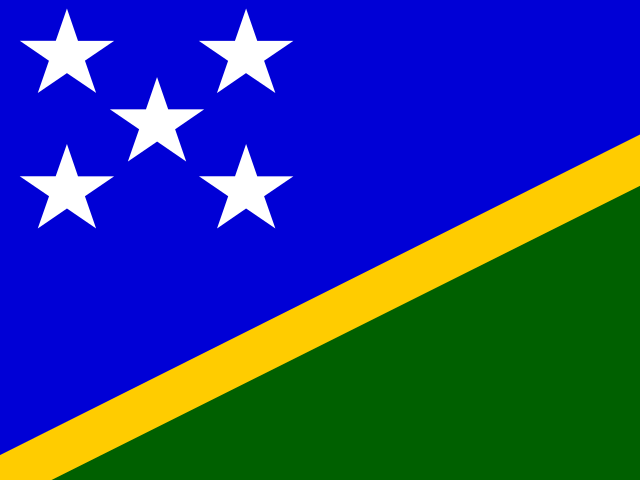
- Description: divided diagonally by a yellow stripe from the lower-left corner; the upper triangle (left side) is blue with five five-pointed white stars in an "X" pattern; the lower triangle is greenMeaning: blue stands for the ocean, green for the land, and yellow for sunshine; the five stars stand for the main island groups
- National colours
- blue, yellow, green, white
- National anthem
- Title: "God Save the King"Lyrics/music: unknownHistory: in use since 1745
- UNESCO World Heritage Sites
- Total World Heritage Sites: 1 (natural)Selected World Heritage Site locales: East Rennell
Economy
- Overview
- lower middle-income Pacific island economy; natural resource rich but environmentally fragile; key agrarian sector; growing Chinese economic relationship; infrastructure damage due to social unrest; metal mining operations
- GDP (PPP)
- $2.07 billion (2024 est.)
- GDP per person (PPP)
- $2,500 (2024 est.)
- GDP growth
- 2.5% (2024 est.)
- Inflation
- 5.9% (2023 est.)
- Unemployment
- 1.5% (2024 est.)
- Farm products
- oil palm fruit, coconuts, sweet potatoes, yams, taro, fruits, pulses, vegetables, cocoa beans, cassava (2023)
- Industries
- fish (tuna), mining, timber
- Exports
- $642.877 million (2024 est.)
- Main exports
- wood, fish, gold, precious metal ore, palm oil (2023)
- Export partners
- China 56%, Australia 11%, Italy 10%, Spain 5%, Netherlands 4% (2023)
- Main imports
- refined petroleum, plastic products, fish, broadcasting equipment, iron structures (2023)
- Import partners
- China 42%, Singapore 13%, Australia 13%, Taiwan 5%, Malaysia 5% (2023)
- Money sent home from abroad
- 5.4% of GDP (2024 est.)
Energy, internet and transport
- Electricity access
- Electrification - total population: 76% (2022 est.)Electrification - urban areas: 79%Electrification - rural areas: 75.4%
- Electricity sources
- Fossil fuels: 90.1% of total installed capacity (2023 est.)Solar: 5.4% of total installed capacity (2023 est.)Hydroelectricity: 0.9% of total installed capacity (2023 est.)Biomass and waste: 3.6% of total installed capacity (2023 est.)
- Internet users
- Percent of population: 43% (2023 est.)
- Mobile phones
- Total subscriptions: 485,000 (2022 est.)Subscriptions per 100 inhabitants: 62 (2022 est.)
- TV and radio
- multi-channel pay-TV is available; Solomon Islands Broadcasting Corporation (SIBC) operates 2 national radio stations and 2 provincial stations; 2 local commercial radio stations; Radio Australia is available via satellite (2019)
- Airports
- 36 (2025)
- Merchant ships
- Total: 25 (2023)By type: general cargo 8, oil tanker 1, other 16
Military and space
- Armed forces
- Ministry of Police, National Security and Correctional Services (MPNSCS): the Royal Solomon Islands Police Force (RSIPF) (2025)
Global issues
- Refugees and displaced people
- IDPs: 1,638 (2023 est.)
- Phone code
- +677
- Internet domain
- .sb