Tonga
Kingdom of Tonga
The only Pacific kingdom never colonised. Hunga Tonga volcano erupted massively in 2022.
See Tonga on the 3D globeTake a quiz
Population100 thousand
Area747 km²
CapitalNuku'alofa
RegionPolynesia
Did you know?
- Sunday trading is banned by its constitution
- Never formally colonised
- The 2022 Hunga Tonga eruption was heard thousands of km away
Key facts about Tonga
- Government
- Constitutional monarchy
- Religion
- Christian ~98%
- Founded / independence
- 1970 (from UK protection)
- Rich in
- Remittances, squash, fishing
- Languages
- English, Tongan
Tongan, English - Currency
- Tongan paʻanga (T$)
- People are called
- Tongan
- Main cities
- Nukuʻalofa, Neiafu
Timeline of Tonga
- 950Tu'i Tonga empire
- 1875Constitution
- 1900British protection
- 1970Independence
- 2022Volcanic eruption
Places to see in Tonga
- Ha'amonga 'a Maui trilithon
- Vava'u humpback whales
- Mapu'a 'a Vaea blowholes
Food and drink
'Ota 'ika (raw fish) · lu pulu
Culture and famous for
The Pacific's only monarchy; whale swimming
Popular sports
Rugby
Geography and climate
- Highest point
- Kao, 1,033 m
- Rivers, lakes and seas
- 169 islands
- Climate
- Tropical
- Coastline
- Has a sea coast
- Population density
- 134 people per km²
Wars and conflicts
- None
Alliances and memberships
Political unions and regional organisations
Pacific Islands ForumCommonwealth of Nations
Tonga in depth
Detailed facts from the CIA World Factbook (public domain, latest edition).
Overview
- History in brief
- The first humans arrived in Tonga around 1000 B.C. The islands’ politics were highly centralized under the Tu’i Tonga, or Tongan king, by A.D. 950, and by 1200, the Tu’i Tonga had expanded his influence throughout Polynesia and into Melanesia and Micronesia. The Tongan Empire began to decline in the 1300s, with civil wars, a military defeat to Samoa, and internal political strife. By the mid-1500s, some Tu’i Tongans were ethnic Samoan, and day-to-day administration of Tonga was transferred to a new position occupied by ethnic Tongans.Dutch navigators explored the islands in the 1600s, followed by the British in the 1770s, who named them the Friendly Islands. Between 1799 and 1852 Tonga went through a period of war and disorder. In the 1830s, a low-ranking chief from Ha’apai began to consolidate control over the islands and was crowned King George TUPOU I in 1845, establishing the only still-extant Polynesian monarchy. During TUPOU's reign (1845–93), Tonga became a unified and independent country with a modern constitution (1875), legal code, and administrative structure. In separate treaties, Germany (1876), Great Britain (1879), and the US (1888) recognized Tonga’s independence. His son and successor, King George TUPOU II, agreed to enter a protectorate agreement with the UK in 1900 after rival Tongan chiefs tried to overthrow him. As a protectorate, Tonga never completely lost its indigenous governance, but it did become more isolated and the social hierarchy became more stratified between a group of nobles and a large class of commoners. Today, about one third of parliamentary seats are reserved for nobles.Tonga regained full control of domestic and foreign affairs and became a fully independent nation within the Commonwealth in 1970. A pro-democracy movement gained steam in the early 2000s, led by ‘Akilisi POHIVA, and in 2006, riots broke out in Nuku’alofa to protest the lack of progress on reform. To appease the activists, in 2008, King George TUPOU V announced he was relinquishing most of his powers leading up to parliamentary elections in 2010 and henceforth most of the monarch’s governmental decisions, except those relating to the judiciary, were to be made in consultation with the prime minister. The 2010 Legislative Assembly was called Tonga’s first democratically elected Parliament. King George TUPOU V died in 2012 and was succeeded by his brother Crown Prince Tupouto‘a Lavaka who ruled as George TUPOU VI. In 2015, ‘Akalisi POHIVA became Tonga
Geography
- Location
- Oceania, archipelago in the South Pacific Ocean, about two-thirds of the way from Hawaii to New Zealand
- Size compared
- four times the size of Washington, D.C.
- Land borders
- Total: 0 km
- Coastline
- 419 km
- Climate
- tropical; modified by trade winds; warm season (December to May), cool season (May to December)
- Terrain
- mostly flat islands with limestone bedrock formed from uplifted coral formation; others have limestone overlying volcanic rock
- Elevation
- Highest point: Kao Volcano on Kao Island 1,046 mLowest point: Pacific Ocean 0 m
- Natural resources
- arable land, fish
- Natural hazards
- cyclones (October to April); earthquakes and volcanic activity on Fonuafo'ouVolcanism: moderate volcanic activity; Fonualei (180 m) has had frequent activity in recent years, and Niuafo'ou (260 m) has forced evacuations; other historically active volcanoes include Late and Tofua
- Notes
- the western islands (making up the Tongan Volcanic Arch) are all of volcanic origin; the eastern islands are nonvolcanic and are composed of coral limestone and sand
- Environmental issues
- deforestation from land being cleared for agriculture and settlement; soil exhaustion; water pollution due to salinization, sewage, and toxic chemicals from farming activities; coral reefs and marine populations threatened
People and society
- Population
- Total: 104,519 (2025 est.)Male: 52,421Female: 52,098
- Nationality
- Noun: Tongan(s)Adjective: Tongan
- Ethnic groups
- Tongan 96.5%, other (European, Fijian, Samoan, Indian, Chinese, other Pacific Islander, other Asian, other) 3.5% (2021 est.)
- Languages
- Tongan only 85%, Tongan and other language 13.9%, Tongan not used at home 1.1% (2021 est.)
- Religions
- Protestant 63.9% (Free Wesleyan Church 34.2%, Free Church of Tonga 11.3%, Church of Tonga 6.8%, Seventh Day Adventist 2.5%, Assembly of God 2.5%, Tokaikolo/Maamafo'ou 1.5%, Constitutional Church of Tonga 1.2%, other Protestant 4%), Church of Jesus Christ 19.7%, Roman Catholic 13.7%, other 2.1%, none 0.6%, no answer 0.1% (2021 est.)
- Median age
- Total: 26.4 years (2025 est.)Male: 25.4 yearsFemale: 26.4 years
- Population growth
- -0.37% (2025 est.)
- Life expectancy
- Total population: 78 years (2024 est.)Male: 76.4 yearsFemale: 79.7 years
- Children per woman
- 2.59 children born/woman (2025 est.)
- Urbanization
- Urban population: 23.2% of total population (2023)Rate of urbanization: 0.99% annual rate of change (2020-25 est.)
- Largest cities
- 23,000 NUKU'ALOFA (2018)
- Literacy
- Total population: 91.1% (2019 est.)Male: 83.8% (2019 est.)Female: 97.6% (2019 est.)
- Years in school
- Total: 18 years (2020 est.)Male: 16 years (2020 est.)Female: 19 years (2020 est.)
Government
- Official names
- Conventional long form: Kingdom of TongaConventional short form: TongaLocal long form: Pule'anga Fakatu'i 'o TongaLocal short form: TongaFormer: Friendly IslandsEtymology: the name is of local origin and is said to mean "island;" the former name, the Friendly Islands, came from Captain James COOK in 1773, based on the welcome he received from the inhabitants
- Government type
- constitutional monarchy
- Capital
- Name: Nuku'alofaGeographic coordinates: 21 08 S, 175 12 WTime difference: UTC+13 (18 hours ahead of Washington, DC, during Standard Time)Daylight saving time: +1hr, begins first Sunday in November; ends second Sunday in JanuaryEtymology: name is said to be composed of the local words nuku, meaning "residence or abode," and alofa, meaning "love;" it may also mean "the south," describing Tonga's position in relation to most other Polynesian islands
- Regions
- 5 island divisions; 'Eua, Ha'apai, Ongo Niua, Tongatapu, Vava'u
- Independence
- 4 June 1970 (from UK protectorate status)
- National holiday
- Official birthday of King TUPOU VI, 4 July (1959)
- Constitution
- History: adopted 4 November 1875, revised 1988, 2016Amendment process: proposed by the Legislative Assembly; passage requires approval by the Assembly in each of three readings, the unanimous approval of the Privy Council (a high-level advisory body to the monarch), the Cabinet, and assent to by the monarch
- Legal system
- English common law
- Voting age
- 21 years of age; universal
- Flag meaning
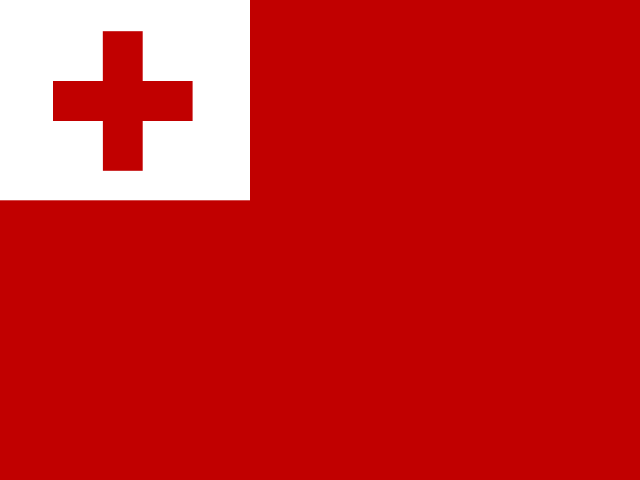
- Description: red with a red cross on a white rectangle in the upper-left cornerMeaning: the cross stands for Christianity in Tonga, red for Christ's blood and sacrifice, and white for purity
- National symbols
- red cross on white field
- National colours
- red, white
- National anthem
- Title: "Ko e fasi 'o e tu'i 'o e 'Otu Tonga" (Song of the King of the Tonga Islands)Lyrics/music: Uelingatoni Ngu TUPOUMALOHI/Karl Gustavus SCHMITTHistory: in use since 1874; more commonly known as "Fasi Fakafonua" (National Song)
Economy
- Overview
- upper middle-income Pacific island economy; enormous diaspora and remittance reliance; key tourism and agricultural sectors; major fish exporter; rapidly growing Chinese infrastructure investments; rising methamphetamine hub
- GDP (PPP)
- $740.082 million (2023 est.)
- GDP per person (PPP)
- $7,100 (2023 est.)
- GDP growth
- 2.1% (2023 est.)
- Inflation
- 3.2% (2024 est.)
- Unemployment
- 2.2% (2024 est.)
- Below poverty line
- 20.6% (2021 est.)
- Farm products
- coconuts, pumpkins/squash, cassava, sweet potatoes, vegetables, yams, taro, root vegetables, plantains, lemons/limes (2023)
- Industries
- tourism, construction, fishing
- Exports
- $119.511 million (2024 est.)
- Main exports
- refined petroleum, gold, processed fruits and nuts, cassava, fish (2023)
- Export partners
- Guyana 17%, USA 17%, NZ 15%, Australia 15%, UAE 12% (2023)
- Main imports
- refined petroleum, plastic products, poultry, cars, sheep and goat meat (2023)
- Import partners
- Fiji 27%, NZ 24%, China 21%, Australia 8%, USA 5% (2023)
- Money sent home from abroad
- 50% of GDP (2023 est.)
Energy, internet and transport
- Electricity access
- Electrification - total population: 100% (2022 est.)
- Electricity sources
- Fossil fuels: 89% of total installed capacity (2023 est.)Solar: 9.6% of total installed capacity (2023 est.)Wind: 1.4% of total installed capacity (2023 est.)
- Internet users
- Percent of population: 59% (2023 est.)
- Mobile phones
- Total subscriptions: 64,800 (2022 est.)Subscriptions per 100 inhabitants: 62 (2022 est.)
- TV and radio
- 1 state-owned TV station and 3 privately owned TV stations; satellite and cable TV services available; 1 state-owned and 5 privately owned radio stations; Radio Australia available via satellite (2019)
- Airports
- 6 (2025)
- Merchant ships
- Total: 29 (2023)By type: container ship 1, general cargo 13, oil tanker 1, other 14
Military and space
- Armed forces
- His Majesty's Armed Forces Tonga (HMAF; aka Tonga Defense Services): Tonga Royal Guard, Tonga Land Force (Royal Tongan Marines), Tonga Navy, Air WingMinistry of Police and Fire Services: Tonga Police Force (2025)
- Military spending
- 1.8% of GDP (2024 est.)
- Military service
- 16-25 years of age for men and women to apply for trainee soldier; no conscription (2025)
- Phone code
- +676
- Internet domain
- .to