Tuvalu
Tuvalu
One of the world's smallest nations; a 2023 treaty lets Tuvaluans migrate to Australia as seas rise.
See Tuvalu on the 3D globeTake a quiz
Population10 thousand
Area26 km²
CapitalFunafuti
RegionPolynesia
Did you know?
- Earns money from its ".tv" internet domain
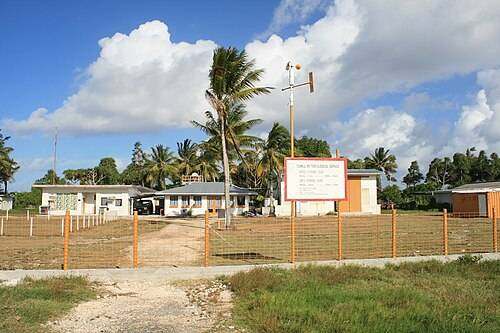
- The airport runway doubles as a sports field
- One of the world's least visited countries
Key facts about Tuvalu
- Government
- Parliamentary constitutional monarchy (Commonwealth realm)
- Religion
- Christian ~97%
- Founded / independence
- 1978 (from UK)
- Rich in
- .tv domain income, fishing licences
- Languages
- English, Tuvaluan
Tuvaluan, English - Currency
- Australian dollar ($), Tuvaluan dollar ($)
- People are called
- Tuvaluan
- Main cities
- Funafuti
Timeline of Tuvalu
- 1892British protectorate
- 1975Splits from Kiribati
- 1978Independence
- 2023Falepili treaty with Australia
Places to see in Tuvalu
- Funafuti Conservation Area
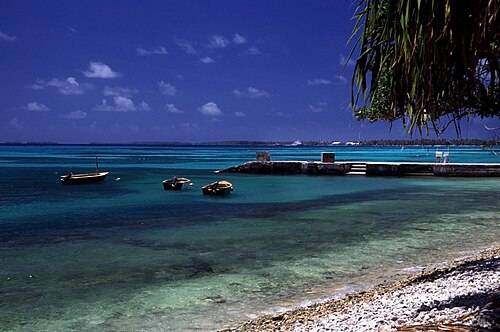
- Funafuti lagoon
Food and drink
Pulaka (swamp taro) · fish
Culture and famous for
Fatele dance
Popular sports
Football, te ano
Geography and climate
- Highest point
- Unnamed point on Niulakita, 4.6 m
- Rivers, lakes and seas
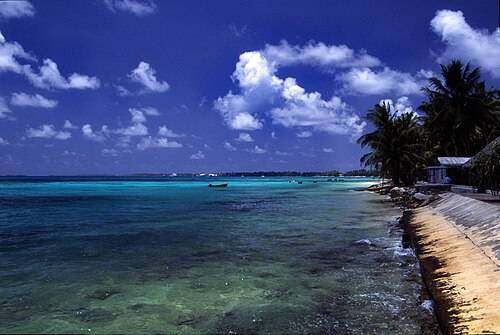
- Nine coral islands
- Climate
- Tropical
- Coastline
- Has a sea coast
- Population density
- 385 people per km²
Wars and conflicts
- None
Alliances and memberships
Political unions and regional organisations
Pacific Islands ForumCommonwealth of Nations
Culture, religion and history
Tuvalu in depth
Detailed facts from the CIA World Factbook (public domain, latest edition).
Overview
- History in brief
- Voyagers from either Samoa or Tonga first populated Tuvalu in the first millennium A.D., and the islands provided a stepping-stone for various Polynesian communities that subsequently settled in Melanesia and Micronesia. Tuvalu eventually came under Samoan and Tongan spheres of influence, although proximity to Micronesia allowed some Micronesian communities to flourish in Tuvalu, in particular on Nui Atoll. In the late 1700s and early 1800s, a series of American, British, Dutch, and Russian ships visited the islands, which were named the Ellice Islands in 1819.The UK declared a protectorate over islands in 1892 and merged them with the Micronesian Gilbert Islands. The Gilbert and Ellice Islands Protectorate became a colony in 1916. During World War II, the US set up military bases on a few islands, and in 1943, after Japan captured many of the northern Gilbert Islands, the UK transferred administration of the colony southward to Funafuti. After the war, Tarawa in the Gilbert Islands was once again made the colony’s capital, and the center of power was firmly in the Gilbert Islands, including the colony’s only secondary school. Amid growing tensions with the Gilbertese, Tuvaluans voted to secede from the colony in 1974, were granted self-rule in 1975, and gained independence in 1978 as Tuvalu. In 1979, the US relinquished its claims to the Tuvaluan islands in a treaty of friendship.
Geography
- Location
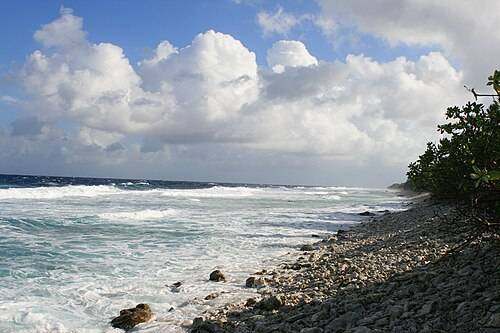
- Oceania, island group consisting of nine coral atolls in the South Pacific Ocean, about half way from Hawaii to Australia
- Size compared
- about the size of Washington, D.C.
- Land borders
- Total: 0 km
- Coastline
- 24 km
- Climate
- tropical; moderated by easterly trade winds (March to November); westerly gales and heavy rain (November to March)
- Terrain
- low-lying and narrow coral atolls
- Elevation
- Highest point: unnamed location 5 mLowest point: Pacific Ocean 0 mMean elevation: 2 m
- Natural resources
- fish, coconut (copra)
- Natural hazards
- severe tropical storms are usually rare, but in 1997 there were three cyclones; low levels of islands make them sensitive to changes in sea level
- Notes
- one of the smallest and most remote countries on earth; six of the nine coral atolls -- Nanumea, Nui, Vaitupu, Nukufetau, Funafuti, and Nukulaelae -- have lagoons open to the ocean; Nanumaya and Niutao have landlocked lagoons; Niulakita does not have a lagoon
- Environmental issues
- limited freshwater resources; beach erosion; deforestation; damage to coral reefs; rising sea levels
People and society
- Population
- Total: 11,824 (2025 est.)Male: 5,865Female: 5,959
- Nationality
- Noun: Tuvaluan(s)Adjective: Tuvaluan
- Ethnic groups
- Tuvaluan 97%, Tuvaluan/I-Kiribati 1.6%, Tuvaluan/other 0.8%, other 0.6% (2017 est.)
- Languages
- Tuvaluan (official), English (official), Samoan, Kiribati (on the island of Nui)
- Religions
- Protestant 92.7% (Congregational Christian Church of Tuvalu 85.9%, Brethren 2.8%, Seventh Day Adventist 2.5%, Assemblies of God 1.5%), Baha'i 1.5%, Jehovah's Witness 1.5%, other 3.9%, none or refused 0.4% (2017 est.)
- Median age
- Total: 28.1 years (2025 est.)Male: 26.8 yearsFemale: 28.8 years
- Population growth
- 0.75% (2025 est.)
- Life expectancy
- Total population: 69 years (2024 est.)Male: 66.5 yearsFemale: 71.6 years
- Children per woman
- 2.76 children born/woman (2025 est.)
- Urbanization
- Urban population: 66.2% of total population (2023)Rate of urbanization: 2.08% annual rate of change (2020-25 est.)
- Largest cities
- 7,000 FUNAFUTI (capital) (2018)
- Literacy
- Total population: 100% (2022 est.)Male: 100% (2022 est.)Female: 100% (2022 est.)
Government
- Official names
- Conventional long form: noneConventional short form: TuvaluLocal long form: noneLocal short form: TuvaluFormer: Ellice IslandsEtymology: the name in the local language means "group of eight" or "eight standing together," referring to eight of the country's nine islands; the remaining island, Nui, was left out of the original grouping because its inhabitants spoke a different language; the former name was given in honor of Canadian shipping company owner Alexander Ellice, who owned a ship that visited the islands in 1819
- Government type
- parliamentary democracy under a constitutional monarchy; a Commonwealth realm
- Capital
- Name: FunafutiGeographic coordinates: 8 31 S, 179 13 ETime difference: UTC+12 (17 hours ahead of Washington, DC, during Standard Time)Etymology: the town has the same name as the island it is located on; the name may either come from the Polynesian word futi (banana) or the name Futi, one of the wives of a local ruler, with the word funa added as a feminine prefix
- Regions
- 7 island councils and 1 town council*; Funafuti*, Nanumaga, Nanumea, Niutao, Nui, Nukufetau, Nukulaelae, Vaitupu
- Independence
- 1 October 1978 (from the UK)
- National holiday
- Independence Day, 1 October (1978)
- Constitution
- History: previous 1978 (at independence); latest effective 1 October 1986Amendment process: proposed by the House of Assembly; passage requires at least two-thirds majority vote by the Assembly membership in the final reading
- Legal system
- mixed system of English common law and local customary law
- Voting age
- 18 years of age; universal
- Flag meaning
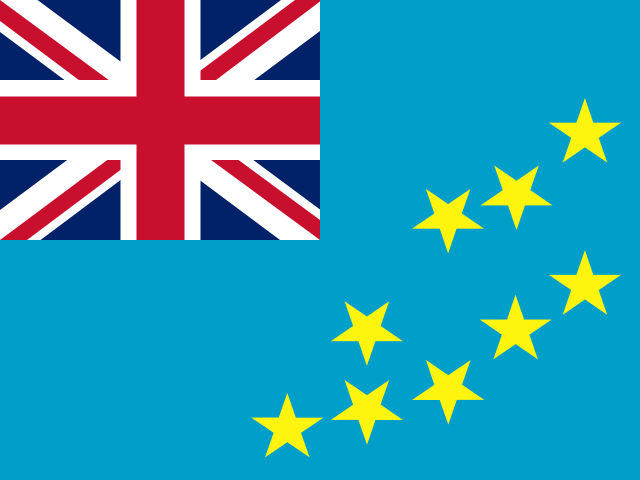
- Description: light blue with the UK flag in the upper-left quadrant; the right half of the flag has nine five-pointed yellow starsMeaning: the stars represent a map of the country, with each symbolizing an atoll in the ocean
- National symbols
- maneapa (native meeting house)
- National colours
- light blue, yellow
- National anthem
- Title: "God Save the King"Lyrics/music: unknownHistory: used since 1745
Economy
- Overview
- upper middle-income Pacific island economy; extremely environmentally fragile; currency pegged to Australian dollar; large international aid recipient; subsistence agrarian sector; Te Kakeega sustainable development; domain name licensing incomes
- GDP (PPP)
- $57.055 million (2023 est.)
- GDP per person (PPP)
- $5,800 (2023 est.)
- GDP growth
- 3.9% (2023 est.)
- Inflation
- 11.5% (2022 est.)
- Farm products
- coconuts, vegetables, tropical fruits, bananas, root vegetables, pork, chicken, eggs, pork fat, pork offal (2023)
- Industries
- fishing
- Exports
- $2.232 million (2022 est.)
- Main exports
- fish (2023)
- Export partners
- Thailand 88%, Japan 6%, Philippines 3%, Ireland 1%, USA 1% (2023)
- Main imports
- ships, refined petroleum, iron structures, fish, hand tools (2023)
- Import partners
- China 42%, Fiji 24%, Japan 11%, Australia 11%, NZ 4% (2023)
- Money sent home from abroad
- 4.2% of GDP (2023 est.)
Energy, internet and transport
- Electricity access
- Electrification - total population: 100% (2022 est.)Electrification - urban areas: 100%Electrification - rural areas: 99.1%
- Internet users
- Percent of population: 74% (2023 est.)
- Mobile phones
- Total subscriptions: 9,880 (2022 est.)Subscriptions per 100 inhabitants: 99 (2022 est.)
- TV and radio
- no TV stations; many households use satellite dishes to watch foreign TV; 1 state-owned radio station, Radio Tuvalu, includes relays from international broadcasters (2019)
- Airports
- 1 (2025)
- Merchant ships
- Total: 270 (2023)By type: bulk carrier 21, container ship 3, general cargo 29, oil tanker 19, other 198
Military and space
- Armed forces
- no regular military forces; Tuvalu Police Force
- Phone code
- +688
- Internet domain
- .tv