Vanuatu
Republic of Vanuatu
Ruled jointly by Britain and France as a "condominium".
See Vanuatu on the 3D globeTake a quiz
Population330 thousand
Area12,189 km²
CapitalPort Vila
RegionMelanesia
Did you know?
- Pentecost land divers inspired bungee jumping
- Mount Yasur is one of the most accessible active volcanoes
- Has an underwater post office
Key facts about Vanuatu
- Government
- Parliamentary republic
- Religion
- Christian ~83%
- Founded / independence
- 1980 (from UK and France)
- Rich in
- Tourism, kava, copra, citizenship sales
- Languages
- Bislama, English, French
Bislama, English, French; over 100 languages - Currency
- Vanuatu vatu (Vt)
- People are called
- Ni-Vanuatu
- Main cities
- Port Vila, Luganville
Timeline of Vanuatu
- 1606Spanish explorer arrives
- 1906Anglo-French condominium
- 1980Independence and Coconut War
Places to see in Vanuatu
- Mount Yasur volcano
- Champagne Beach
- Millennium Cave
- Pentecost land diving
Food and drink
Lap lap · kava
Culture and famous for
Land diving (origin of bungee jumping); sand drawings (UNESCO)
Popular sports
Football, cricket
Geography and climate
- Highest point
- Mount Tabwemasana, 1,877 m
- Rivers, lakes and seas
- 83 islands
- Climate
- Tropical
- Coastline
- Has a sea coast
- Population density
- 27 people per km²
Wars and conflicts
- 1980 Coconut War
Alliances and memberships
Political unions and regional organisations
Pacific Islands ForumCommonwealth of Nations
Vanuatu in depth
Detailed facts from the CIA World Factbook (public domain, latest edition).
Overview
- History in brief
- Austronesian speakers from the Solomon Islands first settled Vanuatu around 2000 B.C. By around 1000, localized chieftain systems began to develop on the islands. Around 1600, Melanesian Chief ROI MATA united some of the islands of modern-day Vanuatu under his rule. In 1606, a Portuguese explorer was the first European to see Vanuatu's Banks Islands and Espiritu Santo, setting up a short-lived settlement on the latter. The next European explorers arrived in the 1760s, and the islands -- then known as the New Hebrides -- were frequented by whalers in the 1800s. European interest in harvesting the islands’ sandalwood trees caused conflict with the inhabitants. In the 1860s, European planters in Australia, Fiji, New Caledonia, and Samoa needed labor and kidnapped almost half the adult males on the islands to work as indentured servants.With growing and overlapping interests in the islands, France and the UK agreed that the New Hebrides would be neutral in 1878 and established a joint naval commission in 1887. In 1906, the two countries created the UK-France condominium to jointly administer the islands, with separate laws, police forces, currencies, and education and health systems. The condominium arrangement was dysfunctional, and the UK used France’s initial defeat in World War II to assert greater control over the islands. During the war, the US stationed up to 50,000 soldiers in Vanuatu. In 1945, they withdrew and sold their equipment, leading to the rise of political and religious movements known as "cargo cults," such as the John Frum movement.The UK-France condominium was reestablished after World War II. The UK was interested in moving the condominium toward independence in the 1960s, but France was hesitant. Political parties agitating for independence began to form, largely divided along linguistic lines. France eventually relented, and elections were held in 1974, with independence granted to the newly named Vanuatu in 1980 under English-speaking Prime Minister Walter LINI. The Nagriamel Movement, with support from French-speaking landowners, then declared the island of Espiritu Santo independent from Vanuatu, but the short-lived state was dissolved 12 weeks later. Linguistic divisions have lessened over time, but highly fractious political parties have led to weak coalition governments that require support from both Anglophone and Francophone parties. Since 2008, prime ministers have been ousted more than a dozen times through no-confidence mot
Geography
- Location
- Oceania, group of islands in the South Pacific Ocean, about three-quarters of the way from Hawaii to Australia
- Size compared
- slightly larger than Connecticut
- Land borders
- Total: 0 km
- Coastline
- 2,528 km
- Climate
- tropical; moderated by southeast trade winds from May to October; moderate rainfall from November to April; may be affected by cyclones from December to April
- Terrain
- mostly mountainous islands of volcanic origin; narrow coastal plains
- Elevation
- Highest point: Tabwemasana 1,877 mLowest point: Pacific Ocean 0 m
- Natural resources
- manganese, hardwood forests, fish
- Natural hazards
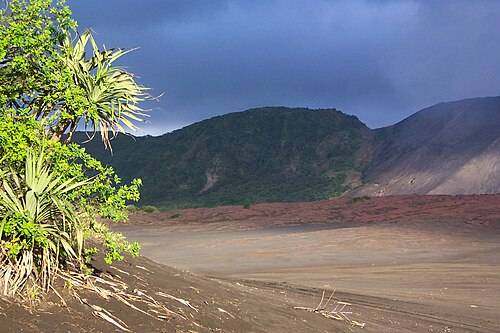
- tropical cyclones (January to April); volcanic activity; volcanism also causes minor earthquakes; tsunamisVolcanism: significant volcanic activity with multiple eruptions in recent years; Yasur (361 m), one of the world's most active volcanoes, has experienced continuous activity in recent centuries; other historically active volcanoes include Aoba, Ambrym, Epi, Gaua, Kuwae, Lopevi, Suretamatai, and Traitor's Head
- Notes
- a Y-shaped chain of four main islands and 80 smaller islands; several of the islands have active volcanoes, including several underwater volcanoes
- Environmental issues
- water pollution; limited potable water; inadequate sanitation; deforestation
People and society
- Population
- Total: 318,007 (2024 est.)Male: 157,932Female: 160,075
- Nationality
- Noun: Ni-Vanuatu (singular and plural)Adjective: Ni-Vanuatu
- Ethnic groups
- Ni-Vanuatu 99%, other 1% (European, Asian, other Melanesian, Polynesian, Micronesian, other) (2020 est.)
- Languages
- indigenous languages (more than 100) 82.6%, Bislama (official; creole) 14.5%, English (official) 2.1%, French (official) 0.8% (2020 est.)
- Religions
- Protestant 39.9% (Presbyterian 27.2%, Seventh Day Adventist 14.8%, Anglican 12%, Churches of Christ 5%, Assemblies of God 4.9%, Neil Thomas Ministry/Inner Life Ministry 3.2%), Roman Catholic 12.1%, Apostolic 2.3%, Church of Jesus Christ 1.8%, customary beliefs (including Jon Frum cargo cult) 3.1%, other 12%, none 1.4%, unspecified 0.1% (2020 est.)
- Median age
- Total: 24.9 years (2025 est.)Male: 24.1 yearsFemale: 25 years
- Population growth
- 1.51% (2025 est.)
- Life expectancy
- Total population: 75.7 years (2024 est.)Male: 74 yearsFemale: 77.4 years
- Children per woman
- 2.46 children born/woman (2025 est.)
- Urbanization
- Urban population: 26% of total population (2023)Rate of urbanization: 2.55% annual rate of change (2020-25 est.)
- Largest cities
- 53,000 PORT-VILA (capital) (2018)
- Literacy
- Total population: 88% (2023 est.)Male: 87.7% (2023 est.)Female: 88.2% (2023 est.)
Government
- Official names
- Conventional long form: Republic of VanuatuConventional short form: VanuatuLocal long form: Ripablik blong VanuatuLocal short form: VanuatuFormer: New HebridesEtymology: the name means "Our land forever" in several of the Austronesian languages spoken on the islands; the former name, New Hebrides, was given by Captain James COOK in 1774 because he thought they looked similar to the Hebrides islands off the coast of Scotland
- Government type
- parliamentary republic
- Capital
- Name: Port-Vila (on Efate)Geographic coordinates: 17 44 S, 168 19 ETime difference: UTC+11 (16 hours ahead of Washington, DC, during Standard Time)Etymology: the local name of Vila is sometimes used alone for the the port town; its meaning is unknown
- Regions
- 6 provinces; Malampa, Penama, Sanma, Shefa, Tafea, Torba
- Independence
- 30 July 1980 (from France and the UK)
- National holiday
- Independence Day, 30 July (1980)
- Constitution
- History: draft completed August 1979, finalized by constitution conference 19 September 1979, ratified by French and British Governments 23 October 1979, effective 30 July 1980 at independenceAmendment process: proposed by the prime minister or by the Parliament membership; passage requires at least two-thirds majority vote by Parliament in special session with at least three fourths of the membership; passage of amendments affecting the national and official languages, or the electoral and parliamentary system also requires approval in a referendum
- Legal system
- mixed system of English common law, French law, and customary law
- Voting age
- 18 years of age; universal
- Flag meaning
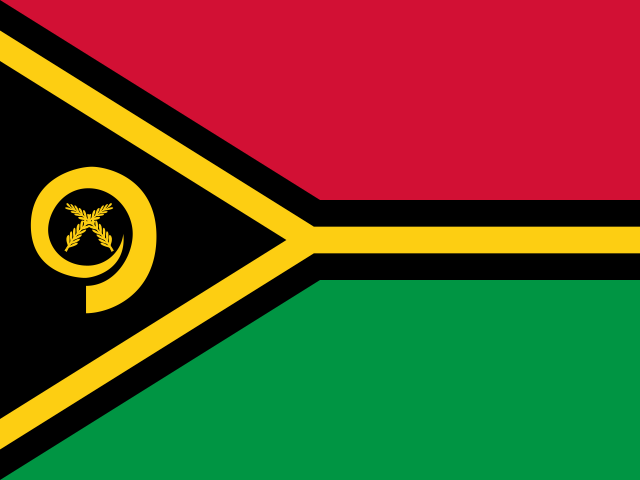
- Description: two equal horizontal bands of red (top) and green with a black isosceles triangle (based on the left side); a black-edged yellow stripe in the shape of a horizontal "Y" faces the left side and encloses the triangle; a boar's tusk in the triangle circles two crossed namele fern fronds, all in yellowMeaning: red stands for unity and the blood of men and boars, green for the richness of the islands, and black for the ni-Vanuatu people; the yellow "Y" reflects the islands' layout in the Pacific Ocean and symbolizes the light of the Gospel; the boar's tusk is a symbol of prosperity; the ferns represent peace
- National symbols
- boar's tusk with crossed fern fronds
- National colours
- red, black, green, yellow
- National anthem
- Title: "Yumi, Yumi, Yumi" (We, We, We)Lyrics/music: Francois Vincent AYSSAVHistory: adopted 1980; the anthem is written in the native Bislama
- UNESCO World Heritage Sites
- Total World Heritage Sites: 1 (cultural)Selected World Heritage Site locales: Chief Roi Mata’s Domain
Economy
- Overview
- lower-middle income Pacific island economy; extremely reliant on subsistence agriculture and tourism; environmentally fragile; struggling post-pandemic and Tropical Cyclone Harold rebound; sizeable inflation; road infrastructure aid from Australia
- GDP (PPP)
- $1.039 billion (2024 est.)
- GDP per person (PPP)
- $3,200 (2024 est.)
- GDP growth
- 4% (2024 est.)
- Inflation
- 11.2% (2023 est.)
- Unemployment
- 5.1% (2024 est.)
- Below poverty line
- 15.9% (2019 est.)
- Farm products
- coconuts, oranges, yams, cabbages, taro, bananas, chillies/peppers, chestnuts, sweet potatoes, cassava (2023)
- Industries
- food and fish freezing, wood processing, meat canning
- Exports
- $152.087 million (2022 est.)
- Main exports
- fish, ships, perfume plants, wood, copra (2023)
- Export partners
- Thailand 49%, Japan 19%, Cote d'Ivoire 10%, China 7%, USA 3% (2023)
- Main imports
- refined petroleum, ships, plastic products, poultry, trucks (2023)
- Import partners
- China 26%, Australia 15%, Angola 11%, Fiji 9%, NZ 8% (2023)
- Money sent home from abroad
- 12.9% of GDP (2023 est.)
Energy, internet and transport
- Electricity access
- Electrification - total population: 70% (2022 est.)Electrification - urban areas: 97%Electrification - rural areas: 60.7%
- Electricity sources
- Fossil fuels: 74.9% of total installed capacity (2023 est.)Solar: 8.7% of total installed capacity (2023 est.)Wind: 5% of total installed capacity (2023 est.)Hydroelectricity: 11.2% of total installed capacity (2023 est.)Biomass and waste: 0.1% of total installed capacity (2023 est.)
- Internet users
- Percent of population: 46% (2023 est.)
- Mobile phones
- Total subscriptions: 256,000 (2022 est.)Subscriptions per 100 inhabitants: 78 (2022 est.)
- TV and radio
- 1 state-owned TV station; multi-channel pay TV available; state-owned Radio Vanuatu has 2 radio stations; 2 privately owned radio broadcasters; multiple international broadcasts available (2023)
- Airports
- 31 (2025)
- Merchant ships
- Total: 338 (2023)By type: bulk carrier 11, container ship 3, general cargo 101, other 223
Military and space
- Armed forces
- no regular military forces; Vanuatu Police Force (VPF)
Global issues
- Refugees and displaced people
- IDPs: 2,336 (2024 est.)
- Phone code
- +678
- Internet domain
- .vu