Angola
Republic of Angola
Home of the Kingdom of Kongo and Ndongo (Queen Nzinga). Portuguese for nearly 500 years and a major slave-trade source. A Cold War civil war followed independence.
See Angola on the 3D globeTake a quiz
Population38 million
Area1,246,700 km²
CapitalLuanda
RegionMiddle Africa
Did you know?
- The giant sable antelope lives only here
- Luanda has been called one of the world's most expensive cities
- Kizomba dance began here
Key facts about Angola
- Government
- Presidential republic
- Religion
- Christian ~90% (Catholic ~41%)
- Founded / independence
- 1975 (from Portugal)
- Rich in
- Oil, diamonds
- Languages
- Portuguese
Portuguese; Umbundu, Kimbundu, Kikongo - Currency
- Angolan kwanza (Kz)
- People are called
- Angolan
- Main cities
- Luanda, Lubango, Huambo, Benguela
Timeline of Angola
- 1482Portuguese arrive
- 1575Luanda founded
- 1961Independence war
- 1975Independence
- 2002Civil war ends
Places to see in Angola
- Kalandula Falls
- Fortress of São Miguel, Luanda
- Namib desert coast
- Tundavala Gap
- Kissama National Park
Food and drink
Muamba de galinha (chicken stew) · funge
Culture and famous for
Kizomba and semba music; Kuduro dance
Popular sports
Basketball, football
Geography and climate
- Highest point
- Morro do Moco, 2,620 m
- Rivers, lakes and seas
- Kwanza, Cunene, Zambezi headwaters
- Climate
- Tropical; dry south
- Coastline
- Has a sea coast
- Population density
- 30 people per km²
Wars and conflicts
- Independence War 1961–74
- Civil War 1975–2002
Empires and states that once stood here
Alliances and memberships
Political unions and regional organisations
Angola in depth
Detailed facts from the CIA World Factbook (public domain, latest edition).
Overview
- History in brief
- Bantu-speaking people settled in the area now called Angola in 6th century A.D.; by the 10th century various Bantu groups had established kingdoms, of which Kongo became the most powerful. From the late-14th to the mid-19th century, a Kingdom of Kongo stretched across central Africa from present-day northern Angola into the current Congo republics. It traded heavily with the Portuguese who, beginning in the 16th century, established coastal colonies and trading posts and introduced Christianity. Angola became a major hub of the transatlantic slave trade conducted by the Portuguese and other European powers -- often in collaboration with local kingdoms, including the Kongo. The Angola area is estimated to have lost as many as 4 million people as a result of the slave trade. The Kingdom of Kongo’s main rival was the Kingdom of Ndongo to its south, whose most famous leader was Nzingha Mbande, the 17th century diplomat to the Portuguese and later Queen, who successfully fought off Portuguese encroachment during her nearly 40-year reign. Smaller kingdoms, such as the Matamba and Ngoyo, often came under the control of the Kongo or Ndongo Kingdoms. During the Berlin Conference of 1884-85, Portugal and other European powers set Angola’s modern borders, but the Portuguese did not fully control large portions of the territory. Portugal gained control of the Kingdom of Kongo in 1888 when Kongo’s King Pedro V sought Portuguese military assistance in exchange for becoming a vassal. After a revolt in 1914, Portugal imposed direct rule over the colony and abolished the Kongo Kingdom.The Angolan National Revolution began in 1961, and in 1975, Angola won its independence when Portugal’s dictatorship fell, a collapse that occurred in part because of growing discontent over conflict in Angola and other colonies. Angola’s multiple independence movements soon clashed, with the Popular Movement for Liberation of Angola (MPLA), led by Agostinho NETO, taking power and the National Union for the Total Independence of Angola (UNITA), led by Jonas SAVIMBI, emerging as its main competitor. After NETO’s death in 1979, Jose Eduardo DOS SANTOS, also of the MPLA, became president. Over time, the Angolan civil war escalated and became a major Cold War conflict, with the Soviet Union and Cuba supporting the MPLA and the US and South Africa supporting UNITA. Up to 1.5 million lives may have been lost -- and 4 million people displaced -- during the more than a quarter-century of fighting. S
Geography
- Location
- Southern Africa, bordering the South Atlantic Ocean, between Namibia and Democratic Republic of the Congo
- Size compared
- about eight times the size of Georgia; slightly less than twice the size of Texas
- Land borders
- Total: 5,369 kmBorder countries: Democratic Republic of the Congo 2,646 km (of which 225 km is the boundary of discontiguous Cabinda Province); Republic of the Congo 231 km; Namibia 1,427 km; Zambia 1,065 km
- Coastline
- 1,600 km
- Climate
- semiarid in south and along coast to Luanda; north has cool, dry season (May to October) and hot, rainy season (November to April)
- Terrain
- narrow coastal plain rises abruptly to vast interior plateau
- Elevation
- Highest point: Moco 2,620 mLowest point: Atlantic Ocean 0 mMean elevation: 1,112 m
- Natural resources
- petroleum, diamonds, iron ore, phosphates, copper, feldspar, gold, bauxite, uranium
- Major rivers
- Rio Zambeze (Zambezi) (shared with Zambia [s], Namibia, Botswana, Zimbabwe, and Mozambique [m]) - 2,740 km; Rio Cubango (Okavango) river source (shared with Namibia and Botswana [m]) - 1,600 kmNote: [s] after country name indicates river source; [m] after country name indicates river mouth
- Natural hazards
- locally heavy rainfall causes periodic flooding on the plateau
- Notes
- the province of Cabinda is an exclave, separated from the rest of the country by the Democratic Republic of the Congo
- Environmental issues
- overuse of pastures and subsequent soil erosion; desertification; deforestation of tropical rainforest from international demand for timber and domestic use as fuel; loss of biodiversity; soil erosion contributing to water pollution and siltation of rivers and dams; inadequate supplies of potable water
People and society
- Population
- Total: 38,984,796 (2025 est.)Male: 19,115,781Female: 19,869,015
- Nationality
- Noun: Angolan(s)Adjective: Angolan
- Ethnic groups
- Ovimbundu 37%, Kimbundu 25%, Bakongo 13%, Mestico (mixed European and native African) 2%, European 1%, other 22%
- Languages
- Portuguese 71.2% (official), Umbundu 23%, Kikongo 8.2%, Kimbundu 7.8%, Chokwe 6.5%, Nhaneca 3.4%, Nganguela 3.1%, Fiote 2.4%, Kwanhama 2.3%, Muhumbi 2.1%, Luvale 1%, other 3.6% (2014 est.)
- Religions
- Roman Catholic 41.1%, Protestant 38.1%, other 8.6%, none 12.3% (2014 est.)
- Median age
- Total: 16.6 years (2025 est.)Male: 15.8 yearsFemale: 16.8 years
- Population growth
- 3.32% (2025 est.)
- Life expectancy
- Total population: 62.9 years (2024 est.)Male: 60.8 yearsFemale: 65.1 years
- Children per woman
- 5.45 children born/woman (2025 est.)
- Urbanization
- Urban population: 68.7% of total population (2023)Rate of urbanization: 4.04% annual rate of change (2020-25 est.)
- Largest cities
- 9.292 million LUANDA (capital), 959,000 Lubango, 905,000 Cabinda, 809,000 Benguela, 783,000 Malanje (2023)
- Literacy
- Total population: 66.2% (2015 est.)Male: 83.8% (2015 est.)Female: 51.9% (2015 est.)
Government
- Official names
- Conventional long form: Republic of AngolaConventional short form: AngolaLocal long form: Republica de AngolaLocal short form: AngolaFormer: People's Republic of AngolaEtymology: in the 15th century, Portuguese explorers derived the name from the title "N'gola," which was held by kings of the Ndongo
- Government type
- presidential republic
- Capital
- Name: LuandaGeographic coordinates: 8 50 S, 13 13 ETime difference: UTC+1 (6 hours ahead of Washington, DC, during Standard Time)Daylight saving time: does not observe daylight savings timeEtymology: the Portuguese named the city São Paulo da Assunção de Loanda (Saint Paul of the Assumption of Loanda); over time, it was shortened to "Luanda," which may derive from a Bantu word meaning "tax" or "duty," in reference to local people paying their dues to the king of the Congo
- Regions
- 21 provinces (provincias, singular - provincia); Bengo, Benguela, Bie, Cabinda, Cuando, Cubango, Cuanza-Norte, Cuanza-Sul, Cunene, Huambo, Huila, Icolo e Bengo, Luanda, Lunda-Norte, Lunda-Sul, Malanje, Moxico, Moxico Leste, Namibe, Uige, Zaire
- Independence
- 11 November 1975 (from Portugal)
- National holiday
- Independence Day, 11 November (1975)
- Constitution
- History: previous 1975, 1992; latest passed by National Assembly 21 January 2010, adopted 5 February 2010Amendment process: proposed by the president of the republic or supported by at least one third of the National Assembly membership; passage requires at least two-thirds majority vote of the Assembly subject to prior Constitutional Court review if requested by the president of the republic
- Legal system
- civil legal system based on Portuguese civil law; no judicial review of legislation
- Voting age
- 18 years of age; universal
- Flag meaning
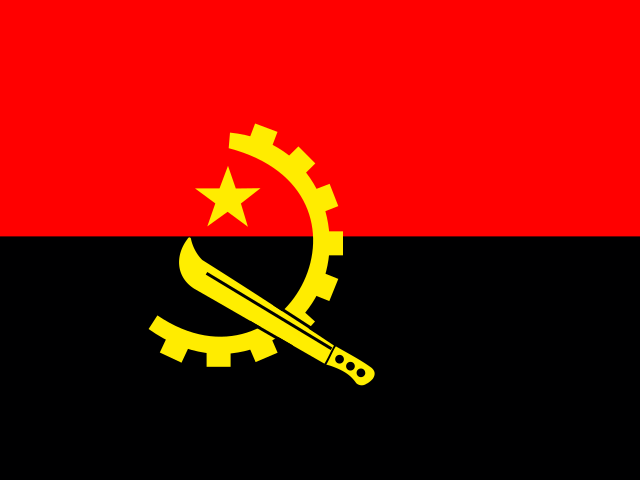
- Description: two equal horizontal bands of red (top) and black with a centered yellow emblem of a five-pointed star inside half a cogwheel, crossed by a machete (in the style of a hammer and sickle)Meaning: red stands for liberty and black for the African continent; the emblem symbolizes workers and peasants
- National symbols
- giant black sable antelope (Palanca negra gigante)
- National colours
- red, black, yellow
- National anthem
- Title: "Angola Avante" (Forward Angola)Lyrics/music: Manuel Rui Alves MONTEIRO/Rui Alberto Vieira Dias MINGAOHistory: adopted 1975
- UNESCO World Heritage Sites
- Total World Heritage Sites: 1 (cultural)Selected World Heritage Site locales: Mbanza-Kongo
Economy
- Overview
- middle-income, oil-dependent African economy; widespread poverty; rising inflation and currency depreciation; seeking diversification through agricultural production; significant corruption in public institutions; major infrastructure investments from China and US; exited OPEC in 2023
- GDP (PPP)
- $278.239 billion (2024 est.)
- GDP per person (PPP)
- $7,300 (2024 est.)
- GDP growth
- 4.4% (2024 est.)
- Inflation
- 28.2% (2024 est.)
- Unemployment
- 14.5% (2024 est.)
- Below poverty line
- 32.3% (2018 est.)
- Farm products
- cassava, bananas, maize, sweet potatoes, sugarcane, tomatoes, pineapples, onions, potatoes, citrus fruits (2023)
- Industries
- petroleum; diamonds, iron ore, phosphates, feldspar, bauxite, uranium, and gold; cement; basic metal products; fish processing; food processing, brewing, tobacco products, sugar; textiles; ship repair
- Exports
- $36.924 billion (2024 est.)
- Main exports
- crude petroleum, diamonds, natural gas, ships, refined petroleum (2023)
- Export partners
- China 40%, India 9%, UAE 6%, Spain 6%, Netherlands 5% (2023)
- Main imports
- refined petroleum, wheat, ships, cars, trucks (2023)
- Import partners
- China 19%, Portugal 10%, UAE 7%, India 6%, USA 5% (2023)
- Money sent home from abroad
- 0% of GDP (2024 est.)
Energy, internet and transport
- Electricity access
- Electrification - total population: 48.5% (2022 est.)Electrification - urban areas: 76.2%Electrification - rural areas: 7.3% (2018 est.)
- Electricity sources
- Fossil fuels: 23.6% of total installed capacity (2023 est.)Solar: 2.2% of total installed capacity (2023 est.)Hydroelectricity: 74% of total installed capacity (2023 est.)Biomass and waste: 0.3% of total installed capacity (2023 est.)
- Internet users
- Percent of population: 45% (2023 est.)
- Mobile phones
- Total subscriptions: 26.4 million (2024 est.)Subscriptions per 100 inhabitants: 70 (2024 est.)
- TV and radio
- state-owned media dominate; only four privately owned newspapers still exist in print form; state-run Radio Nacional de Angola (RNA) is the only outlet to offer programs in local languages such as Bantu; private stations operate in cities, including Catholic Radio Ecclesia, but RNA is the only radio broadcaster with near-national coverage (2023)
- Airports
- 107 (2025)
- Railways
- Total: 2,761 km (2022)Narrow gauge: 2,638 km (2022) 1.067-m gauge
- Merchant ships
- Total: 64 (2023)By type: general cargo 13, oil tanker 8, other 43
Military and space
- Armed forces
- Angolan Armed Forces (Forcas Armadas Angolanas, FAA): Army, Navy (Marinha de Guerra Angola, MGA), Angolan National Air Force (Forca Aerea Nacional Angolana, FANA)Ministry of Interior: National Police, Border Guard Police (2025)
- Military spending
- 1% of GDP (2024 est.)
- Military service
- 20-45 years of age for compulsory and 18-45 years for voluntary military service for men; 20-45 years of age for voluntary service for women; 24-month conscript service obligation; the Navy is entirely staffed with volunteers (2025)
- Space programme
- has a national space strategy with a focus on capacity-building, developing space infrastructure, investing in domestic space sector, supporting socioeconomic growth, and establishing cooperation agreements with foreign technical and scientific institutions in the space industry; contracts with foreign companies to build and launch satellites; operates satellites; cooperates with a variety of foreign space agencies and industries, including those of France, Portugal, Russia, the US, and other African countries; member of the African Space Agency (2025)
- Space milestones
- 2017 - first communications satellite (AngoSat-1) built, launched, and operated by Russia (satellite failed in 2018)2022 - second communications satellite (AngoSat-2) with French-built payload, integrated and launched by Russia2023 - signed US-led Artemis Accords outlining best practices for space exploration2024 - inaugurated a national maritime coordination and surveillance center and country's first satellite mission control center2025 - signed financial agreement with France for construction of country’s first high-resolution remote sensing satellite (ANGEO-1)
Global issues
- Refugees and displaced people
- Refugees: 55,542 (2024 est.)IDPs: 75,308 (2024 est.)
Neighbouring countries
Republic of the CongoDR CongoZambiaNamibia
- Phone code
- +244
- Internet domain
- .ao