Republic of the Congo
Republic of the Congo · République du Congo · Repubilika ya Kongo · Republíki ya Kongó
Part of the Kongo and Loango kingdoms. Marxist state 1969–91; one president has ruled for most years since 1979.
See Republic of the Congo on the 3D globeTake a quiz
Population6.3 million
Area342,000 km²
CapitalBrazzaville
RegionMiddle Africa
Did you know?
- Its "sapeurs" are famous for stylish suits
- Brazzaville faces Kinshasa across the river, the closest pair of capitals
- Congolese rumba is UNESCO heritage
Key facts about Republic of the Congo
- Government
- Presidential republic
- Religion
- Christian ~85%
- Founded / independence
- 1960 (from France)
- Rich in
- Oil, timber
- Languages
- French, Kikongo, Lingala
French; Lingala, Kituba - Currency
- Central African CFA franc (Fr)
- People are called
- Congolese
- Main cities
- Brazzaville, Pointe-Noire, Dolisie
Timeline of Republic of the Congo
- 1880French treaty with Makoko
- 1960Independence
- 1969Marxist state
- 1997Civil war
Places to see in Republic of the Congo
- Odzala-Kokoua National Park
- Brazzaville Basilica
- Pointe-Noire beaches
- Lésio-Louna gorilla reserve
Food and drink
Saka-saka (cassava leaves) · moambe chicken
Culture and famous for
Sapeurs (elegant dandy fashion); Congolese rumba
Popular sports
Football
Geography and climate
- Highest point
- Mont Nabeba, 1,020 m
- Rivers, lakes and seas
- Congo River
- Climate
- Equatorial
- Coastline
- Has a sea coast
- Population density
- 18 people per km²
Wars and conflicts
- Civil wars 1993–99
Alliances and memberships
Political unions and regional organisations
Economy and trade
Republic of the Congo in depth
Detailed facts from the CIA World Factbook (public domain, latest edition).
Overview
- History in brief
- Upon independence in 1960, the former French region of Middle Congo became the Republic of the Congo. From 1968 to 1992, the country was named the People’s Republic of the Congo. A quarter-century of experimentation with Marxism was abandoned in 1990, and a democratically elected government took office in 1992, at which time the country reverted to "the Republic of the Congo" name. A two-year civil war that ended in 1999 restored to power former President Denis SASSOU-Nguesso, who had ruled from 1979 to 1992. A new constitution adopted three years later provided for a multi-party system and a seven-year presidential term, and the next elections retained SASSOU-Nguesso. After a year of renewed fighting, SASSOU-Nguesso and southern-based rebel groups agreed to a final peace accord in 2003. SASSOU-Nguesso was reelected in 2009 and, after passing a constitutional referendum allowing him to run for additional terms, was reelected again in 2016 and 2021. The Republic of the Congo is one of Africa's largest petroleum producers.
Geography
- Location
- Central Africa, bordering the South Atlantic Ocean, between Angola and Gabon
- Size compared
- slightly smaller than Montana; about twice the size of Florida
- Land borders
- Total: 5,554 kmBorder countries: Angola 231 km; Cameroon 494 km; Central African Republic 487 km; Democratic Republic of the Congo 1,775 km; Gabon 2,567 km
- Coastline
- 169 km
- Climate
- tropical; rainy season (March to June); dry season (June to October); persistent high temperatures and humidity; particularly enervating climate astride the Equator
- Terrain
- coastal plain, southern basin, central plateau, northern basin
- Elevation
- Highest point: Mont Nabeba 1,020 mLowest point: Atlantic Ocean 0 mMean elevation: 430 m
- Natural resources
- petroleum, timber, potash, lead, zinc, uranium, copper, phosphates, gold, magnesium, natural gas, hydropower
- Major rivers
- Oubangui (Ubangi) (shared with Central African Republic [s] and Democratic Republic of Congo [m]) - 2,270 kmNote: [s] after country name indicates river source; [m] after country name indicates river mouth
- Natural hazards
- seasonal flooding
- Notes
- about 70% of the population lives in Brazzaville, Pointe-Noire, or along the railroad between them
- Environmental issues
- air pollution from vehicle emissions; water pollution from raw sewage; tap water not potable; deforestation; wildlife protection
People and society
- Population
- Total: 6,097,665 (2024 est.)Male: 3,045,973Female: 3,051,692
- Nationality
- Noun: Congolese (singular and plural)Adjective: Congolese or Congo
- Ethnic groups
- Kongo (Bakongo) 40.5%, Teke 16.9%, Mbochi 13.1%, foreigner 8.2%, Sangha 5.6%, Mbere/Mbeti/Kele 4.4%, Punu 4.3%, Pygmy 1.6%, Oubanguiens 1.6%, Duma 1.5%, Makaa 1.3%, other and unspecified 1% (2014-15 est.)
- Languages
- French (official), French Lingala and Monokutuba (trade languages), many local languages and dialects (of which Kikongo is the most widespread)Major-language sample(s): Buku oyo ya bosembo ya Mokili Mobimba Ezali na Makanisi ya Liboso Mpenza. (Lingala)The World Factbook, the indispensable source for basic information.
- Religions
- Roman Catholic 33.1%, Awakening Churches/Christian Revival 22.3%, Protestant 19.9%, Salutiste 2.2%, Muslim 1.6%, Kimbanguist 1.5%, other 8.1%, none 11.3% (2007 est.)
- Median age
- Total: 20.9 years (2025 est.)Male: 20.5 yearsFemale: 20.9 years
- Population growth
- 2.36% (2025 est.)
- Life expectancy
- Total population: 72.9 years (2024 est.)Male: 71.5 yearsFemale: 74.3 years
- Children per woman
- 3.72 children born/woman (2025 est.)
- Urbanization
- Urban population: 69.2% of total population (2023)Rate of urbanization: 3.19% annual rate of change (2020-25 est.)
- Largest cities
- 2.638 million BRAZZAVILLE (capital), 1.336 million Pointe-Noire (2023)
Government
- Official names
- Conventional long form: Republic of the CongoConventional short form: Congo (Brazzaville)Local long form: République du CongoLocal short form: CongoFormer: French Congo, Middle Congo, People's Republic of the Congo, Congo/BrazzavilleEtymology: named for the Congo River, which makes up much of the country's eastern border; the river name derives from Kongo, a Bantu kingdom in the area
- Government type
- presidential republic
- Capital
- Name: BrazzavilleGeographic coordinates: 4 15 S, 15 17 ETime difference: UTC+1 (6 hours ahead of Washington, DC, during Standard Time)Etymology: named after the Italian-born French explorer and humanitarian, Pierre Savorgnan de BRAZZA (1852-1905), who founded the town in 1883
- Regions
- 15 departments; Bouenza, Brazzaville, Congo-Oubangui, Cuvette, Cuvette-Ouest, Djoue-Lefini, Kouilou, Lekoumou, Likouala, Niari, Nkeni-Alima, Plateaux, Pointe-Noire, Pool, Sangha
- Independence
- 15 August 1960 (from France)
- National holiday
- Independence Day, 15 August (1960)
- Constitution
- History: several previous; latest approved by referendum 25 October 2015Amendment process: proposed by the president of the republic or by Parliament; passage of presidential proposals requires Supreme Court review followed by approval in a referendum; such proposals may also be submitted directly to Parliament, in which case passage requires at least three-quarters majority vote of both houses in joint session; proposals by Parliament require three-fourths majority vote of both houses in joint session; constitutional articles including those affecting the country’s territory, republican form of government, and secularity of the state are not amendable
- Legal system
- mixed system of French civil law and customary law
- Voting age
- 18 years of age; universal
- Flag meaning
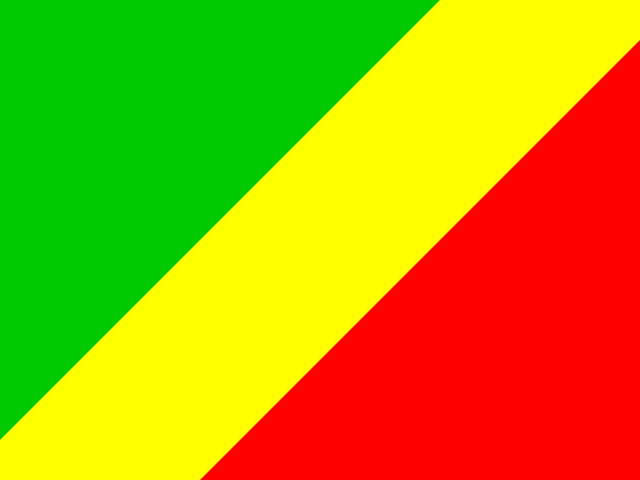
- Description: divided diagonally from the lower-left side by a wide yellow band; the upper triangle (left side) is green, and the lower triangle is redMeaning: green stands for agriculture and forests, and yellow for the people's friendship and nobility; the meaning of the red color is not noted but has been associated with the struggle for independence
- National symbols
- lion, elephant
- National colours
- green, yellow, red
- National anthem
- Title: "La Congolaise" (The Congolese)Lyrics/music: Jacques TONDRA and Georges KIBANGHI/Jean ROYER and Joseph SPADILIEREHistory: originally adopted 1959, restored 1991
- UNESCO World Heritage Sites
- Total World Heritage Sites: 2 (natural)Selected World Heritage Site locales: Sangha Trinational Forest; Forest Massif of Odzala-Kokoua
Economy
- Overview
- primarily an oil- and natural resources-based economy; recovery from mid-2010s oil devaluation has been slow and curtailed by COVID-19; extreme poverty increasing, particularly in southern rural regions; attempting to implement recommended CEMAC reforms; increasing likelihood of debt default
- GDP (PPP)
- $39.147 billion (2024 est.)
- GDP per person (PPP)
- $6,200 (2024 est.)
- GDP growth
- 2.6% (2024 est.)
- Inflation
- 3.1% (2024 est.)
- Unemployment
- 19.7% (2024 est.)
- Farm products
- cassava, sugarcane, oil palm fruit, bananas, plantains, root vegetables, game meat, vegetables, mangoes/guavas, fruits (2023)
- Industries
- petroleum extraction, cement, lumber, brewing, sugar, palm oil, soap, flour, cigarettes
- Exports
- $7.752 billion (2021 est.)
- Main exports
- crude petroleum, refined copper, gold, wood, refined petroleum (2023)
- Export partners
- China 46%, UAE 23%, India 6%, Saudi Arabia 5%, Portugal 3% (2023)
- Main imports
- ships, poultry, garments, iron pipes, refined petroleum (2023)
- Import partners
- China 24%, Angola 20%, Gabon 9%, France 6%, UAE 5% (2023)
- Money sent home from abroad
- 0.3% of GDP (2023 est.)
Energy, internet and transport
- Electricity access
- Electrification - total population: 50.6% (2022 est.)Electrification - urban areas: 67.5%Electrification - rural areas: 12.4%
- Electricity sources
- Fossil fuels: 79.4% of total installed capacity (2023 est.)Solar: 0.2% of total installed capacity (2023 est.)Hydroelectricity: 20.2% of total installed capacity (2023 est.)Biomass and waste: 0.2% of total installed capacity (2023 est.)
- Internet users
- Percent of population: 38% (2023 est.)
- Mobile phones
- Total subscriptions: 5,875,800 (2023 est.)Subscriptions per 100 inhabitants: 96 (2024 est.)
- TV and radio
- 1 state-owned TV and 3 state-owned radio stations; several privately owned TV and radio stations; satellite TV service is available; rebroadcasts of several international broadcasters are available
- Airports
- 56 (2025)
- Railways
- Total: 510 km (2014)Narrow gauge: 510 km (2014) 1.067-m gauge
- Merchant ships
- Total: 11 (2023)By type: oil tanker 1, other 10
Military and space
- Armed forces
- Congolese Armed Forces (Forces Armees Congolaises, FAC): Army, Navy, Congolese Air Force, National GendarmerieMinistry of Interior: National Police (2025)
- Military spending
- 1.2% of GDP (2024 est.)
- Military service
- 18-25 years of age for voluntary military service for men and women (2025)
Global issues
- Refugees and displaced people
- Refugees: 69,766 (2024 est.)
Neighbouring countries
AngolaCameroonCentral African RepublicDR CongoGabon
- Phone code
- +242
- Internet domain
- .cg