Bangladesh
People's Republic of Bangladesh · বাংলাদেশ
Part of Bengal under Mughal and British rule, then East Pakistan from 1947. Won independence in a bloody 1971 war with Indian help. A student uprising in 2024 ousted the long-ruling prime minister.
See Bangladesh on the 3D globeTake a quiz
Population175 million
Area147,570 km²
CapitalDhaka
RegionSouthern Asia
Did you know?
- Cox's Bazar is one of the longest natural sea beaches (about 120 km)
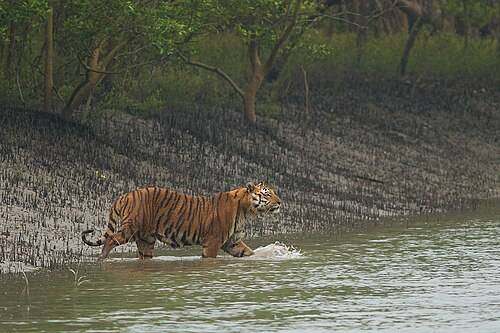
- Home to the Bengal tiger in the Sundarbans
- International Mother Language Day honours its 1952 language movement
Key facts about Bangladesh
- Government
- Parliamentary republic (interim government after 2024 uprising; elections 2026)
- Religion
- Sunni Islam ~91%, Hindu ~8%
- Founded / independence
- 1971 (from Pakistan)
- Rich in
- Garment exports (second largest), jute, natural gas, rice
- Languages
- Bengali
Bengali (Bangla): Sylheti, Chittagonian, Dhakaiya dialects - Currency
- Bangladeshi taka (৳)
- People are called
- Bangladeshi
- Main cities
- Dhaka, Chittagong, Khulna, Rajshahi, Sylhet
Timeline of Bangladesh
- 1757British control after Plassey
- 1947East Pakistan
- 1952Language movement
- 1971Independence
- 1991Return to democracy
- 2024Student uprising
Places to see in Bangladesh
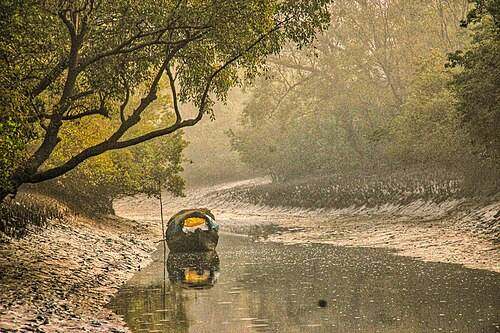
- Sundarbans mangrove forest
- Cox's Bazar beach
- Mosque City of Bagerhat
- Paharpur Buddhist ruins
- Ahsan Manzil, Dhaka
Food and drink
Hilsa fish curry · biryani · bhuna khichuri · mishti sweets
Culture and famous for
Poet Tagore wrote its national anthem; rickshaw art; Grameen microcredit
Popular sports
Cricket, kabaddi
Geography and climate
- Highest point
- Saka Haphong, about 1,050 m
- Rivers, lakes and seas
- Ganges (Padma), Brahmaputra (Jamuna), Meghna — the world's largest river delta
- Climate
- Tropical monsoon
- Coastline
- Has a sea coast
- Population density
- 1,186 people per km²
Wars and conflicts
- Bangladesh Liberation War 1971 (up to 3 million killed)
Empires and states that once stood here
Alliances and memberships
Political unions and regional organisations
SAARCOrganisation of Islamic CooperationCommonwealth of Nations
Bangladesh in depth
Detailed facts from the CIA World Factbook (public domain, latest edition).
Overview
- History in brief
- The huge delta region at the confluence of the Ganges and Brahmaputra River systems -- now referred to as Bangladesh -- was a loosely incorporated outpost of various empires for much of the first millennium A.D. Muslim conversions and settlement in the region began in the 10th century, primarily from Arab and Persian traders and preachers. Europeans established trading posts in the area in the 16th century. Eventually the area known as Bengal, which is primarily Hindu in the western section and mostly Muslim in the eastern half, became part of British India. After the partition of India in 1947, the Muslim-majority area became East Pakistan. Calls for greater autonomy and animosity between the eastern and western areas of Pakistan led to a Bengali independence movement. That movement, led by the Awami League (AL) and supported by India, won the independence war for Bangladesh in 1971.The military overthrew the post-independence AL government in 1975, the first of a series of military coups that resulted in a military-backed government and the subsequent creation of the Bangladesh Nationalist Party (BNP) that took power in 1979. That government also ended in a coup in 1981, followed by military-backed rule until democratic elections were held in 1991. The BNP and AL alternated in power from 1991 to 2008, with the exception of a military-backed, emergency caretaker regime in 2007. The country returned to fully democratic rule in 2008 with the election of the AL and Prime Minister Sheikh HASINA. With the help of international development assistance, Bangladesh is on track to graduate from the UN’s Least Developed Countries (LDC) list in 2026.The economy has grown at an annual average of about 6.25% for the last two decades. Poverty declined from 11.8 percent in 2010 to 5.0 percent in 2022, based on the international poverty line of $2.15 a day (using 2017 Purchasing Power Parity exchange rate). The country made a rapid recovery from the COVID-19 pandemic, but still faces economic challenges.
Geography
- Location
- Southern Asia, bordering the Bay of Bengal, between Burma and India
- Size compared
- slightly larger than Pennsylvania and New Jersey combined; slightly smaller than Iowa
- Land borders
- Total: 4,413 kmBorder countries: Burma 271 km; India 4,142 km
- Coastline
- 580 km
- Climate
- tropical; mild winter (October to March); hot, humid summer (March to June); humid, warm rainy monsoon (June to October)
- Terrain
- mostly flat alluvial plain; hilly in southeast
- Elevation
- Highest point: Mowdok Taung 1,060 mLowest point: Bay of Bengal 0 mMean elevation: 85 m
- Natural resources
- natural gas, arable land, timber, coal
- Major rivers
- Brahmaputra river mouth (shared with China [s] and India) - 3,969 km; Ganges river mouth (shared with India [s]) - 2,704 kmNote: [s] after country name indicates river source; [m] after country name indicates river mouth
- Natural hazards
- droughts; cyclones; much of the country routinely inundated during the summer monsoon season
- Notes
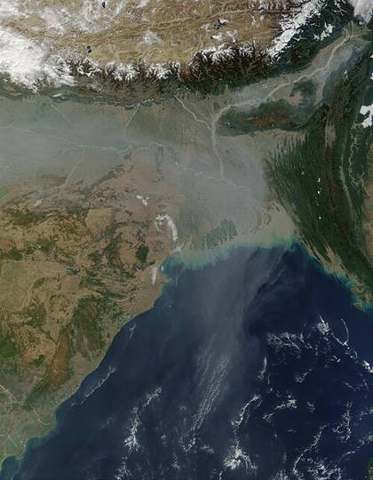
- most of the country is situated on deltas of large rivers flowing from the Himalayas: the Ganges unites with the Jamuna (main channel of the Brahmaputra) and later joins the Meghna to eventually empty into the Bay of Bengal
- Environmental issues
- flooding; water pollution, especially of fishing areas, from the use of commercial pesticides; groundwater pollution from naturally occurring arsenic; falling water tables in the northern and central parts of the country; soil degradation and erosion; deforestation; destruction of wetlands; severe overpopulation with noise pollution
People and society
- Population
- Total: 174,370,536 (2025 est.)Male: 83,908,720Female: 90,461,816
- Nationality
- Noun: Bangladeshi(s)Adjective: Bangladeshi
- Ethnic groups
- Bengali at least 99%, other indigenous ethnic groups 1% (2022 est.)
- Languages
- Bangla 98.8% (official, also known as Bengali), other 1.2% (2011 est.)Major-language sample(s): বিশ্ব ফ্যাক্টবুক, মৌলিক তথ্যের অপরিহার্য উৎস (Bangla)The World Factbook, the indispensable source for basic information.
- Religions
- Muslim 91%, Hindu 8%, other 1% (2022 est.)
- Median age
- Total: 27.8 years (2025 est.)Male: 28.7 yearsFemale: 30.4 years
- Population growth
- 0.91% (2025 est.)
- Life expectancy
- Total population: 75.2 years (2024 est.)Male: 73.1 yearsFemale: 77.5 years
- Children per woman
- 2.25 children born/woman (2025 est.)
- Urbanization
- Urban population: 40.5% of total population (2023)Rate of urbanization: 2.88% annual rate of change (2020-25 est.)
- Largest cities
- 23.210 million DHAKA (capital), 5.380 million Chittagong, 955,000 Khulna, 962,000 Rajshahi, 964,000 Sylhet, 906,000 Bogra (2023)
- Literacy
- Total population: 79% (2022 est.)Male: 81.4% (2022 est.)Female: 76.5% (2022 est.)
- Years in school
- Total: 11 years (2023 est.)Male: 11 years (2023 est.)Female: 12 years (2023 est.)
Government
- Official names
- Conventional long form: People's Republic of BangladeshConventional short form: BangladeshLocal long form: Gana Prajatantri BangladeshLocal short form: BangladeshFormer: East Bengal, East PakistanEtymology: the name is a compound of the Bengali words Bangla (Bengali) and desh (country)
- Government type
- parliamentary republic
- Capital
- Name: DhakaGeographic coordinates: 23 43 N, 90 24 ETime difference: UTC+6 (11 hours ahead of Washington, DC, during Standard Time)Etymology: the origins of the name are unclear, but it may be derived from either the dhak tree or Dhakeshwari, a goddess with a shrine in the city
- Regions
- 8 divisions; Barishal, Chattogram, Dhaka, Khulna, Mymensingh, Rajshahi, Rangpur, Sylhet
- Independence
- 16 December 1971 (from Pakistan)
- National holiday
- Independence Day, 26 March (1971); Victory Day, 16 December (1971)
- Constitution
- History: previous 1935, 1956, 1962 (pre-independence); latest enacted 4 November 1972, effective 16 December 1972, suspended March 1982, restored November 1986Amendment process: proposed by the House of the Nation; approval requires at least two-thirds majority vote of the House membership and assent of the president of the republic
- Legal system
- common law, incorporating elements of English common law; since independence, statutory law has been the primary form of legislation; Islamic law applies to Muslims in family and inheritance laws, with Hindu personal law applying to Hindus and Buddhists
- Voting age
- 18 years of age; universal
- Flag meaning
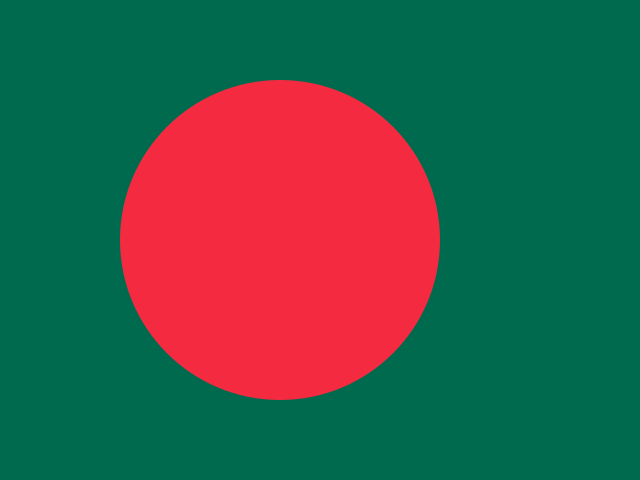
- Description: green field with a large red disk shifted slightly to the leftMeaning: the red disk represents the rising sun and the sacrifice to achieve independence; the green field symbolizes the lush vegetation of Bangladesh
- National symbols
- Bengal tiger, water lily
- National colours
- green, red
- National anthem
- Title: "Amar Shonar Bangla" (My Golden Bengal)Lyrics/music: Rabindranath TAGOREHistory: adopted 1971; Rabindranath TAGORE, a Nobel laureate, also wrote India's national anthem
- UNESCO World Heritage Sites
- Total World Heritage Sites: 3 (2 cultural, 1 natural)Selected World Heritage Site locales: Bagerhat Historic Mosque (c); Ruins of the Buddhist Vihara at Paharpur (c); Sundarbans (n)
Economy
- Overview
- one of the fastest growing emerging market economies; strong economic rebound following COVID-19; significant poverty reduction; exports dominated by textile industry; weakened exports and remittances resulted in declining foreign exchange reserves and 2022 IMF loan request
- GDP (PPP)
- $1.473 trillion (2024 est.)
- GDP per person (PPP)
- $8,500 (2024 est.)
- GDP growth
- 4.2% (2024 est.)
- Inflation
- 10.5% (2024 est.)
- Unemployment
- 4.7% (2024 est.)
- Below poverty line
- 18.7% (2022 est.)
- Farm products
- rice, milk, potatoes, maize, sugarcane, onions, jute, vegetables, mangoes/guavas, tropical fruits (2023)
- Industries
- cotton, textiles and clothing, jute, tea, paper, cement, fertilizer, sugar, light engineering
- Exports
- $53.848 billion (2024 est.)
- Main exports
- garments, footwear, fabric, textiles, trunks and cases (2023)
- Export partners
- USA 16%, Germany 15%, UK 8%, Spain 7%, Poland 6% (2023)
- Main imports
- refined petroleum, cotton fabric, natural gas, cotton, fabric (2023)
- Import partners
- China 34%, India 17%, Indonesia 5%, Singapore 5%, Malaysia 4% (2023)
- Money sent home from abroad
- 6% of GDP (2024 est.)
Energy, internet and transport
- Electricity access
- Electrification - total population: 99.4% (2022 est.)Electrification - urban areas: 100%Electrification - rural areas: 99.3%
- Electricity sources
- Fossil fuels: 98.4% of total installed capacity (2023 est.)Solar: 1% of total installed capacity (2023 est.)Hydroelectricity: 0.6% of total installed capacity (2023 est.)
- Internet users
- Percent of population: 45% (2023 est.)
- Mobile phones
- Total subscriptions: 188 million (2024 est.)Subscriptions per 100 inhabitants: 108 (2024 est.)
- TV and radio
- state-owned Bangladesh Television (BTV) broadcasts nationally; some channels operate via satellite; the government also owns a medium-wave radio channel and some private FM radio news channels; of the 41 approved TV stations, 26 are currently being used to broadcast, and 23 operate under private management via cable distribution
- Airports
- 17 (2025)
- Railways
- Total: 2,460 km (2014)Narrow gauge: 1,801 km (2014) 1.000-m gaugeBroad gauge: 659 km (2014) 1.676-m gauge
- Merchant ships
- Total: 558 (2023)By type: bulk carrier 68, container ship 10, general cargo 170, oil tanker 162, other 148
Military and space
- Armed forces
- Armed Forces of Bangladesh (aka Bangladesh Defense Force): Bangladesh Army, Bangladesh Navy, Bangladesh Air ForceMinistry of Home Affairs: Bangladesh Police, Border Guard Bangladesh (BGB), Bangladesh Coast Guard, Rapid Action Battalion (RAB), Ansars, Village Defense Party (VDP) (2025)
- Military spending
- 0.9% of GDP (2024 est.)
- Military service
- varies by service, but generally 17-23 for voluntary military service; length of service also varies (2025)
- Space programme
- has a modest space program focused on designing, building, and operating satellites, particularly those with remote sensing (RS) capabilities; SPARSSO's mandate is to use space and RS technology in areas such as agriculture, education, environmental studies, fisheries, forestry, geology, land use, mapping, meteorology, and oceanography; has a government-owned company for acquiring and operating satellites (Bangladesh Satellite Company Limited, established in 2017); works with several foreign space agencies and commercial entities, including those of France, Japan, Russia, and the US; member of several international space organizations, such as the Asia-Pacific Space Cooperation Organization (2025)
- Space milestones
- 2017 - first educational/scientific nanosatellite (BRAC-Onnesha) acquired from Japan and launched by US2018 - first communications satellite (Bangabandhu-1) built by a French company and launched by US2025 - signed US-led Artemis Accords for the safe and responsible exploration of space
Global issues
- Refugees and displaced people
- Refugees: 1,005,637 (2024 est.)IDPs: 756,743 (2024 est.)Stateless persons: 1,005,520 (2024 est.)
Neighbouring countries
- Phone code
- +880
- Internet domain
- .bd