India
Republic of India · भारत · இந்தியா
Home of the Indus Valley civilisation and the birthplace of Hinduism, Buddhism, Jainism and Sikhism. Ruled by the Maurya, Gupta and Mughal empires, then Britain. Independent in 1947 amid a violent partition; now the world's most populous country.
See India on the 3D globeTake a quiz
Did you know?
- Has 22 official languages
- Invented the number zero as we use it
- Its 2023 lunar landing was the first near the Moon's south pole
Key facts about India
- Government
- Federal parliamentary republic
- Religion
- Hindu ~79%, Islam ~14%, Christian ~2%, Sikh ~2%
- Founded / independence
- 1947 (from UK)
- Rich in
- IT services, pharmaceuticals, agriculture, coal, iron ore, film; fastest-growing large economy
- Languages
- English, Hindi, Tamil
22 official languages; Hindi and English for government; Bengali, Marathi, Telugu, Tamil, Urdu, Gujarati and hundreds of dialects - Currency
- Indian rupee (₹)
- People are called
- Indian
- Main cities
- Mumbai, Delhi, Bangalore, Hyderabad, Ahmedabad, Chennai, Kolkata
Timeline of India
- 2600 BCIndus cities
- 322 BCMaurya Empire
- 1526Mughal Empire
- 1858British Raj
- 1947Independence
- 1950Republic
- 1991Economic reforms
- 2023Most populous country
Places to see in India
- Taj Mahal
- Red Fort
- Jaipur's Hawa Mahal
- Varanasi ghats
- Kerala backwaters
- Golden Temple, Amritsar
- Goa beaches
Food and drink
Biryani · butter chicken · dosa · samosa · dal · thali · masala chai
Culture and famous for
Bollywood (most films made); yoga; chess originated here (chaturanga); Diwali; Gandhi's non-violence
Popular sports
Cricket (national passion), field hockey, kabaddi
Geography and climate
- Highest point
- Kangchenjunga, 8,586 m
- Rivers, lakes and seas
- Ganges, Indus, Brahmaputra
- Climate
- Tropical to alpine; monsoon rains
- Coastline
- Has a sea coast
- Population density
- 441 people per km²
Wars and conflicts
- Partition 1947
- wars with Pakistan 1947, 1965, 1971, 1999
- China 1962
- 2025 India-Pakistan clashes
- Maoist insurgency
Empires and states that once stood here
Indus Valley Civilisation c. 3300–1300 BCMaurya Empire 322–185 BCGupta Empire c. 320–550 ADVijayanagara Empire 1336–1646Mughal Empire 1526–1857Sikh Empire 1799–1849
Alliances and memberships
Military and security
QuadShanghai Cooperation Organisation
Political unions and regional organisations
BRICSSAARCCommonwealth of Nations
Economy and trade
India in depth
Detailed facts from the CIA World Factbook (public domain, latest edition).
Overview
- History in brief
- The Indus Valley civilization, one of the world's oldest, flourished during the 3rd and 2nd millennia B.C. and extended into northwestern India. Aryan tribes from the northwest infiltrated the Indian subcontinent about 1500 B.C.; their merger with the earlier Dravidian inhabitants created the classical Indian culture. The Maurya Empire of the 4th and 3rd centuries B.C. -- which reached its zenith under ASHOKA -- united much of South Asia. The Gupta dynasty (4th to 6th centuries A.D.) ushered in The Golden Age, which saw a flowering of Indian science, art, and culture. Islam spread across the subcontinent over a period of 700 years. In the 10th and 11th centuries, Turks and Afghans invaded India and established the Delhi Sultanate. In the early 16th century, the Emperor BABUR established the Mughal Dynasty, which ruled large sections of India for more than three centuries. European explorers began establishing footholds in India during the 16th century. By the 19th century, Great Britain had become the dominant political power on the subcontinent, and India was seen as the "Jewel in the Crown" of the British Empire. The British Indian Army played a vital role in both World Wars. Years of nonviolent resistance to British rule, led by Mohandas GANDHI and Jawaharlal NEHRU, eventually resulted in Indian independence in 1947. Large-scale communal violence took place before and after the subcontinent partition into two separate states -- India and Pakistan. The neighboring countries have fought three wars since independence, the last of which was in 1971 and resulted in East Pakistan becoming the separate nation of Bangladesh. India's nuclear weapons tests in 1998 emboldened Pakistan to conduct its own tests that same year. In 2008, terrorists originating from Pakistan conducted a series of coordinated attacks in Mumbai, India's financial capital. India's economic growth after economic reforms in 1991, a massive youth population, and a strategic geographic location have contributed to the country's emergence as a regional and global power. However, India still faces pressing problems such as extensive poverty, widespread corruption, and environmental degradation, and its restrictive business climate challenges economic growth expectations.
Geography
- Location
- Southern Asia, bordering the Arabian Sea and the Bay of Bengal, between Burma and Pakistan
- Size compared
- slightly more than one-third the size of the US
- Land borders
- Total: 13,888 kmBorder countries: Bangladesh 4,142 km; Bhutan 659 km; Burma 1,468 km; China 2,659 km; Nepal 1,770 km; Pakistan 3,190 km
- Coastline
- 7,000 km
- Climate
- varies from tropical monsoon in south to temperate in north
- Terrain
- upland plain (Deccan Plateau) in south, flat to rolling plain along the Ganges, deserts in west, Himalayas in north
- Elevation
- Highest point: Kanchenjunga 8,586 mLowest point: Indian Ocean 0 mMean elevation: 160 m
- Natural resources
- coal (fourth-largest reserves in the world), antimony, iron ore, lead, manganese, mica, bauxite, rare earth elements, titanium ore, chromite, natural gas, diamonds, petroleum, limestone, arable land
- Major rivers
- Brahmaputra (shared with China [s] and Bangladesh [m]) - 3,969 km; Indus (shared with China [s] and Pakistan [m]) - 3,610 km; Ganges river source (shared with Bangladesh [m]) - 2,704 km; Godavari - 1,465 km; Sutlej (shared with China [s] and Pakistan [m]) - 1,372 km; Yamuna - 1,370 km; Narmada - 1,289 km; Chenab river source (shared with Pakistan [m]) - 1,086 km ; Ghaghara river mouth (shared with China [s] and Nepal) - 1,080 kmNote: [s] after country name indicates river source; [m] after country name indicates river mouth
- Major lakes
- Salt water lake(s): Chilika Lake - 1,170 sq km
- Natural hazards
- droughts; flash floods, as well as widespread and destructive flooding from monsoonal rains; severe thunderstorms; earthquakesVolcanism: Barren Island (354 m) in the Andaman Sea has been active in recent years
- Notes
- dominates South Asian subcontinent; near important Indian Ocean trade routes; Kanchenjunga, third tallest mountain in the world, lies on the border with Nepal
- Environmental issues
- deforestation; soil erosion; overgrazing; desertification; air pollution from industrial effluents and vehicle emissions; water pollution from raw sewage and agricultural pesticides; tap water not potable; growing population overstraining natural resources; biodiversity loss
People and society
- Population
- Total: 1,419,316,933 (2025 est.)Male: 730,902,574Female: 688,414,359
- Nationality
- Noun: Indian(s)Adjective: Indian
- Ethnic groups
- Indo-Aryan 72%, Dravidian 25%, and other 3% (2000)
- Languages
- Hindi 43.6%, Bengali 8%, Marathi 6.9%, Telugu 6.7%, Tamil 5.7%, Gujarati 4.6%, Urdu 4.2%, Kannada 3.6%, Odia 3.1%, Malayalam 2.9%, Punjabi 2.7%, Assamese 1.3%, Maithili 1.1%, other 5.6%; English is the subsidiary official language but is the most important one for national, political, and commercial communication (2011 est.)Major-language sample(s): विश्व फ़ैक्टबुक, आधारभूत जानकारी का एक अनिवार्य स्रोत (Hindi) The World Factbook, the indispensable source for basic information.
- Religions
- Hindu 79.8%, Muslim 14.2%, Christian 2.3%, Sikh 1.7%, other and unspecified 2% (2011 est.)
- Median age
- Total: 30.1 years (2025 est.)Male: 29.1 yearsFemale: 30.5 years
- Population growth
- 0.72% (2025 est.)
- Life expectancy
- Total population: 68.2 years (2024 est.)Male: 66.5 yearsFemale: 70.1 years
- Children per woman
- 2 children born/woman (2025 est.)
- Urbanization
- Urban population: 36.4% of total population (2023)Rate of urbanization: 2.33% annual rate of change (2020-25 est.)
- Largest cities
- 32.941 million NEW DELHI (capital), 21.297 million Mumbai, 15.333 million Kolkata, 13.608 million Bangalore, 11.776 million Chennai, 10.801 million Hyderabad (2023)
- Literacy
- Total population: 81.7% (2023 est.)Male: 88.3% (2023 est.)Female: 74.9% (2023 est.)
- Years in school
- Total: 13 years (2024 est.)Male: 13 years (2024 est.)Female: 13 years (2024 est.)
Government
- Official names
- Conventional long form: Republic of IndiaConventional short form: IndiaLocal long form: Republic of India (English)/ Bharatiya Ganarajya (Hindi)Local short form: India (English)/ Bharat (Hindi)Etymology: the English name derives from the Indus River; the Indian name, Bharat, may derive from the Bharatas tribe mentioned in the Sanskrit Vedas (Hindu religious texts); the name is also associated with Emperor Bharata, the legendary conqueror of India
- Government type
- federal parliamentary republic
- Capital
- Name: New DelhiGeographic coordinates: 28 36 N, 77 12 ETime difference: UTC+5.5 (10.5 hours ahead of Washington, DC, during Standard Time)Etymology: the name is of unknown origin; one theory says it may come from the Hindi word dehli (threshold), because of the city's location between the Indus and the Ganges Rivers
- Regions
- 28 states and 8 union territories*; Andaman and Nicobar Islands*, Andhra Pradesh, Arunachal Pradesh, Assam, Bihar, Chandigarh*, Chhattisgarh, Dadra and Nagar Haveli and Daman and Diu*, Delhi*, Goa, Gujarat, Haryana, Himachal Pradesh, Jammu and Kashmir*, Jharkhand, Karnataka, Kerala, Ladakh*, Lakshadweep*, Madhya Pradesh, Maharashtra, Manipur, Meghalaya, Mizoram, Nagaland, Odisha, Puducherry*, Punjab, Rajasthan, Sikkim, Tamil Nadu, Telangana, Tripura, Uttar Pradesh, Uttarakhand, West Bengal
- Independence
- 15 August 1947 (from the UK)
- National holiday
- Republic Day, 26 January (1950)
- Constitution
- History: previous 1935 (pre-independence); latest draft completed 4 November 1949, adopted 26 November 1949, effective 26 January 1950Amendment process: proposed by either the Council of States or the House of the People; passage requires majority participation of the total membership in each house and at least two-thirds majority of voting members of each house, followed by assent of the president of India; proposed amendments to the constitutional amendment procedures also must be ratified by at least one half of the India state legislatures before presidential assent
- Legal system
- common law system based on the English model; separate personal law codes apply to Muslims, Christians, and Hindus; judicial review of legislative acts
- Voting age
- 18 years of age; universal
- Flag meaning
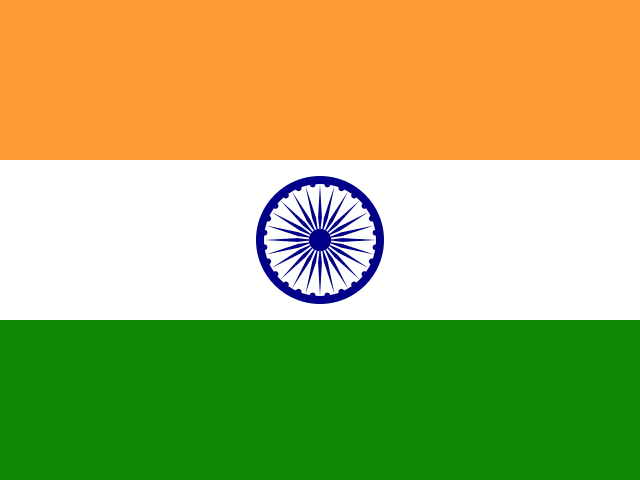
- Description: three equal horizontal bands of saffron (top), white, and green, with a blue chakra (24-spoked wheel) centered in the white bandMeaning: saffron stands for courage, sacrifice, and the spirit of renunciation; white for purity and truth; green for faith and fertility; the chakra symbolizes the wheel of life in movement and death in stagnation
- National symbols
- the Lion Capital of Ashoka, which depicts four Asiatic lions standing back-to-back and mounted on a circular abacus (official); Bengal tiger and lotus flower (traditional)
- National colours
- saffron, white, green
- National anthem
- Title: "Jana-Gana-Mana" (Thou Art the Ruler of the Minds of All People)Lyrics/music: Rabindranath TAGOREHistory: adopted 1950; Rabindranath TAGORE, a Nobel laureate, also wrote Bangladesh's national anthem
- UNESCO World Heritage Sites
- Total World Heritage Sites: 44 (36 cultural, 7 natural, 1 mixed)Selected World Heritage Site locales: Taj Mahal (c); Agra Fort (c); Elphanta Caves (c); Hill Forts of Rajasthan (c); Sundarbans National Park (n); Rock Shelters of Bhimbetka (c); Champaner-Pavagadh Archaeological Park (c); Jaipur (c); Mahabodhi Temple Complex at Bodh Gaya (c); Manas Wildlife Sanctuary (n); Nanda Devi and Valley of Flowers National Parks (n); Khangchendzonga National Park (m); Group of Monuments at Mahabalipuram (c); Sun Temple, Konârak (c); Kaziranga National Park (n); Churches and Convents of Goa (c); Great Living Chola Temples (c); Group of Monuments at Pattadakal (c); Buddhist Monuments at Sanchi (c); Humayun's Tomb, Delhi (c); Qutb Minar and its Monuments, Delhi (c); Great Himalayan National Park Conservation Area (n); Rani-ki-Vav (the Queen’s Stepwell) at Patan, Gujarat (c); Archaeological Site of Nalanda Mahavihara at Nalanda, Bihar (c); Historic City of Ahmadabad (c); Victorian Gothic and Art Deco Ensembles of Mumbai (c); Jaipur City, Rajasthan (c); Kakatiya Rudreshwara (Ramappa) Temple, Telangana (c); Moidams – the Mound-Burial System of the Ahom Dynasty (c); Maratha Military Landscapes of India (c)
Economy
- Overview
- largest South Asian economy; strong, sustained GDP growth led by technology and service sectors, foreign investment, and improved regulatory framework; high poverty rate and income inequality; initiatives on infrastructure development, digitization, manufacturing, and financial access
- GDP (PPP)
- $14.244 trillion (2024 est.)
- GDP per person (PPP)
- $9,800 (2024 est.)
- GDP growth
- 6.5% (2024 est.)
- Inflation
- 5% (2024 est.)
- Unemployment
- 4.3% (2024 est.)
- Farm products
- sugarcane, rice, milk, wheat, bison milk, potatoes, vegetables, maize, bananas, onions (2023)
- Industries
- textiles, chemicals, food processing, steel, transportation equipment, cement, mining, petroleum, machinery, software, pharmaceuticals
- Exports
- $822.046 billion (2024 est.)
- Main exports
- refined petroleum, packaged medicine, diamonds, broadcasting equipment, garments (2023)
- Export partners
- USA 19%, UAE 7%, China 4%, Germany 3%, UK 3% (2023)
- Main imports
- crude petroleum, gold, coal, natural gas, integrated circuits (2023)
- Import partners
- China 19%, Russia 10%, USA 6%, UAE 6%, Saudi Arabia 5% (2023)
- Money sent home from abroad
- 3.5% of GDP (2024 est.)
Energy, internet and transport
- Electricity access
- Electrification - total population: 99.2% (2022 est.)Electrification - urban areas: 100%Electrification - rural areas: 99.3%
- Electricity sources
- Fossil fuels: 75.5% of total installed capacity (2023 est.)Nuclear: 2.7% of total installed capacity (2023 est.)Solar: 6.6% of total installed capacity (2023 est.)Wind: 5.1% of total installed capacity (2023 est.)Hydroelectricity: 8.2% of total installed capacity (2023 est.)Biomass and waste: 1.9% of total installed capacity (2023 est.)
- Internet users
- Percent of population: 56% (2022 est.)
- Mobile phones
- Total subscriptions: 1.15 billion (2024 est.)Subscriptions per 100 inhabitants: 79 (2024 est.)
- TV and radio
- Doordarshan, India's public TV network, has a monopoly on terrestrial broadcasting and operates about 20 national, regional, and local services; a large number of privately owned TV stations are distributed by cable and satellite service providers; cable and satellite TV offer over 850 TV channels; government controls AM radio, with All India Radio operating domestic and external networks; news broadcasts via radio are limited to the All India Radio Network; since 2000, privately owned FM stations have been permitted and have increased rapidly (2020)
- Airports
- 315 (2025)
- Railways
- Total: 65,554 km (2014)Narrow gauge: 1,604 km (2014) 1.000-m gaugeBroad gauge: 63,950 km (2014) (39, 329 km electrified)
- Merchant ships
- Total: 1,859 (2023)By type: bulk carrier 66, container ship 22, general cargo 607, oil tanker 144, other 1020
Military and space
- Armed forces
- Indian Armed Forces (IAF): Army, Navy, Air Force, Coast GuardMinistry of Home Affairs: Central Police Organization, Central Armed Police Forces (includes Assam Rifles, Border Security Force, Central Industrial Security Force, Central Reserve Police Force, Indo-Tibetan Border Police, National Security Guards, Sashastra Seema Bal) (2025)
- Military spending
- 2% of GDP (2024 est.)
- Military service
- ages vary by branch of service and positions, but generally 17-27 years of age for voluntary military service for men and women; no conscription (2025)
- Space programme
- has one of the world’s largest space programs; designs, builds, launches, operates, and tracks the full spectrum of satellites, including communications, navigation, remote sensing (RS), and scientific/technology; designs, builds, and launches rockets, space/satellite launch vehicles (SLVs), and lunar/interplanetary probes; launches satellites for foreign partners; researching and developing additional technologies and capabilities; developing astronaut program and human flight capabilities (with assistance from Russia and the US); has space-related agreements with the ESA and more than 50 countries, including China, France, Germany, Japan, Russia, and the US; participates in international projects such as the Square Kilometer Array radio telescope; the Department of Space administers two government-controlled space industry corporations; has a growing private space sector (2025)
- Space milestones
- 1963 - first sounding (research) rocket launched1975 - first domestically made scientific satellite (Aryabhata) launched by Soviet Union1979 - first experimental remote sensing (RS) satellite (Bhaskara-I) launched by Soviet Union1980 - first successful launch of satellite (Rohini) on Indian satellite launch vehicle (SLV)1984 - first Indian in space on a Soviet rocket1988 - first operational RS satellite (IRS-1A) launched by Soviet Union1994 - first successful launch of Polar Satellite Launch Vehicle (PSLV), India’s premier SLV2008 - first lunar orbiter/probe (Chandrayaan-1) launched, reached lunar orbit, and sent a probe to the surface of the Moon2014 - first interplanetary probe (Mangalyaan) reached orbit around Mars2018 - Indian Regional Navigation Satellite System (INRSS) became operational2019 - launched lunar orbiter/probe (Chandrayaan-2) with lander and rover (lander lost when it crash-landed on Moon’s surface)2023 - successfully landed uncrewed lander/rover mission (Chandrayaan-3) on Moon's surface2024 - launched satellite (XPoSat) to study black holes and placed solar observatory spacecraft (Aditya-L1) in orbital position to study the Sun2025 - first docking of two orbiting satellites and sent its first astronaut to the International Space Station
Global issues
- Refugees and displaced people
- Refugees: 250,006 (2024 est.)IDPs: 642,610 (2024 est.)Stateless persons: 23,262 (2024 est.)
- Drug trade
- USG identification: major illicit drug-producing and/or drug-transit countrymajor precursor-chemical producer (2025)
Neighbouring countries
BangladeshBhutanMyanmarChinaNepalPakistan
- Phone code
- +91
- Internet domain
- .in