Botswana
Republic of Botswana
A British protectorate that became one of Africa's most stable democracies. Diamonds found in 1967 turned one of the poorest countries into a middle-income one. The ruling party lost power for the first time in 2024.
See Botswana on the 3D globeTake a quiz
Population2.5 million
Area582,000 km²
CapitalGaborone
RegionSouthern Africa
Did you know?
- Home to the world's largest elephant population
- The Okavango is an inland delta that never reaches the sea
- About 70% is Kalahari Desert
Key facts about Botswana
- Government
- Parliamentary republic
- Religion
- Christian ~79%
- Founded / independence
- 1966 (from UK)
- Rich in
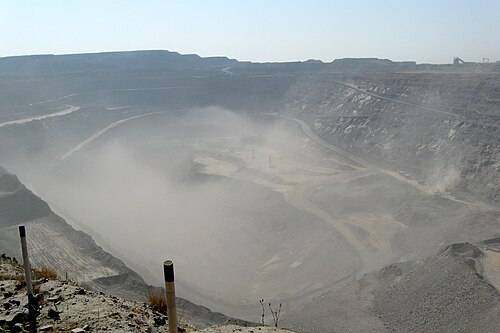
- Diamonds (Debswana), cattle, safari tourism (Okavango)
- Languages
- English, Tswana
Setswana and English - Currency
- Botswana pula (P)
- People are called
- Motswana
- Main cities
- Gaborone, Francistown, Maun
Timeline of Botswana
- 1885Bechuanaland protectorate
- 1966Independence
- 1967Diamonds found
- 2024First change of ruling party
Places to see in Botswana
- Okavango Delta
- Chobe National Park
- Makgadikgadi salt pans
- Central Kalahari
- Tsodilo Hills
Food and drink
Seswaa (pounded beef) · pap · morogo
Culture and famous for
Diamonds; San peoples; safari conservation
Popular sports
Football, athletics
Geography and climate
- Highest point
- Otse Hill, 1,491 m
- Rivers, lakes and seas
- Okavango Delta; Chobe River
- Climate
- Semi-arid
- Coastline
- Landlocked
- Population density
- 4 people per km²
Wars and conflicts
- None since independence
Alliances and memberships
Political unions and regional organisations
African UnionSADCCommonwealth of Nations
Botswana in depth
Detailed facts from the CIA World Factbook (public domain, latest edition).
Overview
- History in brief
- In the early 1800s, multiple political entities in what is now Botswana were destabilized or destroyed by a series of conflicts and population movements in southern Africa. By the end of this period, the Tswana ethnic group, who also live across the border in South Africa, had become the most prominent group in the area. In 1852, Tswana forces halted the expansion of white Afrikaner settlers who were seeking to expand their territory northwards into what is now Botswana. In 1885, Great Britain claimed territory that roughly corresponds with modern day Botswana as a protectorate called Bechuanaland. Upon independence in 1966, the British protectorate of Bechuanaland adopted the new name of Botswana, which means "land of the Tswana."More than five decades of uninterrupted civilian leadership, progressive social policies, and significant capital investment have created an enduring democracy and upper-middle-income economy. The ruling Botswana Democratic Party has won every national election since independence; President Mokgweetsi Eric Keabetswe MASISI assumed the presidency in 2018 after the retirement of former President Ian KHAMA due to constitutional term limits. MASISI won his first election as president in 2019, and he is Botswana’s fifth president since independence. Mineral extraction, principally diamond mining, dominates economic activity, though tourism is a growing sector due to the country's conservation practices and extensive nature preserves. Botswana has one of the world's highest rates of HIV/AIDS infection but also one of Africa's most progressive and comprehensive programs for dealing with the disease.
Geography
- Location
- Southern Africa, north of South Africa
- Size compared
- slightly smaller than Texas; almost four times the size of Illinois
- Land borders
- Total: 4,347.15 kmBorder countries: Namibia 1,544 km; South Africa 1,969 km; Zambia 0.15 km; Zimbabwe 834 km
- Coastline
- 0 km (landlocked)
- Climate
- semiarid; warm winters and hot summers
- Terrain
- predominantly flat to gently rolling tableland; Kalahari Desert in southwest
- Elevation
- Highest point: Manyelanong Hill 1,495 mLowest point: junction of the Limpopo and Shashe Rivers 513 mMean elevation: 1,013 m
- Natural resources
- diamonds, copper, nickel, salt, soda ash, potash, coal, iron ore, silver
- Major rivers
- Zambezi (shared with Zambia [s]), Angola, Namibia, Zimbabwe, and Mozambique [m]) - 2,740 km; Limpopo (shared with South Africa [s], Zimbabwe, and Mozambique [m]) - 1,800 km; Okavango river mouth (shared with Angola [s], and Namibia) - 1,600 kmNote: [s] after country name indicates river source; [m] after country name indicates river mouth
- Natural hazards
- periodic droughts; seasonal August winds blow from the west, carrying sand and dust across the country, which can obscure visibility
- Notes
- landlocked; sparsely populated with most settlement concentrated in the southern and eastern parts of the country; geography dominated by the Kalahari Desert, which covers about 70% of the country, although the Okavango Delta brings considerable biodiversity as one of the largest inland deltas in the World
- Environmental issues
- overgrazing; desertification; limited freshwater resources; air pollution
People and society
- Population
- Total: 2,521,534 (2025 est.)Male: 1,234,898Female: 1,286,636
- Nationality
- Noun: Motswana (singular), Batswana (plural)Adjective: Motswana (singular), Batswana (plural)
- Ethnic groups
- Tswana (or Setswana) 79%, Kalanga 11%, Basarwa 3%, other, including Kgalagadi and people of European ancestry 7%
- Languages
- Setswana 77.3%, Sekalanga 7.4%, Shekgalagadi 3.4%, English (official) 2.8%, Zezuru/Shona 2%, Sesarwa 1.7%, Sembukushu 1.6%, Ndebele 1%, other 2.8% (2011 est.)
- Religions
- Christian 79.1%, Badimo 4.1%, other 1.4% (includes Baha'i, Hindu, Muslim, Rastafarian), none 15.2%, unspecified 0.3% (2011 est.)
- Median age
- Total: 25.8 years (2025 est.)Male: 26 yearsFemale: 28.3 years
- Population growth
- 1.32% (2025 est.)
- Life expectancy
- Total population: 66.4 years (2024 est.)Male: 64.4 yearsFemale: 68.6 years
- Children per woman
- 2.73 children born/woman (2025 est.)
- Urbanization
- Urban population: 72.9% of total population (2023)Rate of urbanization: 2.47% annual rate of change (2020-25 est.)
- Largest cities
- 269,000 GABORONE (capital) (2018)
- Years in school
- Total: 12 years (2021 est.)Male: 12 years (2021 est.)Female: 13 years (2021 est.)
Government
- Official names
- Conventional long form: Republic of BotswanaConventional short form: BotswanaLocal long form: Republic of BotswanaLocal short form: BotswanaFormer: BechuanalandEtymology: the name Botswana means "Land of the Tswana," referring to the country's largest ethnic group
- Government type
- parliamentary republic
- Capital
- Name: GaboroneGeographic coordinates: 24 38 S, 25 54 ETime difference: UTC+2 (7 hours ahead of Washington, DC, during Standard Time)Etymology: named after GABORONE (ca. 1825-1931), a chief of the Tlokwa tribe, whose name means "it is not unbecoming"
- Regions
- 10 districts and 6 town councils*; Central, Chobe, Francistown*, Gaborone*, Ghanzi, Jwaneng*, Kgalagadi, Kgatleng, Kweneng, Lobatse*, North East, North West, Selebi-Phikwe*, South East, Southern, Sowa Town*
- Independence
- 30 September 1966 (from the UK)
- National holiday
- Independence Day (Botswana Day), 30 September (1966)
- Constitution
- History: previous 1960 (pre-independence); latest adopted March 1965, effective 30 September 1966Amendment process: proposed by the National Assembly; passage requires approval in two successive Assembly votes with at least two-thirds majority in the final vote; proposals to amend constitutional provisions on fundamental rights and freedoms, the structure and branches of government, and public services also requires approval by majority vote in a referendum and assent by the president of the republic
- Legal system
- mixed legal system of civil law influenced by the Roman-Dutch model, including customary and common law
- Voting age
- 18 years of age; universal
- Flag meaning
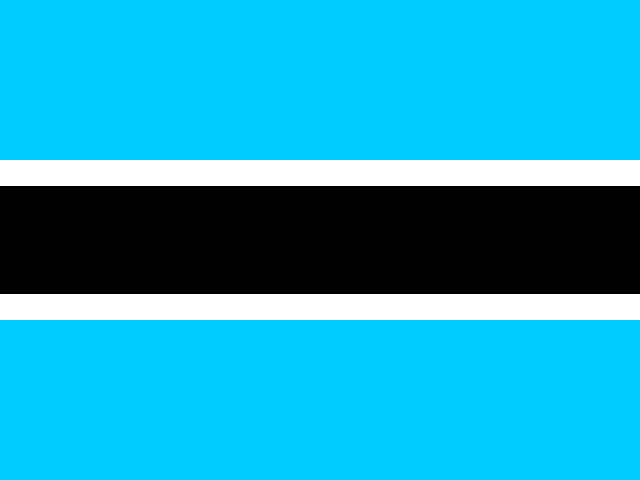
- Description: light blue with a horizontal white-edged black stripe across the middleMeaning: the blue symbolizes rainwater, and the black and white bands represent racial harmony
- National symbols
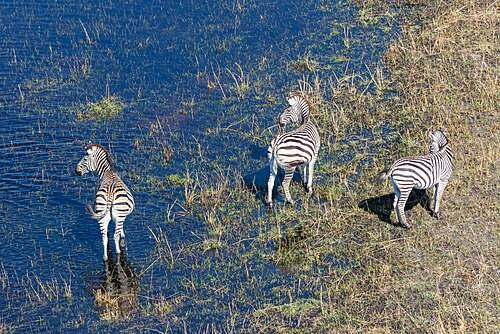
- zebra
- National colours
- light blue, white, black
- National anthem
- Title: "Fatshe leno la rona" (Our Land)Lyrics/music: Kgalemang Tumedisco MOTSETEHistory: adopted 1966
- UNESCO World Heritage Sites
- Total World Heritage Sites: 2 (1 cultural, 1 natural)Selected World Heritage Site locales: Tsodilo Hills (c); Okavango Delta (n)
Economy
- Overview
- good economic governance and financial management; diamond-driven growth model declining; rapid poverty reductions; high unemployment, particularly among youth; COVID-19 sharply contracted the economy and recovery is slow; public sector wages have posed fiscal challenges
- GDP (PPP)
- $45.553 billion (2024 est.)
- GDP per person (PPP)
- $18,100 (2024 est.)
- GDP growth
- -3% (2024 est.)
- Inflation
- 2.8% (2024 est.)
- Unemployment
- 23.2% (2024 est.)
- Below poverty line
- 16.1% (2015 est.)
- Farm products
- root vegetables, beef, vegetables, sorghum, maize, game meat, milk, watermelons, goat milk, sunflower seeds (2023)
- Industries
- diamonds, copper, nickel, salt, soda ash, potash, coal, iron ore, silver; beef processing; textiles
- Exports
- $6.398 billion (2023 est.)
- Main exports
- diamonds, copper ore, insulated wire, carbonates, cattle (2023)
- Export partners
- UAE 27%, India 17%, Belgium 16%, South Africa 8%, USA 7% (2023)
- Main imports
- refined petroleum, diamonds, cars, flavored water, electricity (2023)
- Import partners
- South Africa 65%, Namibia 8%, Canada 5%, China 3%, India 3% (2023)
- Money sent home from abroad
- 0.4% of GDP (2023 est.)
Energy, internet and transport
- Electricity access
- Electrification - total population: 75.9% (2022 est.)Electrification - urban areas: 95.5%Electrification - rural areas: 25%
- Electricity sources
- Fossil fuels: 99.8% of total installed capacity (2023 est.)Solar: 0.2% of total installed capacity (2023 est.)
- Internet users
- Percent of population: 81% (2023 est.)
- Mobile phones
- Total subscriptions: 4.13 million (2024 est.)Subscriptions per 100 inhabitants: 164 (2024 est.)
- TV and radio
- 2 TV stations, 1 state-owned and 1 privately owned; privately owned satellite TV subscription service is available; 2 state-owned national radio stations; 4 privately owned radio stations broadcast locally (2019)
- Airports
- 122 (2025)
- Railways
- Total: 888 km (2014)Narrow gauge: 888 km (2014) 1.067-m gauge
Military and space
- Armed forces
- Botswana Defense Force (BDF): Ground Forces Command, Air Arm Command, Defense Logistics Command (2025)
- Military spending
- 3% of GDP (2024 est.)
- Military service
- 18-24 years of age (men and women) for general recruits and officer candidates; 18-40 for special entrant officers; no conscription (2025)
Global issues
- Refugees and displaced people
- Refugees: 823 (2024 est.)IDPs: 99 (2023 est.)
Neighbouring countries
NamibiaSouth AfricaZambiaZimbabwe
- Phone code
- +267
- Internet domain
- .bw