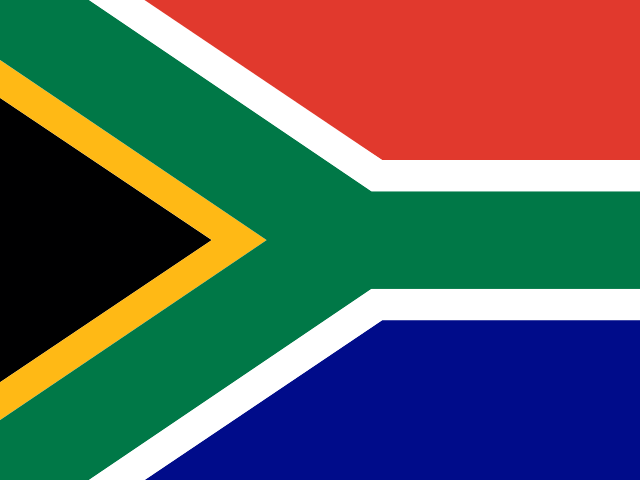
South Africa
Republic of South Africa · Sewula Afrika · Afrika-Borwa · Afrika Borwa
Settled by Dutch in 1652 and Britain later. Apartheid (1948–94) enforced racial segregation until Nelson Mandela became the first Black president in 1994.
See South Africa on the 3D globeTake a quiz
Population64 million
Area1,221,037 km²
CapitalPretoria, Bloemfontein, Cape Town
RegionSouthern Africa
Did you know?
- Has three capitals: Pretoria, Cape Town, Bloemfontein
- Has 12 official languages
- The first human heart transplant was done in Cape Town (1967)
Key facts about South Africa
- Government
- Parliamentary republic (coalition since 2024)
- Religion
- Christian ~78%, traditional
- Founded / independence
- 1910 union; 1994 democracy
- Rich in
- Platinum (largest), gold, chromium, manganese, coal, diamonds — Africa's most industrialised economy
- Languages
- Afrikaans, English, Southern Ndebele, Northern Sotho, Southern Sotho, Swazi, Tswana, Tsonga, Venda, Xhosa, Zulu
12 official languages: Zulu, Xhosa, Afrikaans, English, Sepedi, Tswana, Sotho, Tsonga and more, plus sign language - Currency
- South African rand (R)
- People are called
- South African
- Main cities
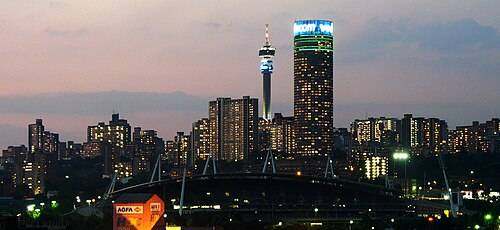
- Johannesburg, Cape Town, Durban, Pretoria, Port Elizabeth (Gqeberha)
Timeline of South Africa
- 1652Dutch settle Cape
- 1886Gold rush
- 1910Union
- 1948Apartheid
- 1990Mandela released
- 1994Democracy
- 2010Hosts World Cup
Places to see in South Africa
- Table Mountain
- Kruger National Park
- Robben Island
- Cape of Good Hope
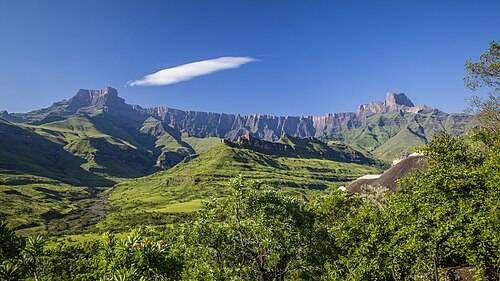
- Drakensberg
- Garden Route
Food and drink
Braai · bobotie · biltong · bunny chow
Culture and famous for
Nelson Mandela; three capital cities; gold and diamond mining
Popular sports
Rugby (four-time world champions), cricket, football
Geography and climate
- Highest point
- Mafadi, 3,450 m
- Rivers, lakes and seas
- Orange, Limpopo, Vaal
- Climate
- Mostly temperate
- Coastline
- Has a sea coast
- Population density
- 52 people per km²
Wars and conflicts
- Anglo-Zulu War 1879
- Boer Wars 1880–1902
- apartheid resistance
- Border War
Empires and states that once stood here
Zulu Kingdom 1816–1897Boer republics (Transvaal and Orange Free State) 1852–1902
Alliances and memberships
Political unions and regional organisations
BRICSAfrican UnionSADCCommonwealth of Nations
Economy and trade
South Africa in depth
Detailed facts from the CIA World Factbook (public domain, latest edition).
Overview
- History in brief
- Some of the earliest human remains in the fossil record were found in South Africa. By about A.D. 500, Bantu-speaking groups began settling into what is now northeastern South Africa, displacing Khoisan-speaking groups to the southwest. Dutch traders landed at the southern tip of present-day South Africa in 1652 and established a stopover point on the spice route between the Netherlands and the Far East, founding the city of Cape Town. After the British seized the Cape of Good Hope area in 1806, many settlers of Dutch descent -- known then as "Boers," or farmers, but later called Afrikaners -- trekked north to found their own republics, Transvaal and Orange Free State. In the 1820s, several decades of wars began as the Zulus expanded their territory, moving out of what is today southeastern South Africa and clashing with other indigenous peoples and the growing European settlements. The discovery of diamonds (1867) and gold (1886) spurred mass immigration, predominantly from Europe.The Zulu kingdom's territory was incorporated into the British Empire after the Anglo-Zulu War in 1879, and the Afrikaner republics were incorporated after their defeat in the Second South African War (1899-1902). Beginning in 1910, the British and the Afrikaners ruled together under the Union of South Africa, which left the British Commonwealth to become a fully self-governing republic in 1961 after a Whites-only referendum. In 1948, the National Party was voted into power and instituted a policy of apartheid -– billed as "separate development" of the races -- which favored the White minority and suppressed the Black majority and other non-White groups. The African National Congress (ANC) led the resistance to apartheid, and many top ANC leaders such as Nelson MANDELA spent decades in South Africa's prisons. Internal protests and insurgency, as well as boycotts from some Western nations and institutions, led to the regime's eventual willingness to unban the ANC and negotiate a peaceful transition to majority rule. The first multi-racial elections in 1994 ushered in majority rule under an ANC-led government. South Africa has since struggled to address apartheid-era imbalances in wealth, housing, education, and health care under successive administrations. President Cyril RAMAPHOSA, who was reelected as the ANC leader in 2022, has made some progress in reigning in corruption.
Geography
- Location
- Southern Africa, at the southern tip of the continent of Africa
- Size compared
- slightly less than twice the size of Texas
- Land borders
- Total: 5,244 kmBorder countries: Botswana 1,969 km; Lesotho 1,106 km; Mozambique 496 km; Namibia 1,005 km; Eswatini 438 km; Zimbabwe 230 km
- Coastline
- 2,798 km
- Climate
- mostly semiarid; subtropical along east coast; sunny days, cool nights
- Terrain
- vast interior plateau rimmed by rugged hills and narrow coastal plain
- Elevation
- Highest point: Ntheledi (Mafadi) 3,450 mLowest point: Atlantic/Indian Oceans 0 mMean elevation: 1,034 m
- Natural resources
- gold, chromium, antimony, coal, iron ore, manganese, nickel, phosphates, tin, rare earth elements, uranium, gem diamonds, platinum, copper, vanadium, salt, natural gas
- Major rivers
- Orange (shared with Lesotho [s], and Namibia [m]) - 2,092 km; Limpoporivier (Limpopo) river source (shared with Botswana, Zimbabwe, and Mozambique [m]) - 1,800 km; Vaal [s] - 1,210 kmNote: [s] after country name indicates river source; [m] after country name indicates river mouth
- Natural hazards
- prolonged droughtsVolcanism: the volcano that formed Marion Island in the Prince Edward Islands is South Africa's only active volcano
- Notes
- Note 1: South Africa completely surrounds Lesotho and almost completely surrounds EswatiniNote 2: sometimes mistaken for the southernmost point of Africa, the Cape of Good Hope is more accurately described as the southwestern-most point of the African continent; Cape Agulhas, the meeting point of the Atlantic and Indian Oceans, is the southernmost point of the African continent
- Environmental issues
- limited freshwater resources due to lack of major rivers or lakes; pollution of rivers from agricultural runoff and urban waste; air pollution resulting in acid rain; deforestation; soil erosion; land degradation; desertification; solid waste pollution; significant floral extinctions
People and society
- Population
- Total: 61,089,926 (2025 est.)Male: 29,989,969Female: 31,099,957
- Nationality
- Noun: South African(s)Adjective: South African
- Ethnic groups
- Black African 80.9%, Colored 8.8%, White 7.8%, Indian/Asian 2.6% (2021 est.)
- Languages
- isiZulu or Zulu (official) 25.3%, isiXhosa or Xhosa (official) 14.8%, Afrikaans (official) 12.2%, Sepedi or Pedi (official) 10.1%, Setswana or Tswana (official) 9.1%, English (official) 8.1%, Sesotho or Sotho (official) 7.9%, Xitsonga or Tsonga (official) 3.6%, siSwati or Swati (official) 2.8%, Tshivenda or Venda (official) 2.5%, isiNdebele or Ndebele (official) 1.6%, other (includes South African sign language (official) and Khoi or Khoisan or Khoe languages) 2% (2018 est.)Major-language sample(s): Die Wereld Feite Boek, n’ onontbeerlike bron vir basiese informasie. (Afrikaans)The World Factbook, the indispensable source for basic information. (English)
- Religions
- Christian 86%, ancestral, tribal, animist, or other traditional African religions 5.4%, Muslim 1.9%, other 1.5%, nothing in particular 5.2% (2015 est.)
- Median age
- Total: 30.7 years (2025 est.)Male: 30.1 yearsFemale: 30.6 years
- Population growth
- 1.06% (2025 est.)
- Life expectancy
- Total population: 71.9 years (2024 est.)Male: 70.3 yearsFemale: 73.5 years
- Children per woman
- 2.23 children born/woman (2025 est.)
- Urbanization
- Urban population: 68.8% of total population (2023)Rate of urbanization: 1.72% annual rate of change (2020-25 est.)
- Largest cities
- 10.316 million Johannesburg (includes Ekurhuleni), 4.890 million Cape Town (legislative capital), 3.228 million Durban, 2.818 million PRETORIA (administrative capital), 1.296 million Port Elizabeth, 934,000 West Rand (2023)
- Literacy
- Total population: 91.2% (2024 est.)Male: 91.5% (2024 est.)Female: 90.8% (2024 est.)
- Years in school
- Total: 14 years (2022 est.)Male: 14 years (2022 est.)Female: 14 years (2022 est.)
Government
- Official names
- Conventional long form: Republic of South AfricaConventional short form: South AfricaFormer: Union of South AfricaAbbreviation: RSAEtymology: self-descriptive name from the country's location on the continent; "Africa" is derived from the Roman designation of the area corresponding to present-day Tunisia "Africa terra," which meant "Land of the Afri" (the tribe resident in that area), but which eventually came to mean the entire continent
- Government type
- parliamentary republic
- Capital
- Name: Pretoria (administrative capital); Cape Town (legislative capital); Bloemfontein (judicial capital)Geographic coordinates: 25 42 S, 28 13 ETime difference: UTC+2 (7 hours ahead of Washington, DC, during Standard Time)Etymology: Pretoria was named in honor of Boer statesman Andries PRETORIUS in 1855; Cape Town's name refers to its location on the Cape of Good Hope; Bloemfontein was named after the farm on which it was built in 1846, whose name combined the Dutch words bloem (flower) and fontein (fountain)
- Regions
- 9 provinces; Eastern Cape, Free State, Gauteng, KwaZulu-Natal, Limpopo, Mpumalanga, Northern Cape, North West, Western Cape
- Independence
- 31 May 1910 (Union of South Africa formed from four British colonies: Cape Colony, Natal, Transvaal, and Orange Free State); 22 August 1934 (Status of the Union Act); 31 May 1961 (republic declared); 27 April 1994 (majority rule)
- National holiday
- Freedom Day, 27 April (1994)
- Constitution
- History: several previous; latest drafted 8 May 1996, approved by the Constitutional Court 4 December 1996, effective 4 February 1997Amendment process: proposed by the National Assembly of Parliament; passage of amendments affecting constitutional sections on human rights and freedoms, non-racism and non-sexism, supremacy of the constitution, suffrage, the multi-party system of democratic government, and amendment procedures requires at least 75% majority vote of the Assembly, approval by at least six of the nine provinces represented in the National Council of Provinces, and assent of the president of the republic; passage of amendments affecting the Bill of Rights, and those related to provincial boundaries, powers, and authorities requires at least two-thirds majority vote of the Assembly, approval by at least six of the nine provinces represented in the National Council, and assent of the president
- Legal system
- mixed system of Roman-Dutch civil law, English common law, and customary law
- Voting age
- 18 years of age; universal
- Flag meaning
- Description: two equal-width horizontal bands of red (top) and blue separated by a central green band that splits into a horizontal Y; a black isosceles triangle is in the Y, with narrow yellow bands around it; the red and blue bands are bordered by narrow white stripesMeaning: the colors have no official meaning, but the Y stands for "the convergence of diverse elements within South African society, taking the road ahead in unity"
- National symbols
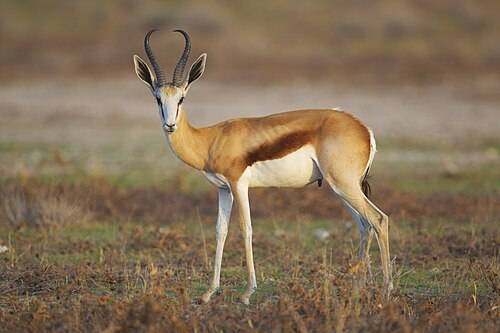
- springbok (antelope), king protea flower
- National colours
- red, green, blue, yellow, black, white
- National anthem
- Title: "National Anthem of South Africa"Lyrics/music: Enoch SONTONGA and Cornelius Jacob LANGENHOVEN/Enoch SONTONGA and Marthinus LOURENS de VilliersHistory: adopted 1997; a combination of "N'kosi Sikelel' iAfrica" (God Bless Africa) and "Die Stem van Suid Afrika" (The Call of South Africa), which were respectively the anthems of the non-white and white communities under apartheid; official lyrics contain a mixture of Xhosa, Zulu, Sesotho, Afrikaans, and English (the five most widely spoken of South Africa's 11 official languages)
- UNESCO World Heritage Sites
- Total World Heritage Sites: 12 (7 cultural, 4 natural, 1 mixed)Selected World Heritage Site locales: Fossil Hominid Sites of South Africa (c); iSimangaliso Wetland Park (n); Robben Island (c); Maloti-Drakensberg Park (m); Mapungubwe Cultural Landscape (c); Cape Floral Region Protected Areas (n); Vredefort Dome (n); Richtersveld Cultural and Botanical Landscape (c); Khomani Cultural Landscape (c); Barberton Makhonjwa Mountains (n); Human Rights, Liberation and Reconciliation: Nelson Mandela Legacy Sites (c); The Emergence of Modern Human Behaviour: The Pleistocene Occupation Sites of South Africa (c)
Economy
- Overview
- upper-middle-income, largest southern African economy; Government of National Unity facing slow growth, fiscal gaps, and structural challenges; high income inequality, unemployment, and poverty; reforms to address electricity generation, transport, and logistics; leading producer and exporter of critical minerals
- GDP (PPP)
- $870.42 billion (2024 est.)
- GDP per person (PPP)
- $13,600 (2024 est.)
- GDP growth
- 0.6% (2024 est.)
- Inflation
- 4.4% (2024 est.)
- Unemployment
- 33.2% (2024 est.)
- Farm products
- sugarcane, maize, milk, soybeans, potatoes, wheat, grapes, chicken, oranges, apples (2023)
- Industries
- mining (world's largest producer of platinum, gold, chromium), automobile assembly, metalworking, machinery, textiles, iron and steel, chemicals, fertilizer, foodstuffs, commercial ship repair
- Exports
- $127.629 billion (2024 est.)
- Main exports
- gold, platinum, coal, cars, iron ore (2023)
- Export partners
- China 19%, USA 8%, Germany 7%, India 7%, UK 6% (2023)
- Main imports
- refined petroleum, crude petroleum, gold, cars, broadcasting equipment (2023)
- Import partners
- China 21%, India 7%, USA 7%, Germany 6%, UAE 4% (2023)
- Money sent home from abroad
- 0.2% of GDP (2024 est.)
Energy, internet and transport
- Electricity access
- Electrification - total population: 86.5% (2022 est.)Electrification - urban areas: 87.1%Electrification - rural areas: 93.4%
- Electricity sources
- Fossil fuels: 87.3% of total installed capacity (2023 est.)Nuclear: 3.7% of total installed capacity (2023 est.)Solar: 2.9% of total installed capacity (2023 est.)Wind: 5.3% of total installed capacity (2023 est.)Hydroelectricity: 0.7% of total installed capacity (2023 est.)Biomass and waste: 0.2% of total installed capacity (2023 est.)
- Internet users
- Percent of population: 76% (2023 est.)
- Mobile phones
- Total subscriptions: 115 million (2024 est.)Subscriptions per 100 inhabitants: 167 (2024 est.)
- TV and radio
- the South African Broadcasting Corporation (SABC) operates 6 free-to-air TV stations; 1 private TV station; multiple subscription TV services with mix of local and international channels; mix of public and private radio stations at the national, regional, and local levels; state-owned SABC radio network has 18 stations, including one for each of the 11 official languages, 4 community stations, and 3 commercial stations; over 100 community stations with rural coverage
- Airports
- 573 (2025)
- Railways
- Total: 30,400 km (2021)Standard gauge: 80 km (2021) 1.435-m gauge (80 km electrified)Narrow gauge: 19,756 km (2014) 1.065-m gauge (8,271 km electrified)
- Merchant ships
- Total: 110 (2023)By type: bulk carrier 3, general cargo 1, oil tanker 7, other 99
Military and space
- Armed forces
- South African National Defense Force (SANDF): South African Army (includes Reserve Force), South African Navy (SAN), South African Air Force (SAAF), South African Military Health ServicesMinistry of Police: South African Police Service (SAPS) (2025)
- Military spending
- 0.7% of GDP (2024 est.)
- Military service
- 18-22 (18-26 for college graduates) years of age for voluntary military service for men and women; initial 24-month service obligation (2025)
- Space programme
- key areas of emphasis for its national space program include Earth observation/remote sensing (RS) capabilities, weather monitoring, research, engineering, and operations (tracking, telemetry, etc.); produces and operates satellites; has a sounding rocket program for carrying experimental payloads for research; cooperates with a range of foreign space agencies and industries, including those of China, France, India, Russia, and the US; member of the African Space Agency; participates in international programs such as the Square Kilometer Array Project; has a number of state- and privately-owned aerospace companies, as well as academic and research institutions involved in space-related activities (2025)
- Space milestones
- 1976 - established a satellite remote sensing (RS)/radio astronomy center (originally built by the US in 1961 to receive data from US space missions)1980s - conducted program to launch reconnaissance satellites on a domestically produced satellite launch vehicle (abandoned in 1994 along with nuclear program)1999 - first domestically built RS/technology demonstrator microsatellite (Sunsat-1) launched by US2009 - first government-owned and -operated RS/scientific/technology demonstrator satellite (SumbandilaSat) launched by Russia2018 - inaugurated a radio space telescope array (Karoo Array Telescope or MeerKAT)2021 - began construction of the international Square Kilometer Array radio telescope observatory; launched a sounding rocket for research purposes to an altitude of nearly 18,000 km (11,185 mi)2022 - opened Africa's first regional space weather center2023 - agreed to participate in China's international lunar research station project
Global issues
- Refugees and displaced people
- Refugees: 171,484 (2024 est.)IDPs: 7,385 (2024 est.)
- Drug trade
- USG identification: major precursor-chemical producer (2025)
Neighbouring countries
BotswanaLesothoMozambiqueNamibiaEswatiniZimbabwe
- Phone code
- +27
- Internet domain
- .za