Denmark
Kingdom of Denmark · Danmark
Viking kingdom that ruled England and Norway in the 11th century and led the Kalmar Union of Scandinavia. Lost Norway in 1814 and Schleswig in 1864. One of the world's oldest monarchies; Greenland and the Faroes remain part of the realm.
See Denmark on the 3D globeTake a quiz
Population6 million
Area43,094 km²
CapitalCopenhagen
RegionNorthern Europe
Did you know?
- No point in the country is more than 52 km from the sea
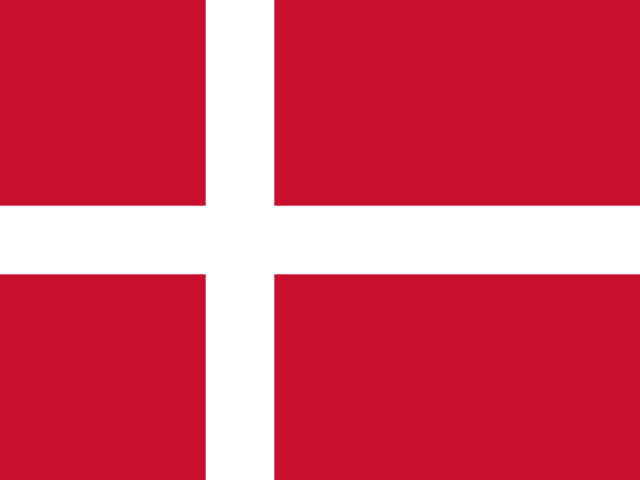
- The Dannebrog is the oldest national flag still in use
- Bicycles outnumber cars in Copenhagen
Key facts about Denmark
- Government
- Parliamentary constitutional monarchy
- Religion
- Lutheran (Church of Denmark) ~72%
- Founded / independence
- c. 965 unification
- Rich in
- Wind energy, pharmaceuticals (Novo Nordisk), shipping (Maersk), agriculture
- Languages
- Danish
Danish: Jutlandic, Insular, Bornholmish dialects; also Greenlandic and Faroese in the realm - Currency
- Danish krone (kr)
- People are called
- Danish
- Main cities
- Copenhagen, Aarhus, Odense, Aalborg
Timeline of Denmark
- 965Harald Bluetooth converts to Christianity
- 1397Kalmar Union
- 1814Loses Norway
- 1864Loses Schleswig
- 1940German occupation
- 1973Joins EEC
- 1989First country to recognise same-sex unions
Places to see in Denmark
- Nyhavn
- Tivoli Gardens
- Little Mermaid statue
- Kronborg Castle
- LEGOLAND in Billund
Food and drink
Smørrebrød (open sandwiches) · frikadeller · Danish pastries
Culture and famous for
LEGO; hygge; designers like Arne Jacobsen; Hans Christian Andersen's fairy tales
Popular sports
Football, handball, cycling
Geography and climate
- Highest point
- Møllehøj, 171 m
- Rivers, lakes and seas
- No large rivers; over 400 islands
- Climate
- Mild maritime
- Coastline
- Has a sea coast
- Population density
- 139 people per km²
Wars and conflicts
- Viking raids
- Kalmar Union wars
- Schleswig wars 1848 and 1864
- WWII occupation
Empires and states that once stood here
Alliances and memberships
Military and security
Political unions and regional organisations
European UnionCouncil of EuropeNordic Council
Economy and trade
Denmark in depth
Detailed facts from the CIA World Factbook (public domain, latest edition).
Overview
- History in brief
- Once the seat of Viking raiders and later a major north European power, Denmark has evolved into a modern, prosperous nation that is part of the general political and economic integration of Europe. It joined NATO in 1949 and the EEC (now the EU) in 1973. The country has opted out of certain elements of the EU's Maastricht Treaty, including the European Economic and Monetary Union and justice and home affairs issues. a 2022 referendum resulted in the removal of Denmark's 30-year opt-out on defense issues, now allowing Denmark to participate fully in the EU's Common Security and Defense Policy.
Geography
- Location
- Northern Europe, bordering the Baltic Sea and the North Sea, on a peninsula north of Germany (Jutland); also includes several major islands (Sjaelland, Fyn, and Bornholm)
- Size compared
- slightly less than twice the size of Massachusetts; about two-thirds the size of West Virginia
- Land borders
- Total: 141 kmBorder countries: Germany 140 km; Canada 1.3 km
- Coastline
- 7,314 km
- Climate
- temperate; humid and overcast; mild, windy winters and cool summers
- Terrain
- low and flat to gently rolling plains
- Elevation
- Highest point: Store Mollehoj 171 mLowest point: Lammefjord -7 mMean elevation: 34 m
- Natural resources
- petroleum, natural gas, fish, arable land, salt, limestone, chalk, stone, gravel and sand
- Natural hazards
- flooding is a threat in some areas of the country (e.g., parts of Jutland, along the southern coast of the island of Lolland) that are protected from the sea by a system of dikes
- Notes
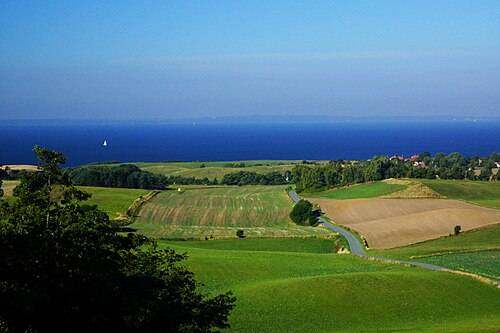
- composed of the Jutland Peninsula and a group of more than 400 islands (Danish Archipelago); controls Danish Straits (Skagerrak and Kattegat) linking Baltic and North Seas; about one-quarter of the population lives in greater Copenhagen
- Environmental issues
- air pollution, principally from vehicle and power-plant emissions; nitrogen and phosphorus pollution of the North Sea; water pollution from animal wastes and pesticides
People and society
- Population
- Total: 6,051,491 (2025 est.)Male: 3,001,698Female: 3,049,793
- Nationality
- Noun: Dane(s)Adjective: Danish
- Ethnic groups
- Danish (includes Greenlandic (who are predominantly Inuit) and Faroese) 84.2%, Turkish 1.1%, other 14.7% (largest groups are Polish, Romanian, Syrian, Ukrainian, German, and Iraqi) (2023 est.)
- Languages
- Danish, Faroese, Greenlandic (an Inuit dialect), German (small minority); note - English is the predominant second languageMajor-language sample(s): Verdens Faktabog, den uundværlig kilde til grundlæggende oplysninger. (Danish)The World Factbook, the indispensable source for basic information.
- Religions
- Evangelical Lutheran (official) 71.4%, Muslim 4.3%, other/none/unspecified (denominations include Roman Catholic, Jehovah's Witness, Serbian Orthodox Christian, Jewish, Baptist, Buddhist, Church of Jesus Christ, Pentecostal, and nondenominational Christian) 24.3% (2024 est.)
- Median age
- Total: 42.2 years (2025 est.)Male: 41 yearsFemale: 43.4 years
- Population growth
- 0.64% (2025 est.)
- Life expectancy
- Total population: 82.1 years (2024 est.)Male: 80.2 yearsFemale: 84.1 years
- Children per woman
- 1.5 children born/woman (2025 est.)
- Urbanization
- Urban population: 88.5% of total population (2023)Rate of urbanization: 0.54% annual rate of change (2020-25 est.)
- Largest cities
- 1.381 million COPENHAGEN (capital) (2023)
- Years in school
- Total: 18 years (2023 est.)Male: 18 years (2023 est.)Female: 19 years (2023 est.)
Government
- Official names
- Conventional long form: Kingdom of DenmarkConventional short form: DenmarkLocal long form: Kongeriget DanmarkLocal short form: DanmarkEtymology: the name derives from the words Dane, a tribal name with unclear Germanic origins, and mark, a Danish word that refers to a march (borderland)
- Government type
- parliamentary constitutional monarchy
- Capital
- Name: CopenhagenGeographic coordinates: 55 40 N, 12 35 ETime difference: UTC+1 (6 hours ahead of Washington, DC, during Standard Time)Daylight saving time: +1hr, begins last Sunday in March; ends last Sunday in October; note - applies to continental Denmark only, not to its North Atlantic componentsEtymology: name derives from the Danish words køber (merchant or buyer) and havn (harbor or port)
- Regions
- metropolitan Denmark - 5 regions (regioner, singular - region); Hovedstaden (Capital), Midtjylland (Central Jutland), Nordjylland (North Jutland), Sjaelland (Zealand), Syddanmark (Southern Denmark)
- Independence
- ca. 965 (unified and Christianized under Harald I GORMSSON); 5 June 1849 (became a parliamentary constitutional monarchy)
- National holiday
- Constitution Day, 5 June (1849)
- Constitution
- History: several previous; latest adopted 5 June 1953Amendment process: proposed by the Folketing (Parliament) with consent of the government; passage requires approval by the next Folketing following a general election, approval by simple majority vote of at least 40% of voters in a referendum, and assent of the chief of state
- Legal system
- civil law; judicial review of legislative acts
- Voting age
- 18 years of age; universal
- Flag meaning
- Description: red field with a white cross that extends to the edges of the flag; the vertical part of the cross is shifted to the leftHistory: referred to as the Dannebrog (Danish flag) and is one of the oldest national flags in the world; the origin of the design is unclear; one legend says that the banner fell from the sky during an early-13th-century battle and inspired the royal army to victory; in actuality, the flag may derive from a crusade banner
- National symbols
- lion, mute swan
- National colours
- red, white
- National anthem
- Title: “Kong Christian stod ved højen mast” (King Christian Stood by the Lofty Mast)Lyrics/music: Johannes EWALD/unknownHistory: adopted 1780; one of the oldest royal anthems in the world; used for events when Danish royalty is present; anthem has equal status with the national anthem
- UNESCO World Heritage Sites
- Total World Heritage Sites: 12 (8 cultural, 4 natural)Selected World Heritage Site locales: Denmark: Mounds, Runic Stones, and Church at Jelling (c); Roskilde Cathedral (c); Kronborg Castle (c); Wadden Sea (n); Stevns Klint (n); Christiansfeld, Moravian Church Settlement (c); Par force hunting landscape, North Zealand (c); Greenland: Ilulissat Icefjord (n); Kujataa, Norse and Inuit Farming (c); Aasivissuit–Nipisat, Inuit Hunting Ground (c); Viking-Age Ring Fortresses (c); Møns Klint (n)
Economy
- Overview
- high-income, EU-member, trade-oriented Nordic economy; growth driven by pharmaceuticals, energy, and services; large share of employment in public sector; fixed exchange rate pegged to euro; strong fiscal position and declining public debt; tight labor market mitigated by migrant workers and higher retirement age
- GDP (PPP)
- $440.558 billion (2024 est.)
- GDP per person (PPP)
- $73,700 (2024 est.)
- GDP growth
- 3.7% (2024 est.)
- Inflation
- 1.4% (2024 est.)
- Unemployment
- 5.6% (2024 est.)
- Below poverty line
- 12.4% (2021 est.)
- Farm products
- milk, wheat, potatoes, barley, sugar beets, pork, rapeseed, rye, oats, chicken (2023)
- Industries
- wind turbines, pharmaceuticals, medical equipment, shipbuilding and refurbishment, iron, steel, nonferrous metals, chemicals, food processing, machinery and transportation equipment, textiles and clothing, electronics, construction, furniture and other wood products
- Exports
- $299.405 billion (2024 est.)
- Main exports
- packaged medicine, fish, vaccines, refined petroleum, pork (2023)
- Export partners
- Germany 13%, USA 10%, Sweden 9%, Netherlands 7%, China 5% (2023)
- Main imports
- natural gas, cars, garments, packaged medicine, refined petroleum (2023)
- Import partners
- Germany 18%, Sweden 11%, Norway 10%, Netherlands 9%, China 7% (2023)
- Money sent home from abroad
- 0.4% of GDP (2024 est.)
Energy, internet and transport
- Electricity access
- Electrification - total population: 100% (2022 est.)
- Electricity sources
- Fossil fuels: 11.3% of total installed capacity (2023 est.)Solar: 9.9% of total installed capacity (2023 est.)Wind: 57.6% of total installed capacity (2023 est.)Hydroelectricity: 0.1% of total installed capacity (2023 est.)Biomass and waste: 21.2% of total installed capacity (2023 est.)
- Internet users
- Percent of population: 100% (2024 est.)
- Mobile phones
- Total subscriptions: 7.57 million (2024 est.)Subscriptions per 100 inhabitants: 127 (2024 est.)
- TV and radio
- strong public-sector TV presence, with Danmarks Radio (DR) operating 6 channels and TV2 operating roughly a half-dozen channels; private stations are available via satellite and cable feed; DR operates 4 FM radio stations, 10 digital audio stations, and 14 web-based radio stations; 140 commercial and 187 community (non-commercial) radio stations (2019)
- Airports
- 102 (2025)
- Railways
- Total: 2,682 km (2020) 876 km electrified
- Merchant ships
- Total: 715 (2023)By type: bulk carrier 15, container ship 132, general cargo 69, oil tanker 107, other 392
Military and space
- Armed forces
- Danish Armed Forces (Forsvaret): Royal Danish Army, Royal Danish Navy, Royal Danish Air Force (2025)
- Military spending
- 3.2% of GDP (2025 est.)
- Military service
- 18 years of age for compulsory and voluntary military service for men and women; draftees serve 11 months, including five months of basic training, followed by six months in an operational unit (2025)
Global issues
- Refugees and displaced people
- Refugees: 100,832 (2024 est.)Stateless persons: 8,566 (2024 est.)
Neighbouring countries
- Phone code
- +45
- Internet domain
- .dk