Dominican Republic
Dominican Republic · República Dominicana
Site of the first Spanish colony in the Americas (1492). Shares Hispaniola with Haiti.
See Dominican Republic on the 3D globeTake a quiz
Population11.4 million
Area48,671 km²
CapitalSanto Domingo
RegionCaribbean
Did you know?
- Has the oldest cathedral in the Americas
- Lake Enriquillo is the Caribbean's lowest point
- Produces more Major League baseball players than any country outside the US
Key facts about Dominican Republic
- Government
- Presidential republic
- Religion
- Catholic ~57%, Evangelical ~23%
- Founded / independence
- 1844 (from Haiti)
- Rich in
- Tourism, gold, cigars, baseball players
- Languages
- Spanish
Spanish (Dominican) - Currency
- Dominican peso ($)
- People are called
- Dominican
- Main cities
- Santo Domingo, Santiago, La Romana, San Pedro de Macorís
Timeline of Dominican Republic
- 1496Santo Domingo founded
- 1844Independence from Haiti
- 1930Trujillo
- 1965US intervention
- 1978Democratic transition
Places to see in Dominican Republic
- Colonial Zone, Santo Domingo
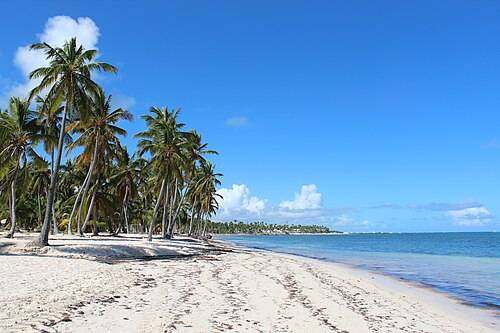
- Punta Cana
- Los Haitises
- Samaná whale watching
- Pico Duarte
Food and drink
La bandera (rice, beans, meat) · mangú · sancocho
Culture and famous for
Merengue and bachata music; amber
Popular sports
Baseball (many MLB players)
Geography and climate
- Highest point
- Pico Duarte, 3,098 m (Caribbean's highest)
- Rivers, lakes and seas
- Yaque del Norte; Lake Enriquillo
- Climate
- Tropical
- Coastline
- Has a sea coast
- Population density
- 234 people per km²
Wars and conflicts
- Haitian occupation
- Trujillo dictatorship 1930–61
- US invasion 1965
Alliances and memberships
Military and security
Political unions and regional organisations
Central American Integration SystemCELACOrganization of American States
Dominican Republic in depth
Detailed facts from the CIA World Factbook (public domain, latest edition).
Overview
- History in brief
- The Taino -- indigenous inhabitants of Hispaniola prior to the arrival of Europeans -- divided the island now known as the Dominican Republic and Haiti into five chiefdoms and territories. Christopher COLUMBUS explored and claimed the island on his first voyage in 1492; it became a springboard for Spanish conquest of the Caribbean and the American mainland. In 1697, Spain recognized French dominion over the western third of the island, which in 1804 became Haiti. The remainder of the island, by then known as Santo Domingo, sought to gain its own independence in 1821, but the Haitians conquered and ruled it for 22 years; it finally attained independence as the Dominican Republic in 1844. In 1861, the Dominicans voluntarily returned to the Spanish Empire, but two years later, they launched a war that restored independence in 1865.A legacy of unsettled and mostly non-representative rule followed, capped by the dictatorship of Rafael Leonidas TRUJILLO from 1930 to 1961. Juan BOSCH was elected president in 1962 but was deposed in a military coup in 1963. In 1965, the US led an intervention in the midst of a civil war sparked by an uprising to restore BOSCH. In 1966, Joaquin BALAGUER defeated BOSCH in the presidential election. BALAGUER maintained a tight grip on power for most of the next 30 years, until international reaction to flawed elections forced him to curtail his term in 1996. Since then, regular competitive elections have been held.
Geography
- Location
- Caribbean, eastern two-thirds of the island of Hispaniola, between the Caribbean Sea and the North Atlantic Ocean, east of Haiti
- Size compared
- slightly more than twice the size of New Jersey
- Land borders
- Total: 376 kmBorder countries: Haiti 376 km
- Coastline
- 1,288 km
- Climate
- tropical maritime; little seasonal temperature variation; seasonal variation in rainfall
- Terrain
- rugged highlands and mountains interspersed with fertile valleys
- Elevation
- Highest point: Pico Duarte 3,098 mLowest point: Lago Enriquillo -46 mMean elevation: 424 m
- Natural resources
- nickel, bauxite, gold, silver, arable land
- Major lakes
- Salt water lake(s): Lago de Enriquillo - 500 sq km
- Natural hazards
- lies in the middle of the hurricane belt and subject to severe storms from June to October; occasional flooding; periodic droughts
- Notes
- shares island of Hispaniola with Haiti (eastern two-thirds makes up the Dominican Republic, western one-third is Haiti); the second largest country in the Antilles (after Cuba); geographically diverse with the Caribbean's tallest mountain, Pico Duarte, and lowest elevation and largest lake, Lago Enriquillo
- Environmental issues
- soil eroding into the sea damages coral reefs; deforestation
People and society
- Population
- Total: 10,899,292 (2025 est.)Male: 5,506,679Female: 5,392,613
- Nationality
- Noun: Dominican(s)Adjective: Dominican
- Ethnic groups
- mixed 70.4% (Mestizo/Indio 58%, Mulatto 12.4%), Black 15.8%, White 13.5%, other 0.3% (2014 est.)
- Languages
- Spanish (official)Major-language sample(s): La Libreta Informativa del Mundo, la fuente indispensable de información básica. (Spanish)The World Factbook, the indispensable source for basic information.
- Religions
- Evangelical 50.2%, Roman Catholic 30.1%, none 18.5%, unspecified 1.2% (2023 est.)
- Median age
- Total: 29.6 years (2025 est.)Male: 29.1 yearsFemale: 29.4 years
- Population growth
- 0.78% (2025 est.)
- Life expectancy
- Total population: 72.6 years (2024 est.)Male: 71 yearsFemale: 74.3 years
- Children per woman
- 2.17 children born/woman (2025 est.)
- Urbanization
- Urban population: 84.4% of total population (2023)Rate of urbanization: 1.64% annual rate of change (2020-25 est.)
- Largest cities
- 3.524 million SANTO DOMINGO (capital) (2023)
- Literacy
- Total population: 94% (2024 est.)Male: 93.6% (2024 est.)Female: 94.4% (2024 est.)
- Years in school
- Total: 14 years (2022 est.)Male: 13 years (2022 est.)Female: 15 years (2022 est.)
Government
- Official names
- Conventional long form: Dominican RepublicConventional short form: The DominicanLocal long form: República DominicanaLocal short form: La DominicanaFormer: Santo Domingo (the capital city's name formerly applied to the entire country)Etymology: the name is a latinized form of the Spanish term Santo Domingo, meaning "holy Sunday;" Spanish explorers originally settled the island on a Sunday in 1496, and the name was first given to the island of Hispaniola as a whole in 1697
- Government type
- presidential republic
- Capital
- Name: Santo DomingoGeographic coordinates: 18 28 N, 69 54 WTime difference: UTC-4 (1 hour ahead of Washington, DC, during Standard Time)Etymology: named after Saint Domingo de GUZMAN (1170-1221), founder of the Dominican Order; the city's full name was originally Santo Domingo de Guzman
- Regions
- 31 provinces (provincias, singular - provincia), 1 district* (distrito); Azua, Baoruco, Barahona, Dajabón, Distrito Nacional*, Duarte, Elías Piña, El Seibo, Espaillat, Hato Mayor, Hermanas Mirabal, Independencia, La Altagracia, La Romana, La Vega, María Trinidad Sánchez, Monseñor Nouel, Monte Cristi, Monte Plata, Pedernales, Peravia, Puerto Plata, Samaná, Sánchez Ramírez, San Cristóbal, San José de Ocoa, San Juan, San Pedro de Macorís, Santiago, Santiago Rodríguez, Santo Domingo, Valverde
- Independence
- 27 February 1844 (from Haiti)
- National holiday
- Independence Day, 27 February (1844)
- Constitution
- History: many previous (38 total); latest proclaimed 13 June 2015Amendment process: proposed by a special session of the National Congress called the National Revisory Assembly; passage requires at least two-thirds majority approval by at least one half of those present in both houses of the Assembly; passage of amendments to constitutional articles, such as fundamental rights and guarantees, territorial composition, nationality, or the procedures for constitutional reform, also requires approval in a referendum
- Legal system
- civil law system based on the French civil code; Criminal Procedures Code modified in 2004 to include important elements of an accusatory system
- Voting age
- 18 years of age; universal and compulsory; married persons can vote, regardless of age
- Flag meaning
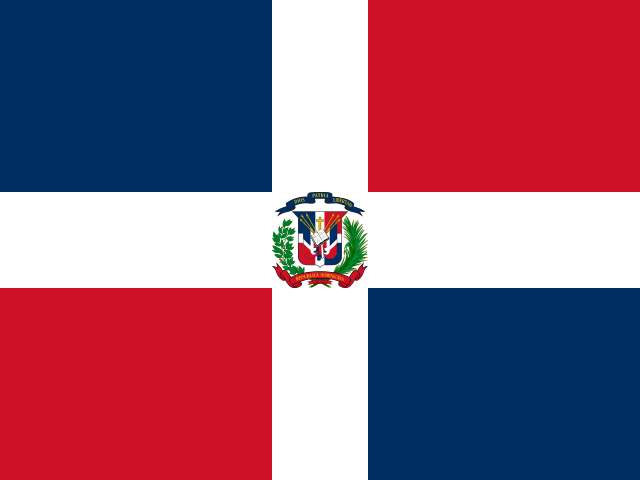
- Description: a centered white cross extends to the edges and divides the flag into four rectangles; the top ones are ultramarine blue (left side) and vermilion red, and the bottom ones are vermilion red (left side) and ultramarine blue; a small coat of arms with a shield supported by a laurel branch and a palm branch is at the center of the cross; above the shield, a blue ribbon displays the motto DIOS, PATRIA, LIBERTAD (God, Fatherland, Liberty); below the shield, REPUBLICA DOMINICANA is on a red ribbon; on the shield, a Bible is opened to a verse that reads "Y la verdad nos hara libre" (And the truth shall set you free)Meaning: blue stands for liberty, white for salvation, and red for the blood of heroes
- National symbols
- palmchat (bird)
- National colours
- red, white, blue
- National anthem
- Title: "Himno Nacional" (National Anthem)Lyrics/music: Emilio PRUD'HOMME/Jose REYESHistory: adopted 1934; also known as "Quisqueyanos valientes" (Valiant Sons of Quisqueye); the anthem refers to the Dominican people as Quisqueyanos, which comes from the ethnic name for the island
- UNESCO World Heritage Sites
- Total World Heritage Sites: 1 (cultural)Selected World Heritage Site locales: Colonial City of Santo Domingo
Economy
- Overview
- surging middle-income tourism, construction, mining, and telecommunications OECS economy; major foreign US direct investment and free-trade zones; developing local financial markets; improving debt management; declining poverty
- GDP (PPP)
- $276.884 billion (2024 est.)
- GDP per person (PPP)
- $24,200 (2024 est.)
- GDP growth
- 5% (2024 est.)
- Inflation
- 3.3% (2024 est.)
- Unemployment
- 5.5% (2024 est.)
- Below poverty line
- 23% (2023 est.)
- Farm products
- sugarcane, bananas, papayas, plantains, avocados, rice, milk, watermelons, vegetables, pineapples (2023)
- Industries
- tourism, sugar processing, gold mining, textiles, cement, tobacco, electrical components, medical devices
- Exports
- $28.563 billion (2024 est.)
- Main exports
- medical instruments, tobacco, gold, garments, power equipment (2023)
- Export partners
- USA 52%, Switzerland 7%, Haiti 6%, China 5%, India 3% (2023)
- Main imports
- refined petroleum, cars, natural gas, plastic products, crude petroleum (2023)
- Import partners
- USA 40%, China 18%, Brazil 4%, Spain 4%, Mexico 3% (2023)
- Money sent home from abroad
- 9% of GDP (2024 est.)
Energy, internet and transport
- Electricity access
- Electrification - total population: 98.1% (2022 est.)Electrification - urban areas: 98.8%Electrification - rural areas: 95%
- Electricity sources
- Fossil fuels: 82.7% of total installed capacity (2023 est.)Solar: 5.5% of total installed capacity (2023 est.)Wind: 4.9% of total installed capacity (2023 est.)Hydroelectricity: 6% of total installed capacity (2023 est.)Biomass and waste: 0.9% of total installed capacity (2023 est.)
- Internet users
- Percent of population: 85% (2023 est.)
- Mobile phones
- Total subscriptions: 10.7 million (2024 est.)Subscriptions per 100 inhabitants: 94 (2024 est.)
- TV and radio
- combination of state-owned and privately owned broadcast media; 1 state-owned TV network and a number of private TV networks; networks operate repeaters to extend signals throughout country; over 300 state-owned and privately owned radio stations (2019)
- Airports
- 32 (2025)
- Railways
- Total: 496 km (2014)Standard gauge: 354 km (2014) 1.435-m gaugeNarrow gauge: 142 km (2014) 0.762-m gauge
- Merchant ships
- Total: 40 (2023)By type: container ship 1, general cargo 2, oil tanker 1, other 36
Military and space
- Armed forces
- Armed Forces of the Dominican Republic: Army of the Dominican Republic (Ejercito de la República Dominicana, ERD), Navy (Armada de República Dominicana or ARD; includes naval infantry), Dominican Air Force (Fuerza Aerea de la República Dominicana, FARD) (2025)
- Military spending
- 0.8% of GDP (2024 est.)
- Military service
- 17-early 20s for voluntary military service for men and women (ages vary depending on military service and position; under 18 admitted with permission of parents) (2025)
Global issues
- Refugees and displaced people
- Refugees: 1,004 (2024 est.)IDPs: 390 (2023 est.)
- Drug trade
- USG identification: major illicit drug-producing and/or drug-transit country (2025)
Neighbouring countries
- Phone code
- +1
- Internet domain
- .do