Haiti
Republic of Haiti · Haïti · Ayiti
The first free Black republic, born from a slave revolt that defeated Napoleon's army. France forced it to pay a huge "independence debt". Gangs control most of the capital.
See Haiti on the 3D globeTake a quiz
Ongoing: Haiti gang war
Population11.8 million
Area27,750 km²
CapitalPort-au-Prince
RegionCaribbean
Did you know?
- The Citadelle is the largest fortress in the Americas
- First country founded by a successful slave revolt
- Soup joumou is eaten every Independence Day
Key facts about Haiti
- Government
- Presidential republic (no elected leaders; transitional council)
- Religion
- Catholic ~55%, Protestant ~30%, Vodou widely practised
- Founded / independence
- 1804 (from France)
- Rich in
- Coffee, mangoes, vetiver; poorest country in the Americas
- Languages
- French, Haitian Creole
Haitian Creole and French - Currency
- Haitian gourde (G)
- People are called
- Haitian
- Main cities
- Port-au-Prince, Cap-Haïtien, Carrefour, Gonaïves
Timeline of Haiti
- 1492Columbus lands
- 1697French Saint-Domingue
- 1804Independence
- 1915US occupation
- 2010Earthquake
- 2021President assassinated
Places to see in Haiti
- Citadelle Laferrière
- Sans-Souci Palace
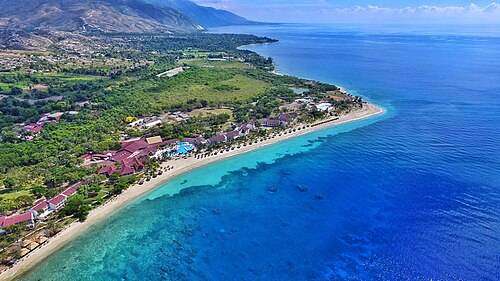
- Labadee
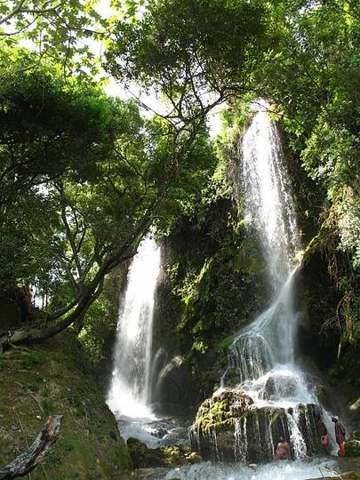
- Bassin Bleu
- Jacmel
Food and drink
Griot (fried pork) · diri ak djon djon (black mushroom rice) · soup joumou (UNESCO)
Culture and famous for
Vodou; colourful naïve painting; kompa music
Popular sports
Football
Geography and climate
- Highest point
- Pic la Selle, 2,680 m
- Rivers, lakes and seas
- Artibonite River
- Climate
- Tropical
- Coastline
- Has a sea coast
- Population density
- 425 people per km²
Wars and conflicts
- Haitian Revolution 1791–1804
- US occupation 1915–34
- gang war 2021–present
Alliances and memberships
Military and security
Political unions and regional organisations
CARICOMCELACOrganization of American States
Haiti in depth
Detailed facts from the CIA World Factbook (public domain, latest edition).
Overview
- History in brief
- The native Taino -- who inhabited the island of Hispaniola when Christopher COLUMBUS first landed in 1492 -- were virtually wiped out by Spanish settlers within 25 years. In the early 17th century, the French established a presence on Hispaniola. In 1697, Spain ceded to the French the western third of the island, which later became Haiti. The French colony, based on forestry and sugar-related industries, became one of the wealthiest in the Caribbean but relied heavily on the forced labor of enslaved Africans and environmentally degrading practices. In the late 18th century, Toussaint L'OUVERTURE led a revolution of Haiti's nearly half a million slaves that ended France's rule on the island. After a prolonged struggle, and under the leadership of Jean-Jacques DESSALINES, Haiti became the first country in the world led by former slaves after declaring its independence in 1804, but it was forced to pay an indemnity of 100 million francs (equivalent to $22 billion USD in March 2023) to France for more than a century and was shunned by other countries for nearly 40 years. In 1862, the US officially recognized Haiti, but foreign economic influence and internal political instability induced the US to occupy Haiti from 1915 to 1934.Francois "Papa Doc" DUVALIER and then his son Jean-Claude "Baby Doc" DUVALIER led repressive and corrupt regimes that ruled Haiti in 1957-1971 and 1971-1986, respectively. Jean-Bertrand ARISTIDE was Haiti's first democratically elected president in 1991 and was elected a second time in 2000, but coups interrupted his first term after only a few months and ended his second term in 2004. President Jovenel MOÏSE was assassinated in 2021, leading the country further into an extra-constitutional governance structure and contributing to the country’s growing fragility. The Government of Haiti then installed Ariel HENRY -- whom President MOÏSE had nominated shortly before his death -- as prime minister.On 29 February 2024, a significant escalation of gang violence occurred on the 20th anniversary of ARISTIDE's second overthrow, after the announcement that HENRY would not hold elections until August 2025. HENRY’s return from an overseas trip was diverted to Puerto Rico when the airport closed due to gang violence. With control of much of the capital, Port-au-Prince, gang leaders called for the ouster of HENRY’S government. By mid-March, Haiti’s continued violence, HENRY’S inability to return to the country, and increasing pressure from the in
Geography
- Location
- Caribbean, western one-third of the island of Hispaniola, between the Caribbean Sea and the North Atlantic Ocean, west of the Dominican Republic
- Size compared
- slightly smaller than Maryland
- Land borders
- Total: 376 kmBorder countries: Dominican Republic 376 km
- Coastline
- 1,771 km
- Climate
- tropical; semiarid where mountains in east cut off trade winds
- Terrain
- mostly rough and mountainous
- Elevation
- Highest point: Pic la Selle 2,674 mLowest point: Caribbean Sea 0 mMean elevation: 470 m
- Natural resources
- bauxite, copper, calcium carbonate, gold, marble, hydropower, arable land
- Natural hazards
- lies in the middle of the hurricane belt and subject to severe storms from June to October; occasional flooding and earthquakes; periodic droughts
- Notes
- shares island of Hispaniola with Dominican Republic (western one-third is Haiti, eastern two-thirds is the Dominican Republic); it is the most mountainous nation in the Caribbean
- Environmental issues
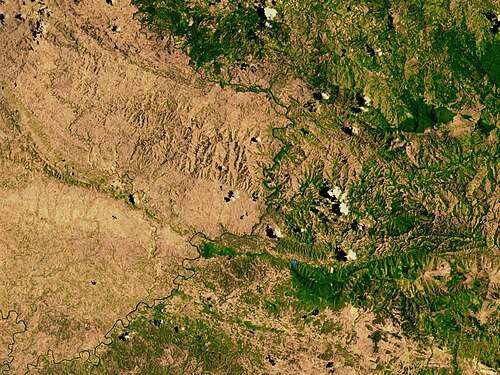
- deforestation (trees cleared for agriculture and used as fuel); soil erosion; inadequate potable water and lack of sanitation; natural disasters
People and society
- Population
- Total: 11,898,812 (2025 est.)Male: 5,863,438Female: 6,035,374
- Nationality
- Noun: Haitian(s)Adjective: Haitian
- Ethnic groups
- Black 95%, mixed and White 5%
- Languages
- French (official), Creole (official)Major-language sample(s): The World Factbook, une source indispensable d'informations de base. (French)The World Factbook, sous endispansab pou enfomasyon debaz. (Haitian Creole)The World Factbook, the indispensable source for basic information.
- Religions
- Catholic 55%, Protestant 29%, Vodou 2.1%, other 4.6%, none 10% (2018 est.)
- Median age
- Total: 25.3 years (2025 est.)Male: 24.7 yearsFemale: 25.3 years
- Population growth
- 1.22% (2025 est.)
- Life expectancy
- Total population: 65.6 years (2024 est.)Male: 63.8 yearsFemale: 67.4 years
- Children per woman
- 2.39 children born/woman (2025 est.)
- Urbanization
- Urban population: 59.7% of total population (2023)Rate of urbanization: 2.47% annual rate of change (2020-25 est.)
- Largest cities
- 2.987 million PORT-AU-PRINCE (capital) (2023)
- Literacy
- Total population: 68% (2017 est.)Male: 72.9% (2017 est.)Female: 63.9% (2017 est.)
Government
- Official names
- Conventional long form: Republic of HaitiConventional short form: HaitiLocal long form: République d'Haïti (French)/Repiblik d Ayiti (Haitian Creole)Local short form: Haïti (French)/ Ayiti (Haitian Creole)Etymology: derived from the Arawak name Ayti, meaning "Land of Mountains," that was originally applied to the entire island of Hispaniola
- Government type
- semi-presidential republic
- Capital
- Name: Port-au-PrinceGeographic coordinates: 18 32 N, 72 20 WTime difference: UTC-5 (same time as Washington, DC, during Standard Time)Daylight saving time: +1hr, begins second Sunday in March; ends first Sunday in NovemberEtymology: the name means "the port of the prince" and probably came from a ship called The Prince that anchored in the bay in the early 18th century
- Regions
- 10 departments (départements, singular - département); Artibonite, Centre, Grand'Anse, Nippes, Nord, Nord-Est, Nord-Ouest, Ouest, Sud, Sud-Est
- Independence
- 1 January 1804 (from France)
- National holiday
- Independence Day, 1 January (1804)
- Constitution
- History: many previous; latest adopted 10 March 1987, with substantial revisions in June 2012Amendment process: proposed by the executive branch or by either the Senate or the Chamber of Deputies; consideration of proposed amendments requires support by at least two-thirds majority of both houses; passage requires at least two-thirds majority of the membership present and at least two-thirds majority of the votes cast; approved amendments enter into force after installation of the next president of the republic; constitutional articles on the democratic and republican form of government cannot be amended
- Legal system
- civil law system strongly influenced by Napoleonic Code
- Voting age
- 18 years of age; universal
- Flag meaning
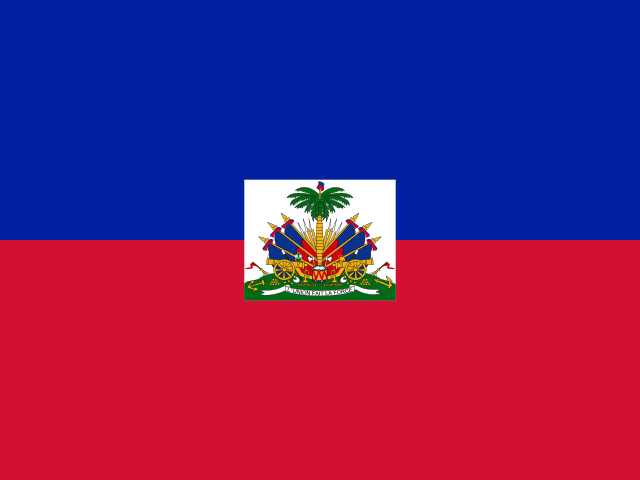
- Description: two equal horizontal bands of blue (top) and red; a centered white rectangle bears the coat of arms, which has a palm tree flanked by flags and two cannons above a scroll with the motto L'UNION FAIT LA FORCE (Union Makes Strength)Meaning: the colors are taken from the French flag and represent the union of ethnic groups
- National symbols
- Hispaniolan trogon (bird), hibiscus flower
- National colours
- blue, red
- National anthem
- Title: "La Dessalinienne" (The Dessalines Song)Lyrics/music: Justin LHERISSON/Nicolas GEFFRARDHistory: adopted 1904; named for Jean-Jacques DESSALINES, founder of Haiti
- UNESCO World Heritage Sites
- Total World Heritage Sites: 1 (cultural)Selected World Heritage Site locales: National History Park – Citadel, Sans Souci, Ramiers
Economy
- Overview
- small Caribbean island economy and OECS-member state; extreme poverty and inflation; enormous income inequality; ongoing civil unrest due to recent presidential assassination; US preferential market access; very open to foreign direct investment
- GDP (PPP)
- $32.971 billion (2024 est.)
- GDP per person (PPP)
- $2,800 (2024 est.)
- GDP growth
- -4.2% (2024 est.)
- Inflation
- 26.9% (2024 est.)
- Unemployment
- 15.1% (2024 est.)
- Farm products
- sugarcane, cassava, plantains, bananas, mangoes/guavas, avocados, maize, tropical fruits, rice, vegetables (2023)
- Industries
- textiles, sugar refining, flour milling, cement, light assembly using imported parts
- Exports
- $1.095 billion (2023 est.)
- Main exports
- garments, essential oils, scrap iron, industrial acids/oils/alcohols, bedding (2023)
- Export partners
- USA 82%, Canada 4%, Mexico 2%, France 2%, India 2% (2023)
- Main imports
- refined petroleum, rice, garments, cotton fabric, plastic products (2023)
- Import partners
- USA 31%, Dominican Republic 23%, China 14%, Indonesia 4%, India 3% (2023)
- Money sent home from abroad
- 18.9% of GDP (2023 est.)
Energy, internet and transport
- Electricity access
- Electrification - total population: 49.3% (2022 est.)Electrification - urban areas: 83%Electrification - rural areas: 1.2% (2019 est.)
- Electricity sources
- Fossil fuels: 81.3% of total installed capacity (2023 est.)Solar: 0.4% of total installed capacity (2023 est.)Hydroelectricity: 18.3% of total installed capacity (2023 est.)
- Internet users
- Percent of population: 39% (2019 est.)
- Mobile phones
- Total subscriptions: 7.5 million (2022 est.)Subscriptions per 100 inhabitants: 65 (2022 est.)
- TV and radio
- 398 legal broadcasting stations, including about 60 community radio stations; 105 TV stations, including 36 in Port-au-Prince, 41 others in the provinces, and more than 40 radio-television stations; large number of stations operate irregularly or flout regulations; VOA Creole Service broadcasts daily on 30 affiliate stations (2019)
- Airports
- 17 (2025)
- Merchant ships
- Total: 4 (2023)By type: general cargo 3, other 1
Military and space
- Armed forces
- The Haitian Armed Forces (FAdH): ArmyMinistry of Justice and Public Security: Haitian National Police (Police Nationale d'Haïti or PNH) (2025)
- Military service
- men and women 18-25 may volunteer for the FAdH (2023)
Global issues
- Refugees and displaced people
- Refugees: 5 (2024 est.)IDPs: 1,041,229 (2024 est.)
- Drug trade
- USG identification: major illicit drug-producing and/or drug-transit country (2025)
Neighbouring countries
- Phone code
- +509
- Internet domain
- .ht