Gambia
Republic of the Gambia
A narrow country along the Gambia River, almost surrounded by Senegal. A 22-year dictatorship ended in 2017.
See Gambia on the 3D globeTake a quiz
Population2.8 million
Area10,689 km²
CapitalBanjul
RegionWestern Africa
Did you know?
- Africa's smallest mainland country
- Almost entirely surrounded by Senegal
- Kunta Kinteh Island is linked to the book Roots
Key facts about Gambia
- Government
- Presidential republic
- Religion
- Sunni Islam ~96%
- Founded / independence
- 1965 (from UK)
- Rich in
- Peanuts, tourism, fishing
- Languages
- English
English; Mandinka, Wolof, Fula - Currency
- dalasi (D)
- People are called
- Gambian
- Main cities
- Serekunda, Banjul, Brikama
Timeline of Gambia
- 1588English trade
- 1889British colony
- 1965Independence
- 1994Coup
- 2017Democratic transition
Places to see in Gambia
- Kunta Kinteh Island
- Abuko Nature Reserve
- Wassu stone circles
- Banjul
Food and drink
Domoda (peanut stew) · benachin (one-pot rice)
Culture and famous for
Kora music; griots (storytellers)
Popular sports
Football, wrestling
Geography and climate
- Highest point
- Unnamed point, 53 m
- Rivers, lakes and seas
- Gambia River
- Climate
- Tropical
- Coastline
- Has a sea coast
- Population density
- 262 people per km²
Wars and conflicts
- 2016–17 constitutional crisis
Alliances and memberships
Political unions and regional organisations
African UnionECOWASOrganisation of Islamic CooperationCommonwealth of Nations
Gambia in depth
Detailed facts from the CIA World Factbook (public domain, latest edition).
Overview
- History in brief
- In the 10th century, Muslim merchants established some of The Gambia’s earliest large settlements as trans-Saharan trade hubs. These settlements eventually grew into major export centers sending slaves, gold, and ivory across the Sahara. Between the 16th and 17th centuries, European colonial powers began establishing trade with The Gambia. In 1664, the United Kingdom established a colony in The Gambia focused on exporting enslaved people across the Atlantic. During the roughly 300 years of the trans-Atlantic slave trade, the UK and other European powers may have exported as many as 3 million people from The Gambia.The Gambia gained its independence from the UK in 1965. Geographically surrounded by Senegal, it formed the short-lived confederation of Senegambia between 1982 and 1989. In 1994, Yahya JAMMEH led a military coup overthrowing the president and banning political activity. He subsequently won every presidential election until 2016, when he lost to Adama BARROW, who headed an opposition coalition during free and fair elections. BARROW won reelection in 2021. The Gambia is the only member of the Economic Community of West African States that does not have presidential term limits. Since the 2016 election, The Gambia and the US have enjoyed improved relations. US assistance to the country has supported democracy-strengthening activities, capacity building, economic development, and security sector education and training programs.
Geography
- Location
- Western Africa, bordering the North Atlantic Ocean and Senegal
- Size compared
- slightly less than twice the size of Delaware
- Land borders
- Total: 749 kmBorder countries: Senegal 749 km
- Coastline
- 80 km
- Climate
- tropical; hot, rainy season (June to November); cooler, dry season (November to May)
- Terrain
- flood plain of the Gambia River flanked by some low hills
- Elevation
- Highest point: unnamed elevation 63 m; 3 km southeast of the town of SabiLowest point: Atlantic Ocean 0 mMean elevation: 34 m
- Natural resources
- fish, clay, silica sand, titanium (rutile and ilmenite), tin, zircon
- Major rivers
- Gambia river mouth (shared with Senegal and Guinea [s]) - 1,094 kmNote: [s] after country name indicates river source; [m] after country name indicates river mouth
- Natural hazards
- droughts
- Notes
- almost an enclave of Senegal; smallest country on the African mainland
- Environmental issues
- deforestation due to slash-and-burn agriculture; desertification; water pollution; water-borne diseases
People and society
- Population
- Total: 2,523,327 (2024 est.)Male: 1,250,490Female: 1,272,837
- Nationality
- Noun: Gambian(s)Adjective: Gambian
- Ethnic groups
- Mandinka/Jahanka 33.3%, Fulani/Tukulur/Lorobo 18.2%, Wolof 12.9%, Jola/Karoninka 11%, Serahuleh 7.2%, Serer 3.5%, other 4%, non-Gambian 9.9% (2019-20 est.)
- Languages
- English (official), Mandinka, Wolof, Fula, other indigenous vernaculars
- Religions
- Muslim 96.4%, Christian 3.5%, other or none 0.1% (2019-20 est.)
- Median age
- Total: 20.5 years (2025 est.)Male: 19.8 yearsFemale: 20.6 years
- Population growth
- 2.09% (2025 est.)
- Life expectancy
- Total population: 68.4 years (2024 est.)Male: 66.7 yearsFemale: 70.1 years
- Children per woman
- 3.39 children born/woman (2025 est.)
- Urbanization
- Urban population: 64.5% of total population (2023)Rate of urbanization: 3.75% annual rate of change (2020-25 est.)
- Largest cities
- 481,000 BANJUL (capital) (2023)
- Literacy
- Total population: 51.6% (2021 est.)Male: 65.3% (2021 est.)Female: 40.5% (2021 est.)
Government
- Official names
- Conventional long form: Republic of The GambiaConventional short form: The GambiaEtymology: named for the Gambia River that flows through the country; Portuguese explorers in the 15th century derived the name for the river from its local name, Ba-Dimma, meaning "the river"
- Government type
- presidential republic
- Capital
- Name: BanjulGeographic coordinates: 13 27 N, 16 34 WTime difference: UTC 0 (5 hours ahead of Washington, DC, during Standard Time)Etymology: the name derives from a misunderstanding between Portuguese colonists and inhabitants in the 15th century; when asked what the area was called, the inhabitants thought they were being asked what they were doing and replied, "bangjulo," or "rope making"
- Regions
- 5 regions, 1 city*, and 1 municipality**; Banjul*, Central River, Kanifing**, Lower River, North Bank, Upper River, West Coast
- Independence
- 18 February 1965 (from the UK)
- National holiday
- Independence Day, 18 February (1965)
- Constitution
- History: previous 1965 (Independence Act), 1970; latest adopted 8 April 1996, approved by referendum 8 August 1996, effective 16 January 1997Amendment process: proposed by the National Assembly; passage requires at least three-fourths majority vote by the Assembly membership in each of several readings and approval by the president of the republic; a referendum is required for amendments affecting national sovereignty, fundamental rights and freedoms, government structures and authorities, taxation, and public funding; passage by referendum requires participation of at least 50% of eligible voters and approval by at least 75% of votes cast
- Legal system
- mixed system of English common law, Islamic law, and customary law
- Voting age
- 18 years of age; universal
- Flag meaning
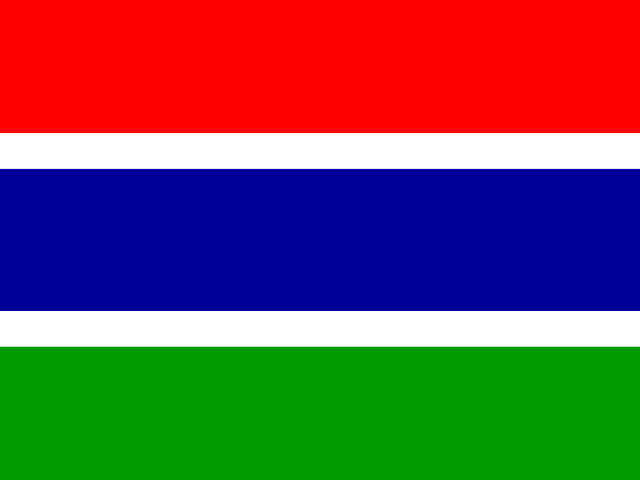
- Description: three equal horizontal bands of red (top), blue with white edges, and greenMeaning: red stands for the sun and the savannah, blue for the Gambia River, and green for forests and agriculture; the white stripes denote unity and peace
- National symbols
- lion
- National colours
- red, blue, green, white
- National anthem
- Title: "For The Gambia, Our Homeland"Lyrics/music: Virginia Julie HOWE/adapted by Jeremy Frederick HOWEHistory: adopted 1965; the music is an adaptation of the traditional Mandinka song "Foday Kaba Dumbuya"
- UNESCO World Heritage Sites
- Total World Heritage Sites: 2 (both cultural)Selected World Heritage Site locales: Kunta Kinteh Island and Related Sites; Stone Circles of Senegambia
Economy
- Overview
- low-income West African economy; agriculture-dominant; high poverty rate; heightened inflation; dependent on foreign assistance and remittances; structural reforms conditioned by IMF Extended Credit Facility program
- GDP (PPP)
- $8.365 billion (2024 est.)
- GDP per person (PPP)
- $3,000 (2024 est.)
- GDP growth
- 5.7% (2024 est.)
- Inflation
- 11.6% (2024 est.)
- Unemployment
- 6.5% (2024 est.)
- Below poverty line
- 53.4% (2020 est.)
- Farm products
- rice, groundnuts, milk, millet, oil palm fruit, maize, vegetables, cassava, fruits, sorghum (2023)
- Industries
- peanuts, fish, hides, tourism, beverages, agricultural machinery assembly, woodworking, metalworking, clothing
- Exports
- $838.409 million (2024 est.)
- Main exports
- packaged medicine, cars, harvesting machinery, refined petroleum, trailers (2023)
- Export partners
- Kazakhstan 92%, Guinea-Bissau 2%, China 1%, India 1%, Greece 1% (2023)
- Main imports
- crude petroleum, refined petroleum, cotton fabric, iron alloys, rice (2023)
- Import partners
- Kazakhstan 26%, China 18%, Senegal 8%, India 7%, Brazil 4% (2023)
- Money sent home from abroad
- 21.1% of GDP (2024 est.)
Energy, internet and transport
- Electricity access
- Electrification - total population: 65.4% (2022 est.)Electrification - urban areas: 82.8%Electrification - rural areas: 31.2%
- Electricity sources
- Fossil fuels: 99% of total installed capacity (2023 est.)Solar: 0.6% of total installed capacity (2023 est.)Wind: 0.4% of total installed capacity (2023 est.)
- Internet users
- Percent of population: 46% (2023 est.)
- Mobile phones
- Total subscriptions: 2.68 million (2021 est.)Subscriptions per 100 inhabitants: 101 (2021 est.)
- TV and radio
- 1 state-run TV-channel; one privately owned TV station; 1 online TV station; 3 state-owned and 31 privately owned radio stations; 8 community radio stations; transmissions of multiple international broadcasters are available; cable and satellite TV subscription services in some parts of the country (2019)
- Airports
- 1 (2025)
- Merchant ships
- Total: 15 (2023)By type: general cargo 5, other 10
Military and space
- Armed forces
- Gambian Armed Forces (GAF; aka Armed Forces of the Gambia): the Gambian National Army (GNA), Gambia Navy, Gambia Air Force, Republican National Guard (RNG)Ministry of Interior: Gambia Police Force (GPF) (2025)
- Military spending
- 0.6% of GDP (2024 est.)
- Military service
- 18-28 years of age for men and women depending on enlisted, officer, or specialized positions (2025)
Global issues
- Refugees and displaced people
- Refugees: 4,411 (2024 est.)IDPs: 7,462 (2024 est.)
Neighbouring countries
- Phone code
- +220
- Internet domain
- .gm