Senegal
Republic of Senegal · Sénégal
Part of the Ghana, Mali and Jolof empires; Gorée Island was a slave-trade site. One of Africa's most stable democracies.
See Senegal on the 3D globeTake a quiz
Population18.5 million
Area196,722 km²
CapitalDakar
RegionWestern Africa
Did you know?
- Lac Rose is pink from salt-loving algae
- The African Renaissance Monument is taller than the Statue of Liberty
- Never had a coup
Key facts about Senegal
- Government
- Presidential republic
- Religion
- Sunni Islam ~95% (Sufi brotherhoods)
- Founded / independence
- 1960 (from France)
- Rich in
- Fishing, peanuts, phosphates, new oil and gas
- Languages
- French
French; Wolof (lingua franca), Pulaar, Serer - Currency
- West African CFA franc (Fr)
- People are called
- Senegalese
- Main cities
- Dakar, Touba, Thiès, Saint-Louis
Timeline of Senegal
- 1000sJolof Empire
- 1444Portuguese reach Cape Verde peninsula
- 1659Saint-Louis founded
- 1960Independence
- 2000First change of power
Places to see in Senegal
- Gorée Island
- Pink Lake (Lac Rose)
- African Renaissance Monument
- Saint-Louis
- Djoudj bird sanctuary
Food and drink
Thieboudienne (fish and rice, UNESCO) · yassa · mafé
Culture and famous for
Mbalax music (Youssou N'Dour); Dakar Rally finish; poet-president Senghor
Popular sports
Football, wrestling (laamb)
Geography and climate
- Highest point
- Unnamed point, 581 m
- Rivers, lakes and seas
- Senegal, Gambia, Casamance rivers
- Climate
- Tropical
- Coastline
- Has a sea coast
- Population density
- 94 people per km²
Wars and conflicts
- Casamance conflict 1982–2014
Empires and states that once stood here
Alliances and memberships
Political unions and regional organisations
African UnionECOWASOrganisation of Islamic Cooperation
Senegal in depth
Detailed facts from the CIA World Factbook (public domain, latest edition).
Overview
- History in brief
- Senegal is one of the few countries in the world with evidence of continuous human life from the Paleolithic period to present. Between the 14th and 16th centuries, the Jolof Empire ruled most of Senegal. Starting in the 15th century, Portugal, the Netherlands, France, and Great Britain traded along the Senegalese coast. Senegal’s location on the western tip of Africa made it a favorable base for the European slave trade. European powers used the Senegalese island of Goree as a base to purchase slaves from the warring chiefdoms on the mainland, and at the height of the slave trade in Senegal, over one-third of the Senegalese population was enslaved. In 1815, France abolished slavery and began expanding inland. During the second half of the 19th century, France took possession of Senegal as a French colony. In 1959, the French colonies of Senegal and French Sudan were merged and granted independence in 1960 as the Mali Federation. The union broke up after only a few months. In 1982, Senegal joined with The Gambia to form the nominal confederation of Senegambia. The envisaged integration of the two countries was never implemented, and the union dissolved in 1989.Since the 1980s, the Movement of Democratic Forces in the Casamance -- a separatist movement based in southern Senegal -- has led a low-level insurgency. Several attempts at reaching a comprehensive peace agreement have failed. Since 2012, despite sporadic incidents of violence, an unofficial cease-fire has remained largely in effect. Senegal is one of the most stable democracies in Africa and has a long history of participating in international peacekeeping and regional mediation. The Socialist Party of Senegal ruled for 40 years until Abdoulaye WADE was elected president in 2000 and re-elected in 2007. WADE amended Senegal's constitution over a dozen times to increase executive power and weaken the opposition. In 2012, WADE’s decision to run for a third presidential term sparked public backlash that led to his loss to current President Macky SALL. A 2016 constitutional referendum limited future presidents to two consecutive five-year terms. President Bassirou Diomaye FAYE took office in April 2024.
Geography
- Location
- Western Africa, bordering the North Atlantic Ocean, between Guinea-Bissau and Mauritania
- Size compared
- slightly smaller than South Dakota; slightly larger than twice the size of Indiana
- Land borders
- Total: 2,684 kmBorder countries: The Gambia 749 km; Guinea 363 km; Guinea-Bissau 341 km; Mali 489 km; Mauritania 742 km
- Coastline
- 531 km
- Climate
- tropical; hot, humid; rainy season (May to November) has strong southeast winds; dry season (December to April) dominated by hot, dry, harmattan wind
- Terrain
- generally low, rolling, plains rising to foothills in southeast
- Elevation
- Highest point: unnamed elevation 2.8 km southeast of Nepen Diaka 648 mLowest point: Atlantic Ocean 0 mMean elevation: 69 m
- Natural resources
- fish, phosphates, iron ore
- Major rivers
- Senegal (shared with Guinea [s], Mali, and Mauritania [m] ) - 1,641 km; Gambie (Gambia) (shared with Guinea [s] and The Gambia [m]) - 1,094 kmNote: [s] after country name indicates river source; [m] after country name indicates river mouth
- Natural hazards
- lowlands seasonally flooded; periodic droughts
- Notes
- westernmost country on the African continent; The Gambia is almost an enclave within Senegal
- Environmental issues
- deforestation; overgrazing; soil erosion; desertification; droughts; seasonal flooding; overfishing; weak environmental laws; poaching
People and society
- Population
- Total: 18,847,519 (2024 est.)Male: 9,283,314Female: 9,564,205
- Nationality
- Noun: Senegalese (singular and plural)Adjective: Senegalese
- Ethnic groups
- Wolof 39.7%, Pulaar 27.5%, Sereer 16%, Mandinka 4.9%, Jola 4.2%, Soninke 2.4%, other 5.4% (includes Europeans and persons of Lebanese descent) (2019 est.)
- Languages
- French (official), Wolof, Pulaar, Jola, Mandinka, Serer, Soninke
- Religions
- Muslim 97.2% (most adhere to one of the four main Sufi brotherhoods), Christian 2.7% (mostly Roman Catholic) (2019 est.)
- Median age
- Total: 19.4 years (2025 est.)Male: 18.4 yearsFemale: 20 years
- Population growth
- 2.4% (2025 est.)
- Life expectancy
- Total population: 70.6 years (2024 est.)Male: 68.8 yearsFemale: 72.4 years
- Children per woman
- 3.96 children born/woman (2025 est.)
- Urbanization
- Urban population: 49.6% of total population (2023)Rate of urbanization: 3.59% annual rate of change (2020-25 est.)
- Largest cities
- 3.340 million DAKAR (capital) (2023)
- Literacy
- Total population: 50.4% (2023 est.)Male: 61.5% (2023 est.)Female: 41.5% (2023 est.)
- Years in school
- Total: 9 years (2023 est.)Male: 8 years (2023 est.)Female: 10 years (2023 est.)
Government
- Official names
- Conventional long form: Republic of SenegalConventional short form: SenegalLocal long form: République du SénégalLocal short form: SénégalFormer: Senegambia (along with The Gambia), Mali FederationEtymology: named for the Senegal River that forms the northern border of the country; the river's name may derive from "Azenegue," the Portuguese name for the Berber Zenaga people who lived north of the river, or it could come from a local word meaning "navigable"
- Government type
- presidential republic
- Capital
- Name: DakarGeographic coordinates: 14 44 N, 17 38 WTime difference: UTC 0 (5 hours ahead of Washington, D.C., during Standard Time)Etymology: the name comes from the Wolof word n'dakar, meaning "tamarind tree"
- Regions
- 14 regions (régions, singular - région); Dakar, Diourbel, Fatick, Kaffrine, Kaolack, Kéedougou, Kolda, Louga, Matam, Saint-Louis, Sedhiou, Tambacounda, Thies, Ziguinchor
- Independence
- 4 April 1960 (from France); 20 August 1960 (full independence after federation with Mali is dissolved)
- National holiday
- Independence Day, 4 April (1960)
- Constitution
- History: previous 1959 (pre-independence), 1963; latest adopted by referendum 7 January 2001, promulgated 22 January 2001Amendment process: proposed by the president of the republic or by the National Assembly; passage requires Assembly approval and approval in a referendum; the president can bypass a referendum and submit an amendment directly to the Assembly, which requires at least three-fifths majority vote; the republican form of government is not amendable
- Legal system
- civil law system based on French law; Constitutional Council reviews legislative acts
- Voting age
- 18 years of age; universal
- Flag meaning
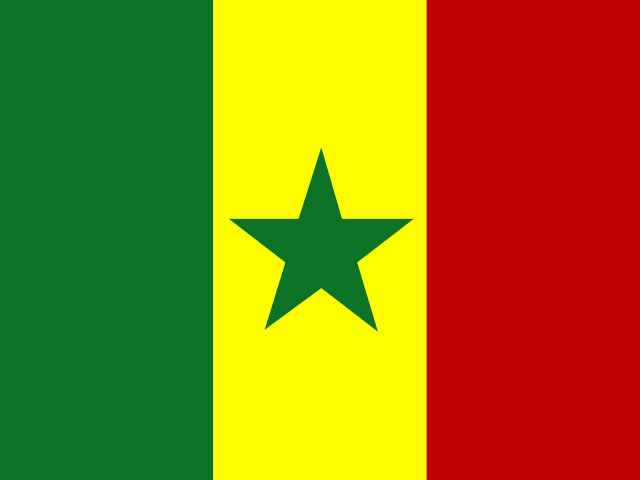
- Description: three equal vertical bands of green (left side), yellow, and red, with a small five-pointed green star centered on the yellow band; green stands for Islam, progress, and hope, yellow for natural wealth and progress, and red for sacrifice and determination; the star represents unity and hopeHistory: uses the colors of the Pan-African movement
- National symbols
- lion
- National colours
- green, yellow, red
- National anthem
- Title: "Pincez tous vos koras, frappez les balafons" (Pluck Your Koras, Strike the Balafons)Lyrics/music: Leopold Sedar SENGHOR/Herbert PEPPERHistory: adopted 1960; lyrics written by Leopold Sedar SENGHOR, Senegal's first president; the anthem sometimes played incorporating the koras (harp-like stringed instruments) and balafons (types of xylophones) mentioned in the title
- UNESCO World Heritage Sites
- Total World Heritage Sites: 7 (5 cultural, 2 natural)Selected World Heritage Site locales: Island of Gorée (c); Niokolo-Koba National Park (n); Djoudj National Bird Sanctuary (n); Island of Saint-Louis (c); Stone Circles of Senegambia (c); Saloum Delta (c); Bassari Country: Bassari, Fula, and Bedik Cultural Landscapes (c)
Economy
- Overview
- lower middle-income, services-driven West African economy; key mining, construction, agriculture, and fishing industries; tourism and exports hit hard by COVID-19; large informal economy; developing offshore oil and gas fields; systemic corruption
- GDP (PPP)
- $83.183 billion (2024 est.)
- GDP per person (PPP)
- $4,500 (2024 est.)
- GDP growth
- 6.9% (2024 est.)
- Inflation
- 0.8% (2024 est.)
- Unemployment
- 3% (2024 est.)
- Farm products
- rice, groundnuts, watermelons, millet, cassava, sugarcane, maize, sorghum, onions, milk (2023)
- Industries
- agricultural and fish processing, phosphate mining, fertilizer production, petroleum refining, zircon, and gold mining, construction materials, ship construction and repair
- Exports
- $7.001 billion (2023 est.)
- Main exports
- gold, refined petroleum, phosphoric acid, fish, cement (2023)
- Export partners
- Mali 21%, India 12%, Switzerland 11%, China 5%, UAE 4% (2023)
- Main imports
- refined petroleum, crude petroleum, rice, garments, wheat (2023)
- Import partners
- China 19%, France 9%, Nigeria 7%, India 7%, Russia 5% (2023)
- Money sent home from abroad
- 10.6% of GDP (2023 est.)
Energy, internet and transport
- Electricity access
- Electrification - total population: 67.9% (2022 est.)Electrification - urban areas: 96.6%Electrification - rural areas: 43.4%
- Electricity sources
- Fossil fuels: 78.3% of total installed capacity (2023 est.)Solar: 7.4% of total installed capacity (2023 est.)Wind: 9.1% of total installed capacity (2023 est.)Hydroelectricity: 3.9% of total installed capacity (2023 est.)Biomass and waste: 1.4% of total installed capacity (2023 est.)
- Internet users
- Percent of population: 61% (2023 est.)
- Mobile phones
- Total subscriptions: 22.4 million (2023 est.)Subscriptions per 100 inhabitants: 120 (2022 est.)
- TV and radio
- over 25 private TV stations; state-run Radiodiffusion Télévision Sénégalaise (RTS) broadcasts from five cities; wide range of independent TV available via satellite; hundreds of radio stations; transmissions of several international broadcasters are accessible on FM in Dakar
- Airports
- 20 (2025)
- Railways
- Total: 906 km (2017) (713 km operational in 2017)Narrow gauge: 906 km (2017) 1.000-m gauge
- Merchant ships
- Total: 36 (2023)By type: general cargo 5, oil tanker 1, other 30
Military and space
- Armed forces
- Senegalese Armed Forces (les Forces Armées Sénégalaises, FAS): Army (l’Armée de Terre, AT), Senegalese National Navy (Marine Séenéegalaise, MNS), Senegalese Air Force (l'Arméee de l'Air du Séenéegal, AAS), National GendarmerieMinistry of Interior: National Police (2025)
- Military spending
- 1.6% of GDP (2024 est.)
- Military service
- 18-28 (up to 35 for specialized roles); 24-month service commitment (2025)
- Space programme
- small, nascent program focused on earth observation/remote sensing capabilities, largely for climate resilience, environmental management, research, and socio-economic development; conducts research in fields such as astronomy and planetary sciences; has cooperated with space agencies in China, France, Turkey, and the US, as well as the ESA (2025)
- Space milestones
- 2023 - signed cooperation agreement with ESA to leverage space technology for socio-economic growth; established a space control center to provide infrastructure for satellite manufacturing and satellite services2024 - first Earth observation/remote sensing nanosatellite (GaindeSat-1A) built with French assistance and launched by US; signed agreement with Turkey on space infrastructure advancement; agreed to participate in China's lunar exploration/research station project2025 - signed US-led Artemis Accords for space and lunar exploration; signed agreement with France for capacity development in space infrastructure and Earth observation initiatives
Global issues
- Refugees and displaced people
- Refugees: 13,064 (2024 est.)IDPs: 5,922 (2024 est.)
Neighbouring countries
GambiaGuineaGuinea-BissauMaliMauritania
- Phone code
- +221
- Internet domain
- .sn