Ireland
Republic of Ireland · Éire
Celtic island Christianised by St Patrick; England began conquering it in 1169. The Great Famine of 1845–52 killed about a million and drove mass emigration. Most of the island won independence in 1922; Northern Ireland stayed in the UK.
See Ireland on the 3D globeTake a quiz
Population5.3 million
Area70,273 km²
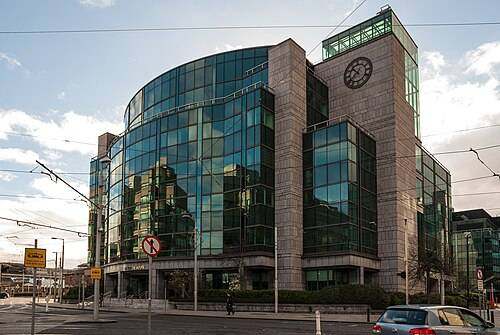
CapitalDublin
RegionNorthern Europe
Did you know?
- Halloween began with the Celtic festival of Samhain
- Has produced four Nobel literature laureates
- Newgrange tomb is older than the pyramids
Key facts about Ireland
- Government
- Parliamentary republic
- Religion
- Catholic ~69%, unaffiliated ~14%
- Founded / independence
- 1922 Free State; 1949 republic
- Rich in
- Tech and pharma multinationals, finance, agriculture
- Languages
- English, Irish
Irish (Gaelic: Munster, Connacht, Ulster dialects) and English (Hiberno-English) - Currency
- Euro (€)
- People are called
- Irish
- Main cities
- Dublin, Cork, Limerick, Galway, Waterford
Timeline of Ireland
- 432St Patrick's mission
- 1169Norman invasion
- 1845Great Famine
- 1916Easter Rising
- 1922Free State
- 1949Republic
- 1973Joins EEC
- 1998Good Friday Agreement
Places to see in Ireland
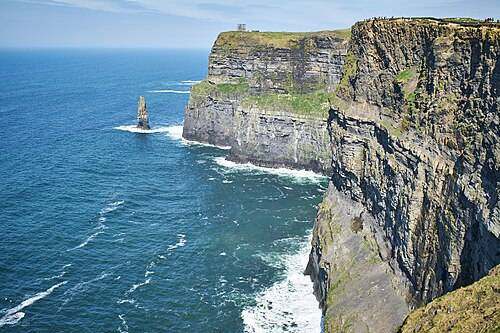
- Cliffs of Moher
- Ring of Kerry
- Trinity College's Book of Kells
- Newgrange
- Giant's Causeway nearby
- Rock of Cashel
Food and drink
Irish stew · soda bread · colcannon · Guinness
Culture and famous for
Writers Joyce, Yeats, Beckett, Wilde; traditional music; St Patrick's Day
Popular sports
Gaelic football, hurling, rugby
Geography and climate
- Highest point
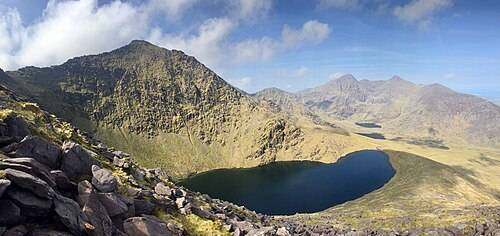
- Carrauntoohil, 1,038 m
- Rivers, lakes and seas
- Shannon (longest in the British Isles)
- Climate
- Mild, wet maritime
- Coastline
- Has a sea coast
- Population density
- 75 people per km²
Wars and conflicts
- Irish War of Independence 1919–21
- Civil War 1922–23
- The Troubles in Northern Ireland 1968–98
Alliances and memberships
Political unions and regional organisations
European UnionEurozoneCouncil of Europe
Economy and trade
Ireland in depth
Detailed facts from the CIA World Factbook (public domain, latest edition).
Overview
- History in brief
- Celtic tribes arrived in Ireland between 600 and 150 B.C. Norse invasions that began in the late 8th century finally ended when King Brian BORU defeated the Danes in 1014. Norman invasions began in the 12th century and set off more than seven centuries of Anglo-Irish struggle marked by fierce rebellions and harsh repressions. The Irish famine of the mid-19th century caused an almost 25-percent decline in the island's population through starvation, disease, and emigration. The population of the island continued to fall until the 1960s, but over the last 50 years, Ireland's high birthrate has made it demographically one of the youngest populations in the EU. The modern Irish state traces its origins to the failed 1916 Easter Monday Uprising that galvanized nationalist sentiment. The ensuing guerrilla war led to independence from the UK in 1921 with the signing of the Anglo-Irish Treaty and the creation of the Irish Free State. The treaty was deeply controversial in Ireland, in part because it helped solidify the country's partition, with six of the 32 counties remaining in the UK as Northern Ireland. The split between pro-Treaty and anti-Treaty partisans led to the Irish Civil War (1922-23). The traditionally dominant political parties in Ireland, Fine Gael and Fianna Fail, are de facto descendants of the opposing sides of the treaty debate. Ireland declared itself a republic in 1949 and formally left the British Dominion.Beginning in the 1960s, deep sectarian divides between the Catholic and Protestant populations and systemic discrimination in Northern Ireland erupted into years of violence known as the Troubles. In 1998, the governments of Ireland and the UK, along with most political parties in Northern Ireland, reached the Belfast/Good Friday Agreement with the support of the US. This agreement helped end the Troubles and initiated a new phase of cooperation between the Irish and British Governments.Ireland was neutral in World War II and continues its policy of military neutrality. Ireland joined the European Community in 1973 and the euro-zone currency union in 1999. The economic boom years of the Celtic Tiger (1995-2007) saw rapid economic growth that came to an abrupt end in 2008 with the meltdown of the Irish banking system. As a small, open economy, Ireland has excelled at courting foreign direct investment, especially from US multi-nationals, which has helped the economy recover from the financial crisis and insulated it somewhat from the econo
Geography
- Location
- Western Europe, occupying five-sixths of the island of Ireland in the North Atlantic Ocean, west of Great Britain
- Size compared
- slightly larger than West Virginia
- Land borders
- Total: 490 kmBorder countries: UK 499 km
- Coastline
- 1,448 km
- Climate
- temperate maritime; modified by North Atlantic Current; mild winters, cool summers; consistently humid; overcast about half the time
- Terrain
- mostly flat to rolling interior plain surrounded by rugged hills and low mountains; sea cliffs on west coast
- Elevation
- Highest point: Carrauntoohil 1,041 mLowest point: Atlantic Ocean 0 mMean elevation: 118 m
- Natural resources
- natural gas, peat, copper, lead, zinc, silver, barite, gypsum, limestone, dolomite
- Natural hazards
- rare extreme weather events
- Notes
- strategic location on major air and sea routes between North America and northern Europe; over 40% of the population resides within 100 km of Dublin
- Environmental issues
- water pollution, especially of lakes, from agricultural runoff; deforestation, including problems with acid rain
People and society
- Population
- Total: 5,233,461 (2024 est.)Male: 2,590,542Female: 2,642,919
- Nationality
- Noun: Irishman(men), Irishwoman(women), Irish (collective plural)Adjective: Irish
- Ethnic groups
- Irish 76.6%, Irish travelers 0.6%, other White 9.9%, Asian 3.3%, Black 1.5%, other (includes Arab, Roma, and persons of mixed backgrounds) 2%, unspecified 2.6% (2022 est.)
- Languages
- English (official, the language generally used), Irish (Gaelic or Gaeilge) (official, spoken by approximately 37.7% of the population)
- Religions
- Roman Catholic 69.2% (includes lapsed), Protestant 3.7% (Church of Ireland/England/Anglican/Episcopalian 2.5%, other Protestant 1.2%), Orthodox 2%, other Christian 0.9%, Muslim 1.6%, other 1.4%, agnostic/atheist 0.1%, none 14.5%, unspecified 6.7% (2022 est.)
- Median age
- Total: 40.5 years (2025 est.)Male: 39.7 yearsFemale: 40.6 years
- Population growth
- 0.8% (2025 est.)
- Life expectancy
- Total population: 82 years (2024 est.)Male: 80.3 yearsFemale: 83.9 years
- Children per woman
- 1.72 children born/woman (2025 est.)
- Urbanization
- Urban population: 64.5% of total population (2023)Rate of urbanization: 1.15% annual rate of change (2020-25 est.)
- Largest cities
- 1.270 million DUBLIN (capital) (2023)
- Years in school
- Total: 19 years (2022 est.)Male: 19 years (2022 est.)Female: 20 years (2022 est.)
Government
- Official names
- Conventional long form: noneConventional short form: IrelandLocal long form: noneLocal short form: EireEtymology: the Irish name Eire evolved from the Gaelic name Eriu, which is possibly derived from the Old Celtic iveriu, meaning "good land;" the English name, Ireland, is a direct translation
- Government type
- parliamentary republic
- Capital
- Name: DublinGeographic coordinates: 53 19 N, 6 14 WTime difference: UTC 0 (5 hours ahead of Washington, DC, during Standard Time)Daylight saving time: +1hr, begins last Sunday in March; ends last Sunday in OctoberEtymology: derived from the Irish words dubh (black or dark) and linn (pool), referring to the color of the Liffey River
- Regions
- 28 counties and 3 cities*; Carlow, Cavan, Clare, Cork, Cork*, Donegal, Dublin*, Dun Laoghaire-Rathdown, Fingal, Galway, Galway*, Kerry, Kildare, Kilkenny, Laois, Leitrim, Limerick, Longford, Louth, Mayo, Meath, Monaghan, Offaly, Roscommon, Sligo, South Dublin, Tipperary, Waterford, Westmeath, Wexford, Wicklow
- Independence
- 6 December 1921 (from the UK); 6 December 1922 (Irish Free State established); 18 April 1949 (Republic of Ireland Act enabled)
- National holiday
- Saint Patrick's Day, 17 March
- Constitution
- History: previous 1922; latest drafted 14 June 1937, adopted by plebiscite 1 July 1937, effective 29 December 1937Amendment process: proposed as bills by Parliament; passage requires majority vote by both the Senate and House of Representatives, majority vote in a referendum, and presidential signature
- Legal system
- common law system based on the English model but substantially modified by customary law; Supreme Court reviews legislative acts
- Voting age
- 18 years of age; universal
- Flag meaning
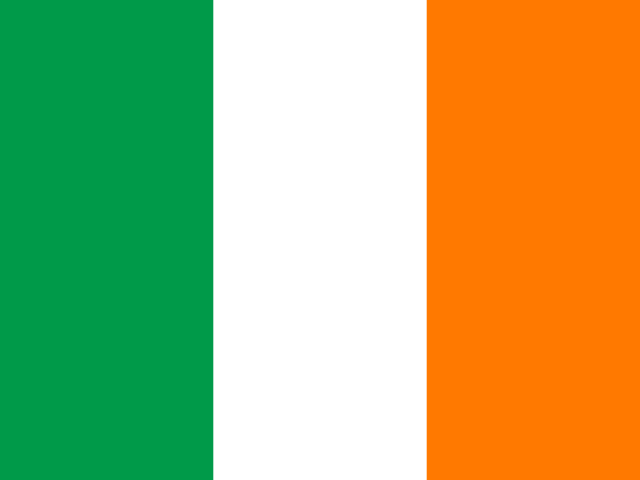
- Description: three equal vertical bands of green (left side), white, and orangeMeaning: the flag colors have no official meaning, but a common interpretation is that the green stands for the Irish nationalist tradition, orange for the Orange tradition (minority supporters of William of Orange), and white for peace or a lasting truce between the green and the orange
- National symbols
- harp, shamrock (trefoil)
- National colours
- blue, green
- National anthem
- Title: "Amhran na bhFiann" (The Soldier's Song)Lyrics/music: Peadar KEARNEY [English], Liam O RINN [Irish]/Patrick HEENEY and Peadar KEARNEYHistory: adopted 1926; the song "Ireland's Call" is often used as the anthem at athletic events if citizens of Ireland and Northern Ireland are competing as a unified team
- UNESCO World Heritage Sites
- Total World Heritage Sites: 2 (both cultural)Selected World Heritage Site locales: Brú na Bóinne - Archaeological Ensemble of the Bend of the Boyne; Sceilg Mhichíl
Economy
- Overview
- high-income, export-oriented EU economy; large multinational business sector contributes to growth and tax revenues but poses volatility risks; high living standards; strong labor market challenged by skill shortages and aging workforce
- GDP (PPP)
- $620.544 billion (2024 est.)
- GDP per person (PPP)
- $115,300 (2024 est.)
- GDP growth
- 1.2% (2024 est.)
- Inflation
- 2.1% (2024 est.)
- Unemployment
- 4.4% (2024 est.)
- Below poverty line
- 14% (2021 est.)
- Farm products
- milk, barley, beef, wheat, potatoes, pork, oats, chicken, rapeseed, beans (2023)
- Industries
- pharmaceuticals, chemicals, computer hardware and software, food products, beverages and brewing; medical devices
- Exports
- $761.876 billion (2023 est.)
- Main exports
- vaccines, packaged medicine, nitrogen compounds, integrated circuits, hormones (2023)
- Export partners
- USA 28%, Germany 11%, UK 8%, Belgium 8%, China 7% (2023)
- Main imports
- aircraft, nitrogen compounds, vaccines, packaged medicine, integrated circuits (2023)
- Import partners
- UK 20%, USA 17%, France 10%, China 7%, Germany 7% (2023)
- Money sent home from abroad
- 0.1% of GDP (2023 est.)
Energy, internet and transport
- Electricity access
- Electrification - total population: 100% (2022 est.)
- Electricity sources
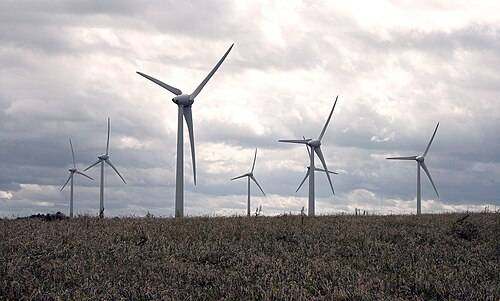
- Fossil fuels: 55.7% of total installed capacity (2023 est.)Solar: 1.3% of total installed capacity (2023 est.)Wind: 37% of total installed capacity (2023 est.)Hydroelectricity: 2.3% of total installed capacity (2023 est.)Biomass and waste: 3.7% of total installed capacity (2023 est.)
- Internet users
- Percent of population: 97% (2023 est.)
- Mobile phones
- Total subscriptions: 5.76 million (2023 est.)Subscriptions per 100 inhabitants: 113 (2022 est.)
- TV and radio
- publicly owned broadcaster Radio Telefis Eireann (RTE) operates 4 TV stations; commercial TV stations are available; about 75% of households use multi-channel satellite and TV services that provide access to a wide range of stations; RTE operates 4 national radio stations and has launched digital audio broadcasts on several; a number of commercial broadcast stations operate at the national, regional, and local levels (2019)
- Airports
- 100 (2025)
- Railways
- Total: 1,688 km (2020) 53 km electrified
- Merchant ships
- Total: 94 (2023)By type: bulk carrier 12, general cargo 32, oil tanker 1, other 49
Military and space
- Armed forces
- Irish Defense Forces (Oglaigh na h-Eireannn): Army, Air Corps, Naval Service, Reserve Defense Forces (2025)
- Military spending
- 0.2% of GDP (2024 est.)
- Military service
- 18-38 years of age for men and women for voluntary military service (2026)
Global issues
- Refugees and displaced people
- Refugees: 156,441 (2024 est.)Stateless persons: 48 (2024 est.)
Neighbouring countries
- Phone code
- +353
- Internet domain
- .ie