Kuwait
State of Kuwait · الكويت
Trading port ruled by the Al Sabah family since 1752. Iraq invaded in 1990; a US-led coalition expelled it in 1991.
See Kuwait on the 3D globeTake a quiz
Population4.9 million
Area17,818 km²
CapitalKuwait City
RegionWestern Asia
Did you know?
- Mitribah recorded about 54°C in 2016, among the hottest temperatures ever measured
- The Kuwaiti dinar is the world's highest-valued currency
- Has no rivers or lakes
Key facts about Kuwait
- Government
- Constitutional monarchy (emirate; parliament suspended 2024)
- Religion
- Islam ~75%
- Founded / independence
- 1961 (from UK)
- Rich in
- Oil (about 6% of world reserves), sovereign wealth fund
- Languages
- Arabic
Arabic (Gulf dialect), English - Currency
- Kuwaiti dinar (د.ك)
- People are called
- Kuwaiti
- Main cities
- Kuwait City, Al Ahmadi, Hawalli
Timeline of Kuwait
- 1752Al Sabah rule
- 1899British protection
- 1938Oil discovered
- 1961Independence
- 1990Iraqi invasion
- 1991Liberation
Places to see in Kuwait
- Kuwait Towers
- Grand Mosque
- Failaka Island
- Souq Al-Mubarakiya
- Liberation Tower
Food and drink
Machboos · gabout · date sweets
Culture and famous for
Dhow-building and pearling heritage
Popular sports
Football, falconry
Geography and climate
- Highest point
- Mutla Ridge, about 300 m
- Rivers, lakes and seas
- No rivers; Persian Gulf coast
- Climate
- Extreme desert; one of the hottest places on Earth
- Coastline
- Has a sea coast
- Population density
- 275 people per km²
Wars and conflicts
- Iraqi invasion 1990
- Gulf War 1991
Alliances and memberships
Political unions and regional organisations
Arab LeagueGulf Cooperation CouncilOrganisation of Islamic Cooperation
Economy and trade
Kuwait in depth
Detailed facts from the CIA World Factbook (public domain, latest edition).
Overview
- History in brief
- Kuwait has been ruled by the AL-SABAH dynasty since the 18th century. The threat of Ottoman invasion in 1899 prompted Amir Mubarak AL-SABAH to seek protection from Britain, ceding foreign and defense responsibility to Britain until 1961, when the country attained its independence. Iraq attacked and overran Kuwait in 1990. After several weeks of aerial bombardment, a US-led UN coalition began a ground assault in 1991 that liberated Kuwait in four days. In 1992, the Amir reconstituted the parliament that he had dissolved in 1986. Amid the 2010-11 uprisings and protests across the Arab world, stateless Arabs known as Bidoon staged small protests demanding citizenship, jobs, and other benefits available to Kuwaiti nationals. Other demographic groups, notably Islamists and Kuwaitis from tribal backgrounds, soon joined the growing protest movements, which culminated with the resignation of the prime minister amid allegations of corruption. Demonstrations renewed in 2012 in response to a decree amending the electoral law that lessened the voting power of the tribal blocs.An opposition coalition of Sunni Islamists, tribal populists, and some liberals largely boycotted legislative elections in 2012 and 2013, which ushered in a legislature more amenable to the government's agenda. Faced with the prospect of painful subsidy cuts, oppositionists and independents actively participated in the 2016 election, winning nearly half the seats, but the opposition became increasingly factionalized. Between 2006 and his death in 2020, the Amir dissolved the National Assembly on seven occasions and shuffled the cabinet over a dozen times, usually citing political stagnation and gridlock between the legislature and the government.The current Amir, who assumed his role in 2020, launched a "National Dialogue" in 2021 meant to resolve political gridlock. As part of this initiative, the Amir pardoned several opposition figures who had been living in exile, and they returned to Kuwait. Legislative challenges remain, and the cabinet has been reshuffled six times since 2020.
Geography
- Location
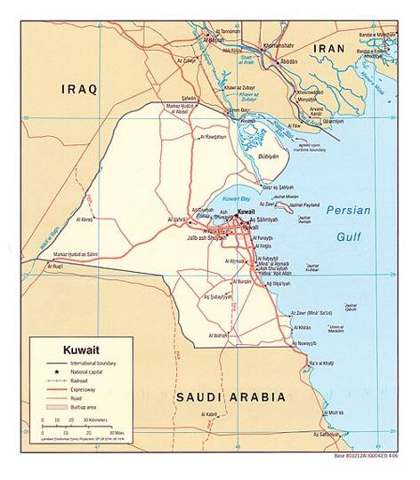
- Middle East, bordering the Persian Gulf, between Iraq and Saudi Arabia
- Size compared
- slightly smaller than New Jersey
- Land borders
- Total: 475 kmBorder countries: Iraq 254 km; Saudi Arabia 221 km
- Coastline
- 499 km
- Climate
- dry desert; intensely hot summers; short, cool winters
- Terrain
- flat to slightly undulating desert plain
- Elevation
- Highest point: 3.6 km W. of Al-Salmi Border Post 300 mLowest point: Persian Gulf 0 mMean elevation: 108 m
- Natural resources
- petroleum, fish, shrimp, natural gas
- Natural hazards
- sudden cloudbursts are common from October to April and bring heavy rain, which can damage roads and houses; sandstorms and dust storms occur throughout the year but are most common between March and August
- Notes
- strategic location at head of Persian Gulf
- Environmental issues
- limited natural freshwater resources; air and water pollution; desertification; loss of biodiversity
People and society
- Population
- Total: 3,172,511 (2025 est.)Male: 1,827,274Female: 1,345,237
- Nationality
- Noun: Kuwaiti(s)Adjective: Kuwaiti
- Ethnic groups
- Kuwaiti 30.4%, other Arab 27.4%, Asian 40.3%, African 1%, other 0.9% (includes European, North American, South American, and Australian) (2018 est.)
- Languages
- Arabic (official), English widely spokenMajor-language sample(s): كتاب حقائق العالم، المصدر الذي لا يمكن الاستغناء عنه للمعلومات الأساسية (Arabic)The World Factbook, the indispensable source for basic information.
- Religions
- Muslim (official) 74.6%, Christian 18.2%, other and unspecified 7.2% (2013 est.)
- Median age
- Total: 30.4 years (2025 est.)Male: 31.1 yearsFemale: 28.9 years
- Population growth
- 1.07% (2025 est.)
- Life expectancy
- Total population: 79.6 years (2024 est.)Male: 78.1 yearsFemale: 81.1 years
- Children per woman
- 2.19 children born/woman (2025 est.)
- Urbanization
- Urban population: 100% of total population (2023)Rate of urbanization: 1.35% annual rate of change (2020-25 est.)
- Largest cities
- 3.298 million KUWAIT (capital) (2023)
- Literacy
- Total population: 96.5% (2020 est.)Male: 97.1% (2020 est.)Female: 95.3% (2020 est.)
- Years in school
- Total: 15 years (2015 est.)Male: 13 years (2015 est.)Female: 16 years (2015 est.)
Government
- Official names
- Conventional long form: State of KuwaitConventional short form: KuwaitLocal long form: Dawlat al KuwaytLocal short form: Al KuwaytEtymology: the name derives from the capital city, which comes from the Arabic al-kuwayt, itself a diminutive of the Hindustani term kut, meaning a fortress-like house
- Government type
- constitutional monarchy (emirate)
- Capital
- Name: Kuwait CityGeographic coordinates: 29 22 N, 47 58 ETime difference: UTC+3 (8 hours ahead of Washington, DC, during Standard Time)Etymology: the name comes from the Arabic al-kuwayt, a diminutive of the Hindustani term kut, meaning a fortress-like house
- Regions
- 6 governorates (muhafazat, singular - muhafazah); Al Ahmadi, Al 'Asimah, Al Farwaniyah, Al Jahra', Hawalli, Mubarak al Kabir
- Independence
- 19 June 1961 (from the UK)
- National holiday
- National Day, 25 February (1950)
- Constitution
- History: approved and promulgated 11 November 1962; suspended 1976 to 1981 (4 articles); 1986 to 1991; May to July 1999Amendment process: proposed by the amir or supported by at least one third of the National Assembly; passage requires two-thirds consent of the Assembly membership and promulgation by the amir; constitutional articles on the initiation, approval, and promulgation of general legislation cannot be amended
- Legal system
- mixed system consisting of English common law, French civil law, and Islamic sharia law
- Voting age
- 21 years of age and at least 20-year citizenship
- Flag meaning
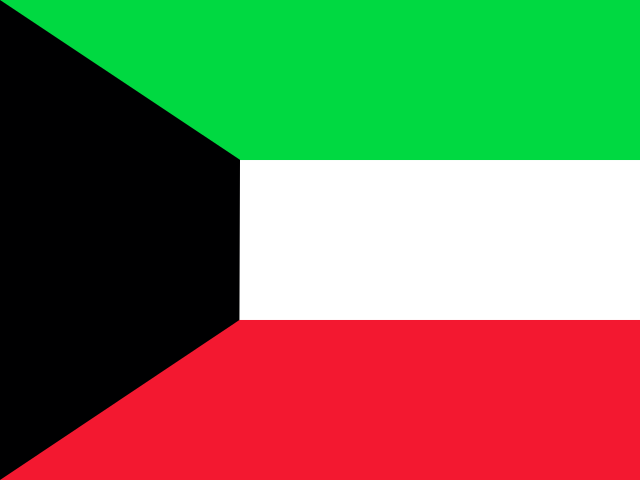
- Description: three equal horizontal bands of green (top), white, and red, with a black trapezoid based on the left sideMeaning: green stands for fertile fields, white for purity, red for blood on Kuwaiti swords, and black for defeating the enemyHistory: colors and design are based on the Arab Revolt flag of World War I
- National symbols
- golden falcon
- National colours
- green, white, red, black
- National anthem
- Title: "Al-Nasheed Al-Watani" (National Anthem)Lyrics/music: Ahmad MUSHARI al-Adwani/Ibrahim Nasir al-SOULAHistory: adopted 1978; the anthem is only used on formal occasions
Economy
- Overview
- small, high-income, oil-based Middle East economy; renewable energy proponent; regional finance and investment leader; maintains oldest sovereign wealth fund; emerging space and tourism industries; mid-way through 25-year development program
- GDP (PPP)
- $225.947 billion (2024 est.)
- GDP per person (PPP)
- $45,400 (2024 est.)
- GDP growth
- -2.6% (2024 est.)
- Inflation
- 2.9% (2024 est.)
- Unemployment
- 2.2% (2024 est.)
- Farm products
- dates, eggs, milk, tomatoes, chicken, lamb/mutton, cucumbers/gherkins, vegetables, maize, eggplants (2023)
- Industries
- petroleum, petrochemicals, cement, shipbuilding and repair, water desalination, food processing, construction materials
- Exports
- $89.71 billion (2024 est.)
- Main exports
- crude petroleum, refined petroleum, natural gas, hydrocarbons, plastics (2023)
- Export partners
- China 25%, India 13%, Japan 13%, Taiwan 7%, UK 5% (2023)
- Main imports
- cars, natural gas, garments, broadcasting equipment, packaged medicine (2023)
- Import partners
- China 18%, UAE 10%, USA 9%, Saudi Arabia 6%, Japan 6% (2023)
- Money sent home from abroad
- 0% of GDP (2024 est.)
Energy, internet and transport
- Electricity access
- Electrification - total population: 100% (2022 est.)
- Electricity sources
- Fossil fuels: 97.8% of total installed capacity (2023 est.)Solar: 0.2% of total installed capacity (2023 est.)Wind: 2% of total installed capacity (2023 est.)
- Internet users
- Percent of population: 100% (2023 est.)
- Mobile phones
- Total subscriptions: 8.11 million (2023 est.)Subscriptions per 100 inhabitants: 168 (2023 est.)
- TV and radio
- state-owned TV broadcaster operates 4 networks and a satellite channel; several private TV broadcasters; satellite TV available, and pan-Arab TV stations are especially popular; state-owned Radio Kuwait broadcasts on a number of channels in Arabic and English; first private radio station in 2005; transmissions of at least 2 international radio broadcasters are available (2019)
- Airports
- 6 (2025)
- Merchant ships
- Total: 176 (2023)By type: general cargo 15, oil tanker 28, other 133
Military and space
- Armed forces
- Kuwait Armed Forces (KAF): Kuwait Army (aka Kuwait Land Forces, KLF), Kuwait Navy (aka Kuwait Naval Force), Kuwait Air Force; Kuwait National Guard (KNG)Ministry of Interior: Kuwait Police, State Security, Kuwait Coast Guard (2025)
- Military spending
- 4.9% of GDP (2024 est.)
- Military service
- 18 years of age for voluntary military service for men and women; 12-month compulsory service for men aged 18-35; mandatory service is divided into two phases – 4 months for training and 8 months for military service (2025)
Global issues
- Refugees and displaced people
- Refugees: 1,271 (2024 est.)Stateless persons: 92,000 (2024 est.)
Neighbouring countries
- Phone code
- +965
- Internet domain
- .kw