Lesotho
Kingdom of Lesotho
A mountain kingdom founded by Moshoeshoe I, entirely surrounded by South Africa.
See Lesotho on the 3D globeTake a quiz
Population2.3 million
Area30,355 km²
CapitalMaseru
RegionSouthern Africa
Did you know?
- The only country entirely above 1,000 m
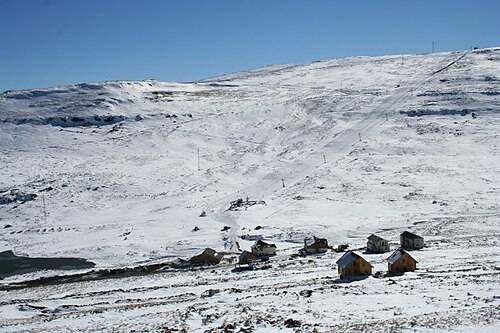
- Has Africa's highest ski resort
- Completely surrounded by South Africa
Key facts about Lesotho
- Government
- Parliamentary constitutional monarchy
- Religion
- Christian ~95%
- Founded / independence
- 1966 (from UK)
- Rich in
- Water and hydropower to South Africa, diamonds, textiles
- Languages
- English, Sotho
Sesotho and English - Currency
- Lesotho loti (L), South African rand (R)
- People are called
- Mosotho
- Main cities
- Maseru, Teyateyaneng
Timeline of Lesotho
- 1822Moshoeshoe I founds kingdom
- 1868British protection
- 1966Independence
- 1998SADC intervention
Places to see in Lesotho
- Maletsunyane Falls
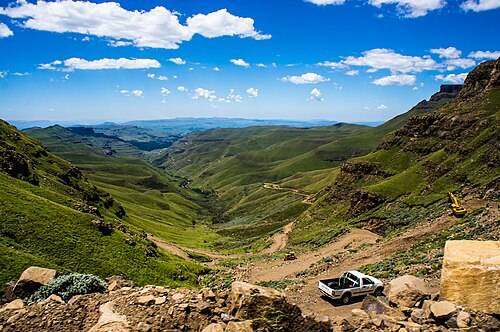
- Sani Pass
- Katse Dam
- Thaba Bosiu
Food and drink
Papa (maize porridge) · moroho (greens)
Culture and famous for
Basotho blankets and conical hats; pony trekking
Popular sports
Football, horse riding
Geography and climate
- Highest point
- Thabana Ntlenyana, 3,482 m
- Rivers, lakes and seas
- Orange (Senqu) River
- Climate
- Cool highland
- Coastline
- Landlocked
- Population density
- 76 people per km²
Wars and conflicts
- 1998 SADC intervention
Alliances and memberships
Political unions and regional organisations
African UnionSADCCommonwealth of Nations
Lesotho in depth
Detailed facts from the CIA World Factbook (public domain, latest edition).
Overview
- History in brief
- Paramount chief MOSHOESHOE I consolidated what would become Basutoland in the early 19th century and made himself king in 1822. Continuing encroachments by Dutch settlers from the neighboring Orange Free State caused the king to enter into an 1868 agreement with the UK that made Basutoland first a British protectorate and, after 1884, a crown colony. After gaining independence in 1966, the country was renamed the Kingdom of Lesotho. The Basotho National Party ruled the country during its first two decades. King MOSHOESHOE II was exiled in 1990, returned to Lesotho in 1992, was reinstated in 1995, and was then succeeded by his son, King LETSIE III, in 1996. Constitutional government was restored in 1993 after seven years of military rule.In 1998, violent protests and a military mutiny following a contentious election prompted a brief but bloody intervention by South African and Batswana military forces under the aegis of the Southern African Development Community (SADC). Subsequent constitutional reforms restored relative political stability. Peaceful parliamentary elections were held in 2002, but the National Assembly elections in 2007 were hotly contested, and aggrieved parties disputed how seats were awarded. In 2012, competitive elections saw Prime Minister Motsoahae Thomas THABANE form a coalition government -- the first in the country's history -- that ousted the 14-year incumbent, Pakalitha MOSISILI, who peacefully transferred power the following month. MOSISILI returned to power in snap elections in 2015 after the collapse of THABANE’s coalition government and an alleged attempted military coup. In 2017, THABANE returned to become prime minister but stepped down in 2020 after being implicated in his estranged wife’s murder. He was succeeded by Moseketsi MAJORO. In 2022, Ntsokoane Samuel MATEKANE was inaugurated as prime minister and head of a three-party coalition.
Geography
- Location
- Southern Africa, an enclave of South Africa
- Size compared
- slightly smaller than Maryland
- Land borders
- Total: 1,106 kmBorder countries: South Africa 1,106 km
- Coastline
- 0 km (landlocked)
- Climate
- temperate; cool to cold, dry winters; hot, wet summers
- Terrain
- mostly highland with plateaus, hills, and mountains
- Elevation
- Highest point: Thabana Ntlenyana 3,482 mLowest point: junction of the Orange and Makhaleng Rivers 1,400 mMean elevation: 2,161 m
- Natural resources
- water, agricultural and grazing land, diamonds, sand, clay, building stone
- Major rivers
- Orange river source (shared with South Africa and Namibia [m]) - 2,092 kmNote: [s] after country name indicates river source; [m] after country name indicates river mouth
- Natural hazards
- periodic droughts
- Notes
- landlocked, surrounded by South Africa; mountainous, more than 80% of the country is 1,800 m (5,900 ft) above sea level
- Environmental issues
- overgrazing; severe soil erosion; soil exhaustion; desertification; Highlands Water Project controls, stores, and redirects water to South Africa
People and society
- Population
- Total: 2,222,962 (2025 est.)Male: 1,099,314Female: 1,123,648
- Nationality
- Noun: Mosotho (singular), Basotho (plural)Adjective: Basotho
- Ethnic groups
- Sotho 99.7%, other 0.3% (includes Kwena, Nguni (Hlubi and Phuthi), Zulu)
- Languages
- Sesotho (official), English (official), Phuthi, Xhosa, Zulu
- Religions
- Protestant 47.8% (Pentecostal 23.1%, Lesotho Evangelical 17.3%, Anglican 7.4%), Roman Catholic 39.3%, other Christian 9.1%, non-Christian 1.4%, none 2.3% (2014 est.)
- Median age
- Total: 24 years (2025 est.)Male: 23.4 yearsFemale: 24.3 years
- Population growth
- 0.73% (2025 est.)
- Life expectancy
- Total population: 60.2 years (2024 est.)Male: 58.1 yearsFemale: 62.3 years
- Children per woman
- 2.49 children born/woman (2025 est.)
- Urbanization
- Urban population: 30.4% of total population (2023)Rate of urbanization: 2.77% annual rate of change (2020-25 est.)
- Largest cities
- 202,000 MASERU (capital) (2018)
- Literacy
- Total population: 90.4% (2024 est.)Male: 83.2% (2024 est.)Female: 96.6% (2024 est.)
- Years in school
- Total: 11 years (2017 est.)Male: 11 years (2017 est.)Female: 11 years (2017 est.)
Government
- Official names
- Conventional long form: Kingdom of LesothoConventional short form: LesothoLocal long form: Kingdom of LesothoLocal short form: LesothoFormer: BasutolandEtymology: the name comes from the Sotho people, whose name means "dark-skinned;" Le- is a singular noun prefix; the former name, Basutoland, uses the plural noun prefix, Ba-
- Government type
- parliamentary constitutional monarchy
- Capital
- Name: MaseruGeographic coordinates: 29 19 S, 27 29 ETime difference: UTC+2 (7 hours ahead of Washington, DC, during Standard Time)Etymology: the name means "[place of] red sandstones" in the Sesotho language
- Regions
- 10 districts; Berea, Butha-Buthe, Leribe, Mafeteng, Maseru, Mohale's Hoek, Mokhotlong, Qacha's Nek, Quthing, Thaba-Tseka
- Independence
- 4 October 1966 (from the UK)
- National holiday
- Independence Day, 4 October (1966)
- Constitution
- History: previous 1959, 1967; latest adopted 2 April 1993 (effectively restoring the 1967 version)Amendment process: proposed by Parliament; passage of amendments affecting constitutional provisions, including fundamental rights and freedoms, sovereignty of the kingdom, the office of the king, and powers of Parliament, requires a majority vote by the National Assembly, approval by the Senate, approval in a referendum by a majority of qualified voters, and assent of the king; passage of amendments other than those specified provisions requires at least a two-thirds majority vote in both houses of Parliament
- Legal system
- mixed system of English common law and Roman-Dutch law; High Court and Court of Appeal review legislative acts
- Voting age
- 18 years of age; universal
- Flag meaning
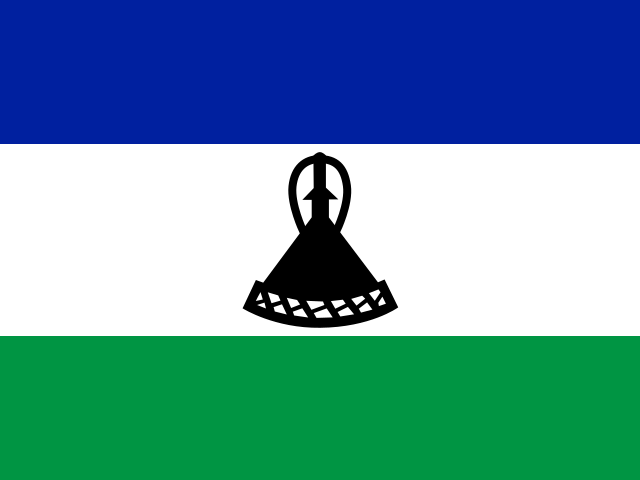
- Description: three horizontal stripes of blue (top), white, and green; centered on the white stripe is a black mokorotlo, a traditional Basotho straw hat and national symbolMeaning: blue stands for rain, white for peace, and green for prosperityHistory: the redesigned flag was introduced in 2006 to celebrate 40 years of independence
- National symbols
- mokorotio (Basotho hat)
- National colours
- blue, white, green, black
- National anthem
- Title: "Lesotho fatse la bo ntat'a rona" (Lesotho, Land of Our Fathers)Lyrics/music: Francois COILLARD/Ferdinand-Samuel LAURHistory: adopted 1967; music derives from an 1823 Swiss songbook
- UNESCO World Heritage Sites
- Total World Heritage Sites: 1 (mixed)Selected World Heritage Site locales: Maloti-Drakensberg Park
Economy
- Overview
- lower middle-income economy surrounded by South Africa; environmentally fragile and politically unstable; key infrastructure and renewable energy investments; dire poverty; urban job and income losses due to COVID-19; systemic corruption
- GDP (PPP)
- $6.166 billion (2024 est.)
- GDP per person (PPP)
- $2,600 (2024 est.)
- GDP growth
- 2.8% (2024 est.)
- Inflation
- 6.1% (2024 est.)
- Unemployment
- 16.2% (2024 est.)
- Below poverty line
- 49.7% (2017 est.)
- Farm products
- milk, potatoes, maize, vegetables, fruits, sorghum, wheat, game meat, beans, wool (2023)
- Industries
- food, beverages, textiles, apparel assembly, handicrafts, construction, tourism
- Exports
- $983.027 million (2024 est.)
- Main exports
- diamonds, garments, wool, power equipment, bedding (2023)
- Export partners
- South Africa 31%, Belgium 26%, USA 20%, UAE 8%, India 8% (2023)
- Main imports
- refined petroleum, fabric, trucks, garments, cotton fabric (2023)
- Import partners
- South Africa 78%, China 10%, Taiwan 3%, Japan 1%, India 1% (2023)
- Money sent home from abroad
- 22% of GDP (2024 est.)
Energy, internet and transport
- Electricity access
- Electrification - total population: 50% (2022 est.)Electrification - urban areas: 83.6%Electrification - rural areas: 37.7%
- Electricity sources
- Fossil fuels: 0.1% of total installed capacity (2023 est.)Solar: 0.3% of total installed capacity (2023 est.)Hydroelectricity: 99.6% of total installed capacity (2023 est.)
- Internet users
- Percent of population: 48% (2023 est.)
- Mobile phones
- Total subscriptions: 1.64 million (2024 est.)Subscriptions per 100 inhabitants: 70 (2024 est.)
- TV and radio
- 1 state-owned TV station and 2 state-owned radio stations; most private broadcast media transmitters are connected to government radio signal towers; satellite TV subscription service available; transmissions of multiple international broadcasters obtainable (2019)
- Airports
- 34 (2025)
Military and space
- Armed forces
- Lesotho Defense Force (LDF) (2025)
- Military spending
- 1.5% of GDP (2024 est.)
- Military service
- 20-30 years of age for voluntary military service for both men and women (2026)
Global issues
- Refugees and displaced people
- Refugees: 610 (2024 est.)
Neighbouring countries
- Phone code
- +266
- Internet domain
- .ls