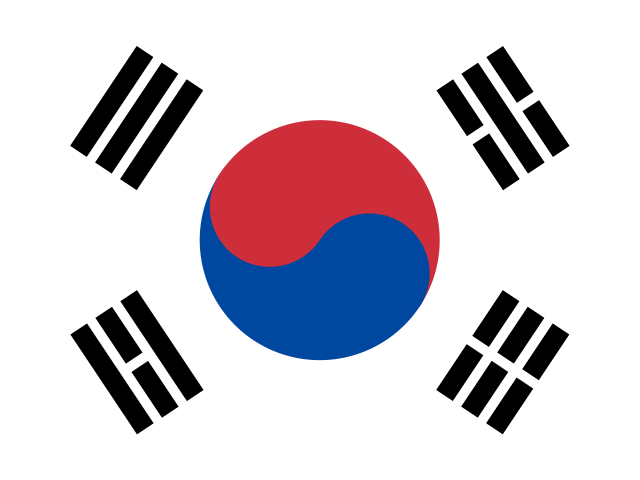
South Korea
Republic of Korea · 한국
Korea's Joseon dynasty lasted 500 years before Japanese annexation. Divided after WWII; the south rose from poverty to a wealthy democracy. A 2024 martial-law attempt ended in the president's removal in 2025.
See South Korea on the 3D globeTake a quiz
Population51.7 million
Area100,210 km²
CapitalSeoul
RegionEastern Asia
Did you know?
- Has some of the fastest internet in the world
- Hangul was invented by King Sejong in 1443
- Hosted the 1988 Summer and 2018 Winter Olympics
Key facts about South Korea
- Government
- Presidential republic
- Religion
- Unaffiliated ~56%, Protestant ~20%, Buddhist ~16%, Catholic ~8%
- Founded / independence
- 1948
- Rich in
- Semiconductors (Samsung, SK), cars, ships, K-pop and dramas
- Languages
- Korean
Korean: Seoul standard, Gyeongsang, Jeolla, Jeju dialects - Currency
- South Korean won (₩)
- People are called
- South Korean
- Main cities
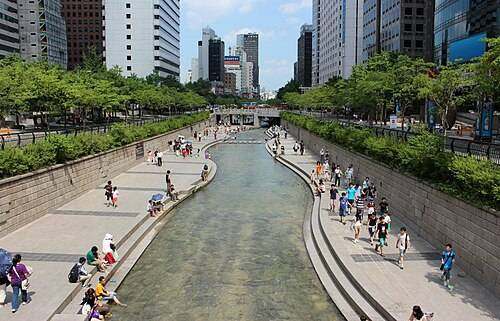
- Seoul, Busan, Incheon, Daegu, Daejeon
Timeline of South Korea
- 1392Joseon dynasty
- 1443Hangul created
- 1910Japanese annexation
- 1948Republic of Korea
- 1950Korean War
- 1987Democracy
- 2025President removed after martial law
Places to see in South Korea
- Gyeongbokgung Palace
- N Seoul Tower
- Jeju Island
- Bulguksa Temple
- DMZ
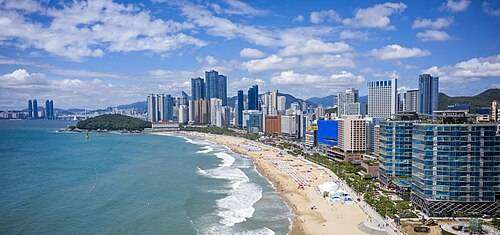
- Busan beaches
Food and drink
Kimchi · bibimbap · Korean barbecue · tteokbokki
Culture and famous for
K-pop; K-dramas; Hangul alphabet; Samsung and Hyundai
Popular sports
Football, baseball, taekwondo, esports
Geography and climate
- Highest point
- Hallasan (Jeju), 1,950 m
- Rivers, lakes and seas
- Han, Nakdong
- Climate
- Temperate; cold winters, hot humid summers
- Coastline
- Has a sea coast
- Population density
- 516 people per km²
Wars and conflicts
- Japanese colonial rule 1910–45
- Korean War 1950–53
Empires and states that once stood here
Alliances and memberships
Economy and trade
Defence treaties
- US–South Korea Mutual Defense Treaty (1953): Signed after the Korean War; about 28,000 US troops are in South Korea.
South Korea in depth
Detailed facts from the CIA World Factbook (public domain, latest edition).
Overview
- History in brief
- The first recorded kingdom (Choson) on the Korean Peninsula dates from approximately 2300 B.C. Over the subsequent centuries, three main kingdoms -- Kogoryo, Baekche, and Silla -- were established on the Peninsula. By the 5th century A.D., Kogoryo emerged as the most powerful, with control over much of the Peninsula and part of Manchuria (modern-day northeast China). However, Silla allied with the Chinese to create the first unified Korean state in 688. Following the collapse of Silla in the 9th century, Korea was unified under the Koryo (Goryeo; 918-1392) and the Chosen (Joseon; 1392-1910) dynasties. Korea became the object of intense imperialistic rivalry among the Chinese (its traditional benefactor), Japanese, and Russian empires in the latter half of the 19th and early 20th centuries. After the Sino-Japanese War (1894-95) and the Russo-Japanese War (1904-1905), Korea was occupied by Imperial Japan. In 1910, Japan formally annexed the entire Peninsula. Korea regained its independence after Japan's surrender to the US and its allies in 1945. A US-supported democratic government (Republic of Korea, ROK) was set up in the southern half of the Korean Peninsula, while a communist-style government backed by the Soviet Union was installed in the north (North Korea; aka Democratic People's Republic of Korea, DPRK). During the Korean War (1950-53), US troops and UN forces fought alongside ROK soldiers to defend South Korea from a North Korean invasion supported by communist China and the Soviet Union. After the 1953 armistice, the two Koreas were separated by a demilitarized zone.Syngman RHEE led the country as its first president from 1948 to 1960. PARK Chung-hee took over leadership of the country in a 1961 coup. During his controversial rule (1961-79), South Korea achieved rapid economic growth, with per capita income rising to roughly 17 times the level of North Korea by 1979. PARK was assassinated in 1979, and subsequent years were marked by political turmoil and continued military rule as the country's pro-democracy movement grew. South Korea held its first free presidential election under a revised democratic constitution in 1987, with former South Korean Army general ROH Tae-woo winning a close race. In 1993, KIM Young-sam became the first civilian president of South Korea's new democratic era. President KIM Dae-jung (1998-2003) won the Nobel Peace Prize in 2000 for his contributions to South Korean democracy and his "Sunshine Policy" of engagement wit
Geography
- Location
- Eastern Asia, southern half of the Korean Peninsula bordering the Sea of Japan and the Yellow Sea
- Size compared
- slightly smaller than Pennsylvania; slightly larger than Indiana
- Land borders
- Total: 237 kmBorder countries: North Korea 237 km
- Coastline
- 2,413 km
- Climate
- temperate, with rainfall heavier in summer than winter; cold winters
- Terrain
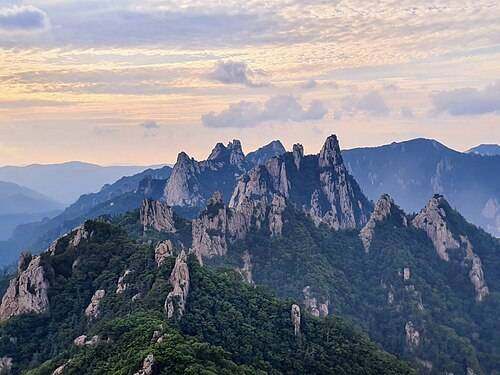
- mostly hills and mountains; wide coastal plains in west and south
- Elevation
- Highest point: Halla-san 1,950 mLowest point: Sea of Japan 0 mMean elevation: 282 m
- Natural resources
- coal, tungsten, graphite, molybdenum, lead, hydropower potential
- Natural hazards
- occasional typhoons bring high winds and floods; low-level seismic activity common in southwestVolcanism: Halla (1,950 m) is considered historically active; it has not erupted in many centuries
- Notes
- strategic location on Korea Strait; about 3,000 mostly small and uninhabited islands lie off the western and southern coasts
- Environmental issues
- air pollution in large cities; acid rain; water pollution from sewage and industrial effluents; drift-net fishing; solid waste disposal; transboundary air pollution from China
People and society
- Population
- Total: 51,486,343 (2025 est.)Male: 25,636,127Female: 25,850,216
- Nationality
- Noun: Korean(s)Adjective: Korean
- Ethnic groups
- Korean
- Languages
- Korean, EnglishMajor-language sample(s): 월드 팩트북, 필수적인 기본 정보 제공처 (Korean)The World Factbook, the indispensable source for basic information.
- Religions
- Protestant 17%, Buddhist 16%, Catholic 6%, none 60% (2021 est.)
- Median age
- Total: 47 years (2025 est.)Male: 44 yearsFemale: 47.3 years
- Population growth
- -0.09% (2025 est.)
- Life expectancy
- Total population: 83.4 years (2024 est.)Male: 80.3 yearsFemale: 86.6 years
- Children per woman
- 0.68 children born/woman (2025 est.)
- Urbanization
- Urban population: 81.5% of total population (2023)Rate of urbanization: 0.31% annual rate of change (2020-25 est.)
- Largest cities
- 9.988 million SEOUL (capital), 3.472 million Busan, 2.849 million Incheon, 2.181 million Daegu (Taegu), 1.577 million Daejon (Taejon), 1.529 million Gwangju (Kwangju) (2023)
- Literacy
- Total population: NAMale: NAFemale: NA
- Years in school
- Total: 17 years (2022 est.)Male: 17 years (2022 est.)Female: 16 years (2022 est.)
Government
- Official names
- Conventional long form: Republic of KoreaConventional short form: South KoreaLocal long form: Taehan-min'gukLocal short form: Han'gukAbbreviation: ROKEtymology: derived from the Chinese name for Goryeo, which was the Korean dynasty that united the peninsula in the 10th century A.D.; the South Korean name "Han'guk" derives from the long form, "Taehan-min'guk," which is itself a derivation from "Daehan-je'guk," which means "the Great Han Empire"
- Government type
- presidential republic
- Capital
- Name: SeoulGeographic coordinates: 37 33 N, 126 59 ETime difference: UTC+9 (14 hours ahead of Washington, DC, during Standard Time)Etymology: the name originates from the Korean word meaning "capital city;" it was the capital of the unified Korea from 1392 to 1910
- Regions
- 9 provinces (do, singular and plural), 6 metropolitan cities (gwangyeoksi, singular and plural), 1 special city (teugbyeolsi), and 1 special self-governing city (teukbyeoljachisi)Provinces: Chungcheongbuk-do (North Chungcheong), Chungcheongnam-do (South Chungcheong), Gangwon-do, Gyeongsangbuk-do (North Gyeongsang), Gyeonggi-do, Gyeongsangnam-do (South Gyeongsang), Jeju-do (Jeju), Jeollabuk-do (North Jeolla), Jeollanam-do (South Jeolla)Metropolitan cities: Busan (Pusan), Daegu (Taegu), Daejeon (Taejon), Gwangju (Kwangju), Incheon (Inch'on), UlsanSpecial city: SeoulSpecial self-governing city: Sejong
- Independence
- 15 August 1945 (from Japan)
- National holiday
- Liberation Day, 15 August (1945)
- Constitution
- History: several previous; latest passed by National Assembly 12 October 1987, approved in referendum 28 October 1987, effective 25 February 1988Amendment process: proposed by the president or by majority support of the National Assembly membership; passage requires at least two-thirds majority vote by the Assembly membership, approval in a referendum by more than one half of the votes by more than one half of eligible voters, and promulgation by the president
- Legal system
- mixed system combining European civil law, Anglo-American law, and Chinese classical thought
- Voting age
- 18 years of age; universal
- Flag meaning
- Description: white with a red-and-blue yin-yang symbol in the center; a black trigram (kwae) from the ancient I Ching (Book of Changes) is in each corner of the white fieldMeaning: the flag is called Taegukki; white is a traditional Korean color and represents peace and purity; blue stands for the negative cosmic forces of the yin, and red for the opposite positive forces of the yang; each trigram represents one of the universal elements, which together express the principle of movement and harmony
- National symbols
- taegeuk (yin-yang symbol), Rose of Sharon (Hibiscus syriacus), Siberian tiger
- National colours
- red, white, blue, black
- National anthem
- Title: "Aegukga" (Patriotic Song)Lyrics/music: YUN Ch'i-Ho or AN Ch'ang-Ho/AHN EaktayHistory: adopted 1948, well-known by 1910; North Korea's and South Korea's anthems have the same name and a similar melody, but different lyrics
- UNESCO World Heritage Sites
- Total World Heritage Sites: 17 (15 cultural, 2 natural)Selected World Heritage Site locales: Jeju Volcanic Island and Lava Tubes (n); Changdeokgung Palace Complex (c); Jongmyo Shrine (c); Seokguram Grotto and Bulguksa Temple (c); Hwaseong Fortress (c); Gochang, Hwasun, and Ganghwa Dolmen Sites (c); Gyeongju Historic Areas (c); Namhansanseong (c); Baekje Historic Areas (c); Sansa, Buddhist Mountain Monasteries in Korea (c); Royal Tombs of the Joseon Dynasty (c); Petroglyphs along the Bangucheon Stream (c)
Economy
- Overview
- high-income, export- and technology-oriented East Asian economy; manufacturing led by semiconductor and automotive industries; slow growth amid declining construction investment, export risks, and recent political instability; aging workforce; increased restraint in fiscal policy while maintaining industry support initiatives
- GDP (PPP)
- $2.607 trillion (2023 est.)
- GDP per person (PPP)
- $50,400 (2023 est.)
- GDP growth
- 1.4% (2023 est.)
- Inflation
- 2.3% (2024 est.)
- Unemployment
- 2.7% (2024 est.)
- Farm products
- rice, vegetables, cabbages, milk, onions, pork, chicken, eggs, tangerines/mandarins, potatoes (2023)
- Industries
- electronics, telecommunications, automobile production, chemicals, shipbuilding, steel
- Exports
- $835.149 billion (2024 est.)
- Main exports
- integrated circuits, cars, refined petroleum, plastics, machine parts (2023)
- Export partners
- China 25%, USA 18%, Hong Kong 4%, Japan 4%, Taiwan 4% (2023)
- Main imports
- integrated circuits, natural gas, crude petroleum, machinery, cars (2023)
- Import partners
- China 31%, USA 13%, Japan 9%, Germany 5%, Australia 4% (2023)
- Money sent home from abroad
- 0.4% of GDP (2023 est.)
Energy, internet and transport
- Electricity access
- Electrification - total population: 100% (2022 est.)
- Electricity sources
- Fossil fuels: 61.5% of total installed capacity (2023 est.)Nuclear: 30.3% of total installed capacity (2023 est.)Solar: 5.3% of total installed capacity (2023 est.)Wind: 0.6% of total installed capacity (2023 est.)Hydroelectricity: 0.4% of total installed capacity (2023 est.)Tide and wave: 0.1% of total installed capacity (2023 est.)Biomass and waste: 1.8% of total installed capacity (2023 est.)
- Internet users
- Percent of population: 97% (2023 est.)
- Mobile phones
- Total subscriptions: 89.2 million (2024 est.)Subscriptions per 100 inhabitants: 173 (2024 est.)
- TV and radio
- multiple national TV networks, with 2 of the 3 largest networks publicly operated; the largest privately owned network, Seoul Broadcasting Service (SBS), has ties with other commercial TV networks; cable and satellite TV subscription services available; publicly operated radio broadcast networks and many privately owned radio broadcasting networks, each with multiple affiliates, and independent local stations
- Airports
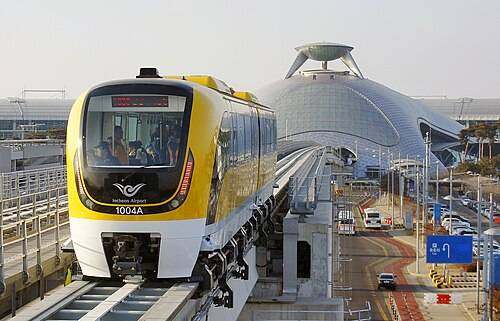
- 92 (2025)
- Railways
- Total: 3,979 km (2016)Standard gauge: 3,979 km (2016) 1.435-m gauge (2,727 km electrified)
- Merchant ships
- Total: 2,149 (2023)By type: bulk carrier 93, container ship 115, general cargo 362, oil tanker 219, other 1,360
Military and space
- Armed forces
- Armed Forces of the Republic of Korea: Republic of Korea Army (ROKA), Republic of Korea Navy (ROKN, includes Marine Corps, ROKMC), Republic of Korea Air Force (ROKAF)Ministry of Maritime Affairs and Fisheries: Korea Coast Guard; Ministry of Interior and Safety: Korean National Police Agency (2025)
- Military spending
- 2.3% of GDP (2025 est.)
- Military service
- 18-29 years of age for voluntary military service for men and women; mandatory military service for all eligible men 18-35 years of age (typically served from 20-28 years of age); compulsory service obligation is 18-21 months based on the branch of service and up to 36 months for alternative service (2025)
- Space programme
- has an ambitious space program focused on developing satellites, satellite launch vehicles (SLVs), and interplanetary probes; has a national space strategy; manufactures and operates satellites, including those with communications, remote sensing (RS), scientific, and multipurpose capabilities; manufactures and launches SLVs; developing interplanetary space vehicles, including orbital probes and landers; participates in international programs and works with an array of foreign space agencies and industries, including those of Australia, the ESA, individual ESA member states (particularly France, Germany, Italy, Spain, UK), India, Indonesia, Israel, Japan, Peru, Russia, UAE, and the US; has an active commercial space industry (2025)
- Space milestones
- 1992 - first domestically made technology-demonstrator satellite (KITSAT-1) launched on European rocket1993-1998 - launched first single-stage sounding rocket (KSR-1) and first two-stage sounding rocket (KSR-2)1999 - first domestically built multi-purpose satellite (KOMPSAT-1, aka Arirang-1) launched by US2008 - first South Korean astronaut in space on International Space Station2013 - first successful satellite launch of two-stage Korean Space Launch Vehicle-I (KSLV-I; aka Naro)2021 - maiden launch of three-stage KSLV-II (aka Nuri); signed the US-led Artemis Accords for space and lunar exploration2022 - first successful attempt to place satellites into orbit on the KSLV-II/Nuri; domestically made lunar orbiter (Danuri) reached Moon's orbit; began development of the Korea Positioning System (KPS) satellite navigational network2024 - third successful launch of Nuri SLV placed eight small satellites in orbit, including a remote sensing satellite (NexSat-2) with radar imaging technology
Global issues
- Refugees and displaced people
- Refugees: 40,084 (2024 est.)Stateless persons: 248 (2024 est.)
- Drug trade
- USG identification: major precursor-chemical producer (2025)
Neighbouring countries
- Phone code
- +82
- Internet domain
- .kr