North Korea
Democratic People's Republic of Korea · 조선
Created in the Soviet occupation zone after WWII. Ruled by the Kim family since 1948; famine in the 1990s killed hundreds of thousands. Has tested nuclear weapons since 2006.
See North Korea on the 3D globeTake a quiz
Population26 million
Area120,538 km²
CapitalPyongyang
RegionEastern Asia
Did you know?
- Uses its own calendar counting from 1912
- Pyongyang's Ryugyong Hotel has been unfinished for decades
- Has the world's deepest metro
Key facts about North Korea
- Government
- Totalitarian one-party state with hereditary leadership (Kim dynasty)
- Religion
- Officially atheist; Juche ideology
- Founded / independence
- 1948
- Rich in
- Coal, iron, rare earths, minerals; nuclear weapons programme
- Languages
- Korean
Korean (Pyongyang standard, Munhwaŏ) - Currency
- North Korean won (₩)
- People are called
- North Korean
- Main cities
- Pyongyang, Hamhung, Chongjin, Nampo
Timeline of North Korea
- 1948State founded
- 1950Korean War
- 1994Kim Il Sung dies
- 2006First nuclear test
- 2011Kim Jong Un takes power
Places to see in North Korea
- Kim Il Sung Square
- Mansudae statues
- Mount Paektu
- Kaesong
- DMZ at Panmunjom
Food and drink
Naengmyeon (cold noodles) · kimchi
Culture and famous for
Mass games performances; propaganda art
Popular sports
Football, weightlifting
Geography and climate
- Highest point
- Mount Paektu, 2,744 m
- Rivers, lakes and seas
- Yalu, Taedong
- Climate
- Continental
- Coastline
- Has a sea coast
- Population density
- 216 people per km²
Wars and conflicts
- Korean War 1950–53 (armistice, no peace treaty)
- troops sent to Russia 2024–25
Empires and states that once stood here
Alliances and memberships
Defence treaties
- China–North Korea Treaty of Friendship (1961): China's only formal military alliance, renewed every 20 years.
- Russia–North Korea Comprehensive Strategic Partnership (2024): Mutual-defence pact; North Korean troops fought for Russia in the Kursk region.
North Korea in depth
Detailed facts from the CIA World Factbook (public domain, latest edition).
Overview
- History in brief
- The first recorded kingdom (Choson) on the Korean Peninsula dates from approximately 2300 B.C. Over the subsequent centuries, three main kingdoms -- Kogoryo, Paekche, and Silla -- were established on the Peninsula. By the 5th century A.D., Kogoryo emerged as the most powerful, with control over much of the Peninsula and part of Manchuria (modern-day northeast China). However, Silla allied with the Chinese to create the first unified Korean state in 688. Following the collapse of Silla in the 9th century, Korea was unified under the Koryo (Goryeo; 918-1392) and the Chosen (Joseon; 1392-1910) dynasties. Korea became the object of intense imperialistic rivalry among the Chinese (its traditional benefactor), Japanese, and Russian empires in the latter half of the 19th and early 20th centuries. After the Sino-Japanese War (1894-95) and the Russo-Japanese War (1904-05), Korea was occupied by Imperial Japan. In 1910, Japan formally annexed the entire peninsula. After World War II, the northern half came under Soviet-sponsored communist control.In 1948, North Korea (formally known as the Democratic People's Republic of Korea or DPRK) was founded under President KIM Il Sung, who consolidated power and cemented autocratic one-party rule under the Korean Worker's Party (KWP). North Korea failed to conquer UN-backed South Korea (formally the Republic of Korea or ROK) during the Korean War (1950-53), after which a demilitarized zone separated the two Koreas. KIM's authoritarian rule included tight control over North Korean citizens and the demonization of the US as the central threat to North Korea's political and social system. In addition, he molded the country's economic, military, and political policies around the core objective of unifying Korea under Pyongyang's control. North Korea also declared a central ideology of juche ("self-reliance") as a check against outside influence, while continuing to rely heavily on China and the Soviet Union for economic support. KIM Il Sung's son, KIM Jong Il, was officially designated as his father's successor in 1980, and he assumed a growing political and managerial role until the elder KIM's death in 1994. Under KIM Jong Il's reign, North Korea continued developing nuclear weapons and ballistic missiles. KIM Jong Un was publicly unveiled as his father's successor in 2010. Following KIM Jong Il's death in 2011, KIM Jong Un quickly assumed power and has since occupied the regime's highest political and military posts. After t
Geography
- Location
- Eastern Asia, northern half of the Korean Peninsula bordering the Korea Bay and the Sea of Japan, between China and South Korea
- Size compared
- slightly larger than Virginia; slightly smaller than Mississippi
- Land borders
- Total: 1,607 kmBorder countries: China 1,352 km; South Korea 237 km; Russia 18 km
- Coastline
- 2,495 km
- Climate
- temperate, with rainfall concentrated in summer; long, bitter winters
- Terrain
- mostly hills and mountains separated by deep, narrow valleys; wide coastal plains in west, discontinuous in east
- Elevation
- Highest point: Paektu-san 2,744 mLowest point: Sea of Japan 0 mMean elevation: 600 m
- Natural resources
- coal, iron ore, limestone, magnesite, graphite, copper, zinc, lead, precious metals, hydropower
- Natural hazards
- late spring droughts often followed by severe flooding; occasional typhoons during the early fallVolcanism: P'aektu-san (2,744 m) (also known as Baitoushan, Baegdu, or Changbaishan), on the Chinese border, is considered historically active
- Notes
- strategic location bordering China, South Korea, and Russia; mountainous interior is isolated and sparsely populated
- Environmental issues
- water pollution; inadequate potable water; deforestation; soil erosion and degradation
People and society
- Population
- Total: 26,402,841 (2025 est.)Male: 12,884,269Female: 13,518,572
- Nationality
- Noun: Korean(s)Adjective: Korean
- Ethnic groups
- racially homogeneous; there is a small Chinese community and a few ethnic Japanese
- Languages
- KoreanMajor-language sample(s): 월드 팩트북, 필수적인 기본 정보 제공처 (Korean)The World Factbook, the indispensable source for basic information.
- Religions
- traditionally Buddhist and Confucian, some Christian and syncretic Chondogyo (Religion of the Heavenly Way)
- Median age
- Total: 36.2 years (2025 est.)Male: 34.5 yearsFemale: 37.4 years
- Population growth
- 0.4% (2025 est.)
- Life expectancy
- Total population: 73.5 years (2024 est.)Male: 70.2 yearsFemale: 77 years
- Children per woman
- 1.8 children born/woman (2025 est.)
- Urbanization
- Urban population: 63.2% of total population (2023)Rate of urbanization: 0.85% annual rate of change (2020-25 est.)
- Largest cities
- 3.158 million PYONGYANG (capital) (2023)
- Years in school
- Total: 12 years (2018 est.)Male: 12 years (2018 est.)Female: 12 years (2018 est.)
Government
- Official names
- Conventional long form: Democratic People's Republic of KoreaConventional short form: North KoreaLocal long form: Choson-minjujuui-inmin-konghwagukLocal short form: ChosonAbbreviation: DPRKEtymology: derived from the Chinese name for Goryeo, which was the Korean dynasty that united the peninsula in the 10th century A.D.; the North Korean name "Choson" means "[Land of the] Morning Calm"
- Government type
- dictatorship, single-party communist state
- Capital
- Name: PyongyangGeographic coordinates: 39 01 N, 125 45 ETime difference: UTC+9 (14 hours ahead of Washington, DC, during Standard Time)Time zone note: on 5 May 2018, North Korea reverted to UTC+9, the same time zone as South KoreaEtymology: the name translates as "flat land" in Korean
- Regions
- 9 provinces (do, singular and plural) and 4 special administration cities (si, singular and plural)Provinces: Chagang, Hambuk (North Hamgyong), Hamnam (South Hamgyong), Hwangbuk (North Hwanghae), Hwangnam (South Hwanghae), Kangwon, P'yongbuk (North Pyongan), P'yongnam (South Pyongan), RyanggangSpecial administration cities: Kaesong, Nampo, P'yongyang, Rason
- Independence
- 15 August 1945 (from Japan)
- National holiday
- Founding of the Democratic People's Republic of Korea (DPRK), 9 September (1948)
- Constitution
- History: previous 1948, 1972; latest adopted 1998Amendment process: proposed by the Supreme People’s Assembly (SPA); passage requires more than two-thirds majority vote of the total SPA membership
- Legal system
- civil law system based on the Prussian model; influenced by Japanese traditions and Communist legal theory
- Voting age
- 17 years of age; universal and compulsory
- Flag meaning
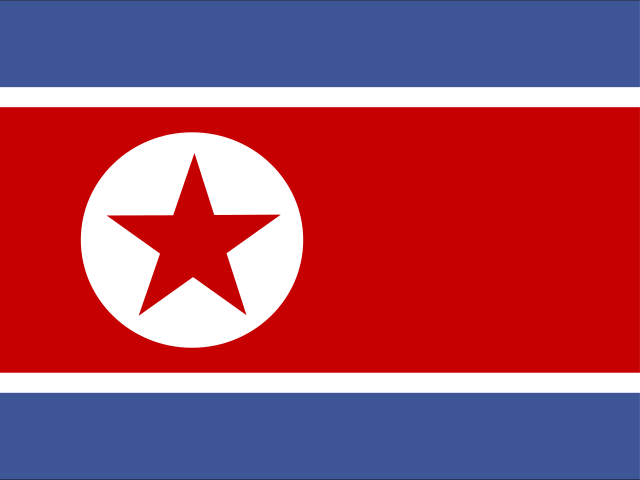
- Description: three horizontal bands of blue (top), red (triple-width), and blue; the red band is edged in white; on the left side of the red band is a white disk with a red five-pointed starMeaning: the red band stands for revolutionary traditions, the white for purity, strength, and dignity; blue for sovereignty, peace, and friendship; the red star represents socialism
- National symbols
- red star, chollima (winged horse)
- National colours
- red, white, blue
- National anthem
- Title: "Aegukka" (Patriotic Song)Lyrics/music: PAK Se Yong/KIM Won GyunHistory: adopted 1947; North Korea's and South Korea's anthems have the same name and a similar melody, but different lyrics; the North Korean anthem is also known as "Ach'imun pinnara" (Let Morning Shine)
- UNESCO World Heritage Sites
- Total World Heritage Sites: 2 (both cultural, one mixed)Selected World Heritage Site locales: Koguryo Tombs Complex; Historic Monuments and Sites in Kaesong; Mount Kumgang – Diamond Mountain from the Sea (m)
Economy
- Overview
- one of the last centrally planned economies; hard hit by COVID-19, crop failures, international sanctions, and isolationist policies; declining growth and trade, and heavily reliant on China; poor exchange rate stability; economic data integrity issues
- GDP (PPP)
- $15.416 billion (2023 est.)
- GDP per person (PPP)
- $600 (2023 est.)
- Unemployment
- 2.9% (2024 est.)
- Farm products
- maize, vegetables, rice, apples, cabbages, fruits, sweet potatoes, potatoes, beans, soybeans (2023)
- Industries
- military products; machine building, electric power, chemicals; mining (coal, iron ore, limestone, magnesite, graphite, copper, zinc, lead, and precious metals), metallurgy; textiles, food processing; tourism
- Main exports
- fake hair, iron alloys, tungsten ore, electricity, cars (2023)
- Export partners
- China 74%, Poland 3%, Senegal 3%, Angola 3%, Austria 3% (2023)
- Main imports
- processed hair, plastic products, garments, fabric, soybean oil (2023)
- Import partners
- China 97%, Togo 1%, Peru 1%, Gabon 1%, India 0% (2023)
Energy, internet and transport
- Electricity access
- Electrification - total population: 54.7% (2022 est.)
- Electricity sources
- Fossil fuels: 36.9% of total installed capacity (2023 est.)Solar: 0.6% of total installed capacity (2023 est.)Hydroelectricity: 62.5% of total installed capacity (2023 est.)
- Mobile phones
- Total subscriptions: 6.35 million (2022 est.)Subscriptions per 100 inhabitants: 24 (2022 est.)
- TV and radio
- no independent media; radios and TVs are pre-tuned to government stations; 4 state-owned TV stations; the Korean Workers' Party owns and operates the Korean Central Broadcasting Station, and the state-run Voice of Korea operates an external broadcast service; the government prohibits listening to and jams foreign broadcasts (2019)
- Airports
- 81 (2025)
- Railways
- Total: 7,435 km (2014)Standard gauge: 7,435 km (2014) 1.435-m gauge (5,400 km electrified)
- Merchant ships
- Total: 264 (2023)By type: bulk carrier 10, container ship 5, general cargo 191, oil tanker 29, other 29
Military and space
- Armed forces
- Korean People's Army (KPA): KPA Ground Forces, KPA Navy, KPA Air Force and Air Defense Forces, KPA Strategic Forces (missile forces), KPA Special Forces (special operations forces); Security Guard Command (aka Bodyguard Command); Military Security CommandMinistry of Social Security (formerly Ministry of Public Security): Border Guard General Bureau, civil security forces; Ministry of State Security: internal security, investigations (2025)
- Military spending
- defense spending is a regime priority; between 2010 and 2020, military expenditures accounted for an estimated 20-30% of North Korea's GDP annually; spending estimates ranged from $7 billion to $11 billion annually; in 2024, North Korea announced that it would spend nearly 16% of state expenditures on defense; North Korea in the 2010s and 2020s has increasingly relied on illicit activities — including cybercrime — to generate revenue for its weapons of mass destruction and ballistic missile programs to evade US and UN sanctions
- Military service
- compulsory military service for men (17-30 years of age) and women (17-23 years of age); service obligation is reportedly up to 10 years for men and up to 7 years for women (2025)
- Space programme
- North Korea’s leader has emphasized the development of space capabilities, particularly satellite launch vehicles (SLVs) and remote sensing satellites; manufactures satellites and rockets/SLVs; independently launches rockets/SLVs; SLV program is viewed as closely related to the country's development of intercontinental ballistic missiles; passed a national space law in 2013, and revised it in 2022 to allow for the use of space for national defense; has cooperated with Iran on space-related technologies, and signed a mutual defense treaty with Russia in 2024 that stated the two countries would “develop exchanges and joint research in science and technology, including space” (2025)
- Space milestones
- 1980s - initiated space program1998 - failed first attempt to place a satellite in orbit on a 3-stage Paektusan-1 satellite launch vehicle (SLV)2012 - successfully placed first satellite (Kwangmyŏngsŏng-3 or Bright Star-3) in orbit on Unha-3 SLV (satellite failed to operate)2016 - second satellite (Kwangmyŏngsŏng-4) placed in orbit on Unha-3 SLV (reportedly a remote sensing (RS) satellite that also failed to operate)2023 - placed a military RS satellite (Malligyong-1) in orbit on Chollima-1 SLV2024 - failed attempt to place a second military RS satellite in orbit on new type SLV
Neighbouring countries
- Phone code
- +850
- Internet domain
- .kp