Timor-Leste
Democratic Republic of Timor-Leste · Timór-Leste
A Portuguese colony for 400 years, then invaded by Indonesia in 1975. Voted for independence in 1999 and became sovereign in 2002. Joined ASEAN in 2025.
See Timor-Leste on the 3D globeTake a quiz
Population1.4 million
Area14,874 km²
CapitalDili
RegionSouth-Eastern Asia
Did you know?
- First new sovereign state of the 21st century
- Coral reefs off Atauro are among the most biodiverse
- Uses the US dollar
Key facts about Timor-Leste
- Government
- Semi-presidential republic
- Religion
- Catholic ~97%
- Founded / independence
- 2002 (from Indonesia)
- Rich in
- Oil and gas fund, coffee
- Languages
- Portuguese, Tetum
Tetum and Portuguese; Indonesian, English - Currency
- United States dollar ($)
- People are called
- East Timorese
- Main cities
- Dili, Baucau, Maliana
Timeline of Timor-Leste
- 1515Portuguese arrive
- 1975Independence and Indonesian invasion
- 1999Independence referendum
- 2002Independence
- 2025Joins ASEAN
Places to see in Timor-Leste
- Cristo Rei statue, Dili
- Atauro Island reefs
- Mount Ramelau
- Jaco Island
Food and drink
Ikan sabuko (fish) · batar daan (corn and pumpkin)
Culture and famous for
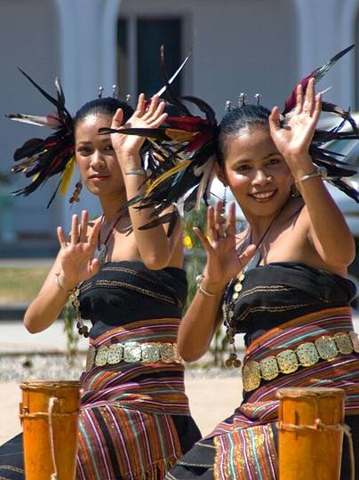
Tais woven textiles
Popular sports
Football, martial arts
Geography and climate
- Highest point
- Mount Ramelau, 2,986 m
- Rivers, lakes and seas
- Laclo River
- Climate
- Tropical
- Coastline
- Has a sea coast
- Population density
- 94 people per km²
Wars and conflicts
- Indonesian occupation 1975–99 (up to a quarter of population died)
Alliances and memberships
Political unions and regional organisations
Timor-Leste in depth
Detailed facts from the CIA World Factbook (public domain, latest edition).
Overview
- History in brief
- The island of Timor was actively involved in Southeast Asian trading networks for centuries, and by the 14th century, it exported sandalwood, slaves, honey, and wax. The sandalwood trade attracted the Portuguese, who arrived in the early 16th century; by mid-century, they had colonized the island, which was previously ruled by local chieftains. In 1859, Portugal ceded the western portion of the island to the Dutch. Imperial Japan occupied Portuguese Timor from 1942 to 1945, but Portugal resumed colonial authority after the Japanese defeat in World War II. The eastern part of Timor declared itself independent from Portugal on 28 November 1975, but Indonesian forces invaded and occupied the area nine days later. It was incorporated into Indonesia in 1976 as the province of Timor Timur (East Timor or Timor Leste). Indonesia conducted an unsuccessful pacification campaign in the province over the next two decades, during which as many as 250,000 people died.In a UN-supervised referendum in 1999, an overwhelming majority of the people of Timor-Leste voted for independence from Indonesia. However, anti-independence Timorese militias -- organized and supported by the Indonesian military -- began a large-scale, scorched-earth campaign of retribution, killing approximately 1,400 Timorese and displacing nearly 500,000. Most of the country's infrastructure was destroyed, including homes, irrigation systems, water supply systems, schools, and most of the electrical grid. Australian-led peacekeeping troops eventually deployed to the country and ended the violence. In 2002, Timor-Leste was internationally recognized as an independent state. In 2006, Australia and the UN had to step in again to stabilize the country, which allowed presidential and parliamentary elections to be conducted in 2007 in a largely peaceful atmosphere. In 2008, rebels staged an unsuccessful attack against the president and prime minister. Since that attack, Timor-Leste has made considerable progress in building stability and democratic institutions, holding a series of successful parliamentary and presidential elections since 2012. Nonetheless, weak and unstable political coalitions have led to periodic episodes of stalemate and crisis. The UN continues to provide assistance on economic development and strengthening governing institutions. Currently, Timor-Leste is one of the world's poorest nations, with an economy that relies heavily on energy resources in the Timor Sea.
Geography
- Location
- Southeastern Asia, northwest of Australia in the Lesser Sunda Islands at the eastern end of the Indonesian archipelago; note - Timor-Leste includes the eastern half of the island of Timor, the Oecussi (Ambeno) region on the northwest portion of the island of Timor, and the islands of Pulau Atauro and Pulau Jaco
- Size compared
- slightly larger than Connecticut; almost half the size of Maryland
- Land borders
- Total: 253 kmBorder countries: Indonesia 253 km
- Coastline
- 706 km
- Climate
- tropical; hot, humid; distinct rainy and dry seasons
- Terrain
- mountainous
- Elevation
- Highest point: Foho Tatamailau 2,963 mLowest point: Timor Sea, Savu Sea, and Banda Sea 0 m
- Natural resources
- gold, petroleum, natural gas, manganese, marble
- Natural hazards
- floods and landslides are common; earthquakes; tsunamis; tropical cyclones
- Notes
- the island of Timor is part of the Malay Archipelago and is the largest and easternmost of the Lesser Sunda Islands; the district of Oecussi is an exclave separated from Timor-Leste proper by Indonesia; Timor-Leste is the only Asian country located completely in the Southern Hemisphere
- Environmental issues
- air pollution and deterioration of air quality; water quality, scarcity, and access; land and soil degradation; forest depletion; deforestation and soil erosion from slash-and-burn agriculture; loss of biodiversity
People and society
- Population
- Total: 1,404,785 (2025 est.)Male: 693,940Female: 710,845
- Nationality
- Noun: TimoreseAdjective: Timorese
- Ethnic groups
- Austronesian (Malayo-Polynesian) (includes Tetun, Mambai, Tokodede, Galoli, Kemak, Baikeno), Melanesian-Papuan (includes Bunak, Fataluku, Bakasai), small Chinese minority
- Languages
- Tetun Prasa 30.6%, Mambai 16.6%, Makasai 10.5%, Tetun Terik 6.1%, Baikenu 5.9%, Kemak 5.8%, Bunak 5.5%, Tokodede 4%, Fataluku 3.5%, Waima'a 1.8%, Galoli 1.4%, Naueti 1.4%, Idate 1.2%, Midiki 1.2%, other 4.5% (2015 est.)
- Religions
- Catholic 90.7%, other 7.1%, Protestant Evangelical 1.9%; less than 1%: Islam, Buddhist, Hindu (2022 est.)
- Median age
- Total: 23 years (2025 est.)Male: 19.8 yearsFemale: 21.3 years
- Population growth
- 1.28% (2025 est.)
- Life expectancy
- Total population: 70.5 years (2024 est.)Male: 68.9 yearsFemale: 72.3 years
- Children per woman
- 2.79 children born/woman (2025 est.)
- Urbanization
- Urban population: 32.5% of total population (2023)Rate of urbanization: 3.31% annual rate of change (2020-25 est.)
- Largest cities
- 281,000 DILI (capital) (2018)
- Literacy
- Total population: 72.5% (2022 est.)Male: 73.1% (2022 est.)Female: 71.8% (2022 est.)
Government
- Official names
- Conventional long form: Democratic Republic of Timor-LesteConventional short form: Timor-LesteLocal long form: Republika Demokratika Timor Lorosa'e (Tetum)/ Republica Democratica de Timor-Leste (Portuguese)Local short form: Timor Lorosa'e (Tetum)/ Timor-Leste (Portuguese)Former: East Timor, Portuguese TimorEtymology: the name partly derives from the Indonesian and Malay word timur, meaning "east;" leste is the Portuguese word for "east," so "Timor-Leste" literally means "Eastern-East"
- Government type
- semi-presidential republic
- Capital
- Name: DiliGeographic coordinates: 8 35 S, 125 36 ETime difference: UTC+9 (14 hours ahead of Washington, DC, during Standard Time)
- Regions
- 12 municipalities (municipios, singular - municipio) and 1 special adminstrative region* (regiao administrativa especial); Aileu, Ainaro, Baucau, Bobonaro (Maliana), Covalima (Suai), Dili, Ermera (Gleno), Lautem (Lospalos), Liquica, Manatuto, Manufahi (Same), Oe-Cusse Ambeno* (Pante Macassar), Viqueque
- Independence
- 28 November 1975 (from Portugal); 20 May 2002 (from Indonesia)
- National holiday
- Restoration of Independence Day, 20 May (2002); Proclamation of Independence Day, 28 November (1975)
- Constitution
- History: drafted 2001, approved 22 March 2002, entered into force 20 May 2002Amendment process: proposed by Parliament and parliamentary groups; consideration of amendments requires at least four-fifths majority approval by Parliament; passage requires two-thirds majority vote by Parliament and promulgation by the president of the republic; passage of amendments to the republican form of government and the flag requires approval in a referendum
- Legal system
- civil law system based on the Portuguese model
- Voting age
- 17 years of age; universal
- Flag meaning
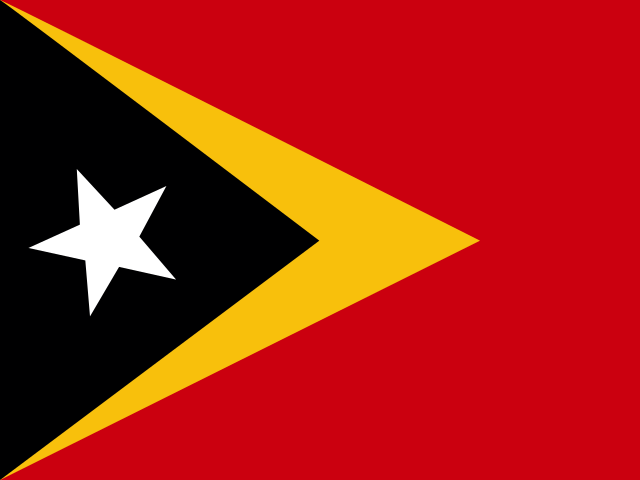
- Description: red with a black isosceles triangle (based on the left side) on a slightly longer yellow arrowhead that extends to the center of the flag; a white star is in the center of the black triangleMeaning: yellow stands for past colonialism, black for obscurantism that needs to be overcome, and red for the struggle for freedom; the white star represents peace and a guiding light
- National symbols
- Mount Ramelau
- National colours
- red, yellow, black, white
- National anthem
- Title: "Patria" (Fatherland)Lyrics/music: Fransisco Borja DA COSTA/Afonso DE ARAUJOHistory: adopted 2002; the song was first used as an anthem when Timor-Leste declared its independence from Portugal in 1975; the lyricist, Francisco Borja DA COSTA, was killed in the Indonesian invasion just days after independence was declared
Economy
- Overview
- lower middle-income Southeast Asian economy; government expenditures funded via oil fund drawdowns; endemic corruption undermines growth; foreign aid-dependent; wide-scale poverty, unemployment, and illiteracy
- GDP (PPP)
- $5.863 billion (2024 est.)
- GDP per person (PPP)
- $4,200 (2024 est.)
- GDP growth
- -2.2% (2024 est.)
- Inflation
- 2.1% (2024 est.)
- Unemployment
- 1.7% (2024 est.)
- Farm products
- maize, rice, coconuts, root vegetables, vegetables, cassava, other meats, pork, beans, coffee (2023)
- Industries
- printing, soap manufacturing, handicrafts, woven cloth
- Exports
- $278.047 million (2024 est.)
- Main exports
- crude petroleum, natural gas, coffee, scrap iron, telephones (2023)
- Export partners
- China 46%, Singapore 25%, Japan 15%, Indonesia 5%, USA 3% (2023)
- Main imports
- refined petroleum, rice, cars, plastic products, trucks (2023)
- Import partners
- Indonesia 34%, China 26%, Singapore 9%, Taiwan 5%, India 4% (2023)
- Money sent home from abroad
- 11.7% of GDP (2024 est.)
Energy, internet and transport
- Electricity access
- Electrification - total population: 99.7% (2022 est.)Electrification - urban areas: 100%Electrification - rural areas: 100%
- Electricity sources
- Fossil fuels: 99.8% of total installed capacity (2023 est.)Solar: 0.2% of total installed capacity (2023 est.)
- Internet users
- Percent of population: 34% (2023 est.)
- Mobile phones
- Total subscriptions: 1.63 million (2024 est.)Subscriptions per 100 inhabitants: 116 (2024 est.)
- TV and radio
- 7 TV stations (3 nationwide satellite coverage; 2 terrestrial coverage, mostly in Dili; 2 cable) and 21 radio stations (3 nationwide coverage) (2019)
- Airports
- 11 (2025)
- Merchant ships
- Total: 1 (2023)By type: other 1
Military and space
- Armed forces
- Timor-Leste Defense Force (Falintil-Forcas de Defesa de Timor-L'este, Falintil (F-FDTL)): Land Component, Air Force Component, Naval ComponentMinistry of Interior: National Police of Timor-Leste (Polícia Nacional de Timor-Leste, PNTL) (2025)
- Military spending
- 2.5% of GDP (2024 est.)
- Military service
- 18 years of age for voluntary military service for men and women; according to Timorese law on military service, all citizens 18-30 must contribute to the defense of independence, sovereignty, and territorial integrity of the country and render their contribution through defense and security institutions (2025)
Neighbouring countries
- Phone code
- +670
- Internet domain
- .tl