Andorra
Principality of Andorra
Tiny Pyrenean state created by a 1278 agreement sharing sovereignty between a French count and the Bishop of Urgell. Its 1993 constitution made it a modern parliamentary democracy.
See Andorra on the 3D globeTake a quiz
Population80 thousand
Area468 km²
CapitalAndorra la Vella
RegionSouthern Europe
Did you know?
- Has no airport and no railway
- One of the longest life expectancies in the world
- It is ruled by two co-princes: France's president and a Catalan bishop
Key facts about Andorra
- Government
- Parliamentary co-principality (French president and Bishop of Urgell)
- Religion
- Roman Catholic ~85%
- Founded / independence
- 1278 (pareage treaty)
- Rich in
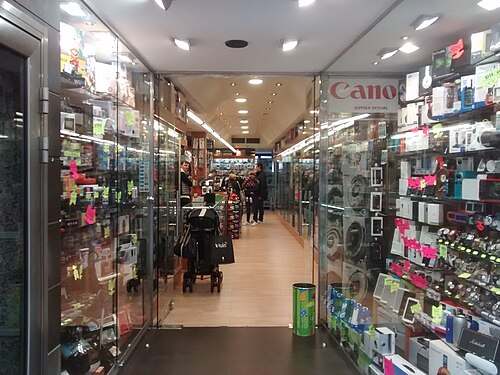
- Tourism, ski resorts, banking, duty-free retail
- Languages
- Catalan
Catalan (official); Spanish, French, Portuguese widely spoken - Currency
- Euro (€)
- People are called
- Andorran
- Main cities
- Andorra la Vella, Escaldes-Engordany, Encamp
Timeline of Andorra
- 1278Pareage treaty creates the co-principality
- 1993First constitution; joins the UN
- 2011Euro becomes official currency
Places to see in Andorra
- Casa de la Vall (old parliament)
- Caldea thermal spa
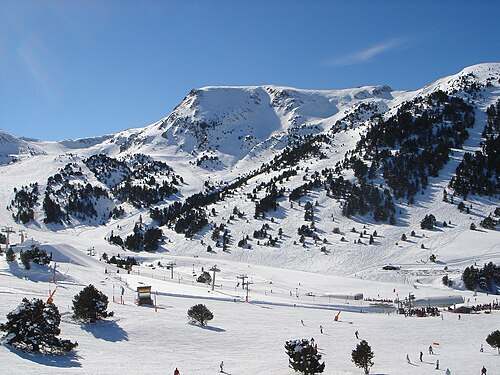
- Grandvalira ski area
- Romanesque churches of Sant Joan de Caselles
Food and drink
Trinxat (cabbage and potato cake) · escudella stew · cured meats
Culture and famous for
Duty-free shopping; Catalan Romanesque art
Popular sports
Skiing, rugby
Geography and climate
- Highest point
- Coma Pedrosa, 2,942 m
- Rivers, lakes and seas
- Valira river; mountain lakes
- Climate
- Alpine; snowy winters
- Coastline
- Landlocked
- Population density
- 171 people per km²
Wars and conflicts
- None significant
- neutral
Alliances and memberships
Political unions and regional organisations
Eurozone (uses the euro without being in the eurozone)Council of Europe
Andorra in depth
Detailed facts from the CIA World Factbook (public domain, latest edition).
Overview
- History in brief
- The landlocked Principality of Andorra -- one of the smallest states in Europe and nestled high in the Pyrenees between the French and Spanish borders -- is the last independent survivor of the Hispanic March states created by Frankish King Charlemagne in 795 after he halted the Moorish invasion of Spain. The March states were a series of buffer states to keep the Muslim Moors from advancing into Christian France. For 715 years, from 1278 to 1993, Andorrans lived under a unique co-principality, ruled by French and Spanish leaders (from 1607 onward, the French chief of state and the Bishop of Urgell). In 1993, this feudal system was modified with the introduction of a modern constitution; the co-princes remained as titular heads of state, but the government transformed into a parliamentary democracy. Andorra's winter sports, summer climate, and duty-free shopping attract approximately 8 million people each year. Andorra has also become a wealthy international commercial center because of its mature banking sector and low taxes. As part of the effort to modernize its economy, Andorra has opened to foreign investment and engaged in other reforms, such as tax initiatives aimed at supporting broader infrastructure. Although not a member of the EU, Andorra enjoys a special relationship with the bloc that is governed by various customs and cooperation agreements, and Andorra uses the euro as its national currency.
Geography
- Location
- Southwestern Europe, Pyrenees mountains, on the border between France and Spain
- Size compared
- 2.5 times the size of Washington, D.C.
- Land borders
- Total: 118 kmBorder countries: France 55 km; Spain 63 km
- Coastline
- 0 km (landlocked)
- Climate
- temperate; snowy, cold winters and warm, dry summers
- Terrain
- rugged mountains dissected by narrow valleys
- Elevation
- Highest point: Pic de Coma Pedrosa 2,946 mLowest point: Riu Runer 840 mMean elevation: 1,996 m
- Natural resources
- hydropower, mineral water, timber, iron ore, lead
- Natural hazards
- avalanches
- Notes
- landlocked; straddles a number of important crossroads in the Pyrenees
- Environmental issues
- deforestation; soil erosion from overgrazing; air pollution; wastewater treatment and solid waste disposal
People and society
- Population
- Total: 85,370 (2024 est.)Male: 43,652Female: 41,718
- Nationality
- Noun: Andorran(s)Adjective: Andorran
- Ethnic groups
- Spanish 34.3%, Andorran 32.1%, Portuguese 10%, French 5.6%, other 18% (2024 est.)
- Languages
- Catalan (official) 44.1%, Castilian 40.3%, Portuguese 13.5%, French 10%, English 3%, other 6.8% (2022 est.)
- Religions
- Christian (predominantly Roman Catholic) 89.5, other 8.8%, unaffiliated 1.7% (2020 est.)
- Median age
- Total: 49.4 years (2025 est.)Male: 48.7 yearsFemale: 48.8 years
- Population growth
- -0.12% (2025 est.)
- Life expectancy
- Total population: 83.8 years (2024 est.)Male: 81.6 yearsFemale: 86.2 years
- Children per woman
- 1.47 children born/woman (2025 est.)
- Urbanization
- Urban population: 87.8% of total population (2023)Rate of urbanization: 0.11% annual rate of change (2020-25 est.)
- Largest cities
- 23,000 ANDORRA LA VELLA (capital) (2018)
- Years in school
- Total: 14 years (2023 est.)Male: 14 years (2023 est.)Female: 15 years (2023 est.)
Government
- Official names
- Conventional long form: Principality of AndorraConventional short form: AndorraLocal long form: Principat d'AndorraLocal short form: AndorraEtymology: the origin of the country's name is obscure; may originate from the Navarrese word andurrial, meaning "shrub-covered land;" alternatively, may derive from the Arabic ad-darra meaning "the forest," a reference to its location; many other theories exist
- Government type
- parliamentary democracy (since March 1993) that retains its chiefs of state in the form of a co-principality; the two princes are the President of France and Bishop of Seu d'Urgell, Spain
- Capital
- Name: Andorra la VellaGeographic coordinates: 42 30 N, 1 31 ETime difference: UTC+1 (6 hours ahead of Washington, DC during Standard Time)Daylight saving time: +1hr, begins last Sunday in March; ends last Sunday in OctoberEtymology: translates as "Andorra the Old" in Catalan
- Regions
- 7 parishes (parroquies, singular - parroquia); Andorra la Vella, Canillo, Encamp, Escaldes-Engordany, La Massana, Ordino, Sant Julia de Loria
- Independence
- 1278 (formed under the joint sovereignty of the French Count of Foix and the Spanish Bishop of Urgell)
- National holiday
- Our Lady of Meritxell Day, 8 September (1278)
- Constitution
- History: drafted 1991, approved by referendum 14 March 1993, effective 28 April 1993Amendment process: proposed by the co-princes jointly or by the General Council; passage requires at least a two-thirds majority vote by the General Council, ratification in a referendum, and sanctioning by the co-princes
- Legal system
- mixed legal system of civil and customary law with the influence of canon (religious) law
- Voting age
- 18 years of age; universal
- Flag meaning
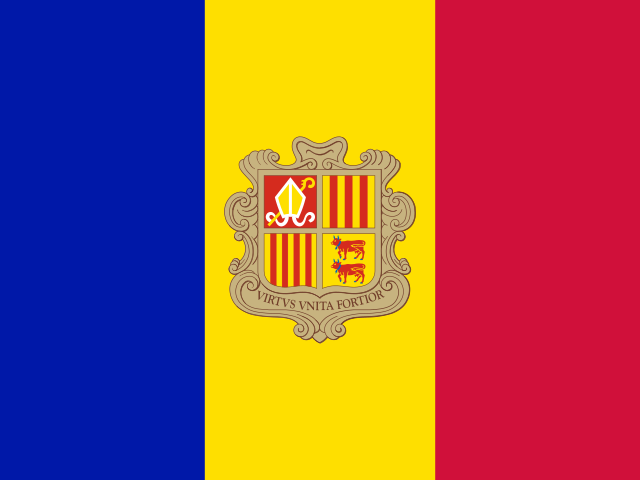
- Description: three vertical bands of blue (left side), yellow, and red, with the national coat of arms centered in the yellow band, which is slightly wider than the other two; the coat of arms features a quartered shield with the emblems of Urgell, Foix, Bearn, and Catalonia; the motto reads VIRTUS UNITA FORTIOR (Strength United is Stronger)Meaning: the flag combines the blue and red French colors with the red and yellow of Spain to symbolize Franco-Spanish protection
- National symbols
- red cow (breed unspecified)
- National colours
- blue, yellow, red
- National anthem
- Title: "El Gran Carlemany" (The Great Charlemagne)Lyrics/music: Joan BENLLOCH i VIVO/Enric MARFANY BONSHistory: adopted 1921; the anthem provides a brief history of Andorra in a first-person narrative
- UNESCO World Heritage Sites
- Total World Heritage Sites: 1 (cultural)Selected World Heritage Site locales: Madriu-Perafita-Claror Valley
Economy
- Overview
- high GDP; low unemployment; non-EU Euro user; co-principality duty-free area between Spain and France; tourist hub but hit hard by COVID-19; modern, non-tax haven financial sector; looking for big tech investments; new member of SEPA and IMF
- GDP (PPP)
- $5.402 billion (2024 est.)
- GDP per person (PPP)
- $65,900 (2024 est.)
- GDP growth
- 3.4% (2024 est.)
- Inflation
- 6.2% (2022 est.)
- Farm products
- small quantities of rye, wheat, barley, oats, vegetables, tobacco, sheep, cattle
- Industries
- tourism (particularly skiing), banking, timber, furniture
- Exports
- $3.169 billion (2023 est.)
- Main exports
- paintings, integrated circuits, cars, orthopedic appliances, garments (2023)
- Export partners
- Spain 39%, USA 21%, France 11%, UK 5%, UAE 3% (2023)
- Main imports
- cars, refined petroleum, garments, perfumes, electricity (2023)
- Import partners
- Spain 65%, France 11%, Germany 4%, China 3%, Italy 3% (2023)
- Money sent home from abroad
- 1.3% of GDP (2023 est.)
Energy, internet and transport
- Electricity access
- Electrification - total population: 100% (2022 est.)
- Internet users
- Percent of population: 95% (2023 est.)
- Mobile phones
- Total subscriptions: 126,214 (2023 est.)Subscriptions per 100 inhabitants: 156 (2024 est.)
- TV and radio
- the media scene is partly shaped by the proximity to France and Spain; Andorrans have access to broadcasts from both countries (2023)
Military and space
- Armed forces
- no regular military forces; Police Corps of Andorra (under the Ministry of Justice and Interior)
Neighbouring countries
- Phone code
- +376
- Internet domain
- .ad