France
French Republic
Roman Gaul became the Frankish kingdom of Charlemagne. Absolute monarchy ended in the 1789 Revolution, which spread ideas of rights and republics; Napoleon briefly ruled much of Europe. Now on its Fifth Republic, a founding EU member with a seat on the UN Security Council.
See France on the 3D globeTake a quiz
Population68.6 million
Area551,695 km²
CapitalParis
RegionWestern Europe
Did you know?
- The most visited country in the world
- Its overseas territories give it the most time zones of any country (12)
- The Louvre is the world's most visited museum
Key facts about France
- Government
- Semi-presidential republic
- Religion
- Catholic ~45%, Islam ~8%, unaffiliated ~35%
- Founded / independence
- 843 (West Francia); 987 Capetian kingdom
- Rich in
- Tourism (most visited country), aerospace, luxury goods, nuclear power, wine
- Languages
- French
French; regional languages Occitan, Breton, Basque, Alsatian, Corsican, Catalan, Picard - Currency
- Euro (€)
- People are called
- French
- Main cities
- Paris, Marseille, Lyon, Toulouse, Nice, Nantes
Timeline of France
- 800Charlemagne crowned emperor
- 1337Hundred Years' War
- 1789Revolution
- 1804Napoleon emperor
- 1871Third Republic
- 1940German occupation
- 1958Fifth Republic
- 2024Paris Olympics
Places to see in France
- Eiffel Tower
- Louvre
- Mont-Saint-Michel
- Palace of Versailles
- Notre-Dame de Paris
- French Riviera
- Loire châteaux
Food and drink
Croissants · baguette · coq au vin · ratatouille · cheese (over 1,000 kinds) · wine
Culture and famous for
Haute cuisine; fashion; Impressionist painting; cinema invented by the Lumière brothers
Popular sports
Football, rugby, cycling (Tour de France), tennis
Geography and climate
- Highest point
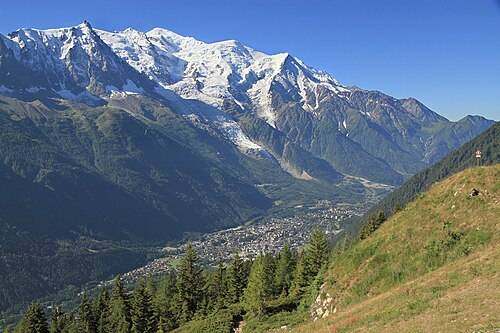
- Mont Blanc, 4,806 m
- Rivers, lakes and seas
- Loire, Seine, Rhône, Garonne
- Climate
- Temperate; Mediterranean in the south
- Coastline
- Has a sea coast
- Population density
- 124 people per km²
Wars and conflicts
- Hundred Years' War
- Wars of Religion
- Revolution and Napoleonic Wars
- WWI
- WWII
- Algerian War
Empires and states that once stood here
Alliances and memberships
Military and security
Political unions and regional organisations
European UnionEurozoneCouncil of EuropeG7
Economy and trade
Defence treaties
- France–Greece Strategic Partnership (2021): Defence pact with a mutual-assistance clause.
France in depth
Detailed facts from the CIA World Factbook (public domain, latest edition).
Overview
- History in brief
- France today is one of the most modern countries in the world and is a leader among European nations. It plays an influential global role as a permanent member of the United Nations Security Council, NATO, the G-7, the G-20, the EU, and other multilateral organizations. France rejoined NATO's integrated military command structure in 2009, reversing then President Charles DE GAULLE's 1966 decision to withdraw French forces from NATO. Since 1958, it has constructed a hybrid presidential-parliamentary governing system resistant to the instabilities experienced in earlier, more purely parliamentary administrations. In recent decades, its reconciliation and cooperation with Germany have proved central to the economic integration of Europe, including the introduction of a common currency, the euro, in January 1999. In the early 21st century, five French overseas entities -- French Guiana, Guadeloupe, Martinique, Mayotte, and Reunion -- became French regions and were made part of France proper.
Geography
- Location
- Metropolitan France: Western Europe, bordering the Bay of Biscay and English Channel, between Belgium and Spain, southeast of the UK; bordering the Mediterranean Sea, between Italy and SpainFrench Guiana: Northern South America, bordering the North Atlantic Ocean, between Brazil and SurinameGuadeloupe: Caribbean, islands between the Caribbean Sea and the North Atlantic Ocean, southeast of Puerto RicoMartinique: Caribbean, island between the Caribbean Sea and North Atlantic Ocean, north of Trinidad and TobagoMayotte: Southern Indian Ocean, island in the Mozambique Channel, about halfway between northern Madagascar and northern MozambiqueReunion: Southern Africa, island in the Indian Ocean, east of Madagascar
- Size compared
- slightly more than four times the size of Georgia; slightly less than the size of Texas
- Land borders
- Total: 3,956 kmBorder countries: Andorra 55 km; Belgium 556 km; Germany 418 km; Italy 476 km; Luxembourg 69 km; Monaco 6 km; Spain 646 km; Switzerland 525 kmMetropolitan France - total: 2751 kmFrench Guiana - total: 1205 km
- Coastline
- 4,853 km
- Climate
- Metropolitan France: generally cool winters and mild summers, but mild winters and hot summers along the Mediterranean; occasional strong, cold, dry, north-to-northwesterly wind known as the mistral
- Terrain
- Metropolitan France: mostly flat plains or gently rolling hills in north and west; remainder is mountainous, especially Pyrenees in south, Alps in eastFrench Guiana: low-lying coastal plains rising to hills and small mountainsGuadeloupe: Basse-Terre is volcanic in origin with interior mountains; Grande-Terre is low limestone formation; most of the seven other islands are volcanic in originMartinique: mountainous with indented coastline; dormant volcanoMayotte: generally undulating, with deep ravines and ancient volcanic peaksReunion: mostly rugged and mountainous; fertile lowlands along coast
- Elevation
- Highest point: Mont Blanc 4,810Lowest point: Rhone River delta -2 mMean elevation: 375 m
- Natural resources
- Metropolitan France: coal, iron ore, bauxite, zinc, uranium, antimony, arsenic, potash, feldspar, fluorspar, gypsum, timber, arable land, fish; French Guiana: gold deposits, petroleum, kaolin, niobium, tantalum, clay
- Major rivers
- Rhin (Rhine) (shared with Switzerland [s], Germany, and Netherlands [m]) - 1,233 km; Loire - 1,012 kmNote: [s] after country name indicates river source; [m] after country name indicates river mouth
- Major lakes
- Fresh water lake(s): Lake Geneva (shared with Switzerland) - 580 sq km
- Natural hazards
- Metropolitan France: flooding; avalanches; midwinter windstorms; drought; forest fires in southOverseas departments: hurricanes (cyclones); floodingVolcanism: Montagne Pelée (1,394 m) on the island of Martinique in the Caribbean is the most active volcano of the Lesser Antilles arc, although it last erupted in 1932; a catastrophic eruption in 1902 destroyed the city of St. Pierre, killing an estimated 30,000 people; La Soufrière (1,467 m) on the island of Guadeloupe has also had explosive eruptions in recent years
- Notes
- largest Western European nation; most major French rivers -- the Meuse, Seine, Loire, Charente, Dordogne, and Garonne -- flow northward or westward into the Atlantic Ocean, only the Rhone flows southward into the Mediterranean Sea
- Environmental issues
- air pollution and acid rain from industrial and vehicle emissions; water pollution from urban wastes, agricultural runoff
People and society
- Population
- Total: 68,512,806 (2025 est.)Male: 33,627,639Female: 34,885,167
- Nationality
- Noun: Frenchman(men), Frenchwoman(women)Adjective: French
- Ethnic groups
- Celtic and Latin with Teutonic, Slavic, North African (Algerian, Moroccan, Tunisian), Indochinese, Basque minorities
- Languages
- French (official) 100%, declining regional dialects and languages (Provençal, Breton, Alsatian, Corsican, Catalan, Basque, Flemish, Occitan, Picard)Major-language sample(s): The World Factbook, une source indispensable d'informations de base. (French)The World Factbook, the indispensable source for basic information.
- Religions
- Roman Catholic 47%, Muslim 4%, Protestant 2%, Buddhist 2%, Orthodox 1%, Jewish 1%, other 1%, none 33%, unspecified 9% (2021 est.)
- Median age
- Total: 42.7 years (2025 est.)Male: 41 yearsFemale: 44.2 years
- Population growth
- 0.2% (2025 est.)
- Life expectancy
- Total population: 82.6 years (2024 est.)Male: 79.8 yearsFemale: 85.5 years
- Children per woman
- 1.9 children born/woman (2025 est.)
- Urbanization
- Urban population: 81.8% of total population (2023)Rate of urbanization: 0.67% annual rate of change (2020-25 est.)
- Largest cities
- 11.208 million PARIS (capital), 1.761 million Lyon, 1.628 million Marseille-Aix-en-Provence, 1.079 million Lille, 1.060 million Toulouse, 1.000 million Bordeaux (2023)
- Years in school
- Total: 16 years (2022 est.)Male: 16 years (2022 est.)Female: 17 years (2022 est.)
Government
- Official names
- Conventional long form: French RepublicConventional short form: FranceLocal long form: République françaiseLocal short form: FranceEtymology: derives from the Latin name Francia, meaning "Land of the Franks"; the Franks were a group of Germanic tribes located along the middle and lower Rhine River in the 3rd century A.D.; the origin of the tribal name is unclear but may come from the Old German word franka, meaning "brave," or from a personal name such as Francio or Francus
- Government type
- semi-presidential republic
- Capital
- Name: ParisGeographic coordinates: 48 52 N, 2 20 ETime difference: UTC+1 (6 hours ahead of Washington, DC, during Standard Time)Daylight saving time: +1hr, begins last Sunday in March; ends last Sunday in OctoberTime zone note: applies to metropolitan France only; for its overseas regions the time difference is UTC-4 for Guadeloupe and Martinique, UTC-3 for French Guiana, UTC+3 for Mayotte, and UTC+4 for ReunionEtymology: name derives from the Parisii, a Celtic tribe that inhabited the area from the 3rd century B.C.; the Celtic settlement became the Roman town of Lutetia Parisiorum (Lutetia of the Parisii); over subsequent centuries it became Parisium and then Paris
- Regions
- 18 regions (régions, singular - région); Auvergne-Rhône-Alpes, Bourgogne-Franche-Comté, Bretagne (Brittany), Centre-Val de Loire (Center-Loire Valley), Corse (Corsica), Grand Est (Grand East), Guadeloupe, Guyane (French Guiana), Hauts-de-France (Upper France), Ile-de-France, Martinique, Mayotte, Normandie (Normandy), Nouvelle-Aquitaine (New Aquitaine), Occitanie (Occitania), Pays de la Loire (Lands of the Loire), Provence-Alpes-Côte d'Azur, Réunion
- Independence
- No official date of independence: 486 (Frankish tribes unified under Merovingian kingship); 10 August 843 (Western Francia established from the division of the Carolingian Empire); 14 July 1789 (French monarchy overthrown); 22 September 1792 (First French Republic established); 4 October 1958 (Fifth French Republic established)
- National holiday
- Fête de la Fédération, 14 July (1790)
- Constitution
- History: many previous; latest effective 4 October 1958Amendment process: proposed by the president of the republic (upon recommendation of the prime minister and Parliament) or by Parliament; proposals submitted by Parliament members require passage by both houses followed by approval in a referendum; passage of proposals submitted by the government can bypass a referendum if submitted by the president to Parliament and passed by at least three-fifths majority vote by Parliament’s National Assembly
- Legal system
- civil law; review of administrative but not legislative acts
- Voting age
- 18 years of age; universal
- Flag meaning
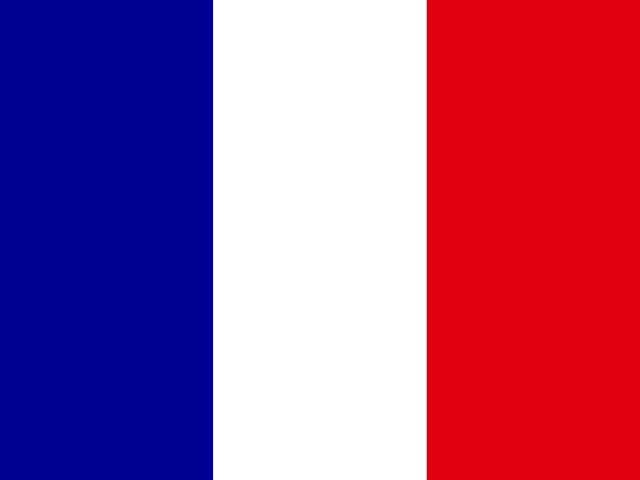
- Description: three equal vertical bands of blue (left side), white, and redHistory: known as the le tricolore (tricolor), the flag dates to 1790 and the French Revolution, when the traditional color of white was combined with the blue and red of the Paris militia; for the first four years of the flag's use (1790-94), the order of colors was reversed (red-white-blue)
- National symbols
- Gallic rooster, fleur-de-lis, Marianne (female personification of the country)
- National colours
- blue, white, red
- National anthem
- Title: "La Marseillaise" (The Song of Marseille)Lyrics/music: Claude-Joseph ROUGET de LisleHistory: adopted 1795, restored 1870; acquired its name when the National Guard of Marseille sang the song while marching into Paris in 1792 during the French Revolution; one of the most recognized anthems in the world
- UNESCO World Heritage Sites
- Total World Heritage Sites: 54 (46 cultural, 7 natural, 1 mixed); note - includes one site in New Caledonia and one site in French PolynesiaSelected World Heritage Site locales: Chartres Cathedral (c); Palace and Park of Versailles (c); Mont-Saint-Michel and its Bay (c); Prehistoric Sites and Decorated Caves of the Vézère Valley (c); Pyrénées - Mont Perdu (m); Cistercian Abbey of Fontenay (c); Paris, Banks of the Seine (c); The Loire Valley between Sully-sur-Loire and Chalonnes (c); Pont du Gard (Roman Aqueduct) (c); Amiens Cathedral (c); Palace and Park of Fontainebleau (c); Historic Fortified City of Carcassonne (c); The Maison Carrée of Nîmes (c); Gulf of Porto: Calanche of Piana, Gulf of Girolata, Scandola Reserve (Corsica) (n); Megaliths of Carnac and of the shores of Morbihan (c)
Economy
- Overview
- high-income, advanced EU economy and eurozone member; strong tourism, aircraft manufacturing, pharmaceuticals, and industrial sectors; high public debt; ongoing pension reform efforts; transitioning to a green economy via "France 2030" strategy
- GDP (PPP)
- $3.732 trillion (2024 est.)
- GDP per person (PPP)
- $54,500 (2024 est.)
- GDP growth
- 1.2% (2024 est.)
- Inflation
- 2% (2024 est.)
- Unemployment
- 7.4% (2024 est.)
- Below poverty line
- 15.6% (2021 est.)
- Farm products
- wheat, sugar beets, milk, maize, barley, potatoes, grapes, rapeseed, pork, sunflower seeds (2023)
- Industries
- machinery, chemicals, automobiles, metallurgy, aircraft, electronics, textiles, food processing, tourism
- Exports
- $1.071 trillion (2024 est.)
- Main exports
- aircraft, cars, packaged medicine, gas turbines, vehicle parts/accessories (2023)
- Export partners
- Germany 11%, Italy 9%, USA 8%, Belgium 8%, Spain 7% (2023)
- Main imports
- cars, natural gas, crude petroleum, refined petroleum, garments (2023)
- Import partners
- Germany 15%, Belgium 11%, Netherlands 9%, Spain 8%, Italy 8% (2023)
- Money sent home from abroad
- 1.2% of GDP (2024 est.)
Energy, internet and transport
- Electricity access
- Electrification - total population: 100% (2022 est.)
- Electricity sources
- Fossil fuels: 7.9% of total installed capacity (2023 est.)Nuclear: 63.9% of total installed capacity (2023 est.)Solar: 4.5% of total installed capacity (2023 est.)Wind: 10.4% of total installed capacity (2023 est.)Hydroelectricity: 10.8% of total installed capacity (2023 est.)Tide and wave: 0.1% of total installed capacity (2023 est.)Biomass and waste: 2.3% of total installed capacity (2023 est.)
- Internet users
- Percent of population: 87% (2023 est.)
- Mobile phones
- Total subscriptions: 77.5 million (2023 est.)Subscriptions per 100 inhabitants: 117 (2023 est.)
- TV and radio
- a mix of both publicly operated and privately owned TV stations; state-owned TV stations operate 4 networks and have part-interest in several thematic cable/satellite channels and international channels; large number of privately owned regional and local TV stations; multi-channel satellite and cable services; public broadcaster Radio France operates 7 national networks, a series of regional networks, and services for overseas territories and foreign audiences; Radio France Internationale, under the Ministry of Foreign Affairs, is a leading international broadcaster; large number of commercial FM stations
- Airports
- 1,218 (2025)
- Railways
- Total: 27,860 km (2020) 16,660 km electrifiedNarrow gauge: -5 km
- Merchant ships
- Total: 553 (2023)By type: container ship 32, general cargo 48, oil tanker 25, other 448
Military and space
- Armed forces
- French Armed Forces (Forces Armées Françaises): Army (l'Armee de Terre; includes Foreign Legion), Navy (Marine Nationale), Air and Space Force (l'Armee de l’Air et de l’Espace); includes Air Defense), National Guard (Garde Nationale), National Gendarmerie (Gendarmerie Nationale) (2025)
- Military spending
- 2.1% of GDP (2025 est.)
- Military service
- generally 17-30 years of age for both men and women with some variations by service, position, and enlisted versus officer; 17-40 for National Gendarmerie; basic service contract is for 12 months; no conscription (abolished 2001) (2025)
- Space programme
- has one of Europe’s largest space programs and is one of the top contributors to the ESA; has independent capabilities in all areas, except for autonomous manned space flight; can build, launch, and operate a range of space/satellite launch vehicles (SLVs) and spacecraft, including exploratory probes and a full spectrum of satellites; shifted astronaut training to ESA in 2001; hosts the ESA headquarters and its space launch facility; participates in international space programs such as the Square Kilometer Array radio telescope and International Space Station; works with a broad range of space agencies and commercial space companies, including those of China, Egypt, individual ESA and EU member countries, India, Indonesia, Israel, Japan, Mexico, Russia, the UAE, the US, and several African countries; has a large commercial space sector involved in satellite construction and payloads, launch capabilities, and a range of other space-related capabilities and technologies (2025)
- Space milestones
- early 1960s - began rocket program and launched animals into space1965 - launched first domestically produced satellite (Asterix) into space on a French Diamant rocket (third country to do so after the Soviet Union and US)1973 - began development of Ariane heavy-lift satellite launch vehicle (SLV) along with other European states, particularly Germany and the UK; Ariane would become the ESA's SLV1970s-1990s - development of a space plane/shuttle program (Hermes)1982 - first French astronaut into space on a Soviet rocket1986 - launched first joint European Earth observation/remote sensing program (SPOT)2018 - launched project (Spaceship FR) to lay the groundwork for robotic and crewed missions to the Moon and Mars2024 - debut launch of Ariane-6 SLV; claimed world's first satellite to ground communications via laser
Global issues
- Refugees and displaced people
- Refugees: 810,325 (2024 est.)IDPs: 59 (2024 est.)Stateless persons: 2,634 (2024 est.)
Neighbouring countries
AndorraBelgiumGermanyItalyLuxembourgMonacoSpainSwitzerland
- Phone code
- +33
- Internet domain
- .fr