Spain
Kingdom of Spain · España
Roman Hispania, then Visigothic and Muslim al-Andalus for nearly 800 years. United in 1479, it built a vast American empire. Franco's dictatorship followed the civil war; democracy returned after 1975.
See Spain on the 3D globeTake a quiz
Population48.6 million
Area505,992 km²
CapitalMadrid
RegionSouthern Europe
Did you know?
- Produces about half the world's olive oil
- La Tomatina is a festival of throwing tomatoes
- Has the second most UNESCO sites in Europe
Key facts about Spain
- Government
- Parliamentary constitutional monarchy
- Religion
- Catholic ~55%, unaffiliated ~40%
- Founded / independence
- 1479 union of Castile and Aragon
- Rich in
- Tourism, cars, agriculture (olive oil, wine), renewables
- Languages
- Spanish
Spanish (Castilian); co-official Catalan, Basque, Galician, Valencian; Andalusian dialects - Currency
- Euro (€)
- People are called
- Spanish
- Main cities
- Madrid, Barcelona, Valencia, Seville, Zaragoza, Bilbao
Timeline of Spain
- 711Muslim conquest
- 1492Granada falls; Columbus sails
- 1588Armada defeated
- 1936Civil War
- 1975Franco dies
- 1978Democratic constitution
- 1986Joins EEC
Places to see in Spain
- Sagrada Família
- Alhambra
- Prado Museum
- Mezquita of Córdoba
- Park Güell
- Santiago de Compostela
Food and drink
Paella · tapas · jamón ibérico · tortilla · gazpacho · churros
Culture and famous for
Flamenco; painters Velázquez, Goya, Picasso, Dalí; architect Gaudí; Cervantes' Don Quixote
Popular sports
Football (Real Madrid, Barcelona), tennis, basketball
Geography and climate
- Highest point
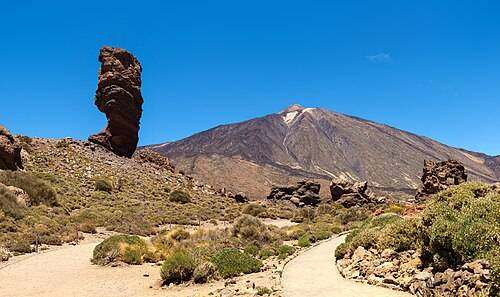
- Teide (Tenerife), 3,718 m; Mulhacén on the mainland, 3,479 m
- Rivers, lakes and seas
- Ebro, Tagus, Guadalquivir
- Climate
- Mediterranean and semi-arid
- Coastline
- Has a sea coast
- Population density
- 96 people per km²
Wars and conflicts
- Reconquista
- Spanish Armada
- Peninsular War
- Spanish Civil War 1936–39
- ETA conflict
Alliances and memberships
Military and security
Political unions and regional organisations
European UnionEurozoneCouncil of Europe
Economy and trade
Spain in depth
Detailed facts from the CIA World Factbook (public domain, latest edition).
Overview
- History in brief
- Spain's powerful world empire of the 16th and 17th centuries ultimately yielded command of the seas to England. Spain remained neutral during both World Wars but suffered through a devastating civil war (1936-39) resulting in a dictatorship. A peaceful transition to democracy after the death of dictator Francisco FRANCO in 1975 and rapid economic modernization after Spain joined the EU in 1986 gave Spain a dynamic and rapidly growing economy. After a severe recession in the wake of the global financial crisis in 2008, Spain has posted solid years of GDP growth above the EU average. Unemployment has fallen but remains high, especially among youth. Spain is the euro-zone's fourth-largest economy. The country has faced increased domestic turmoil in recent years due to the independence movement in its restive Catalonia region.
Geography
- Location
- Southwestern Europe, bordering the Mediterranean Sea, North Atlantic Ocean, Bay of Biscay, and Pyrenees Mountains; southwest of France
- Size compared
- almost five times the size of Kentucky; slightly more than twice the size of Oregon
- Land borders
- Total: 1,952.7 kmBorder countries: Andorra 63 km; France 646 km; Gibraltar 1.2 km; Portugal 1,224 km; Morocco (Ceuta) 8 km and Morocco (Melilla) 10.5 km
- Coastline
- 4,964 km
- Climate
- temperate; clear, hot summers in interior, more moderate and cloudy along coast; cloudy, cold winters in interior, partly cloudy and cool along coast
- Terrain
- large, flat to dissected plateau surrounded by rugged hills; Pyrenees Mountains in north
- Elevation
- Highest point: Pico de Teide (Tenerife) on Canary Islands 3,718 mLowest point: Atlantic Ocean 0 mMean elevation: 660 m
- Natural resources
- coal, lignite, iron ore, copper, lead, zinc, uranium, tungsten, mercury, pyrites, magnesite, fluorspar, gypsum, sepiolite, kaolin, potash, hydropower, arable land
- Major rivers
- Tagus river source (shared with Portugal [m]) - 1,006 kmNote: [s] after country name indicates river source; [m] after country name indicates river mouth
- Natural hazards
- periodic droughts, occasional floodingVolcanism: volcanic activity in the Canary Islands, located off Africa's northwest coast; Teide (3,715 m) has been deemed a Decade Volcano by the International Association of Volcanology and Chemistry of the Earth's Interior, worthy of study due to its explosive history and close proximity to human populations; La Palma (2,426 m) is the most active of the Canary Islands volcanoes; Lanzarote is the only other historically active volcano
- Notes
- strategic location along approaches to Strait of Gibraltar; Spain controls a number of territories in northern Morocco, including the enclaves of Ceuta and Melilla and the islands of Penon de Velez de la Gomera, Penon de Alhucemas, and Islas Chafarinas; Spain's Canary Islands are one of four North Atlantic archipelagos that make up Macaronesia; the others are the Azores (Portugal), Madeira (Portugal), and Cabo Verde
- Environmental issues
- pollution of the Mediterranean Sea from raw sewage and effluents from oil and gas production; drought; air pollution; deforestation; desertification
People and society
- Population
- Total: 47,280,433 (2024 est.)Male: 23,069,327Female: 24,211,106
- Nationality
- Noun: Spaniard(s)Adjective: Spanish
- Ethnic groups
- Spanish 84.8%, Moroccan 1.7%, Romanian 1.2%, other 12.3% (2021 est.)
- Languages
- Castilian Spanish (official) 74%, Catalan (official in Catalonia, the Balearic Islands, and the Valencian Community) 17%, Galician (official in Galicia) 7%, Basque (official in the Basque Country and Navarre) 2%, Aranese (official in part of Catalonia) <5,000 speakersMajor-language sample(s): La Libreta Informativa del Mundo, la fuente indispensable de información básica. (Spanish)The World Factbook, the indispensable source for basic information.
- Religions
- Roman Catholic 58.2%, atheist 16.2%, agnostic 10.8%, other 2.7%, non-believer 10.5%, unspecified 1.7% (2021 est.)
- Median age
- Total: 47.2 years (2025 est.)Male: 45.7 yearsFemale: 47.8 years
- Population growth
- 0.12% (2025 est.)
- Life expectancy
- Total population: 83 years (2024 est.)Male: 80.3 yearsFemale: 85.8 years
- Children per woman
- 1.32 children born/woman (2025 est.)
- Urbanization
- Urban population: 81.6% of total population (2023)Rate of urbanization: 0.24% annual rate of change (2020-25 est.)
- Largest cities
- 6.751 million MADRID (capital), 5.687 million Barcelona, 838,000 Valencia (2023)
- Literacy
- Total population: 99.7% (2021 est.)Male: 99.8% (2021 est.)Female: 99.6% (2021 est.)
- Years in school
- Total: 18 years (2023 est.)Male: 17 years (2023 est.)Female: 18 years (2023 est.)
Government
- Official names
- Conventional long form: Kingdom of SpainConventional short form: SpainLocal long form: Reino de EspañaLocal short form: EspañaEtymology: derivation of the name España is uncertain; the Basque words ezpain or espan ("edge," as in a river bank) are possible sources, or the Punic word span, meaning "rabbit;" some academics tie it to the god Hesperus from Greco-Roman mythology
- Government type
- parliamentary constitutional monarchy
- Capital
- Name: MadridGeographic coordinates: 40 24 N, 3 41 WTime difference: UTC+1 (6 hours ahead of Washington, DC, during Standard Time)Daylight saving time: +1hr, begins last Sunday in March; ends last Sunday in OctoberTime zone note: Spain has two time zones, including the Canary Islands (UTC 0)Etymology: the meaning and origin of the name is unclear; the city grew from a small Moorish fort that was called Majerit in the first recorded mention in A.D. 932; some trace the modern-day name back to the Roman era, with the Latin word materia (materials) as a possible source
- Regions
- 17 autonomous communities (comunidades autonomas, singular - comunidad autonoma) and 2 autonomous cities* (ciudades autonomas, singular - ciudad autonoma); Andalucia; Aragon; Asturias; Canarias (Canary Islands); Cantabria; Castilla-La Mancha; Castilla-Leon; Cataluña (Castilian), Catalunya (Catalan), Catalonha (Aranese) [Catalonia]; Ceuta*; Comunidad Valenciana (Castilian), Comunitat Valenciana (Valencian) [Valencian Community]; Extremadura; Galicia; Illes Baleares (Balearic Islands); La Rioja; Madrid; Melilla*; Murcia; Navarra (Castilian), Nafarroa (Basque) [Navarre]; Pais Vasco (Castilian), Euskadi (Basque) [Basque Country]
- Independence
- 1492
- National holiday
- National Day (Hispanic Day), 12 October (1492)
- Constitution
- History: several previous; latest approved by the General Courts 31 October 1978, passed by referendum 6 December 1978, signed by the king 27 December 1978, effective 29 December 1978Amendment process: proposed by the government, by the General Courts (the Congress or the Senate), or by the self-governing communities submitted through the government; passage requires three-fifths majority vote by both houses and passage by referendum if requested by one tenth of the members of either house; proposals disapproved by both houses are submitted to a joint committee, which submits an agreed upon text for another vote; passage requires two-thirds majority vote in Congress and simple majority vote in the Senate
- Legal system
- civil law system with regional variations
- Voting age
- 18 years of age; universal
- Flag meaning
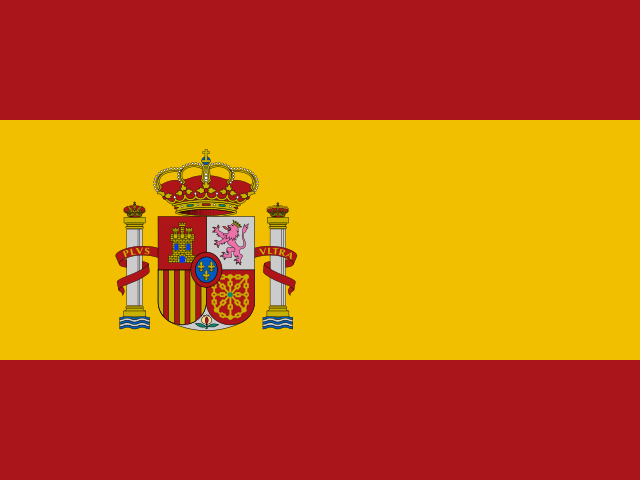
- Description: three horizontal bands of red (top), yellow (double-width), and red, with the national coat of arms on the left side of the yellow band; the coat of arms shows the emblems of the area's former kingdoms (clockwise from upper left: Castile, Leon, Navarre, and Aragon), which also used red and yellow as their colors; the stylized pomegranate at the bottom of the shield represents Granada; the two columns represent the Pillars of Hercules, which are promontories (Gibraltar and Ceuta) on the Strait of Gibraltar; a red scroll bears the imperial motto of "Plus Ultra" (further beyond), referring to Spanish lands outside Europe
- National symbols
- Pillars of Hercules
- National colours
- red, yellow
- National anthem
- Title: "Himno Nacional Espanol" (National Anthem of Spain)Lyrics/music: no lyrics/unknownHistory: adopted 1942;officially in use between 1770 and 1931, restored in 1939; the Spanish anthem was the first to be officially adopted; it first appeared in a 1761 military bugle-call book and was replaced by "Himno de Riego" in the years between 1931 and 1939; the long version of the anthem is used for the king, and the short version is used for the prince, prime minister, and occasions such as sporting events
- UNESCO World Heritage Sites
- Total World Heritage Sites: 50 (44 cultural, 4 natural, 2 mixed)Selected World Heritage Site locales: Cave of Altamira and Paleolithic Cave Art of Northern Spain (c); Works of Antoni Gaudí (c); Santiago de Compostela (Old Town) (c); Historic City of Toledo (c); Archaeological Ensemble of Mérida (c); Tower of Hercules (c); Doñana National Park (n); Pyrénées - Mont Perdu (m); Alhambra, Generalife, and Albayzín in Granada (c); Old City of Salamanca (c); Teide National Park (n); Historic Walled Town of Cuenca (c); Old Town of Segovia and its Aqueduct (c); Historic Cordoba (c); Royal Site of Saint Lorenzo de El Escorial (c); Cathedral, Alcázar, and Archivo de Indias in Seville
Economy
- Overview
- high-income, core-EU and eurozone economy; strong growth driven by public consumption, tourism, and other service exports; tight labor market despite high structural unemployment; efforts to narrow persistent fiscal deficits through tax and spending measures; high but declining unemployment supported by job growth and immigration
- GDP (PPP)
- $2.361 trillion (2024 est.)
- GDP per person (PPP)
- $48,400 (2024 est.)
- GDP growth
- 3.2% (2024 est.)
- Inflation
- 2.8% (2024 est.)
- Unemployment
- 11.4% (2024 est.)
- Below poverty line
- 20.2% (2022 est.)
- Farm products
- milk, olives, pork, grapes, wheat, tomatoes, barley, sugar beets, maize, oranges (2023)
- Industries
- textiles and apparel (including footwear), food and beverages, metals and metal manufactures, chemicals, shipbuilding, automobiles, machine tools, tourism, clay and refractory products, footwear, pharmaceuticals, medical equipment
- Exports
- $642.358 billion (2024 est.)
- Main exports
- cars, packaged medicine, refined petroleum, vehicle parts/accessories, garments (2023)
- Export partners
- France 15%, Germany 10%, Portugal 9%, Italy 9%, UK 6% (2023)
- Main imports
- crude petroleum, cars, garments, vehicle parts/accessories, natural gas (2023)
- Import partners
- Germany 11%, China 10%, France 10%, Italy 7%, USA 7% (2023)
- Money sent home from abroad
- 0.4% of GDP (2024 est.)
Energy, internet and transport
- Electricity access
- Electrification - total population: 100% (2022 est.)
- Electricity sources
- Fossil fuels: 28% of total installed capacity (2023 est.)Nuclear: 20.4% of total installed capacity (2023 est.)Solar: 17.3% of total installed capacity (2023 est.)Wind: 23.6% of total installed capacity (2023 est.)Hydroelectricity: 8.5% of total installed capacity (2023 est.)Biomass and waste: 2.2% of total installed capacity (2023 est.)
- Internet users
- Percent of population: 95% (2023 est.)
- Mobile phones
- Total subscriptions: 61.2 million (2023 est.)Subscriptions per 100 inhabitants: 124 (2022 est.)
- TV and radio
- mix of publicly operated and privately owned TV and radio stations; hundreds of TV channels available, including national, regional, local, public, and international channels; satellite and cable TV available; multiple national radio networks, large number of regional radio networks, and larger number of local radio stations (2019)
- Airports
- 365 (2025)
- Railways
- Total: 15,489 km (2020) 9,953 km electrified
- Merchant ships
- Total: 503 (2023)By type: bulk carrier 1, general cargo 33, oil tanker 24, other 445
Military and space
- Armed forces
- Spanish Armed Forces (Fuerzas Armadas de España): Army (Ejército de Tierra), Spanish Navy (Armada Espanola; includes Marine Corps), Air and Space Force (Ejército del Aire y del Espacio), Emergency Response Unit (Unidad Militar de Emergencias); Civil Guard (Guardia Civil)Ministry of the Interior: Spanish National Police (Cuerpo Nacional de Policía, CNP) (2025)
- Military spending
- 2% of GDP (2025 est.)
- Military service
- 18 years of age for voluntary military service for men and women (upper age limits depend on branch of service, roles, specialties, etc); 24-36 month initial obligation; no conscription, but the Spanish Government retains the right to mobilize citizens 19-25 years of age in a national emergency; 18-58 for the voluntary reserves (2026)
- Space programme
- space program dates back to the 1940s; manufactures and operates communications, remote sensing (RS), and scientific/technology satellites; has developed sounding rockets; conducts research and development in a broad range of space-related capabilities, including astrobiology, astronomy, imaging/RS, meteorology, optics, propulsion, robotics, satellites (particularly micro- and nano-satellites), and satellite launch vehicles; program is integrated into the ESA; also participates in EU space programs; hosts the European Space Astronomy Center (ESOC) and the ESA’s Space Surveillance and Tracking Data Centre (ESAC); cooperates with foreign space agencies and industries, including the US; has an active commercial space industry (2025)
- Space milestones
- 1960s - began working with the US/NASA and the European Space Research Organization (ESRO), the forerunner of the ESA; sounding rocket program (ended in the 1990s)1974 - first satellite (IntaSat) launched by US1990s - satellite launch vehicle (SLV) development program (canceled in 2000)1992 - first communications satellite (Hispasat 1A) launched on European rocket1998 - first astronaut in space on US Space Shuttle2018 - first synthetic-aperture-radar, remote-sensing/reconnaissance satellite (Paz) launched by US2023 - Spanish built Miuri-1 becomes first European private rocket to reach space; joined US-led Artemis Accords for space and lunar exploration2025 - communications satellite (SpainSat NG 1) with advanced security technology launched by US
Global issues
- Refugees and displaced people
- Refugees: 693,298 (2024 est.)IDPs: 3,960 (2024 est.)Stateless persons: 10,164 (2024 est.)
Neighbouring countries
- Phone code
- +34
- Internet domain
- .es