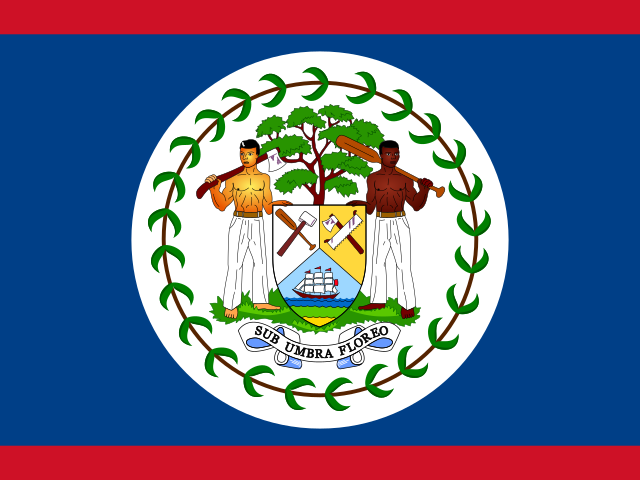
Belize
Belize · Belice
Maya heartland, then British Honduras. The only English-official country in Central America.
See Belize on the 3D globeTake a quiz
Population420 thousand
Area22,966 km²
CapitalBelmopan
RegionCentral America
Did you know?
- Has the second-largest barrier reef in the world
- The Great Blue Hole is about 300 m wide
- The only Central American country with English as official language
Key facts about Belize
- Government
- Parliamentary constitutional monarchy (Commonwealth realm)
- Religion
- Catholic ~40%, Protestant ~30%
- Founded / independence
- 1981 (from UK)
- Rich in
- Tourism, sugar, citrus, barrier reef
- Languages
- Belizean Creole, English, Spanish
English; Belizean Kriol, Spanish, Garifuna, Maya languages - Currency
- Belize dollar ($)
- People are called
- Belizean
- Main cities
- Belize City, Belmopan, San Ignacio
Timeline of Belize
- 250Maya peak
- 1638British settlers
- 1862British Honduras
- 1981Independence
Places to see in Belize
- Great Blue Hole
- Belize Barrier Reef
- Caracol and Xunantunich Maya ruins
- Ambergris Caye
Food and drink
Rice and beans with stew chicken · fry jacks
Culture and famous for
Garifuna drumming; Maya heritage
Popular sports
Football, cycling
Geography and climate
- Highest point
- Doyle's Delight, 1,124 m
- Rivers, lakes and seas
- Belize River
- Climate
- Tropical
- Coastline
- Has a sea coast
- Population density
- 18 people per km²
Wars and conflicts
- Guatemalan territorial claim
Empires and states that once stood here
Maya civilisation c. 2000 BC–1697 AD
Alliances and memberships
Political unions and regional organisations
CARICOMCentral American Integration SystemCELACOrganization of American StatesCommonwealth of Nations
Culture, religion and history
Belize in depth
Detailed facts from the CIA World Factbook (public domain, latest edition).
Overview
- History in brief
- Belize was the site of several Mayan city states until their decline at the end of the first millennium A.D. The British and Spanish disputed the region in the 17th and 18th centuries; it formally became the colony of British Honduras in 1862. Territorial disputes between the UK and Guatemala delayed the independence of Belize until 1981. Guatemala refused to recognize the new nation until 1992, and the two countries are still involved in an ongoing border dispute. Tourism has become the mainstay of the economy. Current concerns include the country's heavy foreign debt burden, high crime rates, high unemployment combined with a majority youth population, growing involvement in the Mexican and South American drug trade, and one of the highest HIV/AIDS prevalence rates in Central America.
Geography
- Location
- Central America, bordering the Caribbean Sea, between Guatemala and Mexico
- Size compared
- slightly smaller than Massachusetts
- Land borders
- Total: 542 kmBorder countries: Guatemala 266 km; Mexico 276 km
- Coastline
- 386 km
- Climate
- tropical; very hot and humid; rainy season (May to November); dry season (February to May)
- Terrain
- flat, swampy coastal plain; low mountains in south
- Elevation
- Highest point: Doyle's Delight 1,124 mLowest point: Caribbean Sea 0 mMean elevation: 173 m
- Natural resources
- arable land potential, timber, fish, hydropower
- Natural hazards
- frequent, devastating hurricanes (June to November) and coastal flooding (especially in south)
- Notes
- only country in Central America without a coastline on the North Pacific Ocean
- Environmental issues
- deforestation; water pollution from sewage, industrial effluents, agricultural runoff; inability to properly dispose of solid waste
People and society
- Population
- Total: 421,960 (2025 est.)Male: 208,844Female: 213,116
- Nationality
- Noun: Belizean(s)Adjective: Belizean
- Ethnic groups
- Mestizo 52.9%, Creole 25.9%, Maya 11.3%, Garifuna 6.1%, East Indian 3.9%, Mennonite 3.6%, White 1.2%, Asian 1%, other 1.2%, unknown 0.3% (2010 est.)
- Languages
- English 62.9% (official), Spanish 56.6%, Creole 44.6%, Maya 10.5%, German 3.2%, Garifuna 2.9%, other 1.8%, unknown 0.5% (2010 est.)Major-language sample(s): The World Factbook, the indispensable source for basic information. (English)La Libreta Informativa del Mundo, la fuente indispensable de información básica. (Spanish)
- Religions
- Roman Catholic 40.1%, Protestant 31.5% (includes Pentecostal 8.4%, Seventh Day Adventist 5.4%, Anglican 4.7%, Mennonite 3.7%, Baptist 3.6%, Methodist 2.9%, Nazarene 2.8%), Jehovah's Witness 1.7%, other 10.5% (includes Baha'i, Buddhist, Hindu, Church of Jesus Christ, Muslim, Rastafarian, Salvation Army), unspecified 0.6%, none 15.5% (2010 est.)
- Median age
- Total: 27.2 years (2025 est.)Male: 26.4 yearsFemale: 27.2 years
- Population growth
- 1.47% (2025 est.)
- Life expectancy
- Total population: 74.3 years (2024 est.)Male: 72.6 yearsFemale: 76.1 years
- Children per woman
- 2.02 children born/woman (2025 est.)
- Urbanization
- Urban population: 46.6% of total population (2023)Rate of urbanization: 2.3% annual rate of change (2020-25 est.)
- Largest cities
- 23,000 BELMOPAN (capital) (2018)
- Literacy
- Total population: 87.9% (2022 est.)Male: 87.9% (2022 est.)Female: 87.9% (2022 est.)
- Years in school
- Total: 12 years (2023 est.)Male: 12 years (2023 est.)Female: 12 years (2023 est.)
Government
- Official names
- Conventional long form: noneConventional short form: BelizeFormer: British HondurasEtymology: traditionally believed to be derived from the Spanish pronunciation of the last name of Scottish explorer Peter Wallace, who settled in the area in 1638; alternatively, may be named for the Belize River, whose name possibly derives from the Maya word "belix," meaning "muddy-watered"
- Government type
- parliamentary democracy (National Assembly) under a constitutional monarchy; a Commonwealth realm
- Capital
- Name: BelmopanGeographic coordinates: 17 15 N, 88 46 WTime difference: UTC-6 (1 hour behind Washington, DC, during Standard Time)Etymology: the name is formed from two words: "Belize," the name of the longest river in the country, and "Mopan," one of the rivers in the area that empties into the Belize River
- Regions
- 6 districts; Belize, Cayo, Corozal, Orange Walk, Stann Creek, Toledo
- Independence
- 21 September 1981 (from the UK)
- National holiday
- Battle of St. George's Caye Day (National Day), 10 September (1798); Independence Day, 21 September (1981)
- Constitution
- History: previous 1954, 1963 (pre-independence); latest signed and entered into force 21 September 1981Amendment process: proposed and adopted by two-thirds majority vote of the National Assembly House of Representatives except for amendments relating to rights and freedoms, changes to the Assembly, and to elections and judiciary matters, which require at least three-quarters majority vote of the House; both types of amendments require assent of the governor general
- Legal system
- English common law
- Voting age
- 18 years of age; universal
- Flag meaning
- Description: royal blue with a narrow red stripe along the top and the bottom edges; the coat of arms is on a large white disk at the center and shows a shield flanked by two workers in front of a mahogany tree, with the motto SUB UMBRA FLOREO (I Flourish in the Shade) on a scroll at the bottom; a green garland of 50 mahogany leaves rings the coat of armsMeaning: the figures, the mahogany tree, and the garland refer to the logging industry that led the British to settle Belize; blue and red are the colors of the two main political parties
- National symbols
- Baird's tapir (a large forest-dwelling mammal), keel-billed toucan, black orchid
- National colours
- red, blue
- National anthem
- Title: "God Save the King"Lyrics/music: unknownHistory: royal anthem, as a Commonwealth country
- UNESCO World Heritage Sites
- Total World Heritage Sites: 1 (natural)Selected World Heritage Site locales: Belize Barrier Reef Reserve System
Economy
- Overview
- tourism- and agriculture-driven economy; strong post-pandemic rebound; innovative and ecological bond restructuring that significantly lowered public debt and expanded marine protections; central bank offering USD-denominated treasury notes; high mobility across borders
- GDP (PPP)
- $5.538 billion (2024 est.)
- GDP per person (PPP)
- $13,300 (2024 est.)
- GDP growth
- 8.2% (2024 est.)
- Inflation
- 3.3% (2024 est.)
- Unemployment
- 7% (2024 est.)
- Farm products
- sugarcane, maize, bananas, sorghum, soybeans, chicken, rice, oranges, fruits, plantains (2023)
- Industries
- garment production, food processing, tourism, construction, oil
- Exports
- $1.64 billion (2024 est.)
- Main exports
- raw sugar, bananas, fish, shellfish, refined petroleum (2023)
- Export partners
- USA 22%, UK 14%, Spain 9%, Guatemala 7%, Portugal 5% (2023)
- Main imports
- refined petroleum, orthopedic appliances, ships, garments, tobacco (2023)
- Import partners
- USA 37%, China 17%, Guatemala 10%, Mexico 8%, Costa Rica 6% (2023)
- Money sent home from abroad
- 4.4% of GDP (2024 est.)
Energy, internet and transport
- Electricity access
- Electrification - total population: 98.6% (2022 est.)Electrification - urban areas: 98.4%Electrification - rural areas: 97.1%
- Electricity sources
- Fossil fuels: 12% of total installed capacity (2023 est.)Solar: 2.4% of total installed capacity (2023 est.)Hydroelectricity: 52.9% of total installed capacity (2023 est.)Biomass and waste: 32.7% of total installed capacity (2023 est.)
- Internet users
- Percent of population: 72% (2023 est.)
- Mobile phones
- Total subscriptions: 271,000 (2022 est.)Subscriptions per 100 inhabitants: 67 (2022 est.)
- TV and radio
- 8 privately owned TV stations; multi-channel cable TV provides access to foreign stations; about 25 radio stations broadcasting on roughly 50 different frequencies; state-run radio was privatized in 1998 (2019)
- Airports
- 27 (2025)
- Merchant ships
- Total: 774 (2023)By type: bulk carrier 49, general cargo 410, oil tanker 64, other 251
Military and space
- Armed forces
- Belize Defense Force (BDF): Army, Air Wing; Belize Coast Guard (BCG) (2025)
- Military spending
- 1% of GDP (2024 est.)
- Military service
- 18-23 years of age for voluntary military service; laws allow for conscription only if volunteers are insufficient, but conscription has never been implemented; initial service obligation is 12 years (2025)
Global issues
- Refugees and displaced people
- Refugees: 2,287 (2024 est.)IDPs: 8 (2024 est.)
- Drug trade
- USG identification: major illicit drug-producing and/or drug-transit country (2025)
Neighbouring countries
- Phone code
- +501
- Internet domain
- .bz