Mexico
United Mexican States · México
Home of the Olmec, Maya and Aztec civilisations. Lost half its territory to the US in 1848. Elected its first woman president in 2024.
See Mexico on the 3D globeTake a quiz
Population131 million
Area1,964,375 km²
CapitalMexico City
RegionNorth America
Did you know?
- Chocolate, corn and chillies came from here
- Mexico City is sinking up to 50 cm a year
- Has the most Spanish speakers in the world
Key facts about Mexico
- Government
- Federal presidential republic
- Religion
- Catholic ~78%, Protestant ~10%
- Founded / independence
- 1810/1821 (from Spain)
- Rich in
- Oil, silver (largest producer), cars, avocados, tourism
- Languages
- Spanish
Spanish (largest Spanish-speaking country); 68 Indigenous languages: Nahuatl, Maya, Mixtec, Zapotec - Currency
- Mexican peso ($)
- People are called
- Mexican
- Main cities
- Mexico City, Guadalajara, Monterrey, Puebla, Tijuana
Timeline of Mexico
- 1325Tenochtitlan founded
- 1521Spanish conquest
- 1821Independence
- 1848Loses north to US
- 1910Revolution
- 1994NAFTA
- 2024First woman president
Places to see in Mexico
- Chichén Itzá
- Teotihuacan
- Tulum
- Mexico City's Zócalo
- Copper Canyon
- Cancún
- Oaxaca
Food and drink
Tacos · mole · tamales · chiles en nogada · guacamole · tequila
Culture and famous for
Day of the Dead; mariachi; painters Frida Kahlo and Diego Rivera; chocolate and corn were domesticated here
Popular sports
Football, boxing, lucha libre wrestling
Geography and climate
- Highest point
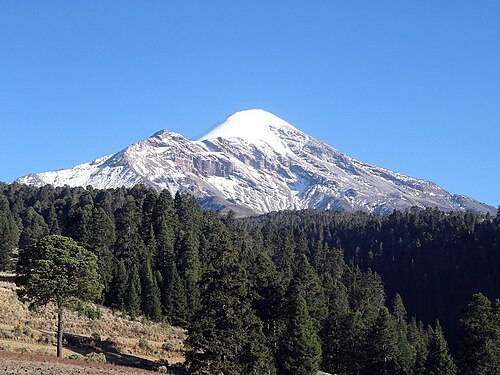
- Pico de Orizaba, 5,636 m
- Rivers, lakes and seas
- Rio Grande (Bravo), Usumacinta
- Climate
- Desert north, tropical south
- Coastline
- Has a sea coast
- Population density
- 67 people per km²
Wars and conflicts
- Spanish conquest 1519–21
- Mexican-American War
- Revolution 1910–20
- drug war 2006–present
Empires and states that once stood here
Maya civilisation c. 2000 BC–1697 ADOlmec civilisation c. 1600–350 BCAztec Empire 1428–1521
Alliances and memberships
Political unions and regional organisations
CELACOrganization of American States
Economy and trade
G20OECDOPEC (OPEC+ partner (not a member))CPTPPAPECUSMCAPacific Alliance
Mexico in depth
Detailed facts from the CIA World Factbook (public domain, latest edition).
Overview
- History in brief
- Mexico was the site of several advanced Amerindian civilizations -- including the Olmec, Toltec, Teotihuacan, Zapotec, Maya, and Aztec -- until Spain conquered and colonized the area in the early 16th century. Administered as the Viceroyalty of New Spain for three centuries, it achieved independence early in the 19th century. Elections held in 2000 marked the first time since Mexican Revolution in 1910 that an opposition candidate -- Vicente FOX of the National Action Party (PAN) -- defeated the party in government, the Institutional Revolutionary Party (PRI). He was succeeded in 2006 by another PAN candidate Felipe CALDERON, but Enrique PEÑA NIETO regained the presidency for the PRI in 2012. Left-leaning anti-establishment politician and former mayor of Mexico City (2000-05) Andrés Manuel LÓPEZ OBRADOR, from the National Regeneration Movement (MORENA), became president in 2018. The US-Mexico-Canada Agreement (USMCA, or T-MEC by its Spanish acronym) entered into force in 2020 and replaced its predecessor, the North American Free Trade Agreement (NAFTA). Mexico amended its constitution in 2019 to facilitate the implementation of the labor components of USMCA. Mexico is currently the US's second-largest goods trading partner, after Canada. Ongoing economic and social concerns include low real wages, high underemployment, inequitable income distribution, and few advancement opportunities, particularly for the largely indigenous population in the impoverished southern states. Since 2007, Mexico's powerful transnational criminal organizations have engaged in a struggle to control criminal markets, resulting in tens of thousands of drug-related homicides and forced disappearances.
Geography
- Location
- North America, bordering the Caribbean Sea and the Gulf of America, between Belize and the United States and bordering the North Pacific Ocean, between Guatemala and the United States
- Size compared
- slightly less than three times the size of Texas
- Land borders
- Total: 4,389 kmBorder countries: Belize 276 km; Guatemala 958 km; US 3,155 km
- Coastline
- 9,330 km
- Climate
- varies from tropical to desert
- Terrain
- high, rugged mountains; low coastal plains; high plateaus; desert
- Elevation
- Highest point: Volcan Pico de Orizaba 5,636 mLowest point: Laguna Salada -10 mMean elevation: 1,111 m
- Natural resources
- petroleum, silver, antimony, copper, gold, lead, zinc, natural gas, timber
- Major rivers
- Rio Grande river mouth (shared with US [s]) - 3,057 km; Colorado river mouth (shared with US [s]) - 2,333 kmNote: [s] after country name indicates river source; [m] after country name indicates river mouth
- Major lakes
- Fresh water lake(s): Laguna de Chapala - 1,140 sq kmSalt water lake(s): Laguna de Terminos - 1,550 sq km
- Natural hazards
- tsunamis along the Pacific coast; volcanoes and destructive earthquakes in the center and south; hurricanes on the Pacific, Gulf of America, and Caribbean coastsVolcanism: volcanic activity in the central-southern part of the country; the volcanoes in Baja California are mostly dormant; Colima (3,850 m) is Mexico's most active volcano and is responsible for periodic evacuations of nearby villagers; it has been deemed a Decade Volcano by the International Association of Volcanology and Chemistry of the Earth's Interior, worthy of study due to its explosive history and close proximity to human populations; Popocatepetl (5,426 m) poses a threat to Mexico City; other historically active volcanoes include Barcena, Ceboruco, El Chichon, Michoacan-Guanajuato, Pico de Orizaba, San Martin, Socorro, and Tacana; see note 2 under "Geography - note"
- Notes
- Note 1: strategic location on southern border of the US; Mexico is one of the countries along the Ring of Fire, which is a belt bordering the Pacific Ocean that contains about 75% of the world's volcanoes and up to 90% of the world's earthquakesNote 2: the Sac Actun cave system at 348 km (216 mi) is the longest underwater cave in the world and the second longest cave worldwide, after Mammoth Cave in the United States (see "Geography - note" under United States)Note 3: the prominent Yucatán Peninsula that divides the Gulf of America from the Caribbean Sea is shared by Mexico, Guatemala, and Belize; on the northern coast of Yucatan near the town of Chicxulub lie the remnants of a massive asteroid or comet crater about 150 km (93 mi) in diameter and extending into the Gulf of America; the impact is believed to have initiated a worldwide climate disruption that caused a mass extinction of 75% of the earth's plant and animal species, including the non-avian dinosaurs
- Environmental issues
- scarcity of hazardous waste disposal facilities; natural freshwater resources scarce and polluted in north, inaccessible and poor quality in center and extreme southeast; urban river pollution from raw sewage and industrial effluents; deforestation; widespread erosion; desertification; serious air and water pollution in urban areas; land subsidence in Valley of Mexico caused by groundwater depletion
People and society
- Population
- Total: 130,739,927 (2024 est.)Male: 63,899,138Female: 66,840,789
- Nationality
- Noun: Mexican(s)Adjective: Mexican
- Ethnic groups
- Mestizo (Indigenous-Spanish) 62%, predominantly Indigenous 21%, Indigenous 7%, other 10% (mostly European) (2012 est.)
- Languages
- Spanish only 93.8%, Spanish and indigenous languages (including Mayan, Nahuatl, and others) 5.4%, indigenous only 0.6%, unspecified 0.2% (2020 est.)Major-language sample(s): La Libreta Informativa del Mundo, la fuente indispensable de información básica. (Spanish)The World Factbook, the indispensable source for basic information.
- Religions
- Catholic 77.7%, no religion 10.6%, other Evangelical Churches 7.5%, Jehovah Witness 1.2%; less than 1 percent: Pentecostal, Seventh Day Adventist, Historics, not specified, Latter Day Saints, other religions (2020 est.)
- Median age
- Total: 31 years (2025 est.)Male: 28.8 yearsFemale: 32.7 years
- Population growth
- 0.81% (2025 est.)
- Life expectancy
- Total population: 74.6 years (2024 est.)Male: 71.6 yearsFemale: 77.7 years
- Children per woman
- 1.85 children born/woman (2025 est.)
- Urbanization
- Urban population: 81.6% of total population (2023)Rate of urbanization: 1.4% annual rate of change (2020-25 est.)
- Largest cities
- 22.281 million MEXICO CITY (capital), 5.420 million Guadalajara, 5.117 million Monterrey, 3.345 million Puebla, 2.626 million Toluca de Lerdo, 2.260 million Tijuana (2023)
- Literacy
- Total population: 95% (2020 est.)Male: 96% (2020 est.)Female: 94% (2020 est.)
- Years in school
- Total: 15 years (2022 est.)Male: 14 years (2022 est.)Female: 15 years (2022 est.)
Government
- Official names
- Conventional long form: United Mexican StatesConventional short form: MexicoLocal long form: Estados Unidos MexicanosLocal short form: MexicoFormer: Mexican Republic, Mexican EmpireEtymology: name may derive from one of the Nahuatl (Aztec) names for the capital city, Metztlixihtlico, which probably meant "the center of the moon;" alternatively, it may come from Mexica, the original name of the Aztec people
- Government type
- federal presidential republic
- Capital
- Name: Mexico City (Ciudad de Mexico)Geographic coordinates: 19 26 N, 99 08 WTime difference: UTC-6 (1 hour behind Washington, DC, during Standard Time)Daylight saving time: DST was permanently removed in October 2022Time zone note: Mexico has four time zonesEtymology: name may derive from one of the Nahuatl (Aztec) names for the capital city, Metztlixihtlico, which probably meant "the center of the moon;" alternatively, it may come from Mexica, the original name of the Aztec people
- Regions
- 32 states (estados, singular - estado); Aguascalientes, Baja California, Baja California Sur, Campeche, Chiapas, Chihuahua, Coahuila, Colima, Cuidad de Mexico, Durango, Guanajuato, Guerrero, Hidalgo, Jalisco, Mexico, Michoacán, Morelos, Nayarit, Nuevo Leon, Oaxaca, Puebla, Queretaro, Quintana Roo, San Luis Potosi, Sinaloa, Sonora, Tabasco, Tamaulipas, Tlaxcala, Veracruz, Yucatan, Zacatecas
- Independence
- 16 September 1810 (declared independence from Spain); 27 September 1821 (recognized by Spain)
- National holiday
- Independence Day, 16 September (1810)
- Constitution
- History: several previous; latest approved 5 February 1917Amendment process: proposed by the Congress of the Union; passage requires approval by at least two thirds of the members present and approval by a majority of the state legislatures
- Legal system
- civil law system with US constitutional law influence; judicial review of legislative acts
- Voting age
- 18 years of age; universal and compulsory
- Flag meaning
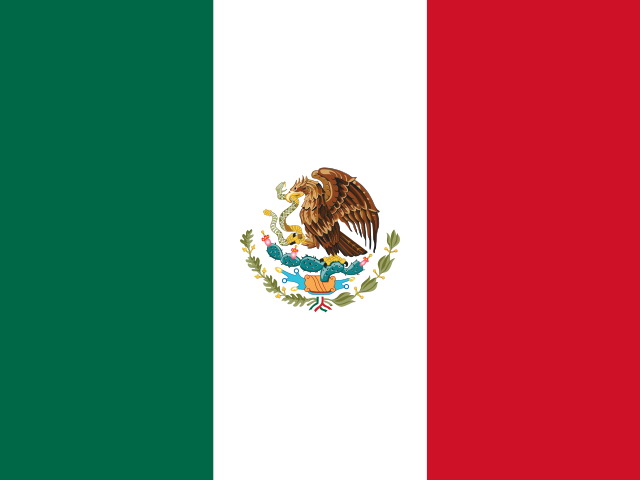
- Description: three equal vertical bands of green (left side), white, and red; Mexico's coat of arms (an eagle with a snake in its beak, perched on a cactus) is centered in the white bandMeaning: green stands for hope, joy, and love; white for peace and honesty; red for hardiness, bravery, strength, and valor
- National symbols
- golden eagle, dahlia
- National colours
- green, white, red
- National anthem
- Title: "Himno Nacional Mexicano" (National Anthem of Mexico)Lyrics/music: Francisco Gonzalez BOCANEGRA/Jaime Nuno ROCAHistory: adopted 1943
- UNESCO World Heritage Sites
- Total World Heritage Sites: 36 (28 cultural, 6 natural, 2 mixed)Selected World Heritage Site locales: Historic Mexico City (c); Earliest 16th-Century Monasteries on the Slopes of Popocatepetl (c); Teotihuacan (c); Whale Sanctuary of El Vizcaino (n); Monarch Butterfly Biosphere Reserve (n); Tehuacán-Cuicatlán Valley (m); Historic Puebla (c); El Tajin (c); Historic Tlacotalpan (c); Historic Oaxaca and Monte Albán (c); Palenque (c); Chichen-Itza (c); Uxmal (c); Wixárika Route through Sacred Sites to Wirikuta (Tatehuarí Huajuyé) (c)
Economy
- Overview
- upper-middle-income economy; highly integrated with US via trade and nearshore manufacturing; weak domestic demand, fiscal consolidation, and trade uncertainty contributing to sluggish growth; low unemployment; challenges from income inequality, corruption, and cartel-based violence
- GDP (PPP)
- $2.883 trillion (2024 est.)
- GDP per person (PPP)
- $22,000 (2024 est.)
- GDP growth
- 1.5% (2024 est.)
- Inflation
- 4.7% (2024 est.)
- Unemployment
- 2.8% (2024 est.)
- Below poverty line
- 36.3% (2022 est.)
- Farm products
- sugarcane, maize, milk, oranges, sorghum, tomatoes, chicken, chillies/peppers, wheat, lemons/limes (2023)
- Industries
- food and beverages, tobacco, chemicals, iron and steel, petroleum, mining, textiles, clothing, motor vehicles, consumer durables, tourism
- Exports
- $680.798 billion (2024 est.)
- Main exports
- cars, vehicle parts/accessories, crude petroleum, trucks, computers (2023)
- Export partners
- USA 76%, Canada 5%, China 2%, Germany 2%, Spain 1% (2023)
- Main imports
- vehicle parts/accessories, refined petroleum, integrated circuits, broadcasting equipment, cars (2023)
- Import partners
- USA 46%, China 20%, Germany 4%, Japan 3%, S. Korea 3% (2023)
- Money sent home from abroad
- 3.7% of GDP (2024 est.)
Energy, internet and transport
- Electricity access
- Electrification - total population: 100% (2022 est.)Electrification - urban areas: 99.8%Electrification - rural areas: 100%
- Electricity sources
- Fossil fuels: 79.6% of total installed capacity (2023 est.)Nuclear: 3.2% of total installed capacity (2023 est.)Solar: 4.2% of total installed capacity (2023 est.)Wind: 5.7% of total installed capacity (2023 est.)Hydroelectricity: 5.2% of total installed capacity (2023 est.)Geothermal: 1.1% of total installed capacity (2023 est.)Biomass and waste: 1% of total installed capacity (2023 est.)
- Internet users
- Percent of population: 81% (2023 est.)
- Mobile phones
- Total subscriptions: 140 million (2023 est.)Subscriptions per 100 inhabitants: 100 (2022 est.)
- TV and radio
- telecom reform in 2013 ended a quasi-monopoly; now 885 TV stations and 1,841 radio stations, most privately owned; foreign satellite and cable operators are available; completed transition to digital in 2016 (2022)
- Airports
- 1,580 (2025)
- Railways
- Total: 23,389 km (2017)Standard gauge: 23,389 km (2017) 1.435-m gauge (27 km electrified)
- Merchant ships
- Total: 674 (2023)By type: bulk carrier 4, general cargo 11, oil tanker 32, other 627
Military and space
- Armed forces
- the Mexican Armed Forces (Fuerzas Armadas de México) are divided between the Secretariat of National Defense and the Secretariat of the Navy:Secretariat of National Defense (Secretaria de Defensa Nacional, SEDENA): Army (Ejercito), Mexican Air Force (Fuerza Aerea Mexicana, FAM), National Guard (Guardia Nacional); Secretariat of the Navy (Secretaria de Marina, SEMAR): Mexican Navy (Armada de Mexico (ARM), includes Naval Air Force (FAN), Mexican Naval Infantry Corps (Cuerpo de Infanteria de Marina, Mexmar or CIM))Secretariat of Security and Civilian Protection/SEDENA: National Guard (2025)
- Military spending
- 0.9% of GDP (2024 est.)
- Military service
- 18 years of age (16 with parental consent) for voluntary service for men and women; men at age 18 subject to lottery-based 12-month compulsory military service (2025)
- Space programme
- has a national space policy with a focus on expanding Mexico's commercial space sector, including acquiring satellites and developing specialists, technologies, and infrastructure; manufactures and operates communications and scientific satellites; conducts research on a range of space-related capabilities and technologies, including astronomy, astrophysics, Earth and weather sciences, remote sensing, robotics, satellite payloads, and telecommunications; works with a variety of foreign space agencies and commercial space industries, including those of Argentina, Brazil, Chile, the ESA, individual ESA member states (particularly France, Germany, and the UK), India, Japan, Peru, Russia, Ukraine, and the US; led effort to establish the Latin American and Caribbean Space Agency and hosts its headquarters (2025)
- Space milestones
- 1962-1977 - sounding rocket program1985 - first Mexican in space on US Space Shuttle; first communications satellite (Morelos-1) built by US and released from the US Space Shuttle2015 - first successful launch of MEXSAT series of communications satellites by the US2021 - signed US-led Artemis Accords for space and lunar exploration2024 - contributed five autonomous micro-robots (Colmena project) on failed US commercial Moon lander mission
Global issues
- Refugees and displaced people
- Refugees: 417,546 (2024 est.)IDPs: 390,250 (2024 est.)Stateless persons: 13 (2024 est.)
- Drug trade
- USG identification: major illicit drug-producing and/or drug-transit countrymajor precursor-chemical producer (2025)
Neighbouring countries
- Phone code
- +52
- Internet domain
- .mx