Bhutan
Kingdom of Bhutan · འབྲུག་ཡུལ་
Unified in the 17th century by Zhabdrung Ngawang Namgyal. Absolute monarchy until the king introduced democracy in 2008. Carbon negative, with about 70% forest cover.
See Bhutan on the 3D globeTake a quiz
Population790 thousand
Area38,394 km²
CapitalThimphu
RegionSouthern Asia
Did you know?
- Tobacco sales are banned
- Television was only allowed in 1999
- Its constitution requires 60% forest cover forever
Key facts about Bhutan
- Government
- Constitutional monarchy
- Religion
- Vajrayana Buddhism ~75%, Hindu ~23%
- Founded / independence
- 1907 (Wangchuck dynasty)
- Rich in
- Hydropower sold to India, tourism; measures Gross National Happiness
- Languages
- Dzongkha
Dzongkha; Nepali (Lhotshampa), Sharchop - Currency
- Bhutanese ngultrum (Nu.), Indian rupee (₹)
- People are called
- Bhutanese
- Main cities
- Thimphu, Phuntsholing, Paro
Timeline of Bhutan
- 1616Zhabdrung unifies
- 1907Wangchuck monarchy
- 1971Joins UN
- 2008Becomes democracy
Places to see in Bhutan
- Paro Taktsang (Tiger's Nest) monastery
- Punakha Dzong
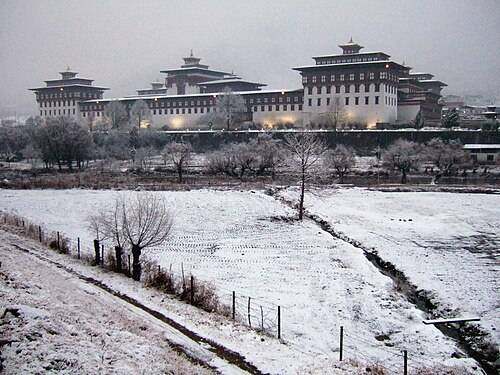
- Thimphu
- Dochula Pass
Food and drink
Ema datshi (chilli and cheese) · red rice · momos
Culture and famous for
Gross National Happiness; dzong fortresses; masked tsechu festivals
Popular sports
Archery (national sport)
Geography and climate
- Highest point
- Gangkhar Puensum, 7,570 m (world's highest unclimbed mountain)
- Rivers, lakes and seas
- Manas, Punatsang Chhu
- Climate
- Subtropical south, alpine north
- Coastline
- Landlocked
- Population density
- 21 people per km²
Wars and conflicts
- Duar War 1864–65
Alliances and memberships
Political unions and regional organisations
Bhutan in depth
Detailed facts from the CIA World Factbook (public domain, latest edition).
Overview
- History in brief
- After Britain’s victory in the 1865 Duar War, Britain and Bhutan signed the Treaty of Sinchulu, under which Bhutan would receive an annual subsidy in exchange for ceding land to British India. Ugyen WANGCHUCK -- who had served as the de facto ruler of an increasingly unified Bhutan and had improved relations with the British toward the end of the 19th century -- was named king in 1907. Three years later, a treaty was signed whereby the British agreed not to interfere in Bhutanese internal affairs, and Bhutan allowed Britain to direct its foreign affairs. Bhutan negotiated a similar arrangement with independent India in 1949. The Indo-Bhutanese Treaty of Friendship returned to Bhutan a small piece of the territory annexed by the British, formalized the annual subsidies the country received, and defined India's responsibilities in defense and foreign relations. Under a succession of modernizing monarchs beginning in the 1950s, Bhutan joined the UN in 1971 and slowly continued its engagement beyond its borders.In 2005, King Jigme Singye WANGCHUCK unveiled the draft of Bhutan's first constitution -- which introduced major democratic reforms -- and held a national referendum for its approval. The King abdicated the throne in 2006 in favor of his son, Jigme Khesar Namgyel WANGCHUCK. In 2007, India and Bhutan renegotiated their treaty, eliminating the clause that stated that Bhutan would be "guided by" India in conducting its foreign policy, although Thimphu continues to coordinate closely with New Delhi. In 2008, Bhutan held its first parliamentary election in accordance with the constitution. Bhutan experienced a peaceful turnover of power following a parliamentary election in 2013, which resulted in the defeat of the incumbent party. In 2018, the incumbent party again lost the parliamentary election. In 2024, of the more than 100,000 ethnic Nepali -- predominantly Lhotshampa -- refugees who fled or were forced out of Bhutan in the 1990s, about 6,500 remain displaced in Nepal.
Geography
- Location
- Southern Asia, between China and India
- Size compared
- slightly larger than Maryland; about one-half the size of Indiana
- Land borders
- Total: 1,136 kmBorder countries: China 477 km; India 659 km
- Coastline
- 0 km (landlocked)
- Climate
- varies; tropical in southern plains; cool winters and hot summers in central valleys; severe winters and cool summers in Himalayas
- Terrain
- mostly mountainous with some fertile valleys and savanna
- Elevation
- Highest point: Gangkar Puensum 7,570 mLowest point: Drangeme Chhu 97 mMean elevation: 2,220 m
- Natural resources
- timber, hydropower, gypsum, calcium carbonate
- Natural hazards
- violent storms from the Himalayas are the source of the country's Bhutanese name, which translates as Land of the Thunder Dragon; frequent landslides during the rainy season
- Notes
- landlocked; strategic location between China and India; controls several key Himalayan mountain passes
- Environmental issues
- soil erosion; limited access to potable water; wildlife conservation; industrial pollution; waste disposal
People and society
- Population
- Total: 892,877 (2025 est.)Male: 461,679Female: 431,198
- Nationality
- Noun: Bhutanese (singular and plural)Adjective: Bhutanese
- Ethnic groups
- Ngalop (also known as Bhote) 50%, ethnic Nepali 35% (predominantly Lhotshampas), indigenous or migrant tribes 15%
- Languages
- Sharchopkha 28%, Dzongkha (official) 24%, Lhotshamkha 22%, other 26% (includes foreign languages) (2005 est.)
- Religions
- Lamaistic Buddhist 75.3%, Indian- and Nepali-influenced Hinduism 22.1%, other 2.6% (2005 est.)
- Median age
- Total: 31.2 years (2025 est.)Male: 31.1 yearsFemale: 30.3 years
- Population growth
- 0.93% (2025 est.)
- Life expectancy
- Total population: 73.7 years (2024 est.)Male: 72.5 yearsFemale: 75 years
- Children per woman
- 1.75 children born/woman (2025 est.)
- Urbanization
- Urban population: 44.4% of total population (2023)Rate of urbanization: 2.52% annual rate of change (2020-25 est.)
- Largest cities
- 203,000 THIMPHU (capital) (2018)
- Literacy
- Total population: 64.9% (2022 est.)Male: 73.4% (2022 est.)Female: 57% (2022 est.)
- Years in school
- Total: 13 years (2022 est.)Male: 12 years (2022 est.)Female: 14 years (2022 est.)
Government
- Official names
- Conventional long form: Kingdom of BhutanConventional short form: BhutanLocal long form: Druk GyalkhapLocal short form: Druk YulEtymology: name may derive from the Sanskrit words bhoṭa, the name for Tibet, and anta, meaning "end" -- a reference to Bhutan's location at the southernmost end of Tibet; the local Dzongkha name Druk Yul means "Land of the Dragon"
- Government type
- constitutional monarchy
- Capital
- Name: ThimphuGeographic coordinates: 27 28 N, 89 38 ETime difference: UTC+6 (11 hours ahead of Washington, DC, during Standard Time)Etymology: the origins of the name are unclear; the traditional explanation, dating to the 14th century, is that thim means "dissolve" and phu means "rock," in reference to a local deity who dissolved before a traveler's eyes, becoming a part of the rock on which the present city stands
- Regions
- 20 districts (dzongkhag, singular and plural); Bumthang, Chhukha, Dagana, Gasa, Haa, Lhuentse, Mongar, Paro, Pemagatshel, Punakha, Samdrup Jongkhar, Samtse, Sarpang, Thimphu, Trashigang, Trashi Yangtse, Trongsa, Tsirang, Wangdue Phodrang, Zhemgang
- Independence
- 17 December 1907 (became a unified kingdom under its first hereditary king); 8 August 1949 (Treaty of Friendship with India maintains Bhutanese independence)
- National holiday
- National Day (Ugyen WANGCHUCK became first hereditary king), 17 December (1907)
- Constitution
- History: previous governing documents were various royal decrees; first constitution drafted November 2001 to March 2005, ratified 18 July 2008Amendment process: proposed as a motion by simple majority vote in a joint session of Parliament; passage requires at least a three-fourths majority vote in a joint session of the next Parliament and assent by the king
- Legal system
- civil law based on Buddhist religious law
- Voting age
- 18 years of age; universal
- Flag meaning
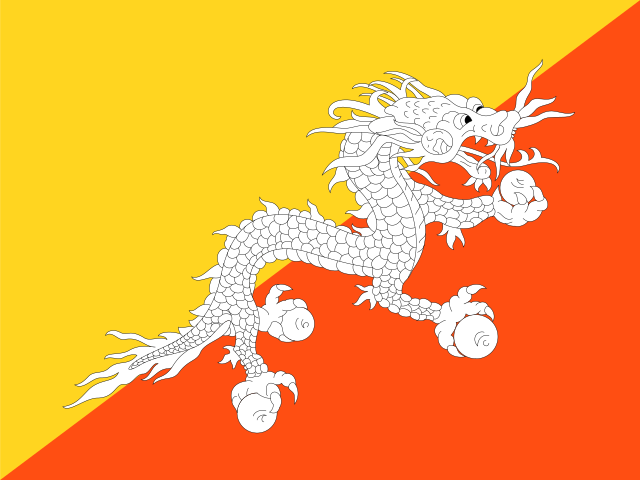
- Description: divided diagonally from the lower-left corner to the upper-right corner; the upper triangle is yellow, and the lower triangle is dark orange; centered along the dividing line is a large, stylized black-and-white dragon facing to the right; the dragon is called the Druk (Thunder Dragon) and is the national emblemMeaning: white stands for purity, and the jewels in the dragon's claws symbolize wealth; the background colors represent the spiritual and secular powers in Bhutan, with orange standing for Buddhism and yellow for the ruling dynasty
- National symbols
- mythical thunder dragon (druk)
- National colours
- orange, yellow
- National anthem
- Title: "Druk tsendhen" (The Thunder Dragon Kingdom)Lyrics/music: Gyaldun Dasho Thinley DORJI/Aku TONGMIHistory: adopted 1953
Economy
- Overview
- hydropower investments spurring economic development; Gross National Happiness economy; sharp poverty declines; low inflation; strong monetary and fiscal policies; stable currency; fairly resilient response to COVID-19; key economic and strategic relations with India; climate vulnerabilities
- GDP (PPP)
- $11.517 billion (2023 est.)
- GDP per person (PPP)
- $14,600 (2023 est.)
- GDP growth
- 4.9% (2023 est.)
- Inflation
- 2.8% (2024 est.)
- Unemployment
- 2.9% (2024 est.)
- Below poverty line
- 12.4% (2022 est.)
- Farm products
- rice, milk, potatoes, root vegetables, maize, oranges, areca nuts, chillies/peppers, pumpkins/squash, carrots/turnips (2023)
- Industries
- cement, wood products, processed fruits, alcoholic beverages, calcium carbide, tourism
- Exports
- $944.391 million (2024 est.)
- Main exports
- iron alloys, aircraft, dolomite, semi-finished iron, cement (2023)
- Export partners
- India 92%, Italy 4%, Indonesia 1%, China 1%, Singapore 0% (2023)
- Main imports
- refined petroleum, gold, plastics, broadcasting equipment, iron reductions (2023)
- Import partners
- India 82%, Singapore 8%, China 5%, Thailand 2%, Indonesia 1% (2023)
- Money sent home from abroad
- 3.6% of GDP (2023 est.)
Energy, internet and transport
- Electricity access
- Electrification - total population: 100% (2022 est.)
- Electricity sources
- Hydroelectricity: 100% of total installed capacity (2023 est.)
- Internet users
- Percent of population: 88% (2023 est.)
- Mobile phones
- Total subscriptions: 790,000 (2024 est.)Subscriptions per 100 inhabitants: 100 (2024 est.)
- TV and radio
- state-owned TV station established in 1999; cable TV service offers dozens of Indian and other international channels; first radio station, privately launched in 1973, is now state-owned; 5 private radio stations are currently broadcasting (2012)
- Airports
- 4 (2025)
Military and space
- Armed forces
- Royal Bhutan Army (RBA; includes Royal Bodyguard of Bhutan, or RBG, and an air wing); National MilitiaMinistry of Home and Cultural Affairs: Royal Bhutan Police (2025)
- Military service
- 18 years of age for voluntary military service for men and women; militia training is compulsory for men aged 20-25 over a 3-year period (2025)
Global issues
- Refugees and displaced people
- IDPs: 138 (2024 est.)
Neighbouring countries
- Phone code
- +975
- Internet domain
- .bt