Burundi
Republic of Burundi · Uburundi
An ancient Tutsi-led kingdom, colonised by Germany and Belgium. Hutu–Tutsi violence killed hundreds of thousands.
See Burundi on the 3D globeTake a quiz
Population14 million
Area27,834 km²
CapitalGitega
RegionEastern Africa
Did you know?
- One of the claimed southernmost sources of the Nile is here
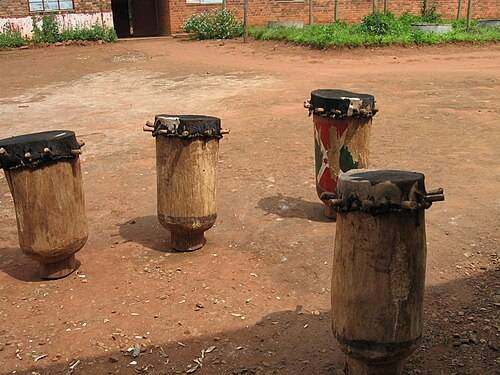
- Its drummers are world-famous
- Among the most densely populated countries in Africa
Key facts about Burundi
- Government
- Presidential republic
- Religion
- Christian ~93%
- Founded / independence
- 1962 (from Belgium)
- Rich in
- Coffee, tea; among the poorest countries
- Languages
- French, Kirundi
Kirundi, French, English - Currency
- Burundian franc (Fr)
- People are called
- Burundian
- Main cities
- Gitega, Bujumbura, Ngozi
Timeline of Burundi
- 1680Kingdom of Burundi
- 1890German rule
- 1916Belgian rule
- 1962Independence
- 1993Civil war
- 2005Peace
Places to see in Burundi
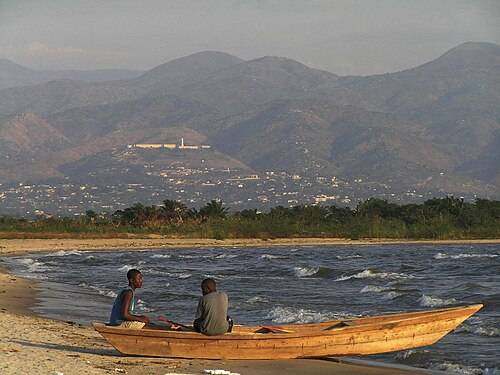
- Lake Tanganyika beaches
- Kibira National Park
- Gishora drum sanctuary
- Karera Falls
Food and drink
Beans and plantains · ugali · brochettes
Culture and famous for
Royal drummers of Burundi (UNESCO)
Popular sports
Football, athletics, running
Geography and climate
- Highest point
- Mount Heha, 2,684 m
- Rivers, lakes and seas
- Lake Tanganyika; source of the Nile (Ruvyironza)
- Climate
- Tropical highland
- Coastline
- Landlocked
- Population density
- 503 people per km²
Wars and conflicts
- Civil War 1993–2005
- ethnic killings 1972
Alliances and memberships
Political unions and regional organisations
African UnionEast African Community
Burundi in depth
Detailed facts from the CIA World Factbook (public domain, latest edition).
Overview
- History in brief
- Established in the 1600s, the Burundi Kingdom has had borders similar to those of modern Burundi since the 1800s. Burundi’s two major ethnic groups, the majority Hutu and minority Tutsi, share a common language and culture and largely lived in peaceful cohabitation under Tutsi monarchs in pre-colonial Burundi. Regional, class, and clan distinctions contributed to social status in the Burundi Kingdom, yielding a complex class structure. German colonial rule in the late 19th and early 20th centuries and Belgian rule after World War I preserved Burundi’s monarchy. Seeking to simplify administration, Belgian colonial officials reduced the number of chiefdoms and eliminated most Hutu chiefs from positions of power. In 1961, the Burundian Tutsi king’s oldest son, Louis RWAGASORE, was murdered by a competing political faction shortly before he was set to become prime minister, triggering increased political competition that contributed to later instability.Burundi gained its independence from Belgium in 1962 as the Kingdom of Burundi. Revolution in neighboring Rwanda stoked ethnic polarization as the Tutsi increasingly feared violence and loss of political power. A failed Hutu-led coup in 1965 triggered a purge of Hutu officials and set the stage for Tutsi officers to overthrow the monarchy in 1966 and establish a Tutsi-dominated republic. A Hutu rebellion in 1972 resulted in the deaths of several thousand Tutsi civilians and sparked brutal Tutsi-led military reprisals against Hutu civilians which ultimately killed 100,000-200,000 people. International pressure led to a new constitution in 1992 and democratic elections in 1993. Tutsi military officers feared Hutu domination and assassinated Burundi's first democratically elected president, Hutu Melchior NDADAYE, in 1993 after only 100 days in office, sparking a civil war. In 1994, his successor, Cyprien NTARYAMIRA, died when the Rwandan president’s plane he was traveling on was shot down, which triggered the Rwandan genocide and further entrenched ethnic conflict in Burundi. The internationally brokered Arusha Agreement, signed in 2000, and subsequent cease-fire agreements with armed movements ended the 1993-2005 civil war. Burundi’s second democratic elections were held in 2005, resulting in the election of Pierre NKURUNZIZA as president. He was reelected in 2010 and again in 2015 after a controversial court decision allowed him to circumvent a term limit. President Evariste NDAYISHIMIYE -- from NKURUNZIZA’s ru
Geography
- Location
- Central Africa, east of the Democratic Republic of the Congo, west of Tanzania
- Size compared
- slightly smaller than Maryland
- Land borders
- Total: 1,140 kmBorder countries: Democratic Republic of the Congo 236 km; Rwanda 315 km; Tanzania 589 km
- Coastline
- 0 km (landlocked)
- Climate
- equatorial; high plateau with considerable altitude variation (772 m to 2,670 m above sea level); average annual temperature varies with altitude from 23 to 17 degrees Celsius but is generally moderate; average annual rainfall is about 150 cm with two wet seasons (February to May and September to November) and two dry seasons (June to August and December to January)
- Terrain
- hilly and mountainous, dropping to a plateau in east, some plains
- Elevation
- Highest point: unnamed elevation on Mukike Range 2,685 mLowest point: Lake Tanganyika 772 mMean elevation: 1,504 m
- Natural resources
- nickel, uranium, rare earth oxides, peat, cobalt, copper, platinum, vanadium, arable land, hydropower, niobium, tantalum, gold, tin, tungsten, kaolin, limestone
- Major lakes
- Fresh water lake(s): Lake Tanganyika (shared with Democratic Republic of Congo, Tanzania, and Zambia) - 32,000 sq km
- Natural hazards
- flooding; landslides; drought
- Notes
- landlocked; straddles crest of the Nile-Congo watershed; the Kagera, which drains into Lake Victoria, is the most remote headstream of the White Nile
- Environmental issues
- soil erosion from overgrazing and agricultural expansion; deforestation; wildlife habitat loss
People and society
- Population
- Total: 13,590,102 (2024 est.)Male: 6,755,456Female: 6,834,646
- Nationality
- Noun: Burundian(s)Adjective: Burundian
- Ethnic groups
- Hutu, Tutsi, Twa, South Asian
- Languages
- Kirundi (official), French (official), English (official, least spoken), Swahili (2008 est.)Major-language sample(s): Igitabo Mpuzamakungu c'ibimenyetso bifatika, isoko ntabanduka ku nkuru z'urufatiro. (Kirundi)The World Factbook, the indispensable source for basic information.
- Religions
- Christian 93.9% (Roman Catholic 58.6%, Protestant 35.3% [includes Adventist 2.7% and other Protestant religions 32.6%]), Muslim 3.4%, other 1.3%, none 1.3% (2016-17 est.)
- Median age
- Total: 17.6 years (2025 est.)Male: 18 yearsFemale: 18.7 years
- Population growth
- 2.96% (2025 est.)
- Life expectancy
- Total population: 68.1 years (2024 est.)Male: 66 yearsFemale: 70.3 years
- Children per woman
- 4.94 children born/woman (2025 est.)
- Urbanization
- Urban population: 14.8% of total population (2023)Rate of urbanization: 5.43% annual rate of change (2020-25 est.)
- Largest cities
- 1.207 million BUJUMBURA (capital) (2023)
- Literacy
- Total population: 71.4% (2020 est.)Male: 78.2% (2020 est.)Female: 66.2% (2020 est.)
- Years in school
- Total: 10 years (2018 est.)Male: 10 years (2018 est.)Female: 10 years (2018 est.)
Government
- Official names
- Conventional long form: Republic of BurundiConventional short form: BurundiLocal long form: République du Burundi (French)/ Republika y'u Burundi (Kirundi)Local short form: BurundiFormer: Urundi, German East Africa, Ruanda-Urundi, Kingdom of BurundiEtymology: name dates from 1966 and is derived from the name of the local Bantu people, the Rundi or Barundi; ba- is the prefix for the people, and bu- is the prefix for the country; the former name, Urundi, is the Swahili version
- Government type
- presidential republic
- Capital
- Name: Gitega (political capital), Bujumbura (commercial capital)Geographic coordinates: 3 25 S, 29 55 ETime difference: UTC+2 (7 hours ahead of Washington, DC, during Standard Time)Etymology: the origin of the name Bujumbura is unclear, but "bu-" is a Bantu prefix meaning "place"
- Regions
- 5 provinces: Buhumuza, Bujumbura, Burunga, Butanyerera, Gitega
- Independence
- 1 July 1962 (from UN trusteeship under Belgian administration)
- National holiday
- Independence Day, 1 July (1962)
- Constitution
- History: several previous, ratified by referendum 28 February 2005Amendment process: proposed by the president of the republic after consultation with the government or by absolute majority support of the membership in both houses of Parliament; passage requires at least two-thirds majority vote by the Senate membership and at least four-fifths majority vote by the National Assembly; the president can opt to submit amendment bills to a referendum; constitutional articles including those on national unity, the secularity of Burundi, its democratic form of government, and its sovereignty cannot be amended
- Legal system
- mixed legal system of Belgian civil law and customary law
- Voting age
- 18 years of age; universal
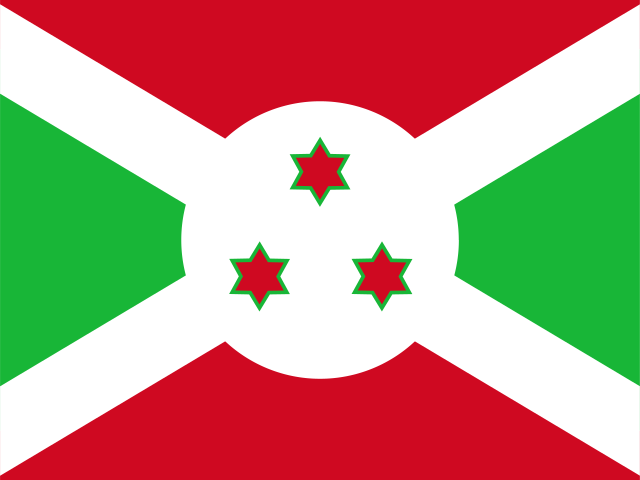
- Flag meaning
- Description: divided by a white diagonal cross into red triangles (top and bottom) and green triangles (on each side) with a white disk at the center bearing three six-pointed red stars outlined in green and arranged in a triangular designMeaning: green stands for hope and optimism, white for purity and peace, and red for the blood shed in the struggle for independence; the three stars represent the major ethnic groups (Hutu, Twa, Tutsi), as well as unity, work, and progress
- National symbols
- lion
- National colours
- red, white, green
- National anthem
- Title: "Burundi Bwacu" (Our Beloved Burundi)Lyrics/music: Jean-Baptiste NTAHOKAJA/Marc BARENGAYABOHistory: adopted 1962
Economy
- Overview
- highly agrarian, low-income Sub-Saharan economy; declining foreign assistance; increasing fiscal insolvencies; dense and still growing population; COVID-19 weakened economic recovery and flipped two years of deflation
- GDP (PPP)
- $11.739 billion (2024 est.)
- GDP per person (PPP)
- $800 (2024 est.)
- GDP growth
- 3.5% (2024 est.)
- Inflation
- 20.2% (2024 est.)
- Unemployment
- 1% (2024 est.)
- Below poverty line
- 51% (2020 est.)
- Farm products
- cassava, bananas, sweet potatoes, beans, maize, vegetables, potatoes, rice, sugarcane, fruits (2023)
- Industries
- light consumer goods (sugar, shoes, soap, beer); cement, assembly of imported components; public works construction; food processing (fruits)
- Exports
- $378.229 million (2023 est.)
- Main exports
- gold, coffee, tea, tin ores, iron bars (2023)
- Export partners
- UAE 59%, Uganda 8%, China 5%, Germany 5%, USA 3% (2023)
- Main imports
- fertilizers, cement, packaged medicine, plastic products, cars (2023)
- Import partners
- Tanzania 26%, China 15%, Uganda 10%, Kenya 10%, India 6% (2023)
- Money sent home from abroad
- 7.5% of GDP (2023 est.)
Energy, internet and transport
- Electricity access
- Electrification - total population: 10.3% (2022 est.)Electrification - urban areas: 64%Electrification - rural areas: 1.7%
- Electricity sources
- Fossil fuels: 31.2% of total installed capacity (2023 est.)Solar: 0.5% of total installed capacity (2023 est.)Hydroelectricity: 66.7% of total installed capacity (2023 est.)Biomass and waste: 1.6% of total installed capacity (2023 est.)
- Internet users
- Percent of population: 11% (2023 est.)
- Mobile phones
- Total subscriptions: 8,646,690 (2023 est.)Subscriptions per 100 inhabitants: 63 (2023 est.)
- TV and radio
- state-controlled Radio Television Nationale de Burundi (RTNB) operates a TV station and a national radio network; 3 private TV stations and about 10 privately owned radio stations; transmissions of several international broadcasters are available in Bujumbura (2019)
- Airports
- 6 (2025)
Military and space
- Armed forces
- Burundi National Defense Force (BNDF; Force de Defense Nationale du Burundi, FDNB): Land Force (Army), Naval Force, Air Force, Specialized UnitsMinistry of Interior, Community Development, and Public Security: Burundi National Police (Police Nationale du Burundi, PNB) (2024)
- Military spending
- 3.5% of GDP (2024 est.)
- Military service
- 18 years of age for voluntary military service for men and women (2025)
Global issues
- Refugees and displaced people
- Refugees: 91,164 (2024 est.)IDPs: 92,174 (2024 est.)Stateless persons: 791 (2024 est.)
Neighbouring countries
- Phone code
- +257
- Internet domain
- .bi