Tanzania
United Republic of Tanzania
Swahili city-states and Omani-ruled Zanzibar traded across the Indian Ocean. German then British rule; united with Zanzibar in 1964.
See Tanzania on the 3D globeTake a quiz
Population69 million
Area945,087 km²
CapitalDodoma
RegionEastern Africa
Did you know?
- Kilimanjaro is the world's tallest free-standing mountain
- Olduvai Gorge is a key site of human evolution
- Lake Tanganyika is the world's second-deepest lake
Key facts about Tanzania
- Government
- Presidential republic (dominant party)
- Religion
- Christian ~63%, Islam ~34% (Zanzibar ~99%)
- Founded / independence
- 1961/1964 (union of Tanganyika and Zanzibar)
- Rich in
- Gold, tourism (Kilimanjaro, Serengeti), gas, agriculture
- Languages
- English, Swahili
Swahili and English; over 120 languages - Currency
- Tanzanian shilling (Sh)
- People are called
- Tanzanian
- Main cities
- Dar es Salaam, Mwanza, Arusha, Dodoma, Zanzibar City
Timeline of Tanzania
- 1498Portuguese arrive
- 1840Omani capital moves to Zanzibar
- 1885German East Africa
- 1961Independence
- 1964Union with Zanzibar
Places to see in Tanzania
- Mount Kilimanjaro
- Serengeti
- Ngorongoro Crater
- Zanzibar's Stone Town
- Selous (Nyerere) park
- Lake Victoria
Food and drink
Ugali · pilau · nyama choma · Zanzibar pizza
Culture and famous for
Swahili language and culture; Tingatinga painting; Freddie Mercury born in Zanzibar
Popular sports
Football, running
Geography and climate
- Highest point
- Mount Kilimanjaro, 5,895 m (Africa's highest)
- Rivers, lakes and seas
- Lake Victoria, Lake Tanganyika, Lake Nyasa
- Climate
- Tropical
- Coastline
- Has a sea coast
- Population density
- 73 people per km²
Wars and conflicts
- Maji Maji rebellion 1905–07
- Uganda-Tanzania War 1978–79
- post-election violence 2025
Empires and states that once stood here
Sultanate of Zanzibar 1856–1964
Alliances and memberships
Political unions and regional organisations
African UnionSADCEast African CommunityCommonwealth of Nations
Tanzania in depth
Detailed facts from the CIA World Factbook (public domain, latest edition).
Overview
- History in brief
- Tanzania contains some of Africa’s most iconic national parks and famous paleoanthropological sites, and its diverse cultural heritage reflects the multiple ethnolinguistic groups that live in the country. Its long history of integration into trade networks spanning the Indian Ocean and the African interior led to the development of Swahili as a common language in much of east Africa and the introduction of Islam into the region. A number of independent coastal and island trading posts in what is now Tanzania came under Portuguese control after 1498 when they began to take control of much of the coast and Indian Ocean trade. By 1700, the Sultanate of Oman had become the dominant power in the region after ousting the Portuguese, who were also facing a series of local uprisings. During the next hundred years, Zanzibar -- an archipelago off the coast that is now part of Tanzania -- became a hub of Indian Ocean trade, with Arab and Indian traders establishing and consolidating trade routes with communities in mainland Tanzania that contributed to the expansion of the slave trade. Zanzibar briefly became the capital of the Sultanate of Oman before it split into separate Omani and Zanzibar Sultanates in 1856. Beginning in the mid-1800s, European explorers, traders, and Christian missionaries became more active in the region. The Germans eventually established control over mainland Tanzania -- which they called Tanganyika -- and the British established control over Zanzibar. Tanganyika came under British administration after the German defeat in World War I. Tanganyika gained independence from Great Britain in 1961, and Zanzibar followed in 1963 as a constitutional monarchy. In Tanganyika, Julius NYERERE, a charismatic and idealistic socialist, established a one-party political system that centralized power and encouraged national self-reliance and rural development. In 1964, a popular uprising overthrew the Sultan in Zanzibar and either killed or expelled many of the Arabs and Indians who had dominated the isles for more than 200 years. Later that year, Tanganyika and Zanzibar combined to form the United Republic of Tanzania, but Zanzibar retained considerable autonomy. Their two ruling parties combined to form the Chama Cha Mapinduzi (CCM) party in 1977, which has since won every presidential election. Tanzania held its first multi-party elections in 1995, but CCM candidates have continued to dominate politics. The ruling party has claimed victory in four conte
Geography
- Location
- Eastern Africa, bordering the Indian Ocean, between Kenya and Mozambique
- Size compared
- more than six times the size of Georgia; slightly larger than twice the size of California
- Land borders
- Total: 4,161 kmBorder countries: Burundi 589 km; Democratic Republic of the Congo 479 km; Kenya 775 km; Malawi 512 km; Mozambique 840 km; Rwanda 222 km; Uganda 391 km; Zambia 353 km
- Coastline
- 1,424 km
- Climate
- varies from tropical along coast to temperate in highlands
- Terrain
- plains along coast; central plateau; highlands in north, south
- Elevation
- Highest point: Kilimanjaro (highest point in Africa) 5,895 mLowest point: Indian Ocean 0 mMean elevation: 1,018 m
- Natural resources
- hydropower, tin, phosphates, iron ore, coal, diamonds, gemstones (including tanzanite, found only in Tanzania), gold, natural gas, nickel
- Major rivers
- Nile (shared with Rwanda [s], Uganda, South Sudan, Sudan, and Egypt [m]) - 6,650 kmNote: [s] after country name indicates river source; [m] after country name indicates river mouth
- Major lakes
- Fresh water lake(s): Lake Victoria (shared with Uganda and Kenya) - 62,940 sq km; Lake Tanganyika (shared with Democratic Republic of Congo, Burundi, and Zambia) - 32,000 sq km; Lake Malawi (shared with Mozambique and Malawi) - 22,490Salt water lake(s): Lake Rukwa - 5,760 sq km
- Natural hazards
- flooding on the central plateau during the rainy season; droughtVolcanism: limited volcanic activity; Ol Doinyo Lengai (2,962 m) has emitted lava in recent years; other historically active volcanoes include Kieyo and Meru
- Notes
- Kilimanjaro is the highest point in Africa and one of only three mountain ranges on the continent that has glaciers (the others are Mount Kenya in Kenya and the Ruwenzori Mountains on the Uganda-Democratic Republic of the Congo border); Tanzania is bordered by three of the largest lakes on the continent: Lake Victoria (the world's second-largest freshwater lake) in the north, Lake Tanganyika (the world's second-deepest) in the west, and Lake Nyasa (Lake Malawi) in the southwest
- Environmental issues
- water pollution; improper management of liquid waste; indoor air pollution from burning wood or charcoal for cooking and heating; soil degradation; deforestation; desertification; coral reef destruction; illegal hunting and animal trade, especially ivory; loss of biodiversity; solid waste disposal
People and society
- Population
- Total: 69,145,464 (2025 est.)Male: 34,597,449Female: 34,548,015
- Nationality
- Noun: Tanzanian(s)Adjective: Tanzanian
- Ethnic groups
- mainland - African 99% (of which 95% are Bantu consisting of more than 130 tribes), other 1% (consisting of Asian, European, and Arab); Zanzibar - Arab, African, mixed Arab and African
- Languages
- Kiswahili or Swahili (official), Kiunguja (name for Swahili in Zanzibar), English (official, primary language of commerce, administration, and higher education), Arabic, many local languagesMajor-language sample(s): The World Factbook, Chanzo cha Lazima Kuhusu Habari ya Msingi. (Kiswahili)The World Factbook, the indispensable source for basic information.
- Religions
- Christian 63.1%, Muslim 34.1%, folk religion 1.1%, Buddhist <1%, Hindu <1%, Jewish <1%, other <1%, unspecified 1.6% (2020 est.)
- Median age
- Total: 18.8 years (2025 est.)Male: 18.8 yearsFemale: 19.4 years
- Population growth
- 2.85% (2025 est.)
- Life expectancy
- Total population: 70.8 years (2024 est.)Male: 69 yearsFemale: 72.6 years
- Children per woman
- 4.45 children born/woman (2025 est.)
- Urbanization
- Urban population: 37.4% of total population (2023)Rate of urbanization: 4.89% annual rate of change (2020-25 est.)
- Largest cities
- 262,000 Dodoma (legislative capital) (2018), 7.776 million DAR ES SALAAM (administrative capital), 1.311 million Mwanza, 800,000 Zanzibar (2023)
- Literacy
- Total population: 78.2% (2022 est.)Male: 84.2% (2022 est.)Female: 73.1% (2022 est.)
- Years in school
- Total: 9 years (2021 est.)Male: 9 years (2021 est.)Female: 9 years (2021 est.)
Government
- Official names
- Conventional long form: United Republic of TanzaniaConventional short form: TanzaniaLocal long form: Jamhuri ya Muungano wa TanzaniaLocal short form: TanzaniaFormer: German East Africa, Trust Territory of Tanganyika, Republic of Tanganyika, People's Republic of Zanzibar, United Republic of Tanganyika and ZanzibarEtymology: the country's name is a combination of the first letters of Tanganyika and Zanzibar, the two states that merged to form Tanzania in 1964
- Government type
- presidential republic
- Capital
- Name: DodomaGeographic coordinates: 6 48 S, 39 17 ETime difference: UTC+3 (8 hours ahead of Washington, DC, during Standard Time)Etymology: the name comes from the name of a nearby mountain; the origin of the mountain's name is unclear
- Regions
- 31 regions; Arusha, Dar es Salaam, Dodoma, Geita, Iringa, Kagera, Kaskazini Pemba (Pemba North), Kaskazini Unguja (Zanzibar North), Katavi, Kigoma, Kilimanjaro, Kusini Pemba (Pemba South), Kusini Unguja (Zanzibar Central/South), Lindi, Manyara, Mara, Mbeya, Mjini Magharibi (Zanzibar Urban/West), Morogoro, Mtwara, Mwanza, Njombe, Pwani (Coast), Rukwa, Ruvuma, Shinyanga, Simiyu, Singida, Songwe, Tabora, Tanga
- Independence
- 26 April 1964 (Tanganyika united with Zanzibar to form the United Republic of Tanganyika and Zanzibar); 29 October 1964 (renamed United Republic of Tanzania); notable earlier dates: 9 December 1961 (Tanganyika became independent from UK-administered UN trusteeship); 10 December 1963 (Zanzibar became independent from UK)
- National holiday
- Union Day (Tanganyika and Zanzibar), 26 April (1964)
- Constitution
- History: several previous; latest adopted 25 April 1977Amendment process: proposed by the National Assembly; passage of amendments to constitutional articles including those on sovereignty of the United Republic, the authorities and powers of the government, the president, the Assembly, and the High Court requires two-thirds majority vote of the mainland Assembly membership and of the Zanzibar House of Representatives membership; House of Representatives approval of other amendments is not required
- Legal system
- English common law; judicial review of legislative acts limited to matters of interpretation
- Voting age
- 18 years of age; universal
- Flag meaning
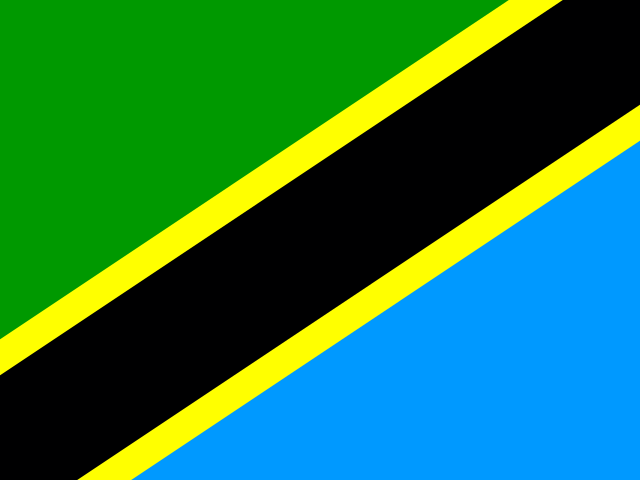
- Description: divided diagonally by a yellow-edged black band, from the lower left corner to the upper right corner; the upper triangle (left side) is green, and the lower is blueMeaning: colors come from the flags of Tanganyika and Zanzibar; green stands for natural vegetation, gold for rich mineral deposits, black for the Swahili people, and blue for lakes and rivers, as well as the Indian Ocean
- National symbols
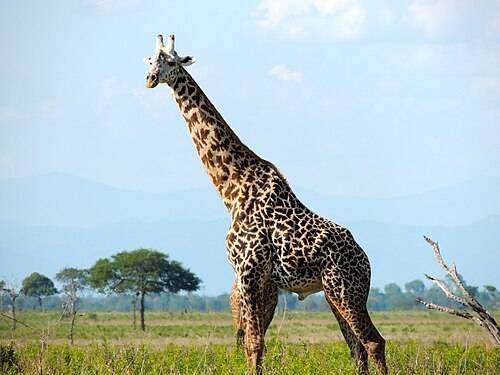
- Uhuru (freedom) torch, giraffe
- National colours
- green, yellow, blue, black
- National anthem
- Title: "Mungu ibariki Afrika" (God Bless Africa)Lyrics/music: collective/Enoch Mankayi SONTONGAHistory: adopted 1961; the anthem, which is also a popular African popular song in Africa, shares the melody of Zambia's anthem and is part of South Africa's anthem
- UNESCO World Heritage Sites
- Total World Heritage Sites: 7 (3 cultural, 3 natural, 1 mixed)Selected World Heritage Site locales: Ngorongoro Conservation Area (m); Ruins of Kilwa Kisiwani and Songo Mnara (c); Serengeti National Park (n); Selous Game Reserve (n); Kilimanjaro National Park (n); Stone Town of Zanzibar (c); Kondoa Rock-Art Sites (c)
Economy
- Overview
- emerging lower middle-income East African economy; resource-rich and growing tourism; strong post-pandemic recovery from hospitality, electricity, mining, and transit sectors; declining poverty; stable inflation; gender-based violence economic and labor force disruptions
- GDP (PPP)
- $246.706 billion (2024 est.)
- GDP per person (PPP)
- $3,700 (2024 est.)
- GDP growth
- 5.5% (2024 est.)
- Inflation
- 3.1% (2024 est.)
- Unemployment
- 2.6% (2024 est.)
- Below poverty line
- 26.4% (2018 est.)
- Farm products
- maize, cassava, sweet potatoes, bananas, milk, sugarcane, rice, vegetables, beans, sunflower seeds (2023)
- Industries
- agricultural processing (sugar, beer, cigarettes, sisal twine); mining (diamonds, gold, and iron), salt, soda ash; cement, oil refining, shoes, apparel, wood products, fertilizer
- Exports
- $13.98 billion (2023 est.)
- Main exports
- gold, refined petroleum, dried legumes, refined copper, coal (2023)
- Export partners
- India 15%, UAE 14%, Uganda 12%, South Africa 10%, China 6% (2023)
- Main imports
- refined petroleum, plastics, garments, fertilizers, wheat (2023)
- Import partners
- China 32%, India 13%, UAE 9%, Saudi Arabia 5%, Japan 4% (2023)
- Money sent home from abroad
- 1% of GDP (2023 est.)
Energy, internet and transport
- Electricity access
- Electrification - total population: 45.8% (2022 est.)Electrification - urban areas: 74.7%Electrification - rural areas: 36%
- Electricity sources
- Fossil fuels: 74.5% of total installed capacity (2023 est.)Solar: 0.3% of total installed capacity (2023 est.)Hydroelectricity: 24.6% of total installed capacity (2023 est.)Biomass and waste: 0.7% of total installed capacity (2023 est.)
- Internet users
- Percent of population: 29% (2023 est.)
- Mobile phones
- Total subscriptions: 86.8 million (2024 est.)Subscriptions per 100 inhabitants: 127 (2024 est.)
- TV and radio
- about 45 TV stations, with 13 national that broadcast free-to-air TV; 196 radio stations, most operating at the district level, but also including 5 independent national stations and 1 state-owned national radio station; international broadcasts widely available through satellite TV; 3 major satellite TV providers (2020)
- Airports
- 206 (2025)
- Railways
- Total: 4,097 km (2022)Standard gauge: 421 km (2022)Narrow gauge: 969 km (2022) 1.067 m gaugeBroad gauge: 2,707 km (2022) 1.000 m guage
- Merchant ships
- Total: 381 (2023)By type: bulk carrier 4, container ship 17, general cargo 170, oil tanker 58, other 132
Military and space
- Armed forces
- Tanzania People's Defense Forces (TPDF or Jeshi la Wananchi la Tanzania, JWTZ): Land Forces, Naval Forces, Air Force, Nation Building Army (Jeshi la Kujenga Taifa, JKT), Reserve ForcesMinistry of Home Affairs: Tanzania Police Force (Jeshi la Polisi Tanzania) (2025)
- Military spending
- 1.3% of GDP (2024 est.)
- Military service
- generally 18-25 years of age for voluntary military service for men and women, but may go up to 35 years of age depending on education levels and for medical specialists; no conscription (2026)
Global issues
- Refugees and displaced people
- Refugees: 218,123 (2024 est.)IDPs: 75,117 (2024 est.)
Neighbouring countries
BurundiDR CongoKenyaMalawiMozambiqueRwandaUgandaZambia
- Phone code
- +255
- Internet domain
- .tz