Rwanda
Republic of Rwanda
A Tutsi-led kingdom colonised by Germany and Belgium. The 1994 genocide killed most Tutsi in 100 days. Now known for order and fast growth under long-time leadership.
See Rwanda on the 3D globeTake a quiz

Ongoing: Eastern Congo (M23) war
Population14 million
Area26,338 km²
CapitalKigali
RegionEastern Africa
Did you know?
- Banned plastic bags in 2008
- Women hold over 60% of parliament seats, a world record
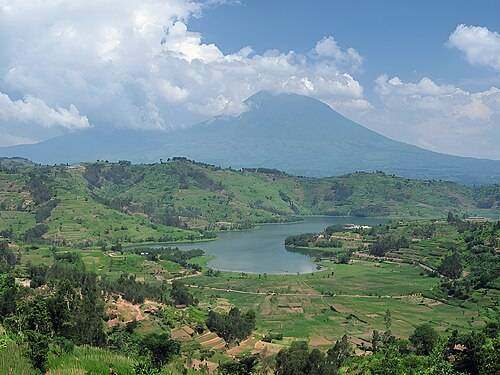
- Called "land of a thousand hills"
Key facts about Rwanda
- Government
- Presidential republic (dominant party)
- Religion
- Christian ~93%
- Founded / independence
- 1962 (from Belgium)
- Rich in
- Coffee, tea, tourism (gorillas), tin and coltan
- Languages
- English, French, Kinyarwanda
Kinyarwanda, English, French, Swahili - Currency
- Rwandan franc (Fr)
- People are called
- Rwandan
- Main cities
- Kigali, Butare, Gisenyi
Timeline of Rwanda
- 1500sKingdom of Rwanda
- 1890German rule
- 1916Belgian rule
- 1962Independence
- 1994Genocide
- 2000Kagame president
Places to see in Rwanda
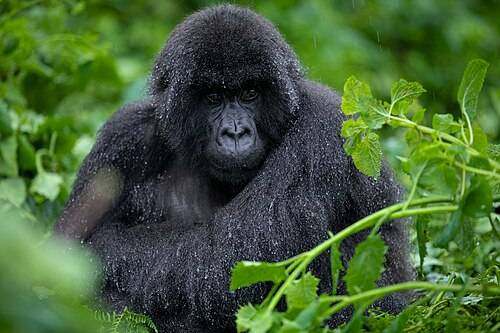
- Volcanoes National Park (mountain gorillas)
- Nyungwe Forest
- Lake Kivu
- Kigali Genocide Memorial
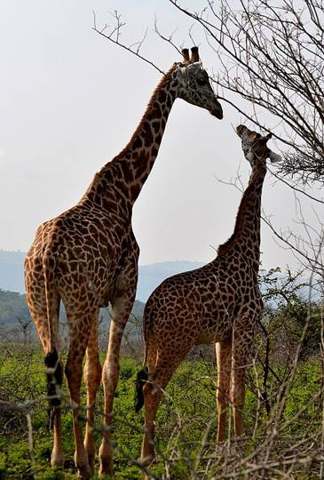
- Akagera
Food and drink
Brochettes · isombe (cassava leaves) · ugali
Culture and famous for
Umuganda community work day; Intore dancers
Popular sports
Cycling, football, basketball
Geography and climate
- Highest point
- Mount Karisimbi, 4,507 m
- Rivers, lakes and seas
- Lake Kivu; Kagera River
- Climate
- Temperate highland
- Coastline
- Landlocked
- Population density
- 532 people per km²
Wars and conflicts
- Rwandan genocide 1994 (about 800,000 Tutsi killed)
- Congo wars
- backs M23
Alliances and memberships
Political unions and regional organisations
African UnionEast African CommunityCommonwealth of Nations
Rwanda in depth
Detailed facts from the CIA World Factbook (public domain, latest edition).
Overview
- History in brief
- Rwanda -- a small and centralized country dominated by rugged hills and fertile volcanic soil -- has exerted disproportionate influence over the African Great Lakes region for centuries. A Rwandan kingdom increasingly dominated the region from the mid-18th century onward, with the Tutsi monarchs gradually extending the power of the royal court into peripheral areas and expanding their borders through military conquest. While the current ethnic labels Hutu and Tutsi predate colonial rule, their flexibility and importance have varied significantly over time and often manifested more as a hierarchical class distinction than an ethnic or cultural distinction. The majority Hutu and minority Tutsi have long shared a common language and culture, and intermarriage was frequent.The Rwandan royal court centered on the Tutsi king (mwami), who relied on an extensive network of political, cultural, and economic relationships. Social categories became more rigid during the reign of RWABUGIRI (1860-1895), who focused on aggressive expansion and solidifying Rwanda’s bureaucratic structures. German colonial conquest began in the late 1890s, but the territory was ceded to Belgian forces in 1916 during World War I. Both European nations quickly realized the benefits of ruling through the already centralized Rwandan Tutsi kingdom. Colonial rule reinforced existing trends toward autocratic and exclusionary rule, leading to the elimination of traditional positions of authority for Hutus. Belgian administrators significantly increased requirements for communal labor and instituted harsh taxes, which fed the population's frustration. Changing political attitudes in Belgium contributed to colonial and Catholic officials shifting their support from Tutsi to Hutu leaders in the years leading up to independence. Simmering resentment of minority rule exploded in 1959, three years before independence from Belgium, when Hutus overthrew the Tutsi king. Thousands of Tutsis were killed over the next several years, and some 150,000 were driven into exile in neighboring countries. Army Chief of Staff Juvenal HABYARIMANA seized power in a coup in 1973 and ruled Rwanda as a single-party state for two decades. HABYARIMANA increasingly discriminated against Tutsis, and extremist Hutu factions gained prominence after multiple parties were introduced in the early 1990s. The children of Tutsi exiles later formed a rebel group, the Rwandan Patriotic Front (RPF) and began a civil war in 1990. The ci
Geography
- Location
- Central Africa, east of the Democratic Republic of the Congo, north of Burundi
- Size compared
- slightly smaller than Maryland
- Land borders
- Total: 930 kmBorder countries: Burundi 315 km; Democratic Republic of the Congo 221 km; Tanzania 222 km; Uganda 172 km
- Coastline
- 0 km (landlocked)
- Climate
- temperate; two rainy seasons (February to April, November to January); mild in mountains with frost and snow possible
- Terrain
- mostly grassy uplands and hills; relief is mountainous with altitude declining from west to east
- Elevation
- Highest point: Volcan Karisimbi 4,519 mLowest point: Rusizi River 950 mMean elevation: 1,598 m
- Natural resources
- gold, cassiterite (tin ore), wolframite (tungsten ore), methane, hydropower, arable land
- Major rivers
- Nile river source (shared with Tanzania, Uganda, South Sudan, Sudan, and Egypt [m]) - 6,650 kmNote: [s] after country name indicates river source; [m] after country name indicates river mouth
- Major lakes
- Fresh water lake(s): Lake Kivu (shared with Democratic Republic of Congo) - 2,220 sq km
- Natural hazards
- periodic droughts; the volcanic Virunga Mountains are in the northwest along the border with Democratic Republic of the CongoVolcanism: Visoke (3,711 m), on the border with the Democratic Republic of the Congo, is the country's only historically active volcano
- Notes
- landlocked; most of the country is intensively cultivated and rugged, with the population predominantly rural
- Environmental issues
- deforestation; overgrazing; land degradation; soil erosion; a decline in soil fertility (soil exhaustion); wetland degradation and loss of biodiversity; widespread poaching
People and society
- Population
- Total: 13,623,302 (2024 est.)Male: 6,684,655Female: 6,938,647
- Nationality
- Noun: Rwandan(s)Adjective: Rwandan
- Ethnic groups
- Hutu, Tutsi, Twa
- Languages
- Kinyarwanda (official, universal Bantu vernacular) 93.2%, French (official) <0.1%, English (official) <0.1%, Swahili/Kiswahili (official, used in commercial centers) <0.1%, more than one language, other 6.3%, unspecified 0.3% (2002 est.)Major-language sample(s): Inkoranya nzimbuzi y'isi, isoko fatizo y'amakuru y'ibanze. (Kinyarwanda)The World Factbook, the indispensable source for basic information.
- Religions
- Catholic 39.9%, Pentecostal 21.3%, Protestant 14.6%, Adventist 12.2%, other Christians 4.2%, no religion 3.0%, Muslim 2.0%, other religions 2.0%; less than 1%: Jehovah Witness, not specified, Animist (2022 est.)
- Median age
- Total: 21.3 years (2025 est.)Male: 20.1 yearsFemale: 21.5 years
- Population growth
- 2% (2025 est.)
- Life expectancy
- Total population: 66.6 years (2024 est.)Male: 64.6 yearsFemale: 68.6 years
- Children per woman
- 3.2 children born/woman (2025 est.)
- Urbanization
- Urban population: 17.9% of total population (2023)Rate of urbanization: 3.07% annual rate of change (2020-25 est.)
- Largest cities
- 1.248 million KIGALI (capital) (2023)
- Literacy
- Total population: 78.8% (2022 est.)Male: 81% (2022 est.)Female: 76.7% (2022 est.)
- Years in school
- Total: 13 years (2023 est.)Male: 13 years (2023 est.)Female: 13 years (2023 est.)
Government
- Official names
- Conventional long form: Republic of RwandaConventional short form: RwandaLocal long form: Republika y'u RwandaLocal short form: RwandaFormer: Kingdom of Rwanda, Ruanda, German East AfricaEtymology: the country is named for a local people, but the meaning of their own name is obscure
- Government type
- presidential republic
- Capital
- Name: KigaliGeographic coordinates: 1 57 S, 30 03 ETime difference: UTC+2 (7 hours ahead of Washington, DC, during Standard Time)Etymology: the city takes its name from nearby Mount Kigali; the name is composed of the Bantu prefix ki- and the Rwandan word gali, meaning "broad," which is probably meant to describe the terrain
- Regions
- 4 provinces (provinces, singular - province (French); intara for singular and plural (Kinyarwanda)) and 1 city* (ville (French); umujyi (Kinyarwanda)); Est (Eastern), Kigali*, Nord (Northern), Ouest (Western), Sud (Southern)
- Independence
- 1 July 1962 (from Belgium-administered UN trusteeship)
- National holiday
- Independence Day, 1 July (1962)
- Constitution
- History: several previous; latest adopted by referendum 26 May 2003, effective 4 June 2003Amendment process: proposed by the president of the republic (with Council of Ministers approval) or by two-thirds majority vote of both houses of Parliament; passage requires at least three-quarters majority vote in both houses; changes to constitutional articles on national sovereignty, the presidential term, the form and system of government, and political pluralism also require approval in a referendum
- Legal system
- mixed system of civil law, based on German and Belgian models, and customary law; Supreme Court reviews legislative acts
- Voting age
- 18 years of age; universal
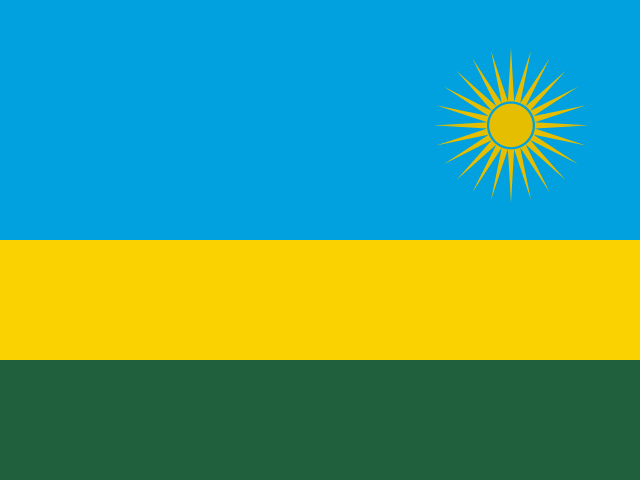
- Flag meaning
- Description: three horizontal bands of sky blue (top, double-width), yellow, and green, with a golden sun with 24 rays on the right end of the blue bandMeaning: blue stands for happiness and peace, yellow for economic development and mineral wealth, and green for hope for prosperity and natural resources; the sun symbolizes unity and enlightenment
- National symbols
- traditional woven basket with peaked lid
- National colours
- blue, yellow, green
- National anthem
- Title: "Rwanda nziza" (Rwanda, Our Beautiful Country)Lyrics/music: Faustin MURIGO/Jean-Bosco HASHAKAIMANAHistory: adopted 2001
- UNESCO World Heritage Sites
- Total World Heritage Sites: 2 (1 cultural, 1 natural)Selected World Heritage Site locales: Memorial sites of the Genocide: Nyamata, Murambi, Gisozi and Bisesero (c); Nyungwe National Park (n)
Economy
- Overview
- low-income Sub-Saharan economy; services, industry, and agriculture sectors driving growth; increased government spending on human capital, energy, and healthcare; major infrastructure projects including the Bugesera Airport intended to support long-term growth; challenges include lack of economic diversification, high inflation, and wide current account deficit
- GDP (PPP)
- $46.543 billion (2024 est.)
- GDP per person (PPP)
- $3,300 (2024 est.)
- GDP growth
- 8.9% (2024 est.)
- Inflation
- 1.8% (2024 est.)
- Unemployment
- 12% (2024 est.)
- Below poverty line
- 38.2% (2016 est.)
- Farm products
- bananas, cassava, sweet potatoes, plantains, potatoes, maize, beans, pumpkins/squash, taro, sorghum (2023)
- Industries
- cement, agricultural products, small-scale beverages, soap, furniture, shoes, plastic goods, textiles, cigarettes
- Exports
- $3.509 billion (2023 est.)
- Main exports
- gold, rare earth ores, coffee, tea, tin ores (2023)
- Export partners
- UAE 66%, China 10%, USA 3%, Kenya 3%, Thailand 2% (2023)
- Main imports
- broadcasting equipment, fish, corn, packaged medicine, plastic products (2023)
- Import partners
- China 19%, Kenya 14%, Uganda 13%, Tanzania 9%, UAE 7% (2023)
- Money sent home from abroad
- 3.6% of GDP (2023 est.)
Energy, internet and transport
- Electricity access
- Electrification - total population: 50.6% (2022 est.)Electrification - urban areas: 98%Electrification - rural areas: 38.2%
- Electricity sources
- Fossil fuels: 43.6% of total installed capacity (2023 est.)Solar: 3.4% of total installed capacity (2023 est.)Hydroelectricity: 52.8% of total installed capacity (2023 est.)Biomass and waste: 0.2% of total installed capacity (2023 est.)
- Internet users
- Percent of population: 34% (2023 est.)
- Mobile phones
- Total subscriptions: 12.8 million (2023 est.)Subscriptions per 100 inhabitants: 80 (2022 est.)
- TV and radio
- 13 TV stations; 35 radio stations, including international broadcasters; government owns most popular TV and radio stations; regional satellite-based TV available
- Airports
- 8 (2025)
Military and space
- Armed forces
- Rwanda Defense Force (RDF; Ingabo z’u Rwanda): Rwanda Army (Rwanda Land Force), Rwanda Air Force (Force Aerienne Rwandaise, FAR), Rwanda Reserve Force, Special UnitsMinistry of Internal Security: Rwanda National Police (2025)
- Military spending
- 1.3% of GDP (2024 est.)
- Military service
- typically 18-30 years of age for men and women for voluntary military service (including officer candidates and those with university degrees and specialized qualifications); enlistment is either as contract (5-years, renewable twice) or career professional; no conscription (2025)
- Space programme
- has a small program focused on developing space technologies, such as satellite communications and imagery for connectivity, disaster management, security, and socioeconomic development; operates communications and remote sensing (RS) satellites; has established ties with the space agencies or industries of several countries, including France, Israel, Japan, Poland, the UAE, and the US, as well as members of the African Space Agency; seeks to establish itself as an African hub for satellite production and has encouraged development of a domestic commercial space sector (2025)
- Space milestones
- 2018 - signed cooperation agreement with Japan for training in designing and producing mini-satellites2019 - first remote sensing (RS) nanosatellite (RWASAT-1) built with assistance from and launched by Japan; first commercial communications satellite (Icyerekezo) built and launched by France2022 - signed US-led Artemis Accords for space exploration2025 - joined newly formed African Space Agency
Global issues
- Refugees and displaced people
- Refugees: 128,561 (2024 est.)IDPs: 21,948 (2024 est.)Stateless persons: 14,500 (2024 est.)
Neighbouring countries
- Phone code
- +250
- Internet domain
- .rw