Cambodia
Kingdom of Cambodia · Kâmpŭchéa
The Khmer Empire built Angkor, the largest religious complex on Earth. A French protectorate from 1863; the Khmer Rouge killed about a quarter of the population. Border fighting with Thailand flared in 2025.
See Cambodia on the 3D globeTake a quiz
Population17.6 million
Area181,035 km²
CapitalPhnom Penh
RegionSouth-Eastern Asia
Did you know?
- Angkor Wat is the largest religious monument in the world
- The Tonlé Sap river flows backwards each rainy season
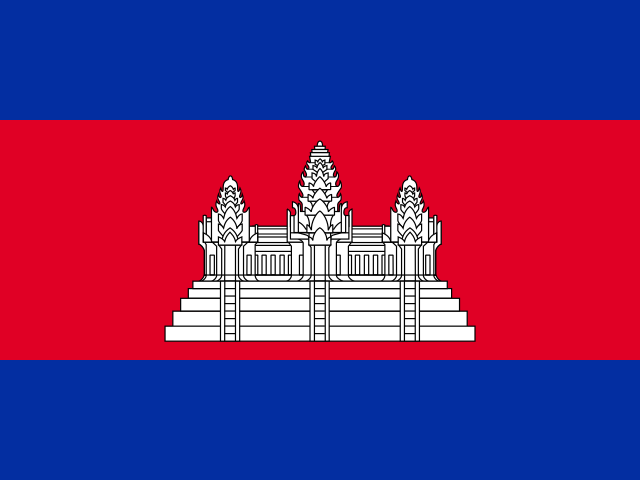
- One of very few national flags showing a building
Key facts about Cambodia
- Government
- Constitutional monarchy (one-party dominant)
- Religion
- Theravada Buddhism ~97%
- Founded / independence
- 1953 (from France)
- Rich in
- Garments, rice, tourism (Angkor Wat)
- Languages
- Khmer
Khmer; Cham, Vietnamese, Chinese - Currency
- Cambodian riel (៛), United States dollar ($)
- People are called
- Cambodian
- Main cities
- Phnom Penh, Siem Reap, Battambang, Sihanoukville
Timeline of Cambodia
- 802Khmer Empire
- 1431Angkor abandoned
- 1863French protectorate
- 1953Independence
- 1975Khmer Rouge
- 1979Vietnamese invasion
- 1993Monarchy restored
Places to see in Cambodia
- Angkor Wat
- Bayon temple
- Ta Prohm
- Royal Palace, Phnom Penh
- Tonlé Sap lake
- Killing Fields memorial
Food and drink
Fish amok · lok lak · kuy teav noodles · num banh chok
Culture and famous for
Apsara dance; Khmer temples; Angkor Wat appears on its flag
Popular sports
Kun Khmer kickboxing, football
Geography and climate
- Highest point
- Phnom Aural, 1,813 m
- Rivers, lakes and seas
- Mekong; Tonlé Sap, a lake that reverses its flow
- Climate
- Tropical monsoon
- Coastline
- Has a sea coast
- Population density
- 97 people per km²
Wars and conflicts
- Cambodian Civil War
- Khmer Rouge genocide 1975–79 (about 2 million killed)
- Thai border clashes 2025
Empires and states that once stood here
Alliances and memberships
Political unions and regional organisations
Economy and trade
Cambodia in depth
Detailed facts from the CIA World Factbook (public domain, latest edition).
Overview
- History in brief
- Most Cambodians consider themselves to be Khmers, descendants of the Angkor Empire that extended over much of Southeast Asia and reached its zenith between the 10th and 13th centuries. Attacks by the Thai and Cham (from present-day Vietnam) weakened the empire, ushering in a long period of decline. The king placed the country under French protection in 1863, and it became part of French Indochina in 1887. Following Japanese occupation in World War II, Cambodia gained full independence from France in 1953. In 1975, after a seven-year struggle, communist Khmer Rouge forces captured Phnom Penh and evacuated all cities and towns. At least 1.5 million Cambodians died from execution, forced hardships, or starvation during the Khmer Rouge regime under POL POT. A 1978 Vietnamese invasion drove the Khmer Rouge into the countryside, began a 10-year Vietnamese occupation, and touched off 13 years of internecine warfare in which a coalition of Khmer Rouge, Cambodian nationalists, and royalist insurgents, with assistance from China, fought the Vietnamese-backed People’s Republic of Kampuchea (PRK).The 1991 Paris Agreements ended the country’s civil war and mandated democratic elections, which took place in 1993 and ushered in a period of multi-party democracy with a constitutional monarchy. King Norodom SIHANOUK was reinstated as head of state, and the Cambodian People's Party (CPP) and the royalist FUNCINPEC party formed a coalition government. Nevertheless, the power-sharing arrangement proved fractious and fragile, and in 1997, a coup led by CPP leader and former PRK prime minister HUN SEN dissolved the coalition and sidelined FUNCINPEC. Despite further attempts at coalition governance, the CPP has since remained in power through elections criticized for lacking fairness, political and judicial corruption, media control, and influence over labor unions, all of which have been enforced with violence and intimidation. HUN SEN remained as prime minister until 2023, when he transferred power to his son, HUN MANET. HUN SEN has subsequently maintained considerable influence as the leader of the CPP and the Senate. The CPP has also placed limits on civil society, press freedom, and freedom of expression. Despite some economic growth and considerable investment from China over the past decade, Cambodia remains one of East Asia's poorest countries.The remaining elements of the Khmer Rouge surrendered in 1999. A UN-backed special tribunal established in Cambodia in 1997 t
Geography
- Location
- Southeastern Asia, bordering the Gulf of Thailand, between Thailand, Vietnam, and Laos
- Size compared
- 1.5 times the size of Pennsylvania; slightly smaller than Oklahoma
- Land borders
- Total: 2,530 kmBorder countries: Laos 555 km; Thailand 817 km; Vietnam 1158 km
- Coastline
- 443 km
- Climate
- tropical; rainy, monsoon season (May to November); dry season (December to April); little seasonal temperature variation
- Terrain
- mostly low, flat plains; mountains in southwest and north
- Elevation
- Highest point: Phnum Aoral 1,810 mLowest point: Gulf of Thailand 0 mMean elevation: 126 m
- Natural resources
- oil and gas, timber, gemstones, iron ore, manganese, phosphates, hydropower potential, arable land
- Major rivers
- Mekong (shared with China [s], Burma, Thailand, Laos, and Vietnam [m]) - 4,350 kmNote: [s] after country name indicates river source; [m] after country name indicates river mouth
- Major lakes
- Fresh water lake(s): Tonle Sap - 2,700-16,000 sq km
- Natural hazards
- monsoonal rains (June to November); flooding; occasional droughts
- Notes
- a land of paddies and forests dominated by the Mekong River and Tonle Sap (Southeast Asia's largest freshwater lake)
- Environmental issues
- habitat and biodiversity loss from illegal logging and strip mining; destruction of mangrove swamps; soil erosion; limited access to potable water in rural areas; illegal fishing and overfishing; deforestation leading to sediment build-up in coastal ecosystems
People and society
- Population
- Total: 17,230,333 (2025 est.)Male: 8,362,224Female: 8,868,109
- Nationality
- Noun: Cambodian(s)Adjective: Cambodian
- Ethnic groups
- Khmer 95.4%, Cham 2.4%, Chinese 1.5%, other 0.7% (2019-20 est.)
- Languages
- Khmer (official) 95.8%, minority languages 2.9%, Chinese 0.6%, Vietnamese 0.5%, other 0.2% (2019 est.)Major-language sample(s): សៀវភៅហេតុការណនៅលើពិភពលោក។ ទីតាំងពត៏មានមូលដានគ្រឹះយាងសំខាន់។. (Khmer)The World Factbook, the indispensable source for basic information.
- Religions
- Buddhist (official) 97.1%, Muslim 2%, Christian 0.3%, other 0.5% (2019 est.)
- Median age
- Total: 28.3 years (2025 est.)Male: 26.9 yearsFemale: 28.9 years
- Population growth
- 0.95% (2025 est.)
- Life expectancy
- Total population: 71.4 years (2024 est.)Male: 69.6 yearsFemale: 73.3 years
- Children per woman
- 2.14 children born/woman (2025 est.)
- Urbanization
- Urban population: 25.6% of total population (2023)Rate of urbanization: 3.06% annual rate of change (2020-25 est.)
- Largest cities
- 2.281 million PHNOM PENH (capital) (2023)
- Literacy
- Total population: 71.9% (2021 est.)Male: 81.5% (2021 est.)Female: 63.6% (2021 est.)
- Years in school
- Total: 11 years (2023 est.)Male: 11 years (2023 est.)Female: 11 years (2023 est.)
Government
- Official names
- Conventional long form: Kingdom of CambodiaConventional short form: CambodiaLocal long form: Preahreacheanachakr Kampuchea (phonetic transliteration)Local short form: KampucheaFormer: Khmer Republic, Democratic Kampuchea, People's Republic of Kampuchea, State of CambodiaEtymology: the name is derived from Kambu, a legendary ancestor of the Cambodian people
- Government type
- parliamentary constitutional monarchy
- Capital
- Name: Phnom PenhGeographic coordinates: 11 33 N, 104 55 ETime difference: UTC+7 (12 hours ahead of Washington, DC, during Standard Time)Etymology: the name means "mountain of plenty," from the Cambodian words phnom (mountain or hill) and penh (full)
- Regions
- 24 provinces (khett, singular and plural) and 1 municipality (krong, singular and plural)Provinces: Banteay Meanchey, Battambang, Kampong Cham, Kampong Chhnang, Kampong Speu, Kampong Thom, Kampot, Kandal, Kep, Koh Kong, Kratie, Mondolkiri, Oddar Meanchey, Pailin, Preah Sihanouk, Preah Vihear, Prey Veng, Pursat, Ratanakiri, Siem Reap, Stung Treng, Svay Rieng, Takeo, Tbong KhmumMunicipalities: Phnom Penh (Phnum Penh)
- Independence
- 9 November 1953 (from France)
- National holiday
- Independence Day, 9 November (1953)
- Constitution
- History: previous 1947; latest promulgated 21 September 1993Amendment process: proposed by the monarch, by the prime minister, or by the president of the National Assembly if supported by one fourth of the Assembly membership; passage requires two-thirds majority of the Assembly membership; constitutional articles on the multiparty democratic form of government and the monarchy cannot be amended
- Legal system
- civil law system (influenced by the UN Transitional Authority in Cambodia), customary law, Communist legal theory, and common law
- Voting age
- 18 years of age; universal
- Flag meaning
- Description: three horizontal bands of blue (top), red (double-width), and blue; a three-towered, stylized white temple outlined in black is in the center of the red band, representing Angkor WatMeaning: red and blue are traditional Cambodian colors
- National symbols
- Angkor Wat temple, kouprey (wild ox)
- National colours
- red, blue
- National anthem
- Title: "Nokoreach" (Royal Kingdom)Lyrics/music: CHUON NAT/F. PERRUCHOT and J. JEKYLLHistory: adopted 1941, restored 1993; the anthem, based on a Cambodian folk tune, was restored after the defeat of the Communist regime
- UNESCO World Heritage Sites
- Total World Heritage Sites: 5 (all cultural)Selected World Heritage Site locales: Angkor; Temple of Preah Vihear; Sambor Prei Kuk; Koh Ker: Archaeological Site of Ancient Lingapora or Chok Gargyar; Cambodian Memorial Sites: From centres of repression to places of peace and reflection (c)
Economy
- Overview
- one of the fastest growing Southeast Asian economies; rebounding tourism and clothing exports; substantial manufacturing and construction sectors; new trade agreements expanding agricultural markets; significant public debt; investing in new ports and roads
- GDP (PPP)
- $123.676 billion (2024 est.)
- GDP per person (PPP)
- $7,000 (2024 est.)
- GDP growth
- 6% (2024 est.)
- Inflation
- 2.1% (2023 est.)
- Unemployment
- 0.3% (2024 est.)
- Farm products
- cassava, rice, maize, sugarcane, vegetables, oil palm fruit, rubber, bananas, jute, pork (2023)
- Industries
- tourism, garments, construction, rice milling, fishing, wood and wood products, rubber, cement, gem mining, textiles
- Exports
- $31.712 billion (2024 est.)
- Main exports
- garments, semiconductors, trunks and cases, footwear, gold (2023)
- Export partners
- USA 36%, Germany 6%, China 6%, Japan 6%, Thailand 5% (2023)
- Main imports
- refined petroleum, fabric, gold, plastic products, synthetic fabric (2023)
- Import partners
- China 39%, Thailand 20%, Vietnam 12%, Singapore 6%, Indonesia 3% (2023)
- Money sent home from abroad
- 6.1% of GDP (2024 est.)
Energy, internet and transport
- Electricity access
- Electrification - total population: 92.3% (2022 est.)Electrification - urban areas: 99%Electrification - rural areas: 88%
- Electricity sources
- Fossil fuels: 55.5% of total installed capacity (2023 est.)Solar: 5.8% of total installed capacity (2023 est.)Hydroelectricity: 38.6% of total installed capacity (2023 est.)Biomass and waste: 0.1% of total installed capacity (2023 est.)
- Internet users
- Percent of population: 61% (2023 est.)
- Mobile phones
- Total subscriptions: 20.5 million (2024 est.)Subscriptions per 100 inhabitants: 116 (2024 est.)
- TV and radio
- mix of state-owned, joint public-private, and privately owned broadcast media; 27 TV stations, with most operating on multiple channels, including 1 state-operated station with multiple locations and 11 stations either jointly operated or privately owned, some with several locations; multi-channel cable and satellite systems; 84 radio stations, including 1 state-owned broadcaster with multiple stations and a mix of public and private broadcasters; one international broadcaster is available, as well as one TV station that is jointly run by China and the Ministry of Interior; several TV and radio operators broadcast online only (often via Facebook) (2019)
- Airports
- 12 (2025)
- Railways
- Total: 642 km (2014)Narrow gauge: 642 km (2014) 1.000-m gauge
- Merchant ships
- Total: 195 (2023)By type: container ship 2, general cargo 123, oil tanker 18, other 52
Military and space
- Armed forces
- Royal Cambodian Armed Forces (RCAF): Royal Cambodian Army, Royal Khmer Navy, Royal Cambodian Air Force, Royal Gendarmerie (Military Police); National Committee for Maritime Security (2025)
- Military spending
- 1.5% of GDP (2024 est.)
- Military service
- 18 is the legal minimum age for military service for men and women (2025)
Global issues
- Refugees and displaced people
- Refugees: 28 (2024 est.)IDPs: 2,526 (2024 est.)Stateless persons: 75,000 (2024 est.)
Neighbouring countries
- Phone code
- +855
- Internet domain
- .kh